German Shepherd Dog Puppy Feeding Chart (8 weeks–16 months, by weight & age)
German Shepherd Dog puppy feeding chart — grams per day by age and adult weight, plus the activity adjustment most owners miss.

A German Shepherd Dog puppy needs roughly 1121–1343 kcal/day at 4 months and 1374–1646 kcal/day at 8 months. On typical large-breed puppy kibble (≈3.70 kcal/g), that's about 305–365 g/day at 4 months and 370–445 g/day at 8 months. Exact amounts depend on adult weight, age, sex, and activity. Body condition score (BCS) trumps the chart.
TL;DR: German Shepherds are a large breed (adult weight 23–41 kg / 50.5–90.5 lb) carrying two breed-defining feeding risks: they account for roughly two-thirds of all canine exocrine pancreatic insufficiency cases, and they're a top-5 GDV (bloat) breed — so feed 2–3 smaller meals at a slow pace, not one large one. The chart below uses the AKC adult-weight standard, AAFCO growth-stage minimums, and the WSAVA / NRC puppy energy formula. Run our feeding calculator for a portion tuned to your specific puppy in 30 seconds, or our puppy weight predictor if you're not sure how big yours will get.
German Shepherd Dog adult-weight quick reference
These are the AKC breed-standard adult weight ranges. Most German Shepherd Dogs settle within them; outliers are normal but worth a vet check if your dog is well outside the band as an adult.
Range (kg) | Range (lb) | Mid (kg) | |
|---|---|---|---|
Male | 29–41 kg | 64–90.5 lb | 35 kg |
Female | 23–32 kg | 50.5–70.5 lb | 27.5 kg |
Size band: Large (25–40 kg adult) — that's what determines puppy-food formula choice (see when to switch puppy to adult food for the cutoff for German Shepherd Dogs).
The German Shepherd Dog puppy feeding chart (g/day, by adult weight × age)
Calorie needs come from the NRC / WSAVA puppy formula: daily energy requirement (DER) is a multiple of resting energy requirement (RER, where RER = 70 × bodyweight_kg^0.75). The DER multiplier tapers smoothly as the puppy approaches adult weight — about 3.0× RER at weaning (~15% of adult weight) and falling toward 1.6× as the puppy reaches adult size. We use the percent-of-adult-weight transition rather than raw age because a large breed hits those landmarks at a different age than a toy or giant.
We've translated that into grams of typical large-breed puppy kibble (≈3.70 kcal/g). Round to the nearest 5 g and split across the meal count below.
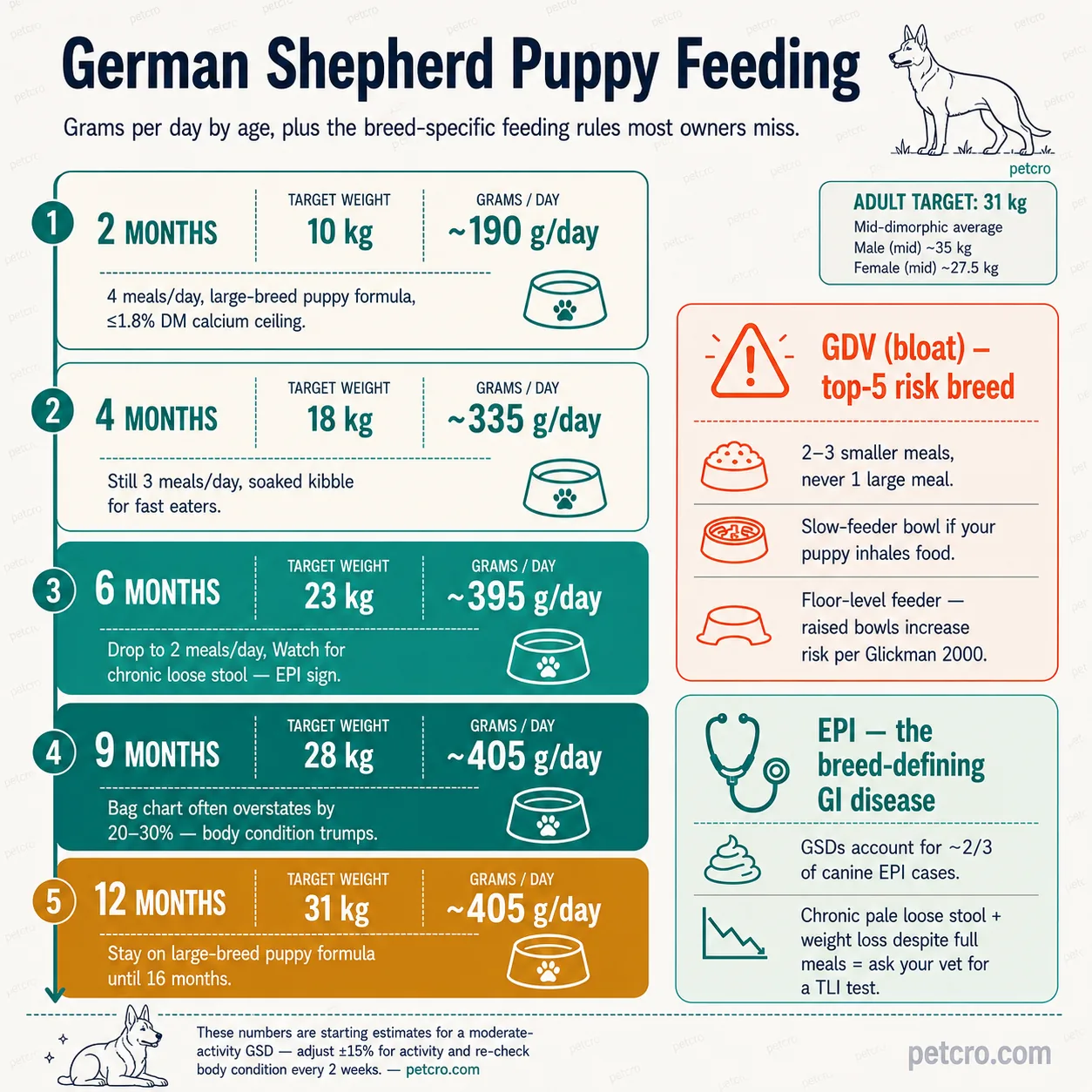
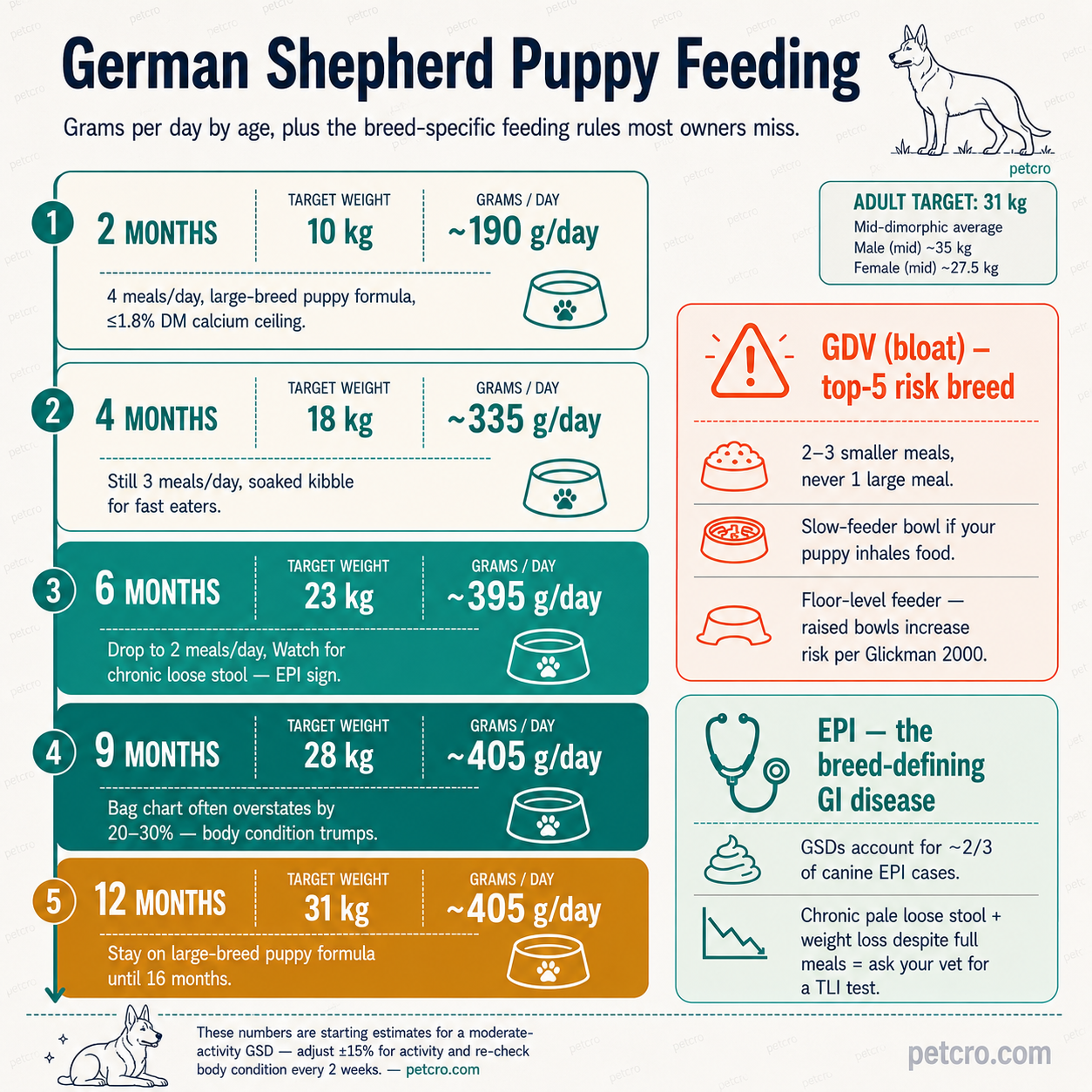
Feeding chart — moderate activity, average puppy
Adult weight (kg) | 2 mo (g/day) | 4 mo (g/day) | 6 mo (g/day) | 9 mo (g/day) | 12 mo (g/day) |
|---|---|---|---|---|---|
23 | 150 | 265 | 315 | 325 | 320 |
27.5 | 170 | 305 | 360 | 370 | 370 |
35 | 205 | 365 | 430 | 445 | 440 |
41 | 230 | 410 | 485 | 500 | 495 |
How to read this: find your puppy's adult weight (not current). If you don't know, our puppy weight predictor estimates it from current weight + age + breed. Cross-reference age in months to read off g/day. Split across meals per the table further down.
Why these numbers are lower than the bag chart: commercial puppy-food charts (Pro Plan, Hill's, Royal Canin) typically recommend 20–30% more food than the WSAVA / NRC formula at the same age. They err on the high side to avoid under-feeding complaints — and most puppies eat more than the strict NRC recommendation without issue. Use the chart above as a conservative starting estimate. If your puppy's body condition score (BCS) drops below 4 after 2 weeks, increase 10–15%. The bag chart is also fine — both are starting points, not prescriptions.
Adjust for activity
Activity level | Description | Multiplier |
|---|---|---|
Sedentary | Indoor mostly, short potty walks, lots of crate time | × 0.85 |
Average | 2 walks/day, normal household play (chart default) | × 1.0 |
Active | Long walks, dog park, hikes most days | × 1.15 |
Working / sport | Trained working dog, 4+ hours active daily | × 1.25 |
So a 31.3-kg adult-weight German Shepherd Dog puppy at 6 months on average activity gets about 395 g/day; bump that to 455 g/day if active or drop to 335 g/day if sedentary.
Meal frequency by age
Same as our general puppy guidance, calibrated for German Shepherd Dogs:
Age | Meals per day | Notes |
|---|---|---|
8–12 weeks | 4 | Small stomachs, fast metabolism |
3–6 months | 3 | Drop to 3 once stool is consistently firm on 3 meals |
6–12 months | 2 | Most German Shepherd Dogs do well on 2 meals from 6 months |
12+ months | 2 | Most German Shepherd Dogs switch to adult food around 16 months (15–18-month range). |
Keep the last meal at least 3 hours before bedtime so house-training stays on track.
German Shepherd Dog-specific feeding considerations
GDV (gastric dilatation-volvulus) is a real risk
Glickman et al.'s landmark 2000 epidemiological study (JAVMA 216:40–45) ranked German Shepherds as a top-5 breed for GDV — what most owners call "bloat." The mechanism is rapid gas distension followed by stomach torsion; it's a surgical emergency with roughly 25% mortality even when treated promptly.
Three feeding practices reduce the risk. (1) Split daily calories into 2–3 meals, never one large meal. (2) Slow the eating pace — eating in under 90 seconds is an independent GDV risk factor per the same study. A slow-feeder bowl or a snuffle mat helps if your puppy inhales food. (3) Avoid vigorous exercise for roughly 60–90 minutes before and after meals.
One old piece of advice to ignore: raised feeders do NOT help, and actually increase risk in deep-chested breeds per Glickman's data. Feed at floor level.
Exocrine pancreatic insufficiency (EPI) is the breed-defining GI disease
EPI is the failure of the pancreas to produce enough digestive enzymes. German Shepherds account for roughly two-thirds of all canine EPI cases in published series (Westermarck, Helsinki; Batchelor et al. 2007, JVIM 21:54–60). Signs are chronic loose, voluminous, pale stool, weight loss despite normal or ravenous appetite, and progressive thinness in a puppy who's eating well. EPI is diagnosed via a serum TLI (trypsin-like immunoreactivity) test and managed lifelong with enzyme replacement. If chronic loose stool persists past 1–2 weeks, talk to your vet — early diagnosis matters.
Hip and elbow dysplasia: weight management starts in puppyhood
Per published OFA disease statistics, German Shepherds have notably elevated rates of both hip and elbow dysplasia. Excess weight during growth accelerates both. Stick to the chart's gram count, recheck body condition every 2 weeks, and use a large-breed puppy formula with the AAFCO ≤1.8% DM calcium ceiling — over-calcium during the growth window is implicated in skeletal disorders in large-breed puppies.
When to switch to adult food
German Shepherd Dogs are a large breed, so adult food typically starts around 16 months (range: 15–18 months). Going earlier risks under-providing the higher-protein, controlled-calcium ratios growing puppies need; going later risks weight gain on calorie-dense puppy formulas.
See our full guide: when to switch puppy to adult food.
Best food formulas for German Shepherd Dog puppies
We don't pick a single "best" brand — what matters is the formula tier (large-breed puppy vs. all-life-stages, sensitive-stomach vs. standard) and that it's AAFCO growth-tested for the right size class.
Purina Pro Plan Large Breed Puppy — see our Pro Plan Large Breed chart. Calorie density 3.93 kcal/g, controlled calcium for large-breed growth, AAFCO growth-tested for adult dogs 70+ lb. The cluster's reference large-breed puppy formula.
Purina Puppy Chow — see our Puppy Chow chart. Budget tier with one universal formula (not size-specific). Workable for smaller German Shepherds (under 30 kg adult target) but not ideal for adult-35-kg+ males who benefit from the calcium-controlled large-breed formula.
Blue Buffalo Life Protection Large Breed Puppy — see our Blue Buffalo chart. Separate large-breed puppy formula with controlled calcium and AAFCO growth-testing. Good general-purpose fit for German Shepherds without specific sensitivities.
Iams ProActive Health Large Breed Puppy — see our Iams chart. Large-breed variant within the value-tier Iams line.
Royal Canin German Shepherd Puppy — a breed-specific formula option at the premium price point. Sold at most large pet retailers if you want a breed-tailored profile.
Special note for German Shepherds: because exocrine pancreatic insufficiency and food allergies run higher in this breed than in most, talk to your vet about a limited-ingredient or hydrolyzed-protein formula if your puppy shows chronic loose stool, vomiting, or skin issues despite a mainstream large-breed food. Sensitive-stomach lines exist in most of the brands above.
Body condition trumps the chart
Re-run a Body Condition Score (BCS) check every 2 weeks during puppyhood. A BCS of 4–5 (out of 9) means you've got the portion right — ribs felt easily through a thin fat layer, visible waist from above, slight tummy tuck from the side.
For German Shepherds specifically: the thick double coat hides body shape — palpate ribs through the fur with both hands rather than eyeballing, and feel for a defined waist behind the ribcage with the puppy standing. Most owners under-detect overweight by 0.5–1 BCS points because the coat smooths the silhouette.
A BCS of 6+ means cut the portion 10%; BCS 3 or under means add 10%. Check again in 2 weeks.
Common feeding mistakes for German Shepherd Dog puppies
Feeding 1 large meal instead of 2–3 smaller ones. A top-5 GDV breed, German Shepherds do measurably better on split feedings — bloat is rapid-onset and fatal without surgery.
Letting them inhale food. Eating in under 90 seconds is an independent GDV risk factor per Glickman 2000. Use a slow-feeder bowl or a snuffle mat if your puppy eats fast.
Ignoring chronic loose stool past 2 weeks. EPI is the breed-defining GI disease — voluminous pale stool plus weight loss despite full meals is the pattern. Get a TLI test if it persists.
Switching to adult food at 12 months. Most German Shepherds need 15–18 months on large-breed puppy formula for proper skeletal development.
Treats as the silent calorie load. Should be under 10% of daily calories; high-drive working-line puppies are especially easy to over-treat during training.
Bag-chart blind faith. Bag charts assume "average activity" — your puppy might be well below or above that, especially if working-line.
Skipping BCS until vet visits. A 2-week-interval BCS check catches drift before it becomes a problem.
This guide is general guidance, not veterinary advice. For your specific dog's nutrition, health, or behavior needs, consult your veterinarian.
Frequently asked questions
How much should a German Shepherd Dog puppy eat per day?
A German Shepherd puppy at 4 months on average activity needs around 305–365 g/day of large-breed puppy kibble, split across 3 meals. By 9 months that's roughly 325–445 g/day on 2 meals. The exact amount depends on adult-weight target (29–41 kg male, 23–32 kg female), activity level, and body condition. Use our feeding calculator for a precise gram count for your specific puppy.
When should I switch my German Shepherd Dog from puppy to adult food?
Most German Shepherd Dogs switch around 16 months (15–18-month range, depending on growth-plate closure and adult weight). Large-breed puppy formulas have specific calcium-to-phosphorus ratios that matter for skeletal development — switching too early risks under-providing those nutrients. See our full when-to-switch guide for a 7–10 day transition protocol.
How many meals a day for a German Shepherd Dog puppy?
4 meals/day until 12 weeks, 3 meals/day from 3–6 months, then 2 meals/day from 6 months onwards. As a top-5 GDV (bloat) breed, German Shepherds should stick to 2–3 smaller meals at any age, never 1 large one — and slow the eating pace if your puppy inhales food.
What's the best puppy food for a German Shepherd Dog?
There's no single best — what matters is the formula tier and AAFCO growth-testing. For most German Shepherds, that means a large-breed puppy formula with controlled calcium (≤1.8% DM) and typical calorie density of 380–400 kcal per 100g — see our Pro Plan Large Breed chart or Blue Buffalo Large Breed chart for the reference profile. If your puppy has chronic loose stool, vomiting, or skin issues despite mainstream food, ask your vet about a limited-ingredient or hydrolyzed-protein option — food sensitivities are common in this breed.
How much do German Shepherd Dogs weigh by age?
At 26 weeks (≈6 months) a typical German Shepherd Dog puppy is about 65% of adult weight. For a 31.3-kg adult, that's around 20.3 kg at 6 months. Use our puppy weight predictor for an exact estimate from your puppy's current weight + age + breed.
My German Shepherd Dog puppy isn't finishing meals — am I overfeeding?
Possibly. German Shepherds are typically moderate-to-high food drive but can become selective if they have a sensitive stomach, an unfamiliar formula, or a developing GI issue like EPI. Drop the portion 10% and watch for a week. If body condition stays at BCS 4–5 and stool is firm, you've found the right amount. If refusal continues past a few days alongside loose stool or visible weight loss, see your vet.
Should I free-feed or scheduled-feed my German Shepherd Dog puppy?
Scheduled meals, not free-feeding. For a GDV-prone, food-motivated breed like the German Shepherd, free-feeding both raises bloat risk (the puppy eats at unpredictable speeds without a window of post-meal calm) and makes BCS tracking nearly impossible. Scheduled meals also make house-training, BCS monitoring, and medication-timing far easier.
TL;DR — the German Shepherd Dog feeding cheat sheet
Adult weight: 23–41 kg (50.5–90.5 lb), size band large
Meals: 4 → 3 → 2 at 12 weeks / 6 months
Switch to adult food at 16 months (15–18-month range)
Use the chart above as a starting estimate, then adjust ±15% for activity and re-check body condition every 2 weeks
GSD owners: 2–3 smaller meals beat 1 big one — bloat is rapid-onset and fatal, and this breed is in the top 5 for risk.
Run our feeding calculator for an exact gram count for your specific puppy
Sources & further reading
AKC German Shepherd Dog official breed standard — adult-weight ranges and breed standard.
Hill's Pet Nutrition: Dog care guides — vet-nutritionist-led guidance on large-breed puppy growth and feeding.
WSAVA Global Nutrition Guidelines — the puppy energy-requirement formula behind the chart.
AAFCO Dog Food Nutrient Profiles — growth-stage minimums for puppy food labelling.
NRC Nutrient Requirements of Dogs and Cats (2006), National Academies Press — the underlying RER / DER math.
AKC German Shepherd Dog official breed page (akc.org/dog-breeds/german-shepherd-dog)
United Kennel Club (UKC) breed standard
Common breed reference ranges (multiple breed-specialist sources)
More from Petcro's puppy feeding cluster
How much to feed a puppy — pillar guide — the master feeding article all chart posts feed back into.
When to switch puppy to adult food — full transition protocol by size class.
Puppy weight chart by breed size — cross-breed growth-curve reference covering the large size band.
Puppy weight predictor — estimate adult weight from current weight + age + breed.
Feeding calculator — exact gram count for your specific puppy in 30 seconds.
Petcro is reader-supported. We may earn an affiliate commission when you click through links to products in this guide. Our editorial picks are independent of any commercial relationship with any pet-food brand.