Puppy Weight Chart by Breed Size (toy to giant, by age)
Puppy weight chart by breed size — predicted weight at every age from toy breeds to giants, plus an adult-weight estimator for mixed breeds.

A puppy weight chart only works if it matches your puppy's adult-weight target — a Yorkie at 6 months and a Great Dane at 6 months are at very different points on their growth curves. Use the chart below by adult-weight target, not by breed name. Body condition score (BCS) trumps the chart at every age.
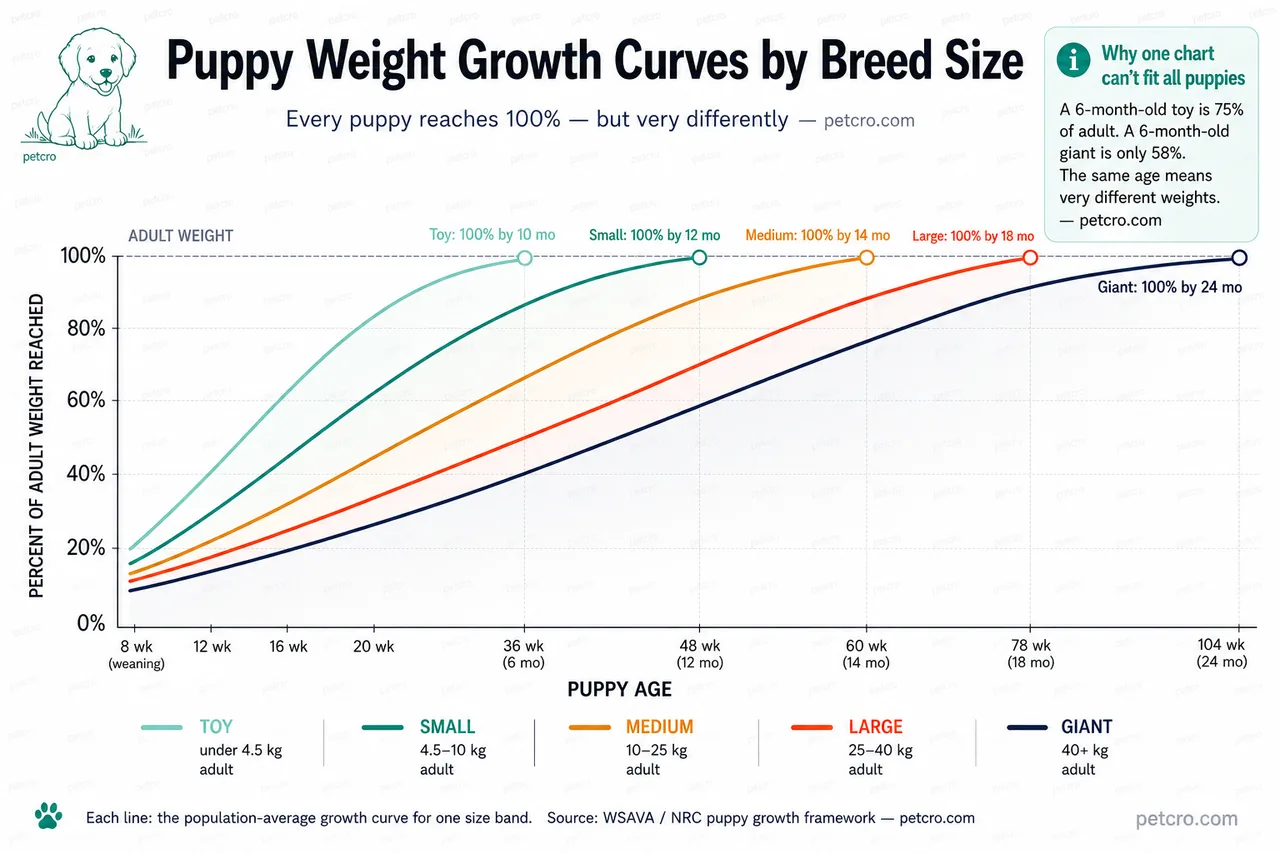
TL;DR: Every "puppy weight chart" you find online treats puppies as one population, but toys reach 100% of adult weight by 9–10 months while giants don't get there until 24. The tabbed chart below is drawn from the WSAVA / NRC growth-curve research, segmented by size band. For your specific puppy, the puppy weight predictor does the math from your current weight + age + breed in 30 seconds.
How to use this chart (and why "by breed size" matters)
Three steps:
- Estimate your puppy's adult-weight target. That's the dog's projected weight at maturity. For a purebred, look up the breed standard (the AKC breed page gives you a range). For a mixed breed, divide your puppy's current weight by the percent-of-adult value at their age (from the chart) — or use the puppy weight predictor which automates the math.
- Pick the size band that contains your adult-weight target — toy, small, medium, large, or giant. Each band has its own growth curve.
- Read off the predicted weight at age. The numbers are population averages. Real puppies vary ±10–15% above or below.
The reason a single "puppy weight chart" doesn't work: a 4-month-old toy puppy is roughly 50% of adult weight, but a 4-month-old giant puppy is only 35%. Mash them into one chart and the numbers don't fit any real puppy.
The puppy weight chart by size band
Pick your puppy's size band. Toggle between kilograms and pounds with the unit selector. Each row is a different adult-weight target within that size band — find the row closest to your dog's projected adult weight.
| Adult weight | 2 mo | 4 mo | 6 mo | 9 mo | 12 mo | 18 mo |
|---|---|---|---|---|---|---|
| 24.5 kglb | 0.41 | 12 | 1.53.5 | 24.5 | 24.5 | 24.5 |
| 36.5 kglb | 0.61.5 | 1.53.5 | 2.35 | 2.96.5 | 36.5 | 36.5 |
| 49 kglb | 0.82 | 24.5 | 36.5 | 3.98.5 | 49 | 49 |
| 4.510 kglb | 0.92 | 2.25 | 3.47.5 | 4.49.5 | 4.510 | 4.510 |
| Adult weight | 2 mo | 4 mo | 6 mo | 9 mo | 12 mo | 18 mo |
|---|---|---|---|---|---|---|
| 511 kglb | 0.92 | 2.35 | 3.68 | 4.610 | 511 | 511 |
| 715.5 kglb | 1.33 | 3.27 | 511 | 6.514.5 | 715.5 | 715.5 |
| 920 kglb | 1.63.5 | 4.29 | 6.514.5 | 8.318.5 | 920 | 920 |
| 1022 kglb | 1.84 | 4.610 | 7.216 | 9.320.5 | 1022 | 1022 |
| Adult weight | 2 mo | 4 mo | 6 mo | 9 mo | 12 mo | 18 mo |
|---|---|---|---|---|---|---|
| 1226.5 kglb | 24.5 | 5.311.5 | 8.218 | 10.824 | 11.826 | 1226.5 |
| 1635.5 kglb | 2.76 | 715.5 | 10.924 | 14.431.5 | 15.734.5 | 1635.5 |
| 2044 kglb | 3.47.5 | 8.819.5 | 13.630 | 1839.5 | 19.643 | 2044 |
| 2555 kglb | 4.29.5 | 1124.5 | 1737.5 | 22.549.5 | 24.554 | 2555 |
| Adult weight | 2 mo | 4 mo | 6 mo | 9 mo | 12 mo | 18 mo |
|---|---|---|---|---|---|---|
| 2759.5 kglb | 4.39.5 | 11.325 | 17.638.5 | 23.551.5 | 25.756.5 | 2759.5 |
| 3270.5 kglb | 5.111 | 13.429.5 | 20.846 | 27.861.5 | 30.467 | 3270.5 |
| 3679.5 kglb | 5.712.5 | 15.133.5 | 23.451.5 | 31.369 | 34.275.5 | 3679.5 |
| 4088 kglb | 6.314 | 16.837 | 2657.5 | 34.876.5 | 3884 | 4088 |
| Adult weight | 2 mo | 4 mo | 6 mo | 9 mo | 12 mo | 18 mo |
|---|---|---|---|---|---|---|
| 4599 kglb | 6.113.5 | 16.536.5 | 26.157.5 | 34.877 | 39.687.5 | 43.295 |
| 55121.5 kglb | 7.516.5 | 20.244.5 | 31.970.5 | 42.694 | 48.4106.5 | 52.8116.5 |
| 70154.5 kglb | 9.621 | 25.756.5 | 40.689.5 | 54.2119.5 | 61.6136 | 67.2148 |
| 90198.5 kglb | 12.327 | 3373 | 52.2115 | 69.7153.5 | 79.2174.5 | 86.4190.5 |
Population averages from the WSAVA / NRC puppy growth curves. Your puppy may be 10-15% above or below — body condition score (BCS) trumps the chart.
How to read this: find your puppy's adult weight target (not current weight) in the leftmost column, then read across to the column for their current age. The number is the average predicted weight at that age. If your puppy is more than 15% above or below, that's a sign to either re-check the adult-weight estimate or talk to your vet.
The cells use linearly-interpolated growth curves drawn from the WSAVA / NRC puppy energy framework — population averages from across the size class, not breed-specific. For Labrador-specific or Frenchie-specific charts, see our Labrador puppy feeding chart and French Bulldog puppy feeding chart — they use the same growth-curve maths but scoped to the breed's actual adult-weight standard.
Predicting your puppy's adult weight
If you don't already know your puppy's adult-weight target, the formula is:
predicted_adult_weight = current_weight ÷ (percent_of_adult_at_age ÷ 100)
For example, a small-breed puppy weighing 3.5 kg at 4 months is about 46% of adult weight (per the small-band curve), so:
3.5 ÷ 0.46 ≈ 7.6 kg adult
Our puppy weight predictor does this math automatically. Type in current weight + age + breed (or size band) and you get a predicted-adult range plus a feeding-portion handoff to the feeding calculator.
The predictor lets you pick by curated breed (10+ supported, with breed-specific curves where Hill's or Royal Canin published them) or by size band only. For mixed breeds, the size band is the right choice — see the next section.
What if my puppy is mixed-breed?
For mixed-breed puppies, your best clue is adult size, not breed. A Lab × Poodle cross will land somewhere between large and medium; a Chihuahua × Yorkie mix will be toy regardless of how much chihuahua-vs-yorkie they look. Three signals to help you place a mixed puppy in a size band:
- Paw size relative to body. Big paws on a small puppy strongly suggest a larger adult. The reverse is less reliable — small paws don't reliably predict a small adult.
- Parents' weights, if known. Average the two — that's your starting estimate. If only one parent is known (rescue puppies often have an unknown sire), assume the unknown parent matches the known one until proven otherwise.
- Current weight at 4–6 months. By 6 months, your puppy is typically 50–75% of their adult weight (faster for smaller breeds, slower for larger). Multiply current weight by 1.3–2.0 to estimate adult, with a wider range for younger / less-typical pups.
If the predicted adult-weight target straddles two size bands, pick the larger band — it gives you longer to switch off puppy food and a more conservative growth estimate. Better to slightly under-feed kibble during the transition than over-feed and accelerate growth.
Why "normal" puppy weight has huge variance
Population averages aren't promises. A puppy at the same age can be 15% above or below the chart and still be perfectly healthy. The chart is a starting point, not a verdict.
What actually matters is body condition score (BCS) — the structural assessment of fat-to-muscle ratio that vets use. A BCS of 4–5 (out of 9) means the dog is at a healthy weight, regardless of where they sit on the chart. You can run a quick check yourself: ribs felt easily through a thin fat layer, visible waist from above, slight tummy tuck from the side.
Re-check BCS every 2 weeks during puppyhood and adjust food up or down by 10% based on what you see. The chart numbers are the starting estimate; the dog's body is the ground truth.
When to worry about your puppy's weight
Most puppies fall comfortably within ±15% of the chart. Reasons to call the vet (not just adjust food):
- Sudden weight loss of more than 5% over a week, or weight not recovering after an illness or stressful change
- Failure to gain for more than two consecutive weeks at any age before maturity
- Falling further off the curve week over week — not just being below average, but increasingly below
- Visible ribs / hip bones or BCS at 3 or below
- Inability to feel ribs at all under a thick fat layer, or BCS at 7 or above
- Weight gain that's outpacing the chart by 15%+ in a large or giant puppy — over-fast growth is a documented risk factor for developmental orthopaedic disease (DOD)
Routine vet visits cover the routine variation. The flags above warrant a phone call, not a wait-and-see.
Growth-related mistakes that derail the curve
Different from feeding-chart mistakes — these are specifically about the growth trajectory, not portion size:
- Comparing your puppy to littermates instead of to the size band. Littermates can vary 15–20% in weight at any single age, even from the same litter. The chart's average is the comparison point, not the most-fed sibling.
- Forcing growth in small breeds. Toy and small puppies are obesity-prone for life. Trying to "bulk up" a small puppy who's tracking the curve normally — by adding meals or switching to higher-calorie food — leads to lifelong weight problems.
- Allowing fast growth in large breeds. Large- and giant-breed puppies that grow faster than the curve are at increased risk for developmental orthopaedic disease — a category of joint and bone problems that don't show up until adulthood and aren't reversible. Calcium-controlled large-breed puppy formulas exist specifically because of this.
- Switching to adult food too early. Adult food has lower calcium and protein than puppy food. Switching before the growth plates close (10–12 months for small breeds, 12 months for medium, 15–18 months for large, 18–24 months for giant) under-provides nutrients during the critical window. See when to switch puppy to adult food for the full size-by-size protocol.
- Trusting the bag chart unmodified. Most commercial puppy-food bag charts assume "average activity" and a single calorie density. Real puppies vary ±15% above or below. The bag is a starting point; BCS is the truth.
This guide is general guidance, not veterinary advice. For your specific dog's nutrition, health, or behavior needs, consult your veterinarian.
Frequently asked questions
What should a 2-month-old puppy weigh?
A 2-month-old puppy is typically 12–20% of their adult weight, depending on size band. A toy adult-target of 3 kg → about 0.5 kg at 2 months. A large adult-target of 30 kg → about 4–5 kg at 2 months. A giant adult-target of 60 kg → about 8 kg at 2 months. Use the puppy weight predictor for an estimate tuned to your puppy's actual breed.
What should a 6-month-old puppy weigh?
At 6 months, a puppy is typically 58–75% of adult weight. Toy puppies are furthest along (≈75%), giants are still earliest in growth (≈58%). For a 30 kg adult-weight target (Lab, Golden, German Shepherd, Boxer), that's about 19–20 kg at 6 months. The exact number depends on your puppy's breed and individual variation — see the chart above by size band.
How can I predict my puppy's adult weight?
Use the formula current_weight ÷ percent_of_adult_at_age from the chart's growth curve. For example, a 6-month-old large-breed puppy weighing 19 kg is at ~65% of adult weight, so the predicted adult is 19 ÷ 0.65 ≈ 29 kg. The puppy weight predictor automates this with breed-specific curves and a confidence range.
Why is my puppy smaller (or larger) than the chart says?
Population-level charts have ~15% variance built in. A puppy at the 25th percentile of their size band will look "small" but is perfectly healthy if BCS is 4–5. If your puppy is consistently 20%+ off the chart and BCS is at the extreme (3 or 7+), talk to your vet. Otherwise, individual variation is normal — the chart is averages, not promises.
When does a puppy stop growing?
Toy and small breeds typically reach adult weight by 9–12 months. Medium breeds by 12–15 months. Large breeds by 15–18 months. Giant breeds keep growing until 18–24 months. Note that "stops growing in weight" doesn't mean "stops developing" — emotional and behavioural maturity for most breeds isn't until 2–3 years.
Do mixed-breed puppies grow differently?
Mixed-breed puppies follow the same general growth curves as purebreds — they just don't fit a single breed-specific chart. Use the size-band curve for their projected adult weight (estimated from parent weights, paw size, or current trajectory). Most mixed puppies fall within the population average for their size band; outliers happen but aren't typical.
Can I tell my puppy's adult size from their paws?
Big paws on a small puppy is a moderately reliable signal of a larger adult — but it's not definitive. Bone structure, parent weights, and growth-rate-to-date are stronger signals. Paw size alone gets you the right ballpark (small / medium / large) but can be 10–15 kg off within the large band. Use the chart's size-band ranges as your guide, not a precise paw-to-pound formula.
TL;DR — the puppy weight chart cheat sheet
- Size bands matter: toy (under 4.5 kg adult) finishes growing fastest, giant (40+ kg) takes 24 months
- At 6 months, expect ~58–75% of adult weight depending on size band (toys ≈75%, large ≈65%, giants ≈58%)
- Body condition score (BCS) trumps the chart — re-check every 2 weeks during puppyhood
- Mixed-breed: pick the size band, not a specific breed
- Variance ±15% is normal; only worry at the extremes (BCS 3 or 7+, sudden loss, falling off curve consistently)
- Run our puppy weight predictor for an estimate tuned to your specific puppy
Sources & further reading
- WSAVA Global Nutrition Guidelines — the puppy energy-requirement and growth framework behind the chart curves.
- AAFCO Dog Food Nutrient Profiles — size-class growth definitions and the calcium ceilings for large-breed puppy food.
- AKC dog breed pages — adult-weight ranges for every recognised breed (the input to your size-band selection).
- Hill's Pet Nutrition: puppy growth and weight tracking — published growth curves cross-referenced against the SOT.
- NRC Nutrient Requirements of Dogs and Cats (2006), National Academies Press — the underlying RER / DER math that feeds into the growth-curve interpolation.
More from Petcro's puppy feeding cluster
- How much to feed a puppy — pillar guide — the master feeding article, covering the kcal-per-kg math behind portion sizes.
- Labrador puppy feeding chart — large-breed example with breed-specific feeding considerations (POMC obesity gene, AAFCO calcium control).
- French Bulldog puppy feeding chart — small-breed example with brachycephaly-specific feeding posture rules.
- Puppy weight predictor — estimate adult weight from current weight + age + breed.
- Body Condition Score (BCS) check — the 9-point scale to verify whether the chart's number actually fits your dog.
- Feeding calculator — exact gram count for your specific puppy in 30 seconds.
Petcro is reader-supported. We may earn an affiliate commission when you click through links to products in this guide. Our editorial picks are independent of any commercial relationship with any pet-food brand.