French Bulldog Puppy Feeding Chart (8 weeks–10 months, by weight & age)
French Bulldog puppy feeding chart — grams per day by age and adult weight, plus the bowl-shape and meal-timing rules brachycephalic puppies need.
A French Bulldog puppy needs roughly 520–580 kcal/day at 4 months and 610–680 kcal/day at 8 months. On typical small-breed puppy kibble (≈4.0 kcal/g), that's about 130–145 g/day at 4 months and 150–170 g/day at 8 months. Exact amounts depend on adult-weight target, age, and activity level. Body condition score (BCS) trumps the chart.
TL;DR: French Bulldogs are a small-breed dog with adult weight 7.7–12.7 kg (17–28 lb). Frenchies are brachycephalic — short-faced — so feeding posture matters as much as portion size: shallow bowls, scheduled meals, and never feeding right before or after exercise are non-negotiable, and the breed's high allergy rate means brand-switching is risky. The chart below is drawn from the AKC adult-weight standard, AAFCO growth-stage minimums, and the WSAVA / NRC puppy energy formula. Run our feeding calculator for a portion that's tuned to your specific puppy in 30 seconds, or our puppy weight predictor if you're not sure how big yours will get.
French Bulldog adult-weight quick reference
These are the AKC breed-standard adult weight ranges. Most French Bulldogs settle within them; outliers are normal but worth a vet check if your dog is well outside the band as an adult.
| Range (kg) | Range (lb) | Mid (kg) | |
|---|---|---|---|
| Male | 9–12.7 kg | 20–28 lb | 10.9 kg |
| Female | 7.7–10.9 kg | 17–24 lb | 9.3 kg |
Size band: Small (4.5–10 kg adult) — that's what determines puppy-food formula choice (see when to switch puppy to adult food for the cutoff for French Bulldogs).
The French Bulldog puppy feeding chart (g/day, by adult weight × age)
Calorie needs come from the NRC / WSAVA puppy formula: daily energy requirement (DER) is a multiple of resting energy requirement (RER, where RER = 70 × bodyweight_kg^0.75). The DER multiplier tapers smoothly as the puppy approaches adult weight — about 3.0× RER at weaning (~15% of adult weight) and falling toward 1.6× as the puppy reaches adult size. We use the percent-of-adult-weight transition rather than raw age because a small breed hits those landmarks at a different age than a toy or giant.
We've translated that into grams of typical small-breed puppy kibble (≈4.00 kcal/g). Round to the nearest 5 g and split across the meal count below.
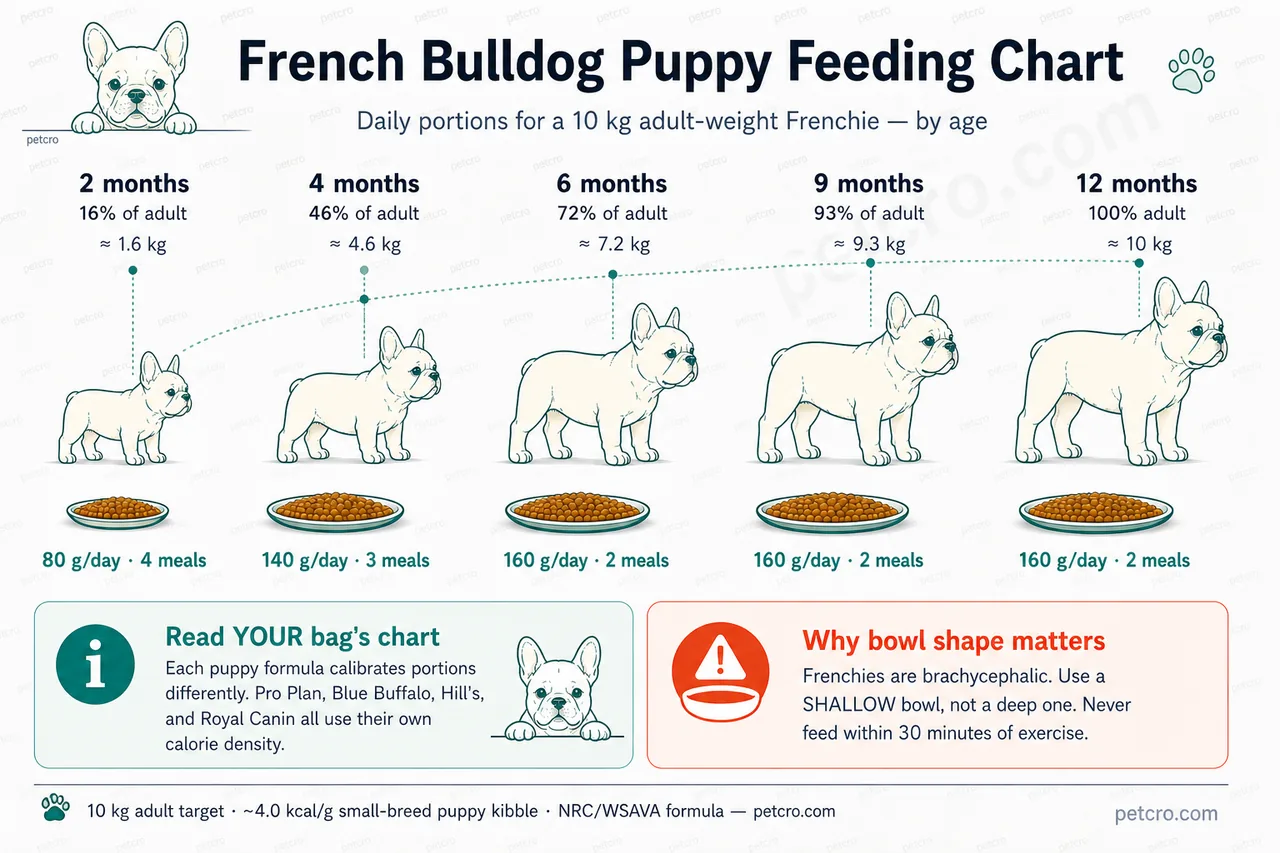
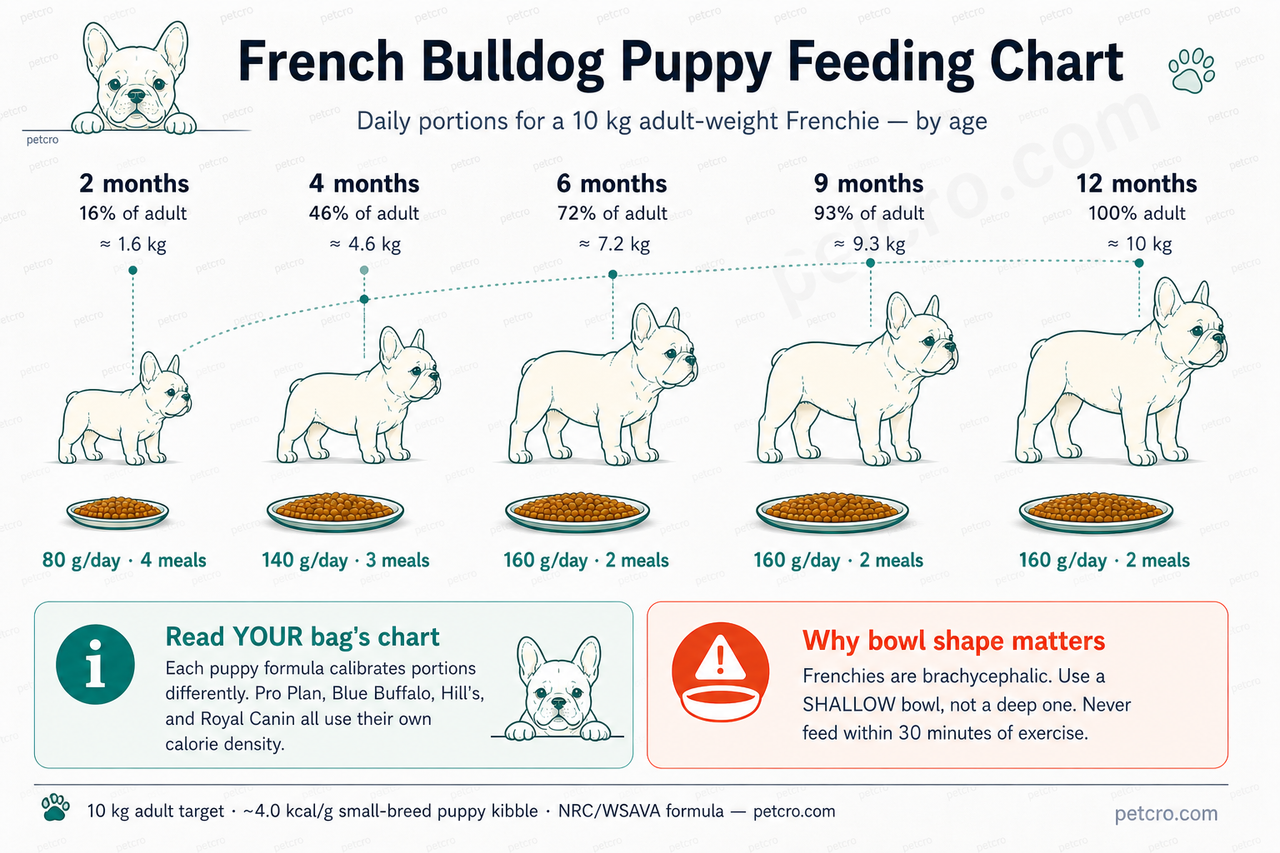
Feeding chart — moderate activity, average puppy
| Adult weight (kg) | 2 mo (g/day) | 4 mo (g/day) | 6 mo (g/day) | 9 mo (g/day) | 12 mo (g/day) |
|---|---|---|---|---|---|
| 7.7 | 65 | 115 | 130 | 130 | 130 |
| 9.3 | 75 | 130 | 150 | 150 | 150 |
| 10.9 | 85 | 145 | 170 | 170 | 170 |
| 12.7 | 95 | 165 | 190 | 190 | 190 |
How to read this: find your puppy's adult weight (not current). If you don't know, our puppy weight predictor estimates it from current weight + age + breed. Cross-reference age in months to read off g/day. Split across meals per the table further down.
Why these numbers are lower than the bag chart: commercial puppy-food charts (Pro Plan, Hill's, Royal Canin) typically recommend 20–30% more food than the WSAVA / NRC formula at the same age. They err on the high side to avoid under-feeding complaints — and most puppies eat more than the strict NRC recommendation without issue. Use the chart above as a conservative starting estimate. If your puppy's body condition score (BCS) drops below 4 after 2 weeks, increase 10–15%. The bag chart is also fine — both are starting points, not prescriptions.
Adjust for activity
| Activity level | Description | Multiplier |
|---|---|---|
| Sedentary | Indoor mostly, short potty walks, lots of crate time | × 0.85 |
| Average | 2 walks/day, normal household play (chart default) | × 1.0 |
| Active | Long walks, dog park, hikes most days | × 1.15 |
| Working / sport | Trained working dog, 4+ hours active daily | × 1.25 |
So a 10.1-kg adult-weight French Bulldog puppy at 6 months on average activity gets about 160 g/day; bump that to 185 g/day if active or drop to 135 g/day if sedentary.
Meal frequency by age
Same as our general puppy guidance, calibrated for French Bulldogs:
| Age | Meals per day | Notes |
|---|---|---|
| 8–12 weeks | 4 | Small stomachs, fast metabolism |
| 3–6 months | 3 | Drop from 4 meals to 3 once stool is consistently firm |
| 6–12 months | 2 | Most French Bulldogs do well on 2 meals from 6 months |
| 12+ months | 2 | Most French Bulldogs switch to adult food around 10 months (10–12-month range). |
Keep the last meal at least 3 hours before bedtime so house-training stays on track.
French Bulldog-specific feeding considerations
BOAS, brachycephaly, and feeding posture
French Bulldogs are brachycephalic — short-faced, flat-muzzled — which makes them a lifelong-risk breed for Brachycephalic Obstructive Airway Syndrome (BOAS). The Cambridge BOAS Research Group and the Royal Veterinary College's VetCompass studies have documented BOAS as one of the most common health issues in pet Frenchies. Several feeding habits matter specifically because of this:
- Use a shallow, wide bowl (a saucer or "flat-faced breed" bowl) instead of a deep dog dish. A deep bowl forces a Frenchie to bury their face into food, which restricts breathing and increases air-swallowing.
- Never feed right before or after exercise. A panting Frenchie eating fast can choke or trigger respiratory distress. Wait at least 30 minutes after activity before feeding, and don't exercise for 60+ minutes after a meal.
- Consider a slow-feeder bowl if your puppy gulps. Air-swallowing is the cause behind the well-documented Frenchie reputation for burping and gas, and it's a real GI-distress trigger.
Heat sensitivity at meal time
Brachycephalic dogs can't pant efficiently to dissipate heat. In summer or in heated rooms, feed during the cooler parts of the day (early morning, evening) and ensure water is always available during and after meals. A Frenchie that's panting heavily after exercise or in a warm room should not be fed until they've cooled down — heat-stress and a full stomach are a dangerous combination for this breed.
Skin and food allergies are common
Frenchies are over-represented in skin and allergy presentations at vet clinics — VetCompass and breed-club veterinary surveys list atopic dermatitis as one of the most-reported Frenchie health concerns. Food sensitivities show up frequently. If your puppy presents recurring ear infections, persistent itching, or chronic loose stool, talk to your vet about a supervised elimination diet — not a self-prescribed brand switch. True food allergies need a vet-supervised diagnostic process; rotating brands at home tends to obscure the trigger rather than identify it.
When to switch to adult food
French Bulldogs are a small breed, so adult food typically starts around 10 months (range: 10–12 months). Going earlier risks under-providing the higher-protein, controlled-calcium ratios growing puppies need; going later risks weight gain on calorie-dense puppy formulas.
See our full guide: when to switch puppy to adult food.
Best food formulas for French Bulldog puppies
We don't pick a single "best" brand — what matters is the formula tier (large-breed puppy vs. all-life-stages, sensitive-stomach vs. standard) and that it's AAFCO growth-tested for the right size class.
For a Frenchie puppy, choose a formula labelled for small-breed growth or all-life-stages. The AAFCO calcium ceiling matters less for a small adult-target dog than for a large-breed one, but calorie density matters a lot — Frenchies are obesity-prone, and 50 g of dense kibble carries the same calories as 65 g of less-dense kibble.
- Purina Pro Plan Puppy (regular, not Large Breed) — see our Pro Plan chart. AAFCO growth-tested, ~4.19 kcal/g, small kibble shape suits Frenchie mouths.
- Blue Buffalo Life Protection Puppy — see our Blue Buffalo chart (the regular Life Protection table). Grain-inclusive recipes, AAFCO growth-tested.
- Royal Canin French Bulldog Puppy — breed-specific kibble shape designed for short-faced eating. Pricier but a defensible pick if your Frenchie struggles with regular kibble shape.
- Purina Puppy Chow — see our Puppy Chow chart. Budget tier, single formula not size-specific.
Avoid: large-breed puppy formula (calcium not balanced for a small adult target), "all-life-stages" formulas that don't disclose calorie density on the bag, and rapid brand-switching during the first 6 months — Frenchie GI tracts protest with loose stool. If your vet has diagnosed a food allergy, ask about prescription hydrolyzed-protein or limited-ingredient diets (Hill's z/d, Royal Canin Hypoallergenic, Purina HA) rather than self-prescribing an off-the-shelf "limited ingredient" pick.
Body condition trumps the chart
Re-run a Body Condition Score (BCS) check every 2 weeks during puppyhood. A BCS of 4–5 (out of 9) means you've got the portion right — ribs felt easily through a thin fat layer, visible waist from above, slight tummy tuck from the side.
For French Bulldogs specifically: Frenchies hide weight gain in their compact, stocky build — the broad chest and short body look much the same at BCS 5 and BCS 7. Feel for ribs through a thin fat layer, not a thick one; if you can't easily find them with light pressure, the dog is overweight regardless of how "normal" the silhouette looks.
A BCS of 6+ means cut the portion 10%; BCS 3 or under means add 10%. Check again in 2 weeks.
Common feeding mistakes for French Bulldog puppies
- Deep bowls. A standard dog bowl forces a Frenchie to bury their face into food, restricting breathing and increasing air-swallowing. Use a shallow, wide bowl or a "flat-faced breed" saucer instead.
- Feeding too close to exercise. A panting Frenchie shouldn't be eating, and a Frenchie shouldn't exercise for 60+ minutes after a meal — both can trigger respiratory distress in brachycephalic dogs.
- Switching brands every few weeks. Frenchie GI tracts are sensitive — 7–10 day transitions are mandatory, not optional. Frequent switching causes the loose stool you're trying to fix.
- Free-feeding. Frenchies are food-motivated and pair their high drive with a sensitive GI tract. Scheduled meals make obesity prevention and stool monitoring far easier.
- Treats as the silent calorie load. A 10 kg Frenchie's daily target is ~150–200 g of food. Even small training treats eat 10–15% of that budget fast.
- Self-diagnosing food allergies. Skin issues, recurring ear infections, and chronic loose stool warrant a vet visit and a supervised elimination diet — not an Amazon switch to "grain-free" or "limited-ingredient" without guidance.
- Ignoring summer heat at meal time. Brachycephalic dogs can't pant effectively. Feed in cooler hours, ensure water is always available, and never feed a Frenchie that's still panting hard.
This guide is general guidance, not veterinary advice. For your specific dog's nutrition, health, or behavior needs, consult your veterinarian.
Frequently asked questions
How much should a French Bulldog puppy eat per day?
A French Bulldog puppy at 4 months on average activity needs around 115–165 g/day of small-breed puppy kibble (~4.0 kcal/g), split across 3 meals. By 9 months that's 130–190 g/day on 2 meals. The exact amount depends on adult-weight target (9–12.7 kg male, 7.7–10.9 kg female), activity level, and body condition score. Run our feeding calculator for a portion tuned to your specific puppy.
When should I switch my French Bulldog from puppy to adult food?
Most French Bulldogs switch around 10 months (10–12-month range, depending on growth-plate closure and adult weight). Small-breed puppy formulas have specific calcium-to-phosphorus ratios that matter for skeletal development — switching too early risks under-providing those nutrients. See our full when-to-switch guide for a 7–10 day transition protocol.
How many meals a day for a French Bulldog puppy?
4 meals/day until 12 weeks, 3 meals/day from 3–6 months, then 2 meals/day from 6 months onwards. French Bulldogs do well on 2 meals into adulthood. For Frenchies specifically, 2 smaller meals are easier on a brachycephalic puppy's breathing during eating than 1 larger meal — and meal timing matters: never feed within 30 minutes of exercise.
What's the best puppy food for a French Bulldog?
For a Frenchie puppy, "best" is whichever AAFCO-growth-tested small-breed or all-life-stages formula your dog tolerates well — Frenchie GI tracts are sensitive, so the brand your puppy doesn't have loose stool on beats whichever brand is "premium" by marketing. Solid options are Pro Plan Puppy, Blue Buffalo Life Protection Puppy, Hill's Science Diet Small Paws Puppy, and the breed-specific Royal Canin French Bulldog Puppy. If your puppy presents skin issues, recurring ear infections, or persistent loose stool, talk to your vet about a supervised elimination diet — don't self-prescribe a hypoallergenic formula.
How much do French Bulldogs weigh by age?
At 26 weeks (≈6 months) a typical French Bulldog puppy is about 72% of adult weight. For a 10.1-kg adult, that's around 7.3 kg at 6 months. Use our puppy weight predictor for an exact estimate from your puppy's current weight + age + breed.
My French Bulldog puppy isn't finishing meals — am I overfeeding?
Possibly. Frenchies are at the high end of food drive — finishing every meal is the breed default, and a Frenchie refusing food is a stronger signal than the same behavior in less-motivated breeds. Drop the portion 10% and watch for a week. If body condition stays at BCS 4–5 and stool is firm, you've found the right amount. Don't push food a healthy puppy is refusing — but if a Frenchie refuses food for more than 24 hours, call your vet (especially if accompanied by lethargy or vomiting; a brachycephalic dog under stress can deteriorate quickly).
Should I free-feed or scheduled-feed my French Bulldog puppy?
Scheduled meals, not free-feeding. For Frenchies especially: free-feeding combined with the breed's high food drive and sensitive GI tract is a near-guaranteed path to either overweight or chronic loose stool. Scheduled meals also make house-training, BCS tracking, and medication-timing far easier — and they let you control feeding away from exercise windows, which matters for brachycephalic dogs.
TL;DR — the French Bulldog feeding cheat sheet
- Adult weight: 7.7–12.7 kg (17–28 lb), size band small
- Meals: 4 → 3 → 2 at 12 weeks / 6 months
- Switch to adult food at 10 months (10–12-month range)
- Use the chart above as a starting estimate, then adjust −15% (sedentary) to +25% (very active) for activity and re-check body condition every 2 weeks
- Frenchie owners: bowl shape and meal timing matter as much as portion size — shallow bowls, scheduled meals, and never feed within 30 min of exercise.
- Run our feeding calculator for an exact gram count for your specific puppy
Sources & further reading
- AKC French Bulldog official breed standard — adult-weight ranges and breed standard.
- The Royal Kennel Club (UK) French Bulldog breed standard — UK-side cross-reference.
- United Kennel Club (UKC) breed standard — additional cross-reference for the same adult range.
- WSAVA Global Nutrition Guidelines — the puppy energy-requirement formula behind the chart.
- AAFCO Dog Food Nutrient Profiles — growth-stage minimums for puppy food labelling.
- Hill's Pet Nutrition: Dog care guides — vet-nutritionist-led guidance on small-breed puppy growth and brachycephalic-specific feeding considerations.
- NRC Nutrient Requirements of Dogs and Cats (2006), National Academies Press — the underlying RER / DER math.
More from Petcro's puppy feeding cluster
- How much to feed a puppy — pillar guide — the master feeding article all chart posts feed back into.
- When to switch puppy to adult food — full transition protocol by size class.
- French Bulldog first-year guide — month-by-month timeline, training, health watch-outs.
- Puppy weight predictor — estimate adult weight from current weight + age + breed.
- Feeding calculator — exact gram count for your specific puppy in 30 seconds.
Petcro is reader-supported. We may earn an affiliate commission when you click through links to products in this guide. Our editorial picks are independent of any commercial relationship with any pet-food brand.