8-Week-Old Puppy Feeding Schedule (4 meals, soaked kibble, hypoglycaemia watch)
An 8-week-old puppy needs 4 meals a day on a 4-hour cycle, soaked kibble for the first 2 weeks, and small-breed hypoglycaemia watch — the full schedule.
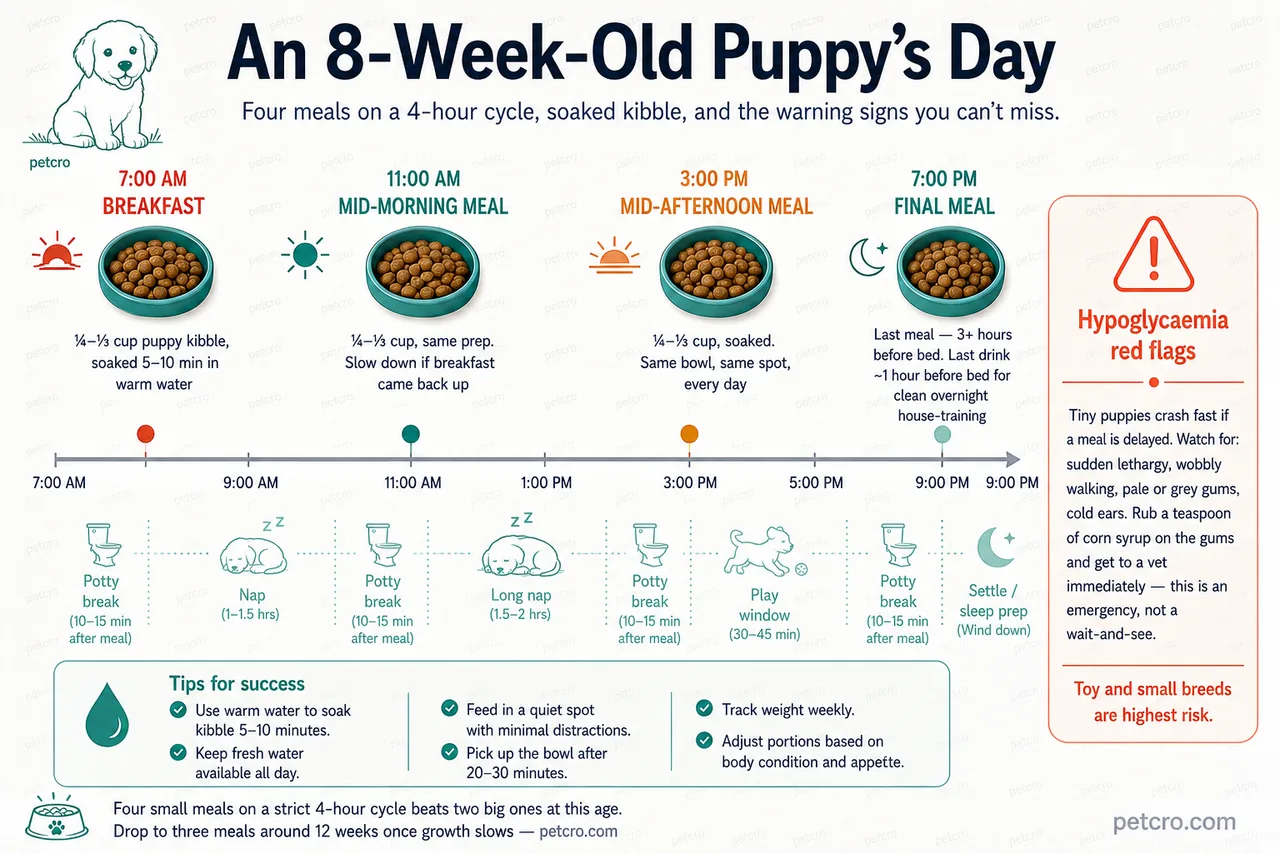
An 8-week-old puppy needs 4 meals a day on a 4-hour cycle (7am, 11am, 3pm, 7pm), portion-sized to projected adult weight. Soak kibble in warm water for the first 2 weeks at home — gums are still tender and the texture transition off mother's milk matters. Last meal 3+ hours before bedtime to keep house-training clean.
TL;DR: At 8 weeks, you're not feeding a small dog — you're feeding the most metabolically demanding window of an animal's life. 4 meals/day at 7/11/3/7 is the default, soak kibble in warm water for the first 2 weeks, and never let a small-breed puppy go more than 4 hours without food — hypoglycaemia is a real emergency for toy breeds at this age. Portions: roughly 30–60 g per meal for typical small-to-medium puppies depending on adult-weight target. Run the feeding calculator for an exact gram count tuned to your specific puppy.
The 8-week feeding schedule (the actual times)
Here's the schedule we recommend to anyone bringing home an 8-week-old puppy this week:
| Time | What | Notes |
|---|---|---|
| 7:00 am | Meal 1 | Right after morning potty. Soaked kibble for the first 2 weeks. |
| 11:00 am | Meal 2 | Mid-morning. Pair with crate routine — see crate-training guide. |
| 3:00 pm | Meal 3 | Mid-afternoon. Same bowl, same spot, same timing every day. |
| 7:00 pm | Meal 4 | Last meal. 3+ hours before bedtime so house-training stays clean overnight. |
Why exactly 4 meals, not 3 or 5?
Three reasons:
- Stomach capacity. An 8-week-old puppy's stomach holds about 50–80 ml comfortably. Spread across 4 meals, daily intake is digestible. Compress to 2 large meals and you'll see vomiting or loose stool from over-stretching.
- Blood-sugar stability. Puppies under 12 weeks have limited liver glycogen reserves. Long gaps between meals — anything over 5 hours — can drop blood glucose into hypoglycaemic territory, especially in toy and small breeds. More on that below.
- House-training rhythm. Predictable meal times produce predictable potty times. Eat → 15-30 min later → potty break → calm crate stretch. That cycle is the spine of the first month at home.
Stick to the same times for 7 consecutive days before adjusting anything. Routine is more valuable to an 8-week puppy than perfect portion math.
How much should an 8-week-old puppy eat per day?
Daily intake at 8 weeks is roughly 130–160 kcal per kilogram of body weight — a much higher per-kg rate than adult dogs because of the rapid growth. Translated into grams of typical puppy kibble (~3.5 kcal/g), that's roughly:
| 8-week puppy weight | g/day | g per meal (÷ 4) | Likely adult-weight target |
|---|---|---|---|
| 1 kg | ~50 g | 12 g | Toy (3–5 kg adult) |
| 2 kg | ~95 g | 24 g | Small (6–10 kg adult) |
| 3 kg | ~135 g | 34 g | Small / medium (10–15 kg adult) |
| 4 kg | ~165 g | 41 g | Medium (15–22 kg adult) |
| 5 kg | ~195 g | 49 g | Medium / large (22–28 kg adult) |
| 6 kg | ~225 g | 56 g | Large (28–35 kg adult) |
| 7+ kg | ~250+ g | 62+ g | Large / giant — see large-breed puppy formula |
These are starting estimates. Actual portions depend on calorie density of your specific kibble (premium puppy formulas at 4.0+ kcal/g need ~15% less by weight), activity level, and whether your puppy is naturally a smaller or larger eater within their breed.
The honest test: weigh on a kitchen scale, don't measure with a cup. Cup volumes drift wider than gram weights as kibble settles, and at this age a 10% over-feeding window adds up to a lifetime habit fast. For a more precise number tuned to your puppy's specifics, run our feeding calculator.
For the underlying calorie math (RER × growth multiplier formula), see our pillar guide on how much to feed a puppy.
Why soaked kibble for the first 2 weeks
This is the single most-skipped tip and it's worth a section.
At 8 weeks, your puppy just left the litter and stopped nursing. Their gums are still tender from teething, their gut microbiome is still adjusting from milk-protein to plant-and-meat-protein digestion, and dry kibble is unfamiliar in both texture and temperature.
The fix is simple: pour warm (not hot) water over their portion, let it sit 5–10 minutes, mash slightly with a fork. The kibble softens, the smell amplifies (puppies eat with their nose first), and the moisture eases gut transition.
How long to soak:
- Week 1 home (8 weeks): Fully soaked — soft, mushy texture
- Week 2 (9 weeks): Half-soaked — kibble holds shape but yields to chewing
- Week 3 (10 weeks): Lightly damped — most of the surface moisture only
- Week 4+ (11 weeks): Dry, as labelled
If your puppy is reluctant to eat the dry kibble at 11 weeks, slow down — go back to half-soaked for another 3–5 days. Forcing the dry transition while a puppy is still figuring out solid food is one of the most common reasons for the "my puppy stopped eating" call to the vet at 9–10 weeks.
For more on that pattern, see puppy not eating but acting normal.
Hypoglycaemia watch — toy and small breeds
This is the part of the 8-week-old puppy guide that the cute schedule doesn't cover, and it's the most important.
Toy and small-breed puppies under 12 weeks (Yorkies, Chihuahuas, Maltese, Pomeranians, Toy Poodles, Papillons, miniature breeds in general) can crash into hypoglycaemia within hours of skipping a meal. The mechanism: tiny bodies have small liver glycogen reserves, low fat-mass to draw from, and a metabolic rate that burns through fuel fast.
Signs of hypoglycaemia in a puppy:
- Wobbly walking, looking "drunk"
- Glazed or unfocused eyes
- Lethargy out of proportion to activity
- Cold ears, cold paws
- In serious cases: seizures, unresponsiveness
If you see any of these:
- Rub a small amount of honey or maple syrup directly on the gums (about ¼ teaspoon)
- Call your vet immediately — this is an emergency
- Don't wait to see if it resolves; small breeds can deteriorate fast
Prevention is the same answer the schedule already gives you: never go more than 4 hours between meals if your puppy is small-breed and under 12 weeks. If you have to be out of the house longer, leave a kibble-stuffed Kong or a dispensing toy that releases food gradually.
For larger breeds (medium-large at 8 weeks), the 4-hour rule is still the schedule recommendation, but the hypoglycaemia margin is wider — they can usually handle a 5–6 hour gap if they have to.
What NOT to feed an 8-week-old puppy
The omissions matter as much as the inclusions:
- Cow's milk. Puppies lose the ability to digest lactose around the time they wean. Cow's milk causes diarrhoea — and at 8 weeks, diarrhoea dehydrates fast. If you want to add milk-flavour appeal to a meal, use a small splash of unsweetened goat's milk or a vet-recommended puppy milk replacer instead.
- Adult dog food. Adult formulas are calibrated for maintenance, not growth. At 8 weeks, a puppy needs roughly 2× the calorie-per-kg of an adult dog and specific calcium-to-phosphorus ratios for skeletal development. Adult food at 8 weeks under-fuels the most important growth window of the puppy's life.
- Raw bones, even small ones. Raw bones can splinter or cause choking in a puppy who hasn't yet learned to chew safely. Wait until 4+ months and supervise heavily — see our raw diet for puppies guide for the full safety case.
- Table scraps with onion, garlic, chocolate, grapes, raisins, or xylitol. All toxic to dogs. At 8 weeks, even tiny amounts can be dangerous because of body size.
- Free-feeding (food left out all day). Schedule beats access. Free-feeding teaches grazing, hides early appetite changes, and breaks the meal-time-equals-potty-time rhythm that makes house-training work.
Transitioning your puppy's food (if the breeder fed something different)
Most breeders send puppies home with a small bag of whatever brand they were eating in the litter. Whether you keep that brand or switch, never switch in one meal. Sudden food changes cause the kind of loose stool that turns into a vet visit fast in a puppy.
The 7-day transition protocol:
| Days | Old food | New food |
|---|---|---|
| 1–2 | 75% | 25% |
| 3–4 | 50% | 50% |
| 5–6 | 25% | 75% |
| 7+ | 0% | 100% |
For sensitive-stomach breeds (Frenchies, English Bulldogs, some German Shepherds), stretch this to 14 days. For breeds with confident stomachs (Labs, mixed-breed mutts), 7 days is fine.
If stool stays soft past day 4, you've moved too fast — go back two days in the ratio table and slow down. A digestive support paste like Pro-Kolin+ by Protexin is what most vets reach for first if the transition isn't going smoothly.
For the full size-by-size transition timing later in puppyhood, see when to switch puppy to adult food.
When to drop from 4 meals to 3
Most puppies are ready to drop from 4 meals to 3 meals around 12 weeks. The signal: stool is consistently firm on 4 meals, the puppy isn't acting hungry between meals, and they've started leaving food in the bowl.
When you make the switch, consolidate the 11am and 3pm meals into a single 1pm meal. Schedule becomes 7am / 1pm / 7pm. Most puppies adjust within 3 days.
Don't drop earlier than 11 weeks even if the puppy seems fine — the metabolic rate is still high enough that 4 meals is doing useful work. Don't hold at 4 meals past 14 weeks — you'll start over-feeding because the per-kg calorie need is dropping.
Common 8-week feeding mistakes (and the easy fix)
- Free-feeding. Already mentioned but worth the bullet — the single most common mistake at this age.
- Cup-measuring instead of weighing. Volume varies; grams don't.
- Skipping the soak. Dry kibble in week 1 home is a big jump from mother's milk.
- Treats above 10% of daily calories. Training-treat creep is real. Most "small" training treats are 3–5 kcal — easy to give 50 in a session and accidentally double a meal.
- Feeding right before crate time. A full puppy in a crate either toilets or whines. Wait 30 minutes after eating before crate stretches.
- Last meal too close to bedtime. Aim for at least 3 hours between dinner and lights-out so the bladder is empty before crate-up.
- Different food brand from breeder, switched in one meal. Always run the 7-day transition.
Body condition is the source of truth
The chart and the schedule are the starting estimate. Body condition score (BCS) is the actual answer.
Run the Body Condition Score check every 2 weeks during these first months. At 8 weeks specifically, you're looking for:
- Ribs felt easily through a thin layer of fat (not visible at standing rest, not buried under a thick layer)
- Visible waist from above (subtle hourglass shape)
- Slight tummy tuck from the side
- Eyes bright, coat shiny, energy proportional to age
If ribs are visible at standing rest, increase portion 10% and re-check in a week. If you can't find the ribs through the layer at all, drop portion 10%. Don't yo-yo — adjust slowly.
For the full BCS framework and what each of the 9 scores looks like, see our body condition scorer.
This guide is general guidance, not veterinary advice. For your specific dog's nutrition, health, or behavior needs, consult your veterinarian.
Frequently asked questions
How much should an 8-week-old puppy eat per day?
Roughly 130–160 kcal per kilogram of body weight, split across 4 meals. For a typical 3 kg puppy that's about 135 g/day of standard puppy kibble (~3.5 kcal/g), or about 34 g per meal. Run our feeding calculator for a brand-specific number tuned to your puppy's actual weight and adult-weight target.
Can I leave food out all day for an 8-week-old puppy?
No — scheduled meals beat free-feeding at every age, but especially at 8 weeks. Free-feeding teaches grazing, hides early appetite changes (which are sometimes the first sign of illness), and breaks the meal-time → potty-time rhythm that makes house-training work. Stick to 4 meals on a fixed schedule for the first month at home.
What if my 8-week-old puppy refuses to eat?
First check the kibble — is it stale or has the bag been open more than 6 weeks? Then check whether the food has been switched recently (sudden brand changes cause refusal). Try soaking the kibble in warm water for 5–10 minutes if you haven't been already. If refusal lasts more than 8 hours in a small-breed puppy (hypoglycaemia risk) or 24 hours in a larger puppy, call the vet. See puppy not eating but acting normal for the full red-flag checklist.
Should I feed wet food, dry food, or both at 8 weeks?
Either works if the food is labelled "complete and balanced for growth" by AAFCO. Soaked dry kibble is the most common starting point — it's cheaper, easier to portion exactly, and helps the dental development as kibble texture firms up over the next month. Some owners do 75% dry + 25% wet as a topper if their puppy is a picky eater. Avoid switching brands in the first 2 weeks home — give the GI tract time to settle first.
When should I stop feeding 4 meals a day?
Around 12 weeks is the typical drop from 4 meals to 3. Signals: stool is firm on the current schedule, puppy isn't food-seeking between meals, and they've started leaving food in the bowl at the end of a meal. Don't drop before 11 weeks even if it seems fine — the metabolic rate is still high. The next drop (3 → 2 meals) typically happens at 6 months. See our pillar feeding guide for the full age-by-age schedule.
Can I give an 8-week-old puppy treats?
Yes, but cap treats at ≤10% of daily calories and use them for training, not snacking. Most "small" training treats are 3–5 kcal each; a typical 3 kg puppy gets ~390 kcal/day, so the treat budget is about 10–13 small treats. Cut treats into thirds or quarters for training sessions to stretch the budget without breaking it.
What about water at 8 weeks?
Free-access fresh water at all times — no schedule, no restriction. Puppies need roughly 50–100 ml per kg of body weight per day. The exception is the 1–2 hours before bedtime, when removing the water bowl helps overnight house-training (some owners do this, some don't — both work).
TL;DR — the 8-week feeding cheat sheet
- 4 meals/day on a 4-hour cycle (7am, 11am, 3pm, 7pm); last meal 3+ hours before bedtime
- Soak kibble in warm water for the first 2 weeks home; transition to dry by week 4
- Portions: roughly 30–60 g per meal for typical small-to-medium breeds, scaling with adult-weight target
- Never more than 4 hours between meals for toy / small breeds — hypoglycaemia risk
- No cow's milk, no adult food, no raw bones, no human leftovers at this age
- 7-day transition if switching food brands; never in one meal
- Drop from 4 to 3 meals around 12 weeks — not earlier than 11 weeks. Body condition every 2 weeks is your truth signal.
Sources & further reading
- WSAVA Global Nutrition Guidelines — the international veterinary baseline for puppy energy requirements and the RER × growth multiplier formula behind the daily-calorie math.
- AAFCO Dog Food Nutrient Profiles — the regulatory baseline that defines "complete and balanced for growth" on a puppy food label.
- AKC: Puppy feeding fundamentals — kennel-club guidance on first-month feeding habits and meal-frequency by age.
- ASPCA Dog Nutrition Tips — vet-organisation guidance on growth-stage feeding, including small-breed hypoglycaemia warning signs.
- Tufts Petfoodology: Reading a pet food label — independent vet-nutritionist analysis of what "complete and balanced for growth" actually means at the bag level.
If your puppy has a specific health condition (kidney, liver, allergies, pancreatitis, GI issues), follow your vet's guidance over any general feeding chart — including the one in this guide.
More from Petcro's puppy nutrition cluster
- How much to feed a puppy — the pillar guide — the calorie formula and gram-by-weight chart this 8-week schedule is built on.
- Tips on how to crate-train a puppy — meal timing pairs tightly with crate routine for the first month.
- Puppy not eating but acting normal — the red-flag checklist for the "my puppy refused breakfast" scenario.
- When to switch puppy to adult food — the next switching decision, by adult size.
- Feeding calculator — exact gram count for your specific 8-week-old puppy in 30 seconds.
- Vaccination timeline — the medical companion to the feeding schedule for the first months home.
Petcro is reader-supported. We may earn an affiliate commission when you click through links to products in this guide. Our editorial picks are independent of any commercial relationship with any brand.