When to Switch Your Puppy to Adult Food (the size-by-size answer)
When to switch puppy to adult food, by adult size — plus the 7-day transition protocol and signs you've timed it wrong.

When to switch puppy to adult food depends on adult size: small breeds (under 10 kg) at 10–12 months, medium breeds (10–25 kg) at 12 months, large breeds (25–40 kg) at 15–18 months, and giant breeds (40 kg+) at 18–24 months. Run a 7–10 day transition (75/25 → 50/50 → 25/75 → 100% new) regardless of size to prevent diarrhea.
Most puppy food bags say "feed until 12 months." That's roughly right for a Beagle and completely wrong for a Great Dane — who's still skeletally a puppy at 18 months. This guide gives you the size-by-size timeline, the transition protocol, and the warning signs you switched too early.
TL;DR: Small breeds (under 10 kg adult) switch at 10–12 months. Medium breeds (10–25 kg) switch at 12 months. Large breeds (25–40 kg) wait until 15–18 months. Giant breeds (40 kg+) wait until 18–24 months. Whatever your timeline, take 7–10 days to transition — old food → new food in increasing ratios. Track body condition over the first month — that tells you whether you got it right. Run the calculator to see your exact post-transition portion.
Why timing this wrong is more than a digestion issue
Puppy food and adult food aren't just calorie levels. They differ in three ways that matter for a growing skeleton:
- Calcium and phosphorus ratios. Puppy food is calibrated to support fast bone growth (1.2:1 to 1.4:1 ratio). Adult food has lower absolute calcium because adult skeletons aren't being built — they're being maintained. Switch a still-growing large-breed puppy to adult food at 12 months and you can shortchange the final 6 months of skeletal development.
- Protein and DHA. Puppy formulas have higher DHA (brain development), more digestible protein, and often joint precursors like glucosamine. The transition needs to happen after growth is structurally done, not while it's slowing.
- Caloric density per kg. Adult food is less calorie-dense per gram because adult dogs need less fuel per kilogram than puppies. Switching too early under-fuels growth; switching too late over-fuels and pushes weight gain.
The cost of switching too early in a large or giant breed shows up years later — as joint problems. The cost of switching too late in a small breed shows up in months — as a chunky 14-month-old who's now in a calorie deficit fight.
Get the timing right and you avoid both.
!Adult dog and growing puppy side by side showing relative size differences
When to switch puppy to adult food, by adult size
Adult size is the variable that matters. If you don't know your puppy's projected adult size, the rule of thumb: puppies reach roughly 60–75% of adult weight at 6 months depending on size band — toys closer to 75%, large breeds around 65%, giants closer to 58%. They reach about 95% at 12 months for small breeds, 18 months for large breeds, and 24 months for giants. See our puppy weight chart by breed size for the size-band-specific curves.
| Adult size | Typical adult weight | Switch at | Why this timing |
|---|---|---|---|
| Toy / small | Under 10 kg (Chihuahua, Yorkie, Pomeranian) | 10–12 months | Skeletal growth wraps fast; staying on puppy food past 12 mo causes weight gain |
| Small / medium | 10–25 kg (Beagle, Cocker Spaniel, Border Collie) | 12 months | Growth plates close around 11–13 mo; safe to switch at 12 |
| Large | 25–40 kg (Labrador, Golden Retriever, Boxer) | 15–18 months | Skeletal development continues to ~15 mo; switch too early and you risk joint issues |
| Giant | 40 kg+ (Great Dane, Mastiff, St Bernard, Newfoundland) | 18–24 months | Some breeds still adding bone density at 2 years — vet sign-off recommended |
Two important caveats:
- Mixed breeds: estimate adult size at 4–5 months (paw size and skeletal frame are surprisingly predictive), then use the matching row above.
- Spayed / neutered before 6 months: caloric needs drop 20–30% within weeks of surgery. The switch timing doesn't change, but your portion math does — re-run the feeding calculator post-surgery.
!Dog food bowl with mixed puppy and adult kibble during transition week
The 7–10 day transition protocol
Switching food fast is the single biggest reason puppies get diarrhea around their first birthday. Their gut microbiome adapted to puppy food's specific protein sources, fats, and fiber profile over months. Throw an entirely new food at them in one meal and you're looking at 3–5 days of soft stool, sometimes worse.
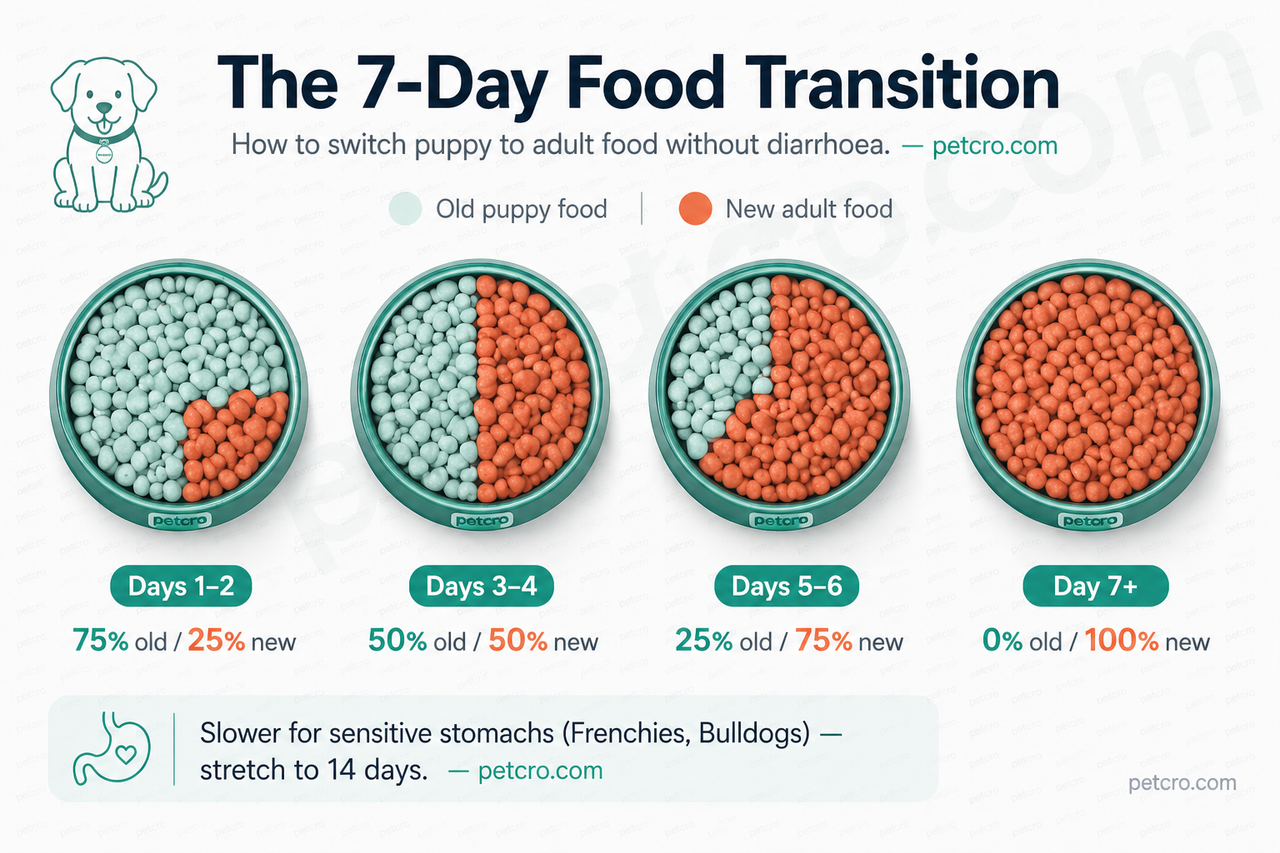
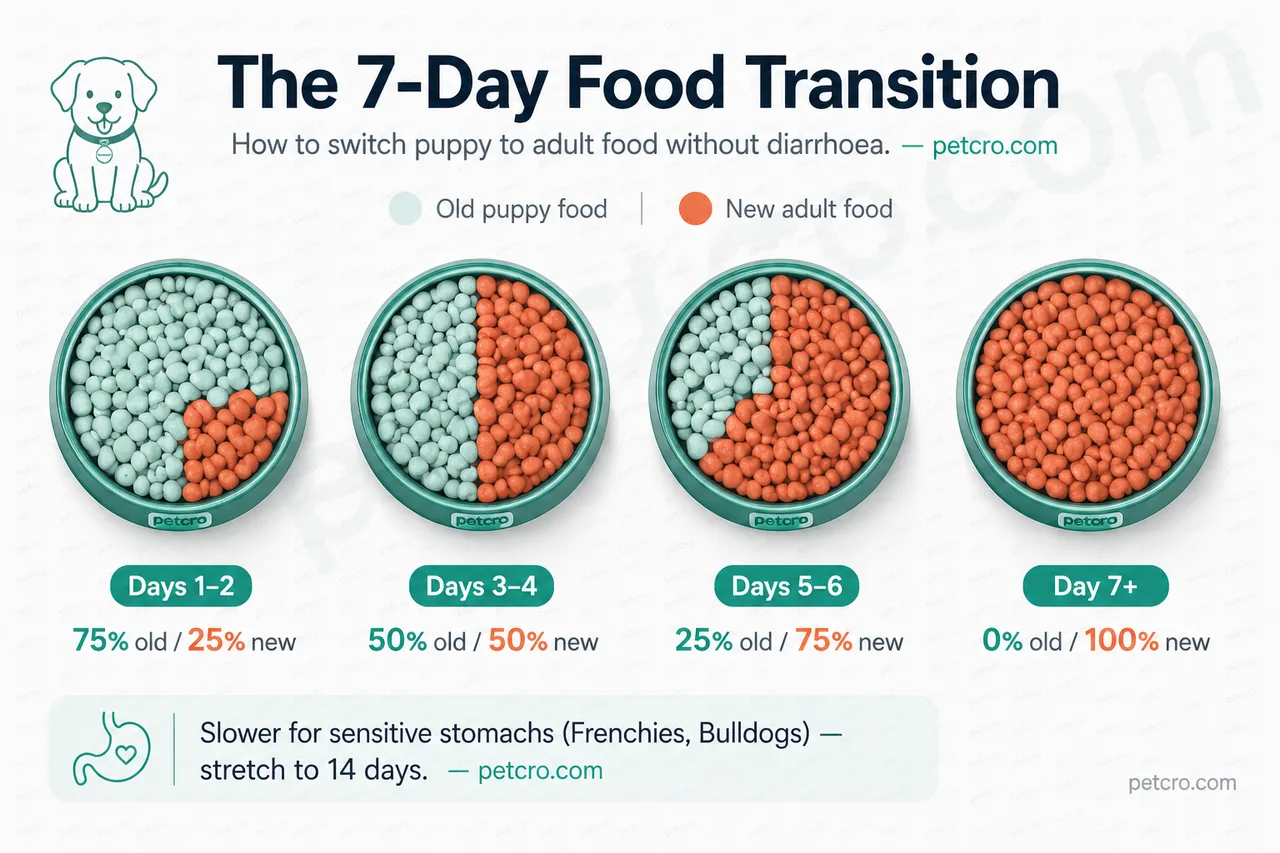
The vet-standard protocol is a gradual swap over 7–10 days:
| Day | Old food | New food |
|---|---|---|
| 1–2 | 75% | 25% |
| 3–4 | 50% | 50% |
| 5–6 | 25% | 75% |
| 7+ | 0% | 100% |
Day 1-2: 75% old, 25% new
Body acclimating to new ingredients in small amounts. Soft stool is unusual at this stage; if you see any, you're going too fast — hold this ratio another day before advancing.
Day 3-4: 50/50 split
The riskiest window — the gut microbiome is mid-shift. Watch stool consistency closely. If looser than usual at this ratio, drop back to Day 1-2's ratio for 2 more days before retrying.
Day 5-6: 25% old, 75% new
Mostly new food now. Most puppies tolerate this without symptoms by day 5; the few that don't usually have an underlying GI sensitivity worth flagging to your vet.
Day 7-10: 100% new food
Full switch. The whole point of the 7–10 day window is to land here with normal stool. If stool is still soft at this stage, drop back to 50/50 for 3 days and ramp again more slowly.
For sensitive-stomach puppies (Frenchies, English Bulldogs, some German Shepherds), stretch this to 14 days. For confident-stomach breeds (Labs, mixed-breed mutts), 7 days is fine.
Keep the meal environment identical during the switch — same bowl, same time, same room. If you've followed the crate-training routine, you already have a stable rhythm in place; that consistency reduces stress-related appetite dips that get blamed on the new food.
What to have on hand for transition week. Soft stool during a transition is normal up to about day 4. If it's still soft at day 6, you've gone too fast — drop back two days in the ratio table and slow down. A digestive support paste like Pro-Kolin+ by Protexin is what most vets reach for first — it combines kaolin (firms stool) with live probiotics (rebuilds the gut culture). For the full strain-by-strain rundown of canine probiotic picks, see our best probiotics for puppies guide; if the soft stool turns into actual diarrhea, our puppy diarrhea decision tree walks through whether it's home-care or vet territory. Worth having Pro-Kolin+ on hand before you start the switch, not after the carpet's already been ruined.
If your puppy is vomiting, has bloody stool, or is lethargic during the transition, stop the switch immediately and call your vet. Those aren't transition symptoms — those are signs of a different problem.
How to know your puppy is ready to switch
Three signals, in order of reliability:
1. Growth has actually slowed
Weigh weekly for a month. If your puppy gained less than 5% over the four weeks, growth has plateaued and the calcium/phosphorus argument for staying on puppy food is over.
2. Body condition is on track
Use the Body Condition Score tool — it walks you through the rib/waist/belly check that vets use. A puppy ready to switch should sit at BCS 4–5 on the 9-point scale (ribs felt through a thin layer, visible waist from above, belly tucks slightly). A BCS 6+ puppy needs portion adjustment before switching, not the switch itself.
3. Age matches the size table above
Don't switch a 12-month Great Dane just because the bag suggests it. Match the table, not the bag.
If only one of the three signals lines up, wait. If two of three line up and the dog is acting healthy, you're probably ready. If all three line up, switch with confidence.
Signs you switched too early
Worth knowing because the fix is reversible if you catch it in the first month:
- Slowed weight gain that was previously steady. If your puppy was adding 200–300 g/week and that drops to <100 g/week post-switch without a body-condition reason, the calorie cut may be too sharp. Add 10% portion or move back to puppy food for another month.
- Coat starts looking dull or dry. Adult food has less DHA and omega-3. A fading coat 4–6 weeks after switching is suggestive — bridge with a fish oil supplement or move back.
- Energy drop that doesn't match a growth spurt. Some puppies have low-energy weeks during growth. But persistent low energy after a switch can mean the calorie density is now too low for the puppy's actual needs.
- Skeletal pain or limping (large/giant breeds only). Rare but serious. If you switched a large breed at 12 months and they're showing joint stiffness at 14 months, vet visit immediately. The damage is sometimes reversible if caught early.
If any of the above appear in the first 60 days, the safe play is to revert to puppy food for another 2–3 months and try again.
Signs you switched too late
The opposite problem is more common than people realise:
- Steady weight gain that doesn't match growth. A 14-month small-breed puppy still on puppy formula is getting ~15% more calories than they need. That's where adult-onset chubbiness starts.
- Reduced appetite. Some puppies start refusing puppy food once they're past their growth phase — their bodies stop wanting the higher fat content. Listen to that signal.
- Increased thirst, paired with the chubbiness. Slightly elevated water intake plus weight gain can be a metabolism signal that the food is no longer matched to the dog's needs.
If you notice these and your dog matches the size table for switching, don't drag it out. Run the 7-day transition this week.
Special cases worth flagging
Giant breeds — get a vet to weigh in
For Great Danes, Mastiffs, Newfoundlands, and similar, the difference between switching at 18 vs 24 months can show up in lifetime joint health. Most large-breed vets will do a quick growth-plate X-ray at 18 months — it's the cheapest insurance policy you can buy on a $3,000 dog.
Working dogs and athletes
Border Collies, Aussies, Mals, and other working breeds with adult sizes in the 15–25 kg range can often go to "high-performance adult" food rather than standard maintenance. Talk to your vet — the calorie levels are closer to puppy food but the calcium ratios are adult.
Pregnant or lactating mothers
A puppy that's been bred (yes, it happens — late puppyhood overlap is real) needs to stay on puppy food or move to a "pregnancy / lactation" formula, not adult. Caloric needs roughly double in late pregnancy.
Health-condition diets
Kidney, liver, allergy, and pancreatitis diets have their own switching rules — follow your vet's protocol, not generic guidance.
This guide is general guidance, not veterinary advice. For your specific dog's nutrition, health, or behavior needs, consult your veterinarian.
Frequently asked questions
What age do you switch a puppy to adult food?
It depends on adult size: 10–12 months for small breeds, 12 months for medium, 15–18 months for large, 18–24 months for giant. Skeletal maturity drives the timing, not age alone.
Can I switch puppy to adult food at 6 months?
Almost never the right call. Even small breeds are still in active growth at 6 months. The exceptions are vet-prescribed early switches for specific health conditions.
Do I need to switch food brands when going from puppy to adult?
Not strictly. Most premium brands (Royal Canin, Hill's, Purina Pro Plan, Eukanuba) have a matched adult formula in the same line. Sticking with the brand often means a smoother transition because the protein sources and fiber profile carry over.
How long does the puppy-to-adult food transition take?
Seven days minimum, ten days for typical breeds, fourteen for sensitive stomachs. Faster than that risks diarrhea and a longer recovery than you saved.
What if my puppy refuses the new food?
Slow the transition — drop the ratio of new food back to 25% and hold there for 3 days before stepping up again. Warming the food slightly or adding a tablespoon of plain, unsalted bone broth helps for picky eaters.
Should I switch a senior puppy (1+ year) to adult food immediately?
If you only just realised they should already be on adult food, run a 7–10 day transition starting today. Don't switch in one meal even if they're "old enough."
Does my puppy need to switch to large-breed adult food?
Large-breed adult formulas have controlled calcium and joint support — worth it for breeds 25 kg+. Small and medium breeds don't need the large-breed line.
TL;DR — the puppy-to-adult food cheat sheet
- Adult size dictates timing, not the bag's "12 months" rule
- Small breeds: 10–12 months. Medium: 12 months. Large: 15–18 months. Giant: 18–24 months
- Take 7–10 days to transition — never one meal
- Have digestive support on hand before you start, not after
- Watch body condition for the first 30 days post-switch
- If signals don't match the table, wait
Once the switch is done, your portion math changes. Adult dogs need roughly half the calories per kilogram of an active puppy. Re-run the feeding calculator the first day they're on 100% adult food — that's the moment your bag chart goes from "starting estimate" to "actually accurate."
Sources & further reading
- WSAVA Global Nutrition Guidelines — the framework behind the size-by-size transition timing in this guide.
- AAFCO Dog Food Nutrient Profiles — defines what "complete and balanced" means at each life stage; the regulatory baseline a brand must meet to label food as "puppy" or "adult."
- Tufts Petfoodology: When to switch puppy food — vet-nutritionist guidance on the puppy-to-adult transition window, especially for large and giant breeds.
- ASPCA Dog Nutrition Tips — vet-organisation guidance on life-stage transitions and label-reading at each stage.
If your puppy has a specific health condition (kidney, liver, allergies, pancreatitis), your vet's recommendation overrides anything written above. Vet-prescribed diets aren't optional.
More from Petcro's puppy nutrition cluster
- How Much to Feed a Puppy — the underlying calorie formula your transition portion is built on.
- Purina Pro Plan Puppy Feeding Chart — formula-by-formula chart for the most-bought premium puppy food.
- Purina Pro Plan Large Breed Feeding Chart — calcium-controlled formula for 25 kg+ adults.
- Feeding calculator — exact gram count for your specific dog at any life stage.
Petcro is reader-supported. We may earn an affiliate commission when you click through links to products in this guide. Our editorial picks are independent of any commercial relationship with any brand.