Purina Pro Plan Large Breed Puppy Feeding Chart (the joint-protection version)
The Purina Pro Plan Large Breed Puppy feeding chart by adult weight and age, plus the calcium-ratio reason large breeds need a different formula.

The Purina Pro Plan Large Breed Puppy feeding chart applies to puppies with 50+ lb (23 kg+) adult weight. Per Pro Plan's bag chart, daily portions range 1⅓–4⅓ cups (142–461 g) at 1½–5 months for a 50–75 lb adult, scaling up by adult size. Stay on the formula until 15–18 months — the difference is controlled calcium, not portion size.
Pro Plan Large Breed Puppy is calibrated to grow large-breed puppies more slowly and with tighter calcium-to-phosphorus control than regular Pro Plan Puppy. Over-fed or over-supplemented large-breed puppies are the textbook case for developmental orthopaedic disease — the kind of joint problems that don't show up until adulthood and aren't reversible. Get the formula and the portion right between 4 months and 18 months, and you've protected the dog's skeleton for life.
This guide gives you the Pro Plan Large Breed feeding chart by adult weight, the activity adjustment most owners miss, and the answer to the one question this formula is built around: when to switch off it.
TL;DR: Pro Plan Large Breed Puppy is for puppies whose adult weight will be 25 kg+ (Labradors, Goldens, German Shepherds, Boxers, Dobermans, Rottweilers). Stay on it until 15–18 months before switching to adult food — large breeds keep growing skeletally past 12 months. The portions below assume moderate activity; adjust −15% (sedentary) to +25% (working/sport) for your puppy's actual energy level. Run our feeding calculator for an exact gram count tuned to your puppy.
Is your puppy actually a large breed?
Pro Plan Large Breed Puppy is calibrated for puppies who'll reach 25–40 kg as adults. Below that, regular Pro Plan Puppy. Above 40 kg, you may want a giant-breed-specific formula or vet guidance.
Common breeds that fit Pro Plan Large Breed:
| Breed | Typical adult weight | Pro Plan formula |
|---|---|---|
| Labrador Retriever | 25–36 kg | Large Breed ✓ |
| Golden Retriever | 25–34 kg | Large Breed ✓ |
| German Shepherd | 23–41 kg | Large Breed ✓ |
| Boxer | 25–32 kg | Large Breed ✓ |
| Doberman Pinscher | 27–40 kg | Large Breed ✓ |
| Rottweiler | 35–60 kg | Large Breed (or Sport Performance for working line) |
| Belgian Malinois | 25–34 kg | Large Breed (or Sport Puppy if working) |
| Great Pyrenees | 39–60 kg | Borderline → vet input recommended |
| Saint Bernard | 65–80 kg | Giant breed — different formula category |
| Great Dane | 50–80 kg | Giant breed — different formula category |
| Newfoundland | 50–70 kg | Giant breed — different formula category |
If your puppy's projected adult weight sits in the 18–25 kg range (mid-size labs, Aussie shepherds, Border Collies on the bigger side), regular Pro Plan Puppy is fine. The Large Breed formula's controlled-calcium benefit kicks in for dogs that grow slower over a longer window.
The Pro Plan Large Breed difference (in 90 seconds)
Three things are calibrated differently in the Large Breed formula vs regular Pro Plan Puppy:
1. Calcium / phosphorus ratio
Pro Plan Large Breed Puppy targets a calcium-to-phosphorus ratio around 1.2:1 with absolute calcium around 1.0–1.2% on a dry matter basis. Regular Pro Plan Puppy runs slightly higher on both numbers because small/medium breeds finish growing faster and benefit from a steeper bone-building curve. Feed regular Pro Plan to a slow-growing 25 kg+ puppy and you over-deliver calcium during the months their skeleton is still developing — exactly when over-supply causes problems.
2. Calorie density
Pro Plan Large Breed Puppy is slightly lower in calorie density (3934 kcal/kg / ≈3.93 kcal/g vs 4188 kcal/kg / ≈4.19 kcal/g for regular Pro Plan Puppy — a ~6% reduction). The intent: keep large-breed puppies from eating themselves into accelerated growth. The reality: portion grams look only marginally different, but over a 15-month feeding window the cumulative calorie effect is meaningful.
3. Glucosamine + chondroitin
Pro Plan Large Breed Puppy includes joint-precursor supplements baked into the formula. The peer-reviewed evidence on whether dietary glucosamine actually reaches developing joints in meaningful amounts is mixed — but it doesn't hurt, and it's free if you're already on the formula.
Why this formula matters: large breeds grow slower
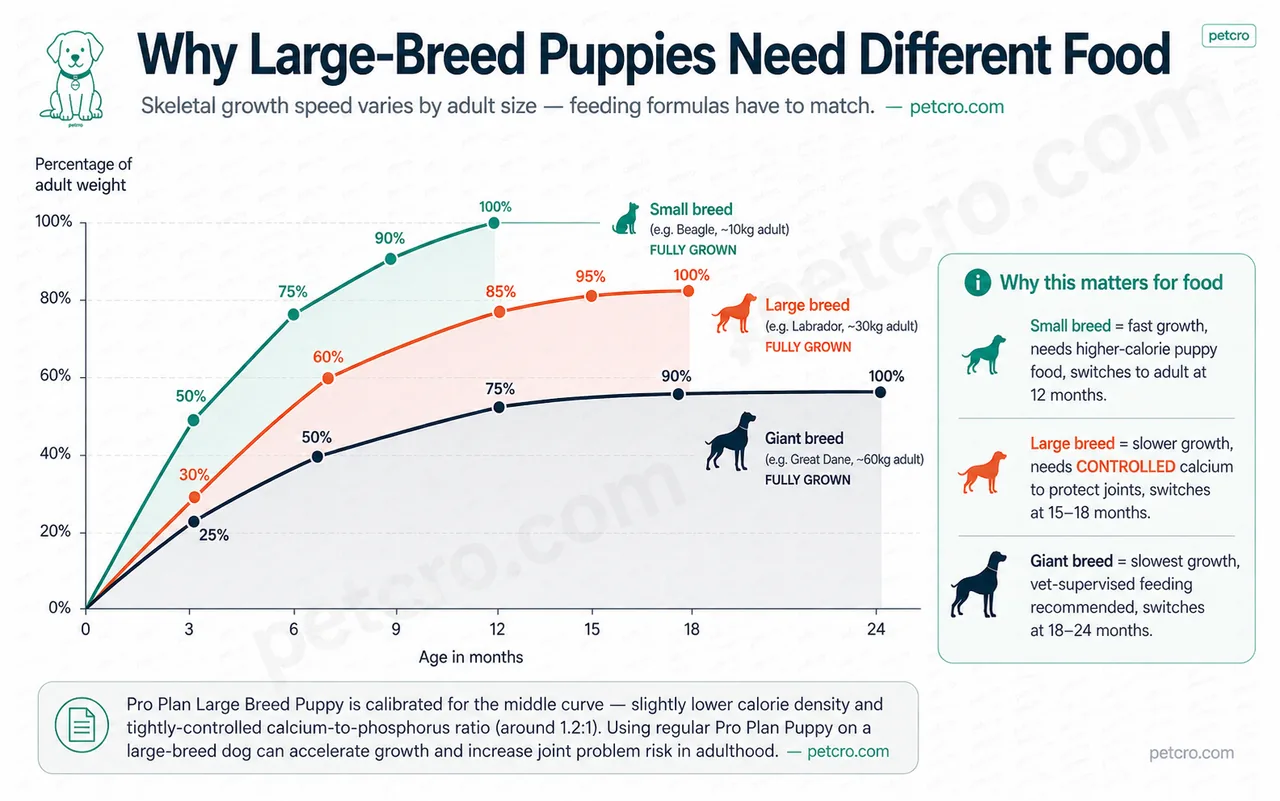
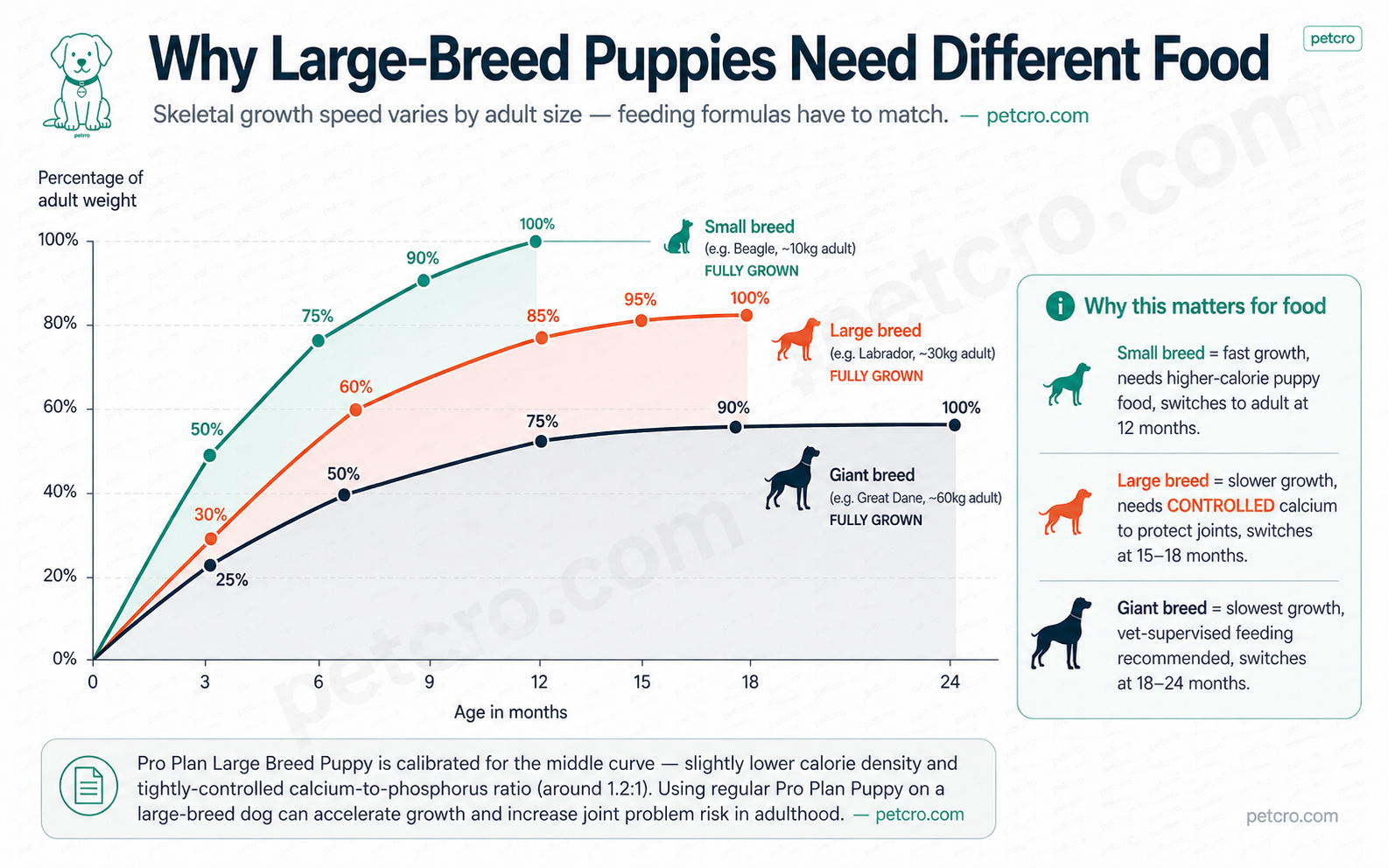
Look at the curve above. A small-breed puppy reaches 100% of adult weight at 12 months. A 30 kg Labrador is still adding bone density at 15 months. A Mastiff is still growing skeletally at 24 months.
Veterinary research is clear on what happens when you feed a large-breed puppy too much, too rich, or with too high a calcium load during the slow-growth window: rates of hip dysplasia, elbow dysplasia, and panosteitis all increase. None of these are reversible. None of them show up while you're feeding them. They show up at 3–5 years old — and by then the formula choices that contributed are 3 years in the past.
The Pro Plan Large Breed formula is calibrated against the middle curve specifically. It's the closest commercially-available answer to "feed for slow, controlled growth."
The feeding chart — Pro Plan Large Breed Puppy by weight × age
These values come directly from Pro Plan's published bag chart for the Large Breed Puppy formula (verified against the printed feeding guide on the bag). Find the row matching your puppy's expected adult weight, then look up the column for their current age. Cells show ranges — start at the lower end and adjust up if your puppy is staying lean.
By projected adult weight × current age
1 cup ≈ 106 g · 3934 kcal/kg · 419 kcal/cup
| Adult weight | 1½ – 5 months | 6 – 11 months | 12 – 20 months | 21 – 24 months |
|---|---|---|---|---|
| 50 – 75 lb (22 – 35 kg) | 1⅓ – 4⅓ cups (142 – 461 g) | 3⅔ – 5¼ cups (390 – 558 g) | 2¾ – 4⅓ cups (292 – 461 g) | 2⅔ – 4 cups (283 – 425 g) |
| 76 – 100 lb (36 – 45 kg) | 1¾ – 4⅓ cups (186 – 461 g) | 4 – 5⅔ cups (425 – 602 g) | 4 – 4¾ cups (425 – 505 g) | 4 – 4½ cups (425 – 478 g) |
| 101 – 130 lb (46 – 60 kg) | 1¾ – 5¾ cups (186 – 611 g) | 4 – 7¼ cups (425 – 771 g) | 4⅓ – 6 cups (461 – 638 g) | 4½ – 5½ cups (478 – 585 g) |
| 131 – 155 lb (61 – 70 kg) | 2⅓ – 6⅓ cups (248 – 673 g) | 5¼ – 8 cups (558 – 850 g) | 5½ – 6⅔ cups (585 – 709 g) | 5½ – 6¼ cups (585 – 664 g) |
For dogs over 155 lb / 70 kg adult weight: consider a giant-breed-specific puppy formula. Pro Plan doesn't currently have a giant-specific line in their main range, but Royal Canin Giant Breed Puppy and Eukanuba Large Breed Puppy are common alternatives. Vet input recommended for breeds projected past 70 kg adult.
About these numbers: These come directly from Pro Plan Large Breed's bag chart at 3934 kcal/kg, 419 kcal/cup. Pro Plan publishes wide cell ranges — the lower end is for puppies on the smaller side of their adult-weight band, the upper end for the larger side. For large breeds especially, erring lean is safer than chunky — over-feeding through the long growth window is a documented contributor to developmental orthopaedic disease. The Kealy 2002 Purina lifespan study found that lifelong lean feeding extended canine lifespan by ~1.8 years with reduced osteoarthritis. Always feed to body-condition-score, not to any chart — start at the lower end of each range and adjust up only if your puppy stays lean at recheck.
Meal frequency
| Age | Meals per day | Sample times |
|---|---|---|
| 2–3 months | 4 | 7am, 11am, 3pm, 7pm |
| 3–6 months | 3 | 7am, 12:30pm, 6pm |
| 6–18 months | 2 | 7am, 6pm |
Last meal at least 3 hours before bedtime to avoid overnight bathroom accidents.
Activity adjustment (the part the bag chart skips)
The bag chart assumes "moderate activity" — two daily walks, normal household play. Real puppies vary a lot.
Multiply the bag chart number by: × 0.85 for sedentary (indoor mostly, short walks, lots of crate time), × 1.0 for average (2 walks/day + normal play — the chart's assumption), × 1.15 for active (long walks, dog park, hikes most days), × 1.25 for working/sport (trained working dog — police K9, herding, agility — 4+ hours active daily).
A note on Pro Plan's chart structure: the bag's wide cell ranges already encode some activity variation — the upper end of each cell is for the more-active end of the adult-weight band, the lower end for the less-active end. Use the multipliers above as a refinement once you've picked a number inside the range.
Example: a 30 kg adult-projected, 8-month-old Lab puppy on Pro Plan Large Breed Puppy is in the 50–75 lb / 22–35 kg row at 6–11 months → 3⅔ to 5¼ cups (390 – 558 g/day). A 30 kg adult is mid-band, so start near the middle (~470 g) for moderate activity. Sedentary → 0.85× (≈400 g). Active → 1.15× (≈540 g, near the upper end). Working → 1.25× (≈585 g, edging above the range — adjust based on body condition).
The multiplier and the bag's range work together: the chart says "anywhere from 390 to 558 is reasonable for this dog at this age"; the multiplier helps you pick where in that range your specific puppy lands.
Body condition is the source of truth
Re-run the Body Condition Score check every two weeks during the large-breed puppy growth window. The target band:
- BCS 4–5 (out of 9) — ribs felt under a thin layer of fat, visible waist from above, slight belly tuck — is the goal.
- BCS 6+ — drop portion 10%, recheck in two weeks.
- BCS 3 or below — large-breed puppies should NOT be lean-thin at this age. Add 10% portion immediately and call your vet if there's no change in 7 days.
Why this matters more for large-breed puppies than small/medium: skeletal damage from over- or under-fueled growth is permanent. The portion adjustment window is small. Body condition every two weeks is non-negotiable for dogs in this category.
When to switch from Large Breed Puppy to Adult food
This is the most-asked question for Pro Plan Large Breed Puppy and the answer differs from regular Pro Plan Puppy.
| Adult weight | Switch to Pro Plan Large Breed Adult at |
|---|---|
| 25–30 kg | 15 months |
| 30–40 kg | 15–18 months |
| 40 kg+ | 18 months minimum (some breeds 24) |
Switching early — at 12 months like you would for a Beagle — under-fuels the final 3–6 months of skeletal development. Large breeds keep adding bone density past 12 months even when their height looks adult.
Run a 7–10 day gradual transition, not one meal. See our full when to switch puppy to adult food guide for the size-by-size protocol.
After switching, re-run the feeding calculator — adult dogs need roughly half the calories per kilogram of an active large-breed puppy. The bag's adult-feeding chart is your starting point, but the math changes overnight.
How Pro Plan Large Breed compares to other Pro Plan formulas
If you're not sure you're on the right one:
- Regular Pro Plan Puppy — small/medium adult size (under 25 kg). Higher calcium, slightly higher calorie density. Wrong for large-breed puppies.
- Pro Plan Large Breed Puppy — adult size 25–40 kg. The formula this article is about. Controlled calcium, slower-growth calibration.
- Pro Plan Sport Puppy — high-drive working puppies regardless of size, 4+ hours active daily. Higher protein and fat. Use only if your puppy is genuinely working / training intensively.
- Pro Plan Sensitive Skin & Stomach Puppy — for puppies with food sensitivities, allergies, or chronic loose stool. Available in Large Breed sub-variant if needed.
For the formula picker visualization and a side-by-side comparison, see our main Pro Plan Puppy feeding chart guide.
This guide is general guidance, not veterinary advice. For your specific dog's nutrition, health, or behavior needs, consult your veterinarian.
Frequently asked questions
How much Pro Plan Large Breed Puppy should I feed a Labrador?
For a Lab projected at 30 kg / ~66 lb adult weight (mid-band of the 50–75 lb / 22–35 kg row), per the bag chart: 1⅓–4⅓ cups (142–461 g) at 1½–5 months, 3⅔–5¼ cups (390–558 g) at 6–11 months, 2¾–4⅓ cups (292–461 g) at 12–20 months, 2⅔–4 cups (283–425 g) at 21–24 months. Mid-band Labs typically land in the middle of each range. Adjust ±15% for activity level (see the activity multipliers above). Run the feeding calculator for a more precise number.
Can I switch from regular Pro Plan Puppy to Pro Plan Large Breed Puppy mid-puppyhood?
Yes — and you should if you've realised your puppy is going to be 25 kg+. Run a 7–10 day gradual transition. Best time to make the switch is between 4–6 months, before peak skeletal growth.
Is Pro Plan Large Breed Puppy worth the price difference vs cheaper large-breed puppy foods?
The calcium-control and joint-precursor benefits are real, but they're not unique to Pro Plan. Royal Canin Large Breed Puppy, Hill's Science Diet Large Breed Puppy, Eukanuba Large Breed Puppy, and others target the same growth-curve specs. Within that bracket, Pro Plan is mid-priced. The bigger difference is between premium large-breed puppy formulas (Pro Plan, RC, Hill's) and budget brands (Beneful, Pedigree) — the budget brands often don't have the calcium-control specs at all.
Can my puppy eat Pro Plan Large Breed Adult instead while still a puppy?
No. Adult formulas have different calcium ratios and lower DHA. A still-growing large-breed puppy on adult food shorts the final months of skeletal development.
How long can I keep my dog on Pro Plan Large Breed Puppy?
Until 15–18 months for most breeds, 18–24 months for the largest large-breeds (closer to giant). Switching too late causes weight gain — adult dogs need fewer calories per kg.
Does Pro Plan Large Breed Puppy require supplements?
No, and you should NOT add calcium or joint supplements on top of it. The formula is balanced. Adding more calcium can take you over the safe ratio and cause the exact problem the formula prevents. The only supplement many vets endorse is fish oil for coat — and even that is rarely necessary if the puppy is on a complete formula.
My puppy isn't eating the Pro Plan Large Breed Puppy I've been feeding. Why?
Common reasons: stale bag (smell-check it), teething (4–6 months — soak the kibble in warm water), recent vaccination (off-food for 12–24 hours is normal), or simply not being hungry. If refusal lasts more than 24 hours and the puppy isn't acting normal, see our puppy not eating but acting normal guide.
TL;DR — the Pro Plan Large Breed Puppy cheat sheet
- For puppies projected to 25–40 kg adult weight (Labs, Goldens, GSDs, Boxers, Dobermans)
- Calcium ratio is the formula's central feature — protects developing joints
- Don't switch to adult food at 12 months — large breeds keep growing past then
- Real switch window: 15 months for the smaller end (25–30 kg), 18+ months for the larger end (40 kg+)
- Body condition every 2 weeks during the puppy growth window — non-negotiable
- Activity adjustment is −15% (sedentary) to +25% (working/sport) on top of the bag chart
- Don't add calcium or joint supplements on top — the formula is already balanced
Get the formula and the portion right between 4 months and 18 months, and you've protected your dog's skeleton for the next 12 years. The chart is the easy part. The discipline is the hard part — body condition checks and resisting the temptation to give "just a bit more."
Sources & further reading
- Purina Pro Plan official feeding guides (UK) — manufacturer's published feeding charts and full ingredient lists.
- WSAVA Global Nutrition Guidelines — international veterinary standard for puppy energy needs and large-breed-specific calcium recommendations.
- AAFCO Dog Food Nutrient Profiles — regulatory baseline for "complete and balanced for growth (large size, 70+ lb)."
- Tufts Petfoodology: Feeding the large-breed puppy — vet-nutritionist guidance on calcium-ratio specifics.
- Merck Veterinary Manual: Dog Owners' Edition — independent veterinary reference covering large-breed puppy growth-rate management and developmental orthopaedic disease.
If your large-breed puppy has been diagnosed with a developmental orthopaedic condition, follow your vet's specific feeding plan — that overrides any commercial chart, including this one.
More from Petcro's puppy nutrition cluster
- How Much to Feed a Puppy — the underlying calorie formula every brand chart is calibrated to.
- Purina Pro Plan Puppy Feeding Chart — the regular Pro Plan formulas (small to medium adult size).
- When to Switch Your Puppy to Adult Food — full transition timing by adult size.
- Feeding calculator — exact gram count for your specific puppy in 30 seconds.
Petcro is reader-supported. We may earn an affiliate commission when you click through links to products in this guide. Our editorial picks are independent of any commercial relationship with Purina or any other brand.