Puppy Proofing Your Home (Room-by-Room Checklist)
Puppy proofing your home — room-by-room hazards, the puppy's-eye-view crawl method, toxic foods + plants, cord and gate setup, and what to actually buy.

Puppy proofing your home is the 2–3 hour job you do before pickup day so the first month isn't a series of vet bills and ruined shoes. Get on hands and knees in every room the puppy will access, fix what they can chew or swallow, and gate off everywhere else.
TL;DR: You don't need to puppy-proof the whole house — make two zones safe (sleep area + day area) and gate off the rest. The fastest method is the puppy's-eye-view crawl: get on hands and knees in each room and look at what's reachable. Top hazards by ASPCA call frequency: human medications (#1), toxic foods on counters (chocolate, grapes, raisins, xylitol gum), houseplants, household chemicals, electrical cords, swallowed objects (socks, hair ties, kids' toys). Spend $100–150 on baby gates + cord covers + cabinet latches + lidded trash + medication storage and you'll prevent most of the first-year incidents owners associate with puppies.
The puppy's-eye-view crawl — the only method that works
Standing-up puppy proofing misses things. The fastest, most thorough method is simple: get on the floor on hands and knees and look around at puppy height. You'll see what they see: power cords running behind sofas, raisins under the dining table, a hair tie kicked under a dresser, a charging cable dangling off the bedside table.
Do the crawl in every room the puppy will access. Fix what's reachable; gate off everything else. Most owners try to puppy-proof the entire house — don't. Two zones is the realistic target for puppy proofing your home: where the crate lives, and where the daytime supervision happens (typically the kitchen + one adjacent living space). The rest gets baby-gated until the puppy is 6+ months old and reliably trained. The American Kennel Club's puppy proofing guide takes the same two-zone-and-crawl approach.
The supply-list companion to this room-by-room view is in the new puppy checklist.
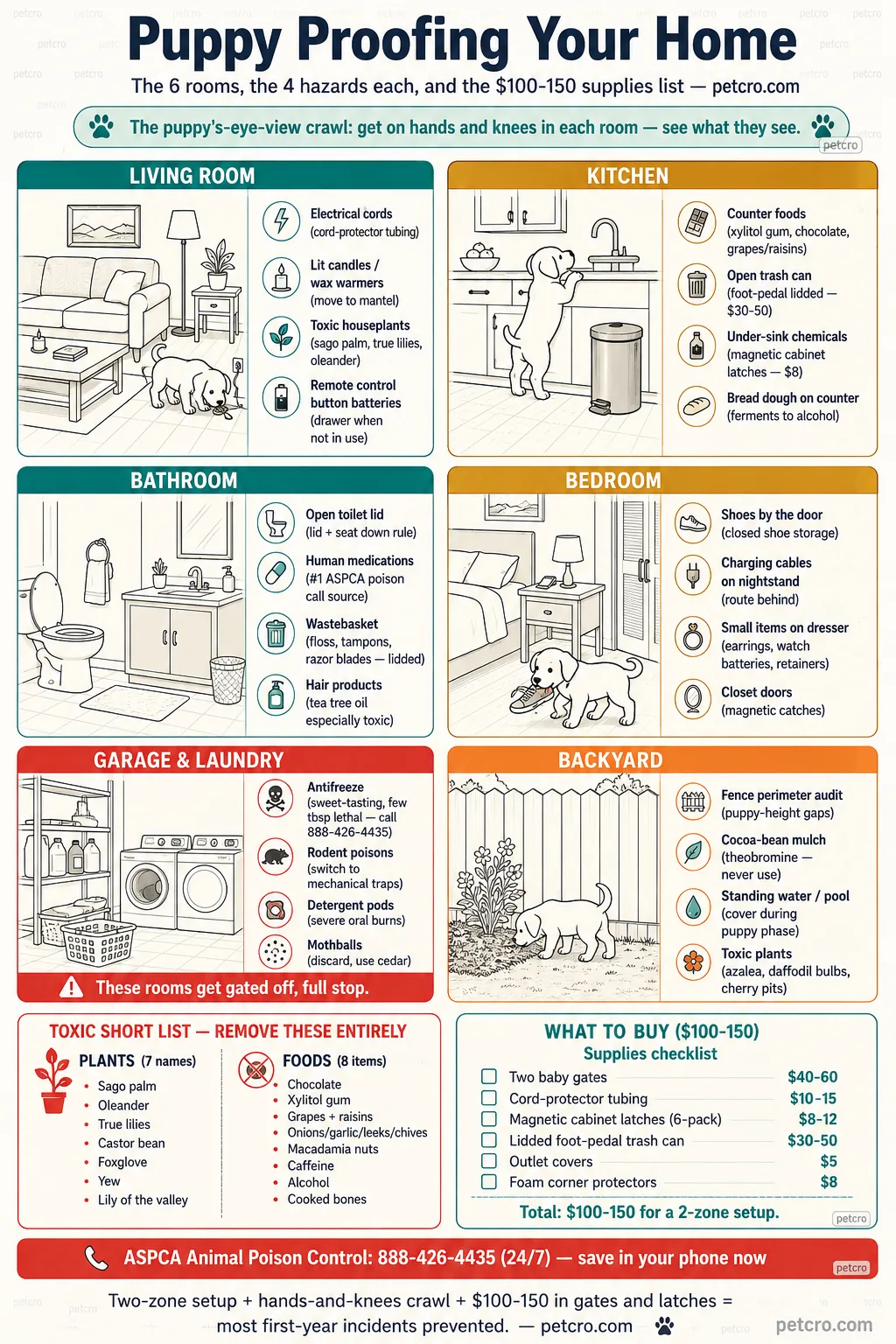
Living room — cords, candles, and the coffee-table zone
The living room is where most puppies spend their supervised free time, so it's the highest-priority room.
The big hazards (in order of how often they cause vet visits):
Electrical cords running along baseboards or behind furniture. Cord chewing is one of the most common puppy-proofing failure modes — burns, oral lacerations, occasional electrocution. Cord-protector tubing ($10-15) wrapped around any reachable cord, plus unplug at the wall when you're not in the room.
Lit candles or wax warmers. Wagging tails knock them over. Move to mantel height or switch to flameless LED for the first 6 months.
Houseplants on side tables and the floor. Many common houseplants are mildly toxic (pothos, philodendron, peace lily, aloe vera). A few are severely dangerous (sago palm, true lilies, oleander). Move out of reach or rehome the dangerous ones — full cull list in the toxic plants section below.
Remote controls + game controllers. Button batteries inside cause severe esophageal burns if swallowed.
Tasselled throws and decor pillows. Tassels swallowed → linear-foreign-body obstruction. Move out of reach.
Sharp furniture corners at puppy head-height. Foam corner protectors ($8 for a pack of 8) — cheap insurance, especially for glass coffee tables.
Kitchen — counters, cabinets, and the trash can
The kitchen is hazard-dense (food, cleaning supplies, trash) and usually the primary daytime zone — must be fully puppy-proofed.
Counter surfing. A 4-month-old large-breed puppy can already reach a kitchen counter on their hind legs. The fix isn't training — it's keeping food off the counter when you're not there. Bread, butter, fruit bowls, chocolate bars in shopping bags — all go into cabinets the moment you're done. Counter surfing rewarded once is a behavior that lasts for years.
The trash can. A foot-pedal lidded can is the single best puppy-proofing investment in the kitchen — $30-50 for a stainless model. Open trash cans are a buffet of toxic and obstruction-causing items (chicken bones, corn cobs, onion skins, foil with food residue, plastic bags).
Under-sink cabinet. Where most cleaning chemicals live. Bleach, drain cleaner, dishwasher pods, oven cleaner — all toxic, several caustic enough to burn the mouth and throat on the first lick. Magnetic cabinet latches ($8 for a 6-pack) on all lower cabinets, not just the chemicals — puppies open everything.
Counter items that look harmless but aren't: xylitol gum/mints (a single piece can cause hypoglycemia in a 5-kg puppy; multiple pieces can cause liver failure), grapes and raisins (any quantity), chocolate, macadamia nuts, onions/garlic/leeks/chives, coffee grounds + tea bags, bread dough rising on the counter (ferments to alcohol in the stomach).
The toxic food checker covers the full list with per-weight toxicity thresholds — bookmark it on your phone for the inevitable "did the puppy eat X?" moment.
Bathroom — toilet lids, meds, and the wastebasket
Bathrooms have small footprints but high hazard density. The wastebasket alone is responsible for a meaningful share of preventable vet visits.
Toilet lid + seat down, always. Puppies fall in (small breeds), drink chemicals from automatic cleaners, play with toilet paper rolls.
Medications. Human meds are the #1 cause of pet poisoning calls to the ASPCA — ahead of food, plants, and chemicals. The dangerous list: ibuprofen and naproxen (NSAIDs cause kidney failure in dogs at common dose-equivalents), acetaminophen (Tylenol — extremely toxic), antidepressants, ADHD meds, sleep aids. Store every medication, including supplements, in a closed cabinet — never on a nightstand or counter. Pill bottles are easy to crunch open.
Bathroom wastebasket. Dental floss, tampons, applicators, razor blades, cotton balls with chemical residue — all choking, obstruction, or chemical hazards. Lidded wastebasket ($15) or one inside a closed cabinet.
Hair products + cosmetics. Many contain alcohol or essential oils (tea tree oil is especially dangerous). High shelf only.
Bathmats. Puppies chew the rubber backing and swallow chunks — both choking and intestinal-blockage risks. Roll up + store out of reach during the puppy phase.
Bedroom — shoes, charging cables, and the under-bed zone
The bedroom is usually the puppy's overnight space (crate next to your bed for the first 5-7 nights per tips on how to crate train a puppy), so the floor must be puppy-clean.
Under-bed flashlight crawl before pickup day. Socks, hair ties, charging cables, dropped earrings, pills — anything small enough to swallow is a potential obstruction surgery.
Charging cables on nightstands. Phone, smartwatch, e-reader cables — all chewable, all at puppy-head height when they stand on hind legs. Route cables behind the nightstand or use cord covers.
Shoes by the bedroom door. Chew targets ($200 of leather in 10 minutes); laces and small heel attachments are swallow risks. Closed shoe storage during the puppy phase.
Small items on dressers/nightstands. Earrings, watch batteries, pill organizers, contact lens cases, retainers — all reachable to a paw-up puppy. Keep dresser tops bare or store in drawers.
Closet doors. Shoes + laundry inside = irresistible chew zone; floors collect dust, mothballs, dropped jewelry. Magnetic door catches keep them shut.
Garage, laundry, and utility room — the high-toxicity zone
These rooms get gated off, full stop. The chemical density is too high to puppy-proof item by item. If the laundry is on a path between zones, baby-gate the doorway or keep the door fully closed.
The toxic-load list:
Antifreeze (ethylene glycol). Sweet-tasting and lethal at small doses — a few tablespoons can kill a small dog. Fix: pet-safe propylene-glycol antifreeze + immediate spill clean-up. Suspected ingestion → call the ASPCA Animal Poison Control Center (888-426-4435) immediately; this one is time-critical.
Rodent poisons. Anticoagulants, bromethalin, cholecalciferol — progressive symptoms over 1-7 days. Switch to mechanical traps during the puppy phase.
Detergent pods. Brightly colored and chewy; the concentrated detergent inside causes severe oral burns and aspiration pneumonia. High cabinet, locked.
Mothballs. Highly toxic (naphthalene or paradichlorobenzene); smell is appealing to puppies. Discard, use cedar instead.
Batteries in storage. Lithium-ion, button cells, 9V — high cabinet, never low drawer.
Hot or sharp tools — irons, soldering kit, power tools — store unplugged + out of reach.
Backyard + outdoor spaces — fence gaps, mulch, and plants
Outdoor walking is gated until after the 16-week DHPP dose per the puppy vaccination schedule chart — until then, your backyard is the only outdoor space, and it needs to be safe.
Fence perimeter audit at puppy height. Walk the line looking for gaps under fences, broken slats, gates that don't latch firmly, decorative fences with horizontal rails (a ladder). A 4-month-old puppy fits through smaller gaps than you'd expect.
Mulch matters. Cocoa-bean mulch contains theobromine (same as chocolate) — never use it. Pine bark + hardwood are safer. Avoid rubber-tire mulch — chunks get chewed and swallowed.
Standing water + swimming pools. Birdbaths, ponds, pool steps — drowning risks for puppies who can't yet climb out. Pool cover during the puppy phase, or never unsupervised access.
Toxic outdoor plants to remove or fence off: sago palm (often fatal even with treatment), oleander, azalea + rhododendron, yew, foxglove, lily of the valley, daffodil + tulip bulbs, cherry/peach/apricot pits.
The ASPCA's toxic plants database is searchable and includes images — worth a 10-minute audit of your yard before pickup day.
Toxic plants and foods — the short dangerous list
You don't need to memorize every toxic plant and food for puppy proofing your home. You need to know the handful that cause severe or fatal outcomes and remove those entirely; the mildly-toxic plants and foods can stay if relocated out of reach.
Severe-to-fatal plants — remove from the home:
Sago palm — sold as houseplant in warm climates; often fatal even with treatment
Oleander — cardiac toxin
True lilies (Lilium, Hemerocallis) — severe in cats; GI upset and rare kidney effects in dogs
Castor bean / ricin plant — contains ricin
Foxglove, yew, lily of the valley — cardiac glycosides; toxic at small doses
Common houseplants that cause vomiting, drooling, or oral irritation but rarely worse (move to heights the puppy can't reach):
Pothos, philodendron, peace lily, dieffenbachia (dumb cane), snake plant, ZZ plant, monstera, English ivy, aloe vera
The toxic-foods short list — household items behind most puppy poisoning calls:
Chocolate (especially dark and baking)
Xylitol (sugar-free gum, mints, peanut butter, baked goods)
Grapes + raisins (any quantity)
Onions, garlic, leeks, chives (cooked or raw)
Macadamia nuts, caffeine, alcohol (including rising bread dough)
Cooked bones (splinter, GI perforation)
Avocado pits + skin, cherry/peach/apricot pits
Bookmark the toxic food checker on your phone — when you walk in on the puppy chewing something questionable, the answer needs to be 30 seconds away. The Merck Veterinary Manual's household hazards chapter covers the full toxicology if you want depth.
The underrated swallowable list — anything smaller than the puppy's mouth opening is a potential foreign-body obstruction. Top offenders: hair ties, socks, coins, Lego pieces, bottle caps, earrings, sewing needles, rubber bands, button batteries (watch / hearing aid / key fob — these cause severe esophageal burns within hours of ingestion). If a puppy swallows something obstruction-sized and starts vomiting + refusing food, that's an ER visit. See puppy not eating but acting normal for the decision tree.
The puppy proofing supplies list — what to actually buy
For roughly $100-150 you can fully equip puppy proofing your home for a 2-zone setup (slightly more if you add the optional toilet lock and stair gate):
Item | Purpose | Cost |
|---|---|---|
Two baby gates | Block off the puppy-proofed zones from the rest of the house | $20-30 each |
Cord-protector tubing | Wrap any accessible electrical cord | $10-15 for 10-ft pack |
Magnetic cabinet latches (6-pack) | All lower cabinets, especially under-sink | $8-12 |
Lidded foot-pedal trash can | Kitchen trash, ideally stainless steel | $30-50 |
Toilet seat lock (optional, for households with kids) | Backup for "lid down" rule | $10 |
Outlet covers | Empty wall outlets (chewing risk) | $5 for 24-pack |
Foam corner protectors | Coffee table corners + low furniture edges | $8 for 8-pack |
Pet gate for stairs (if applicable) | Top + bottom of stairs for breeds prone to joint injury | $30-40 |
The single biggest impact item is the baby gates — they let you puppy-proof two zones thoroughly instead of trying to puppy-proof the whole house badly. Detailed gear walk-through with sizing notes is in the new puppy checklist.
📥 Tick items off as you buy them — the interactive new puppy checklist tool lets you save state across visits and email yourself a printable PDF.
When can you relax the puppy proofing?
Not a single date — a gradual relaxation over 4-12 months as the puppy matures and earns trust:
0-4 months — full puppy-proofing in the 2 zones. No unsupervised access elsewhere.
4-6 months — adolescence begins, teething peaks. Don't relax yet.
6-9 months — start expanding accessible zones one room at a time.
9-18 months — many "trustworthy" 1-year-old dogs regress unpredictably; keep cord covers + cabinet latches in place.
18 months+ — most dogs can be trusted in a normal setup, except food-motivated breeds (Labradors, Beagles, most terrier breeds) who remain counter-surfing for life.
The cord covers, cabinet latches, and outlet covers are cheap insurance — keep them even when the puppy "doesn't need them anymore." A bored adult dog reverts to puppy behavior on a stressful day.
This guide is general guidance, not veterinary advice. For your specific dog's nutrition, health, or behavior needs, consult your veterinarian.
If you suspect ingestion of anything toxic, call your vet, the ASPCA Animal Poison Control Center (888-426-4435), or the Pet Poison Helpline (855-764-7661) immediately.
Frequently asked questions
How long does puppy proofing your home take?
For a typical 2-zone setup, plan on 2-3 hours of active work: 1 hour for the puppy's-eye-view crawl + hazard removal, 1 hour for baby gates and cabinet latches, 30 minutes for supplies shopping. Best done 3-5 days before pickup.
Do I have to puppy proof every room?
No. Realistically puppy-proof two zones: the crate-and-sleep area + the daytime supervised area (typically kitchen + adjacent living space). The rest gets baby-gated until the puppy is 6+ months old. Trying to puppy-proof the whole house from day 1 misses the higher-impact moves (gates, cord covers, lockable trash).
What's the single biggest puppy proofing mistake?
Underestimating electrical cords. Cord chewing causes more vet-visit-worthy injuries than most owners expect — burns, oral lacerations, occasional electrocution. The fix is trivial: $10-15 of cord-protector tubing wrapped around every reachable cord, plus unplugging at the wall when you're not in the room. Most owners don't think about cords until after an incident.
Is it OK to use a playpen instead of baby gates?
Yes for very young puppies (8-10 weeks). A playpen creates a defined zone larger than a crate but smaller than a gated room. By 12-14 weeks most puppies need a bigger zone, and baby gates become the better setup. Playpen + gates together also work — playpen attached to the crate as a daytime "apartment."
How do I know which houseplants to remove?
Cross-check your plants against the ASPCA toxic plants database, which is searchable by plant name and includes images. The severe-to-fatal list (sago palm, oleander, true lilies, castor bean, foxglove, yew, lily of the valley) should be removed from the home entirely. The mildly-toxic-but-common list (pothos, philodendron, peace lily, dieffenbachia, ivy) can stay if relocated to heights the puppy can't reach.
My puppy ate something — when is it an emergency?
If they ingested any quantity of: chocolate (especially dark or baker's), grapes or raisins, xylitol, antifreeze, rodent bait, medications, or a known toxic plant — call the ASPCA Animal Poison Control Center (888-426-4435) or your emergency vet immediately. Don't wait for symptoms. For non-toxic swallowed objects (sock, toy, hair tie), watch for vomiting + refusing food + lethargy; those three together = ER visit. See puppy not eating but acting normal for a detailed decision tree.
Do I need to puppy proof for an older rescue dog?
Less aggressively, but yes — especially for the first 2-4 weeks while you learn their habits. Stress-chewing during transition is common. Run the puppy's-eye-view crawl once on arrival, gate off rooms you don't want them in, and watch for 2 weeks before relaxing.
TL;DR — the puppy proofing checklist cheat sheet
Puppy proofing your home in 7 bullets:
Two zones, not the whole house — crate area + daytime supervised area; baby-gate the rest
Hands-and-knees crawl every room — see what the puppy sees
Top 5 fixes in order: cord covers + cabinet latches + lidded trash + baby gates + medication storage
The toxic-food short list: chocolate, xylitol, grapes/raisins, onions/garlic, macadamia, caffeine, alcohol, cooked bones
The severe-toxic-plant short list: sago palm, oleander, true lilies, castor bean, foxglove, yew, lily of the valley — remove from the home
ASPCA Animal Poison Control: 888-426-4435 (save in phone now)
Relax the proofing slowly from 6 months on, not all at once
Two to three hours of puppy proofing your home now prevents most of the first-year vet bills people associate with puppies.
Sources & further reading
ASPCA Animal Poison Control Center — 24/7 toxicology hotline (888-426-4435) and the canonical reference for what's toxic to dogs.
ASPCA Toxic and Non-Toxic Plants Database — searchable plant-by-plant reference with images.
American Kennel Club — Puppy-Proofing Tips for Your Home and Yard — kennel-club owner-facing guide to room-by-room puppy proofing.
Merck Veterinary Manual — Household Hazards — vet-reference chapter on indoor toxicology.
Cornell Riney Canine Health Center — academic reference for canine behavior and health research.
More from Petcro's puppy training cluster
New Puppy Checklist (The Actually Useful Version) — the supply-list companion to this room-by-room guide; what to buy before puppy day 1.
Tips on how to crate train a puppy — crate placement (next to your bed for 5-7 nights) ties directly to which zone you puppy-proof first.
Puppy Vaccination Schedule Chart — the 16-week vaccination gate that determines when outdoor exploration becomes safe.
Interactive new puppy checklist tool — tick items off as you buy them, with a personalised printable PDF.
Petcro is reader-supported. We may earn an affiliate commission when you click through links to products in this guide. Our editorial picks are independent of any commercial relationship with any brand mentioned.