Puppy Vaccination Schedule Chart (Printable Timeline by Age)
Printable puppy vaccination schedule chart by age — DHPP, rabies, Bordetella, Lepto. WSAVA + Merck Vet Manual aligned. With visit-by-visit guide.
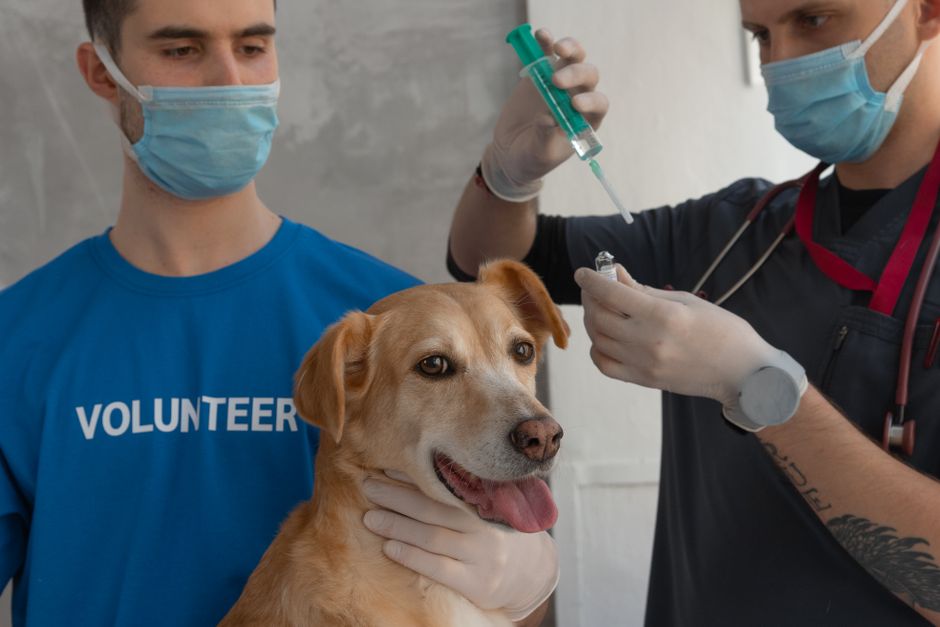
A puppy vaccination schedule chart maps three rounds of DHPP shots between 6 and 16 weeks, the rabies vaccine at the final puppy visit, and the lifestyle vaccines a vet recommends based on where the puppy lives. Most puppies finish their primary series by 16 weeks, get a 1-year booster, then move to a 1–3 year cadence as adults.
TL;DR: Three DHPP doses between 6 and 16 weeks, rabies at the last puppy visit, then a booster at 1 year. The dose that matters most is the 16-week one — that's when maternal antibodies have faded enough for the vaccine to actually take. Skip the optional shots (Bordetella, Lepto, Lyme) only if your puppy genuinely won't see kennels, dog parks, or wildlife. Most US puppies should get all three, plus monthly heartworm and flea/tick prevention from 8 weeks for life.
The puppy vaccination schedule at a glance
The chart below shows the typical schedule for a US puppy. The exact dates shift slightly by state law (rabies), local disease pressure (Lepto, Lyme), and your vet's specific protocol. Use it as a planning tool, not a substitute for your clinic's calendar.
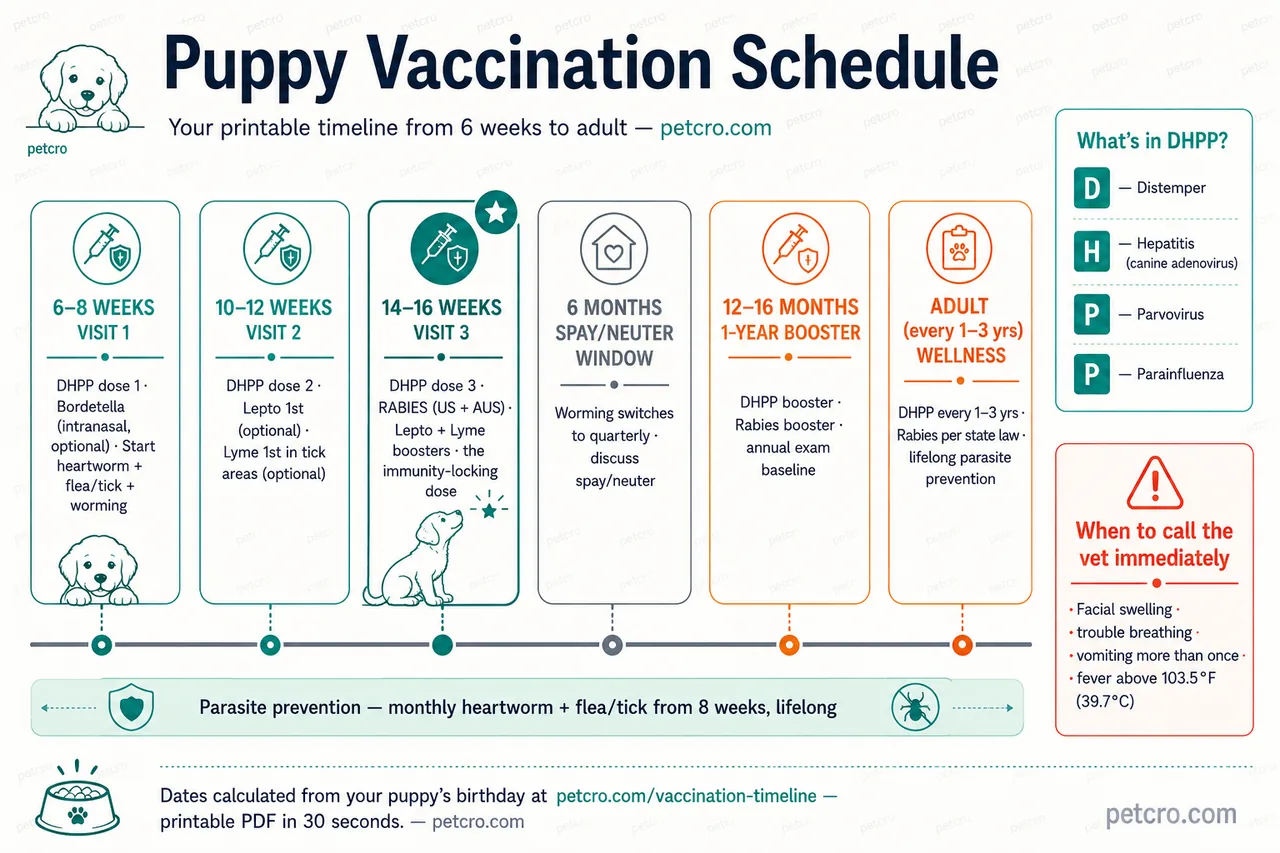
| Age | Visit | Core vaccines | Optional / lifestyle | Parasite prevention |
|---|---|---|---|---|
| 6–8 weeks | 1st | DHPP (1st dose) | Bordetella (if puppy class or boarding) | Start monthly heartworm + flea/tick. Worming every 2 weeks. |
| 10–12 weeks | 2nd | DHPP (2nd dose) | Leptospirosis (1st), Lyme (1st in tick areas) | Continue monthly preventatives. Worming every 2 weeks until 12 weeks. |
| 14–16 weeks | 3rd | DHPP (3rd dose); Rabies (US + AUS) | Lepto (2nd, booster); Lyme (2nd) | Continue monthly. Worming switches to monthly. |
| 6 months | Spay/neuter window | — | — | Worming switches to quarterly. |
| 12–16 months | 1-year booster | DHPP booster; Rabies booster | Annual booster for any optional already given | Continue lifelong monthly preventatives. |
| Adult (every 1–3 years) | Wellness | DHPP every 1–3 years; Rabies every 1–3 years per state law | Annual booster if lifestyle still applies | Lifelong. |
DHPP stands for Distemper, Hepatitis (canine adenovirus), Parvovirus, Parainfluenza — the four diseases bundled into the standard core combo most US vets administer. Some clinics use "DAPP" or "DA2PP" on the label; it's the same shot.
📥 Want a date-precise version for your puppy? Enter your puppy's birthday in our vaccination timeline tool — it generates a printable PDF with every due date calculated to the day, and works for US, UK, and Australian schedules.
What core vaccines does every puppy need?
Core vaccines are the ones every dog should get regardless of lifestyle. The WSAVA Vaccination Guidelines and the Merck Veterinary Manual both list them as non-negotiable: DHPP plus rabies.
DHPP — three doses, 6 to 16 weeks
The reason it's three doses (not one) is maternal antibodies. Puppies are born with antibodies passed from their mother that protect them for roughly 6 to 16 weeks but also block any vaccine given during that window. Vets can't predict exactly when a given puppy's maternal antibodies will fade, so they vaccinate every 3–4 weeks until at least 16 weeks. That guarantees at least one dose lands after maternal antibodies are gone.
The single most important dose is the 16-week one. Many parvo cases in US emergency clinics involve puppies whose owners "got behind" on the third shot — losing weeks of building immunity at exactly the age the disease hits hardest. The full 7-symptom progression and the 48-72 hour critical window are in our parvo symptoms guide.
Rabies — once, around 14–16 weeks
Rabies is required by law in every US state and across Australia. The first dose typically goes in at the 14–16 week visit (some states mandate ≥12 weeks; check your state). Then a 1-year booster, then every 1–3 years depending on the vaccine product and your state's rabies law.
The UK does not require rabies for dogs that won't travel internationally. Australia requires it on a federal cadence rather than US-style state law — confirm with your local vet.
Which optional vaccines should my puppy get?
"Optional" doesn't mean unimportant — it means the answer depends on what your puppy will actually do. Three lifestyle vaccines come up at almost every puppy visit:
Bordetella (kennel cough) — recommended if your puppy will go to puppy classes, boarding, grooming, or dog parks. Most facilities require it. Given as early as 6–8 weeks (intranasal) or 10–12 weeks (injectable). Boosted annually.
Leptospirosis — bacterial infection spread through wildlife urine in standing water. The ASPCA pet vaccinations guide recommends it for dogs near rivers, lakes, ponds, hiking trails, or anywhere with raccoons, skunks, or rodents. That's most of the US. Two-dose primary series at 12 and 16 weeks, then annually.
Lyme disease — tick-borne. Recommended in the Northeast, upper Midwest, and parts of the West Coast where deer ticks are endemic. Two-dose primary series, then annually. Cornell's Riney Canine Health Center is the academic reference for canine Lyme research in the US.
Canine influenza and rattlesnake toxoid — niche. Discuss with your vet if you board your puppy in influenza-active regions or live in rattlesnake country.
A simple decision rule: if the puppy will ever leave your house and yard, give Bordetella and Lepto. Add Lyme if you live where ticks are. Skip the rest unless your vet gives a specific local reason.
Parasite prevention timeline
Parasite preventatives aren't vaccines but they belong on the same chart because they share the puppy's first vet visit and run on a monthly cadence for life.
| Preventative | Start | Cadence |
|---|---|---|
| Heartworm | 8 weeks | Monthly, lifelong. Don't skip — heartworm treatment for an adult dog is brutal and expensive. |
| Flea & tick | 8 weeks | Monthly, lifelong. Use a puppy-safe product; some adult formulations are toxic under 8 weeks or 1.5 kg. |
| Worming (deworming) | 6–8 weeks | Every 2 weeks until 12 weeks → monthly until 6 months → quarterly for life. |
The AKC puppy shots guide covers parasite-prevention timing alongside the vaccine schedule, and your vet's puppy package usually bundles all three.
Puppies are born with roundworms transmitted through the placenta, so even a "clean" litter is dewormed every two weeks from 6 weeks. That's normal, not a sign anything is wrong.
What to expect at each vet visit
Three puppy visits, plus a 1-year booster. Each runs roughly 30 minutes and costs $80–250 depending on what's included.
Visit 1 — 6 to 8 weeks (often done by the breeder/shelter)
- Full physical exam — eyes, ears, heart, hips, dental
- DHPP dose 1
- First fecal test (worms)
- Worming dose
- Heartworm + flea/tick prevention starts
- Microchip (commonly here, sometimes at visit 2)
Visit 2 — 10 to 12 weeks
- Repeat physical
- DHPP dose 2
- First Lepto + Lyme if recommended
- Bordetella if needed for puppy class
- Continue monthly preventatives
Visit 3 — 14 to 16 weeks
- Repeat physical
- DHPP dose 3 (the critical one)
- Rabies (US + AUS)
- Lepto + Lyme boosters
- Discuss spay/neuter timing
1-year booster — 12 to 16 months
- DHPP booster + rabies booster
- Annual exam baseline
- Heartworm test (post puppy-prevention)
- Switch to adult food if you haven't already — see our puppy-to-adult-food guide
If your puppy seems off after a visit — quieter than usual, sleepy, off food for 12–24 hours — that's normal. We cover the post-vaccine appetite drop in detail in puppy not eating but acting normal.
When can my puppy meet other dogs and go outside?
This is where parents get the most contradictory advice. The two real risks are:
- Parvo and distemper in unvaccinated environments (dog parks, pet stores, sidewalks frequented by other dogs) before the 16-week dose locks in immunity.
- Under-socialization if you keep the puppy isolated until 16 weeks, missing the critical socialization window that closes around 12–14 weeks.
The American Veterinary Society of Animal Behavior (AVSAB) position statement, which the Merck Vet Manual cites, recommends starting structured socialization classes once the puppy has had its first DHPP dose plus a 7-day waiting period — so roughly 8–9 weeks at the earliest. Safe socialization at this age means:
- Puppy classes that require proof of vaccinations from all attendees
- Friends' homes with vaccinated, healthy adult dogs
- Carrying the puppy in busy human environments (vet office floor and pet-store floor are the two highest-risk surfaces — keep your puppy off both)
Avoid until after the 16-week dose: dog parks, sidewalks heavily used by other dogs, pet store floors, kennels.
This is the same gate that determines when crate-training expands to outdoor potty trips — see tips on how to crate train a puppy for the routine that bridges the puppy's first weeks home.
Common side effects after vaccination
Most puppies have a mild reaction in the 24 hours after each visit. Normal:
- Lethargy and extra sleep — the immune system is working. They'll bounce back the next morning.
- Off food for 12–24 hours — especially after the first few rounds. Don't try to make it up the next day with a double portion. Resume the normal feeding schedule when appetite returns.
- Mild soreness at the injection site — handle gently; don't manipulate the spot.
- Low-grade fever (under 103.5°F / 39.7°C) — typical for 24 hours.
Call the vet within an hour for any of these:
- Vomiting more than once, or persistent diarrhea
- Facial swelling, hives, or trouble breathing — possible anaphylaxis (rare but treatable if caught fast)
- Fever above 103.5°F that doesn't resolve in 24 hours
- Collapse, severe lethargy where the puppy won't engage at all
Anaphylaxis is rare — under 1 in 1,000 vaccinations in published veterinary research — but it's an emergency. If you've had a reactive puppy on a previous dose, your vet may pre-medicate with antihistamine before the next visit, or split optional vaccines onto separate days.
This guide is general guidance, not veterinary advice. For your specific dog's nutrition, health, or behavior needs, consult your veterinarian.
Frequently asked questions
What is the cheapest way to vaccinate a puppy?
Low-cost vaccination clinics run by humane societies and PetSmart Banfield typically charge $25–50 per core vaccine versus $50–120 at a private clinic. Tractor Supply hosts mobile vet clinics in many states for under $30 per shot. The catch: these don't include a full physical exam, and the rabies certificate may need a separate $20–35 visit. For a healthy puppy with no concerns, low-cost clinics are fine. For a puppy with any health issue, pay for the full clinic.
Can I vaccinate my puppy at home?
You can buy DHPP from feed stores in many US states for $10–15 a dose and administer it yourself. We don't recommend it for first-time owners — handling, storage temperature, and injection technique all matter, and a vet visit also catches early problems (heart murmurs, hernias, eye issues) you'd miss at home. Rabies must always be administered by a licensed vet because the certificate has legal weight for licensing, travel, and bite incidents.
What happens if I miss a puppy vaccination?
If the gap exceeds 6 weeks between doses, the WSAVA guidelines recommend restarting the series — not just resuming where you left off. The earlier doses no longer count toward immunity. If you're 1–3 weeks late, your vet will usually just give the next scheduled dose. The cost of restarting is real (extra $80–250), but skipping is worse — parvo treatment runs $1,500–4,500 if your puppy survives.
At what age should a puppy get a rabies shot?
Most US states require rabies between 12 and 16 weeks of age, with most vets giving it at the 14–16 week visit alongside the third DHPP dose. State rules vary — check your state's animal control or department of health website. The first rabies dose is good for one year regardless of vaccine product; the booster at 1 year may be 1-year or 3-year depending on which vaccine your vet uses.
Does my puppy need the Lyme vaccine?
Only if you live where deer ticks are common — primarily the Northeast, upper Midwest, and parts of the Pacific Coast. The CDC tick maps published at cdc.gov are the cleanest reference. If you're in Texas, the Southeast outside North Carolina, or most of the West, your vet probably won't push it. Tick prevention with a monthly product matters more than the vaccine in any region.
How much do puppy shots cost in total?
Roughly $250–700 for the full first-year series at a private clinic, or $150–400 at low-cost clinics. That includes three puppy visits, the 1-year booster, parasite tests, and the first 12 months of heartworm and flea/tick prevention. Pet insurance generally doesn't cover routine vaccines but a "wellness add-on" plan often does — check before buying.
Can a puppy get sick from a vaccine?
Mild post-vaccine effects (lethargy, off food for 12–24 hours, low fever) are common — many owners notice some sign in the day after each visit, and they resolve on their own within 24 hours. A serious reaction (vomiting, facial swelling, anaphylaxis) is under 1 in 1,000 in published veterinary research. The vaccine itself can't cause the disease it's preventing — modified-live vaccines are too attenuated. If your puppy was already incubating parvo or distemper before the shot, symptoms may show within days, but the vaccine didn't cause it.
TL;DR — the puppy vaccination schedule cheat sheet
- Three DHPP doses between 6 and 16 weeks; the 16-week dose is the one that matters most
- Rabies at 14–16 weeks (US + AUS) — required by law in all US states
- Optional vaccines (Bordetella, Lepto, Lyme) belong on the schedule for almost every US puppy
- Parasite prevention starts at 8 weeks and runs lifelong — heartworm is the non-negotiable
- Socialization begins after dose 2 + 7 days, but stay off dog parks and pet store floors until after 16 weeks
- Off food for 12–24 hours after a visit is normal; vomiting or facial swelling is an emergency
- Skipping is more expensive than vaccinating — parvo treatment runs $1,500–4,500 if it works
Print this chart, stick it on the fridge, and bring it to every vet visit until your puppy hits the 1-year booster.
Sources & further reading
- WSAVA Vaccination Guidelines — global core/non-core framework used by most veterinary schools.
- Merck Veterinary Manual — Routine Health Care of Dogs — the comprehensive owner reference, including vaccination.
- ASPCA — Vaccinations for Your Pet — owner-friendly summary of core and lifestyle shots.
- AKC Puppy Shots Complete Guide — visit-by-visit breakdown with cost ranges.
- CDC — About Rabies — US public-health authority on rabies and animal vaccination.
- Cornell Riney Canine Health Center — academic research on canine vaccine science and emerging diseases.
If your puppy has a history of vaccine reaction, an immune-mediated condition, or a vet-prescribed atypical schedule, follow your vet's protocol — not this chart.
More from Petcro's new puppy onboarding cluster
- How much to feed a puppy — the puppy-nutrition pillar covering portions, kcal, and the switch to adult food.
- Puppy not eating but acting normal — the post-vaccine appetite-drop guide and when to call the vet.
- Tips on how to crate train a puppy — the routine for the first weeks home, before the 16-week socialization gate opens.
- Vaccination timeline tool — date-precise schedule calculated from your puppy's birthday, with a printable PDF.
Petcro is reader-supported. We may earn an affiliate commission when you click through links to products in this guide. Our editorial picks are independent of any commercial relationship with any vaccine manufacturer or veterinary brand.