Tips on How to Crate Train a Puppy (the calm-week protocol)
How to crate train a puppy without a week of crying — crate sizing, the 7-day intro schedule, what to do the first night, and the 4 mistakes that drag it out.
The honest version of crate training: it's a one-week project if you size the crate correctly, introduce it slowly, and stick to the schedule for seven days. It becomes a multi-month nightmare when you skip the setup, rush the intro, or give in the first time the puppy cries at 2am. Here's the calm-week protocol.
Most crate training advice on the internet is some version of "be patient and ignore the crying." That's not advice. That's a description of the problem.
This is the guide we'd give to a friend bringing home an 8-week-old. It covers the crate size that actually works, the seven-day intro schedule, what to do during the first night without setting up bad habits, and the four mistakes that turn a one-week project into a three-month one. If feeding-side timing is also a moving target for you, check our puppy feeding pillar guide — meal timing and crate timing pair tightly in the first weeks.
TL;DR: Pick a crate that's exactly large enough for the puppy to stand, turn around, and lie down — no bigger. Run a 7-day introduction where the door doesn't close for any meaningful stretch until day 4 (day 3 is just brief mealtime closures). The first night, the crate goes next to your bed with your hand reachable through the door. Never let the puppy out while crying — only when they're quiet, even briefly. Most puppies are calm in a crate within 5–7 days when this protocol is followed.
Why crate training matters (it's not optional)
Skip this section if you're already convinced. But if you're on the fence: a crate-trained puppy is a fundamentally easier dog to live with for the next 12–15 years.
Three concrete benefits:
- House-training is 3× faster. Puppies have an instinct not to soil where they sleep. A right-sized crate teaches bladder and bowel control faster than any other method. Puppies trained without a crate often take 4–6 months to be reliably house-broken; with a crate, 6–8 weeks is typical.
- You can leave the house. A crate-trained puppy is safe alone for 2–3 hours from 12 weeks, longer as they age. A non-crate-trained puppy either chews your house apart or has a panic attack the moment you leave.
- Vet visits, travel, and emergencies are easier for the rest of their life. Adult dogs who never learned to crate as puppies often panic in vet kennels, on flights, and during emergencies. The 7 days you spend now save 12 years of stress.
The ASPCA general dog-care guidance and the American Kennel Club both treat early crate exposure as a cornerstone of puppy welfare for exactly these reasons. The puppy doesn't see the crate as a cage if you introduce it correctly — they see it as their den.
!Puppy resting calmly inside a wire crate with the door open
How to choose the right crate (the 80% problem)
If your puppy hates the crate, the crate is probably the wrong size. This is the #1 mistake.
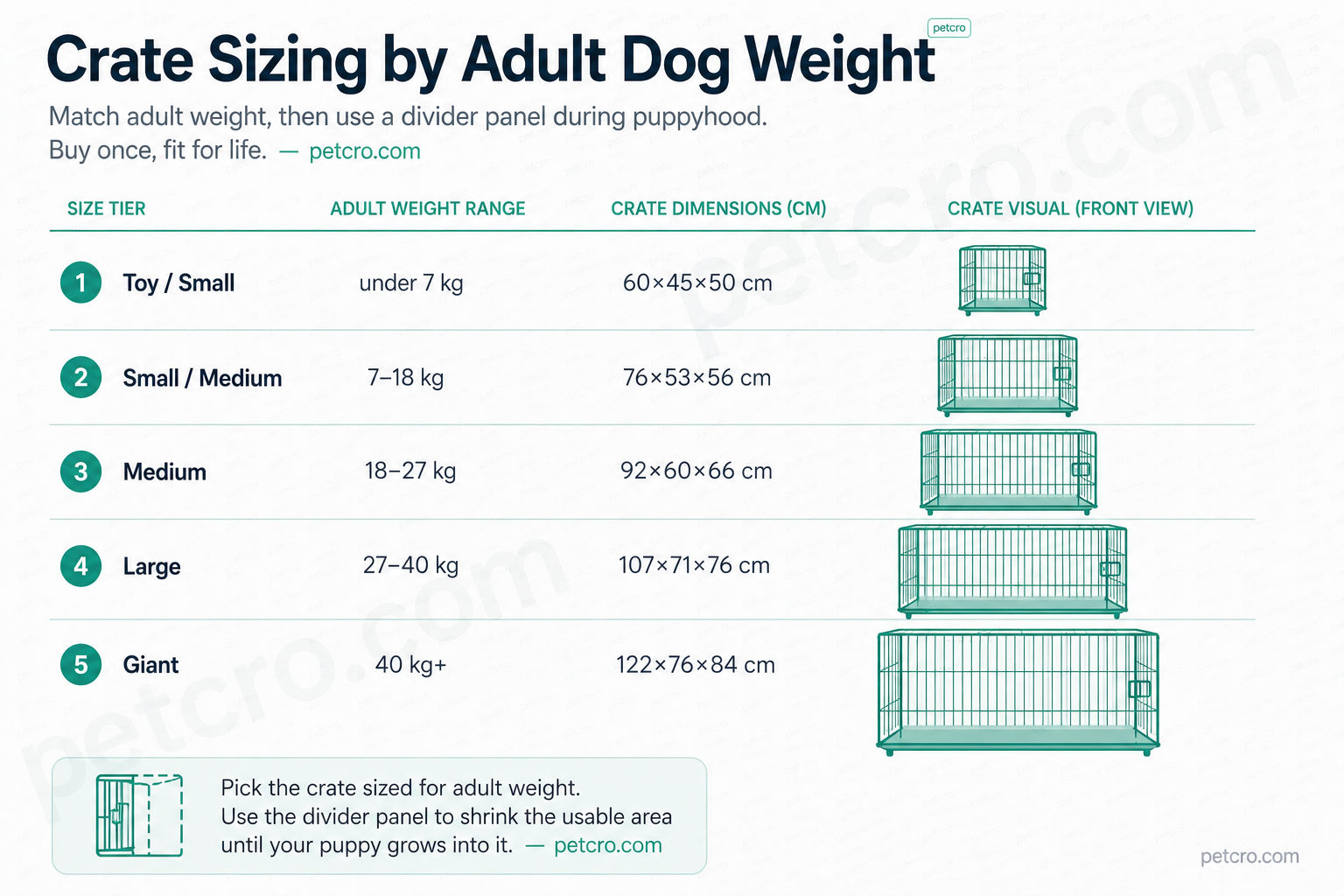
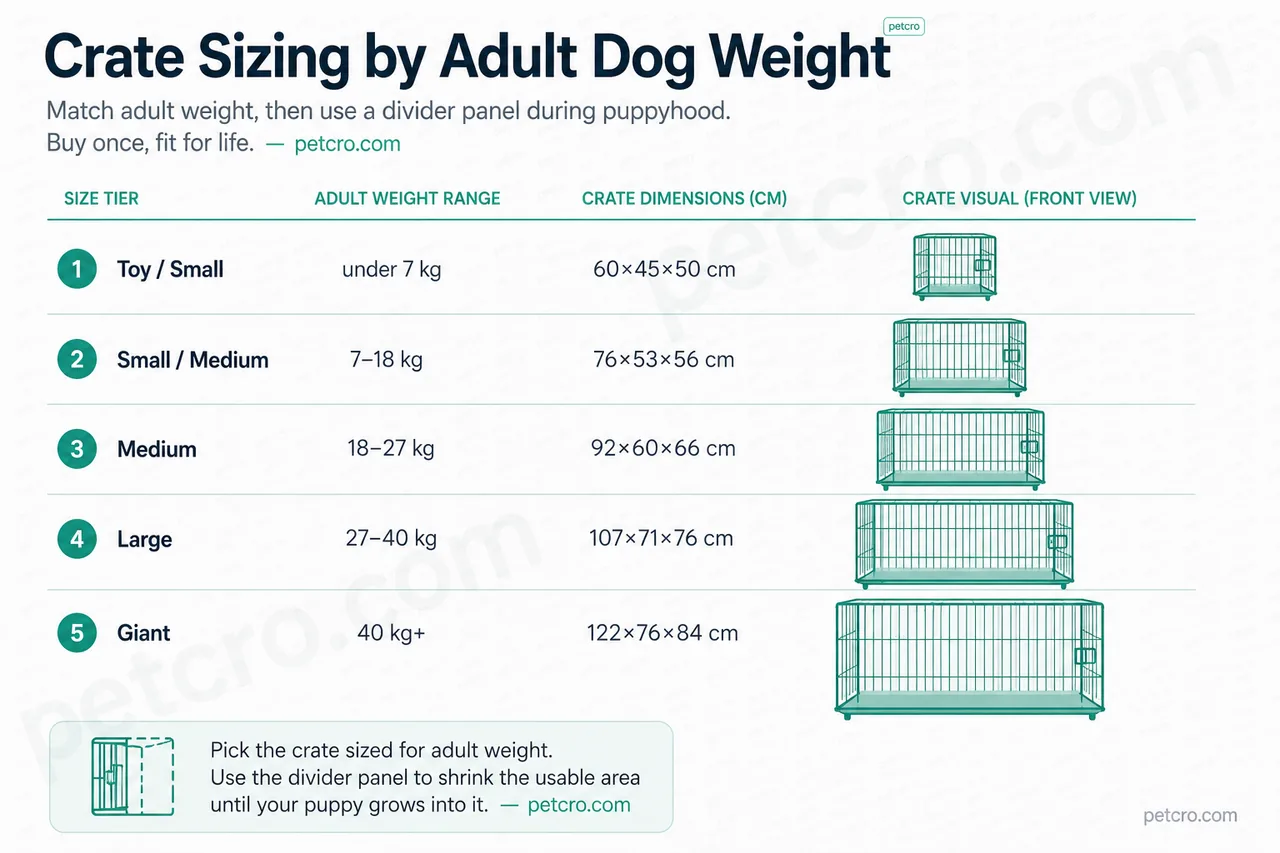
The rule: the crate should be just large enough for the puppy to stand up without ducking, turn around without their tail hitting the wall, and lie down with legs extended. That's it. No more.
Why size matters this much: a crate that's too big gives the puppy room to soil one end and sleep at the other — defeating the house-training mechanism entirely. A crate sized correctly forces them to hold it, because they don't want to lie in their own mess.
The chart above shows recommended crate dimensions by adult dog weight. **Get a crate sized for your puppy's adult size, with a divider panel** that you move outward as they grow. This is the cheap, correct way — one crate for the dog's lifetime, not three.
Wire vs plastic vs soft-sided
| Type | Best for | Avoid if |
|---|---|---|
| Wire crate (with divider) | Most puppies, all sizes | You travel a lot or live somewhere very cold |
| Plastic kennel | Travel, anxious puppies, cold environments | Larger breeds (limited size range) |
| Soft-sided | Calm adult dogs only | Any puppy — they'll chew through it in week 1 |
For 90% of new puppy owners, a wire crate with a divider panel is the right answer. It's the cheapest, the most adjustable, and the easiest to clean.
The 7-day crate introduction protocol
Don't shortcut this. The temptation on day 1 is to put the puppy in the crate and shut the door. That's how you create a puppy who will scream every time the door closes for the next six months.
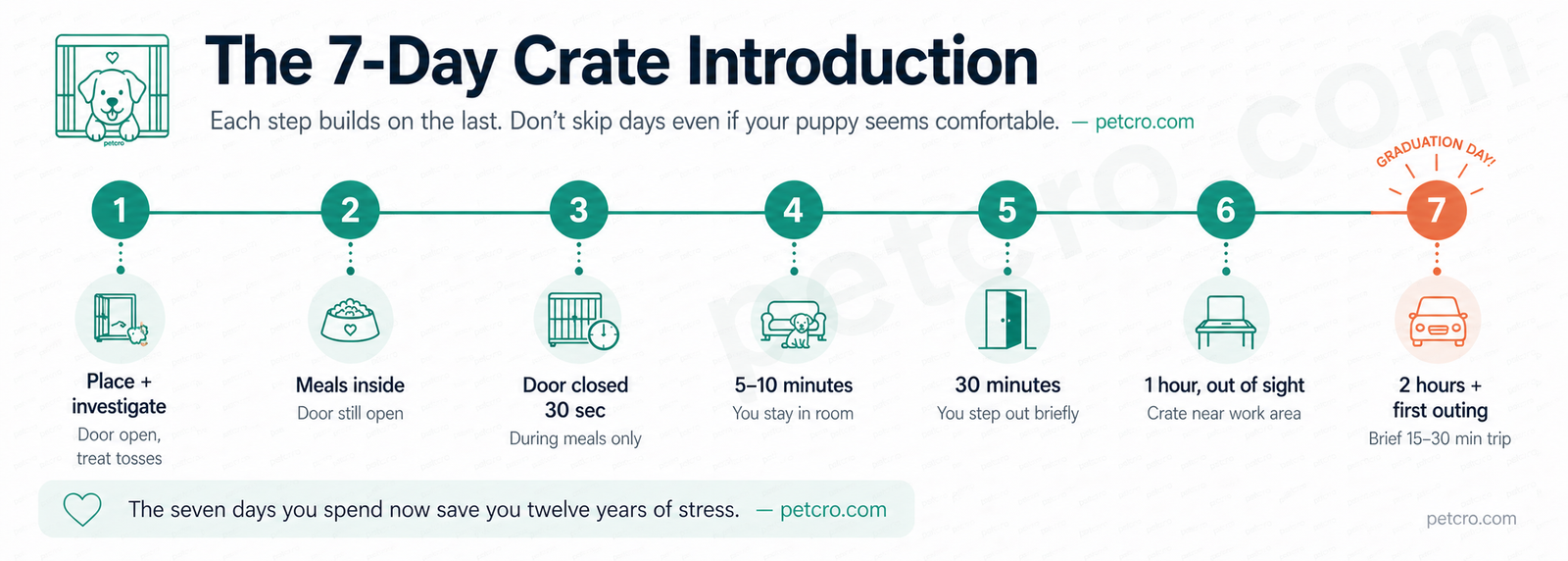
Instead, run this seven-day schedule.
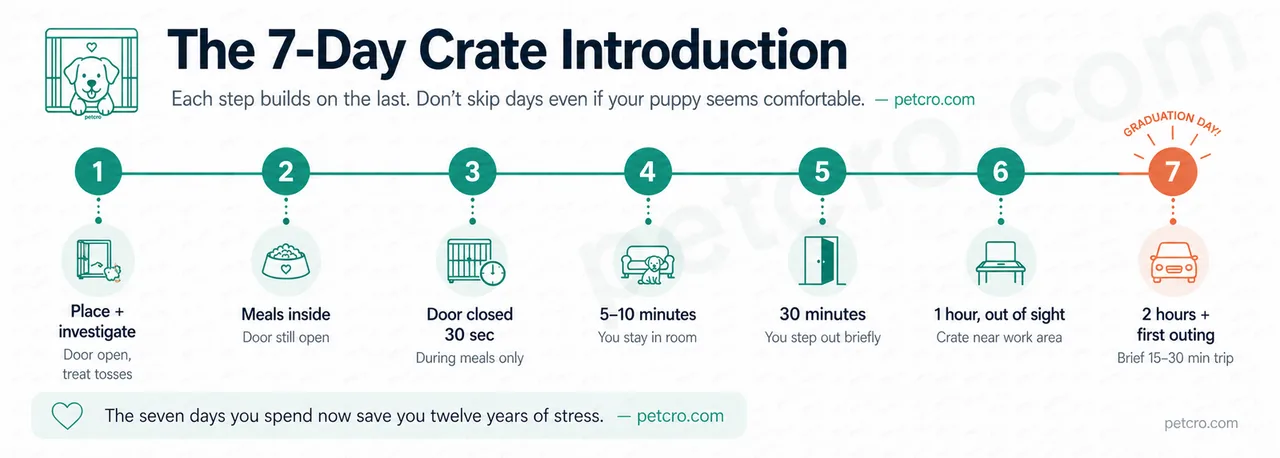
The detail behind each day:
Day 1: Place the crate, leave the door open
Put the crate where the family spends time during the day (living room, kitchen). Don't put a puppy in it yet. Just let the puppy investigate. Toss a treat inside every few hours — the puppy goes in, gets the treat, comes back out. Door stays open all day. No closing it.
Day 2: Feed meals in the crate (door open)
Put the food bowl at the back of the crate so the puppy has to step all the way in to eat. Stay nearby but don't make a big deal out of it. The puppy is now associating the crate with food — the strongest positive association you can build. (If you're not sure how much to put in that bowl yet, run the puppy feeding calculator before day 2 starts.) Door still stays open.
Day 3: Close the door for 30 seconds
While the puppy is eating their meal, gently close the door. Open it as soon as they finish. Don't react to whining — wait for a quiet moment, then open. Repeat at the next meal. By bedtime day 3, the puppy has tolerated the closed door 4–6 times.
Day 4: Close the door for 5–10 minutes
Right after a meal (when the puppy is tired and full), close the door and stay in the same room. Read a book, work on your laptop. Don't talk to the puppy. Open after 5–10 minutes if quiet. If they cry, wait for a 10-second silence, then open. Repeat 3–4 times during the day.
Day 5: Close the door for 30 minutes, leave the room briefly
Same as day 4, but step out of the room for 1–2 minutes mid-session. Come back without making a fuss. The puppy is learning that the door closing doesn't mean abandonment.
Day 6: One full hour, you out of sight
Now extend to a full hour, with you out of the room for most of it. Crate goes near your work area or living space — the puppy isn't isolated, they're just not free to roam.
Day 7: 2-hour stretch + first short outing
Close the puppy in the crate, leave the house for 15–30 minutes. Come back, casual greeting, let them out, take them straight to the toilet spot. Most puppies are now comfortable in the crate. While you're checking their toilet output, this is a good moment to run our poop health checker — early-week stress can show up as soft stool before it shows up in behavior.
After day 7, you can typically extend to 2–3 hour stretches during the day and overnight, depending on age and bladder capacity (more on that in a minute).
The first night — what actually works
The first night is where most owners crack. The puppy whines, you can't sleep, you bring them into your bed, and now you have a puppy who learned that whining = bed access. Don't do that.
The protocol that works:
- Crate goes next to your bed for the first 5–7 nights. Not in another room. The puppy can see you, smell you, and hear you breathing. This is the single biggest factor in a calm first night.
- Drape a blanket over three sides of the crate. Den effect. Most puppies settle within 20 minutes when the crate feels enclosed.
- Last potty break: 30 minutes before your bedtime. Then no water, no food, straight to the crate.
- If they whine: wait, don't engage. Most whining stops within 5–10 minutes. Engaging — even saying "shh" — teaches them whining gets attention.
- If they whine for more than 15 minutes straight, take them out — but to the toilet only, in silence. No play, no cuddles. Back in the crate after.
- Move the crate slightly further from your bed each night after week 1. By week 3, it's across the room. By week 4–6, it can move to its permanent spot.
Key principle: the puppy needs to learn the crate is safe and learn that whining doesn't get them out. These two things must happen together. If you only do the first, they're crate-comfortable but manipulative. If you only do the second, they're crate-tolerant but anxious. Both, and you have a calm dog.
How long can a puppy hold their bladder?
This determines how long the crate stretches can be at each age. The rough rule: a puppy can hold for roughly their age in months as a daytime maximum — though the very youngest (8-week) puppies often top out closer to 2 hours regardless. Use the table below as the practical limits.
| Puppy age | Max crate time (day) | Overnight |
|---|---|---|
| 8 weeks | 2 hours | One mid-night break (around 3 am) |
| 10–12 weeks | 3 hours | Sleeps through if last potty is at 11 pm |
| 3–4 months | 4 hours | Reliable overnight |
| 4–6 months | 4–5 hours | Solid overnight |
| 6+ months | 6+ hours | Solid overnight |
Never crate a puppy longer than these intervals during the day. A puppy who has an accident in the crate had it in them held too long — that's on the human, not the puppy. It also breaks the house-training mechanism.
By the time your puppy hits the 6+ hour band, the crate is doing less of the day's heavy lifting — and the bigger questions shift to diet. Run our body condition scorer every couple of weeks to confirm the calmer crate-time / free-time mix is still producing a lean dog, and read our when-to-switch-to-adult-food guide — the diet handoff usually overlaps with the end of formal crate training.
The four mistakes that drag this out for months
Owners whose crate training takes 8 weeks instead of 1 made one or more of these mistakes:
1. The crate is too big
Already covered. Most common mistake by far. If your puppy is going to one corner of the crate to pee and lying in the other, the crate is too big. Get a divider, shrink it.
2. Letting the puppy out while crying
Even once. The first time you open the door while they're whining, you've taught them that crying works. From then on, every crate session is a negotiation. Wait for silence — even a 5-second pause counts — then open.
3. Making the crate a punishment
If the puppy chews a shoe, don't put them in the crate. The crate must always be neutral or positive. Time-outs work elsewhere — not here.
4. Skipping the 7-day intro and going straight to lock-and-leave
This is the "but my puppy was fine the first night, then on night three started screaming" pattern. Day 1–2 felt fine because the puppy was exhausted. The crying starts when they realise it's a thing now. The slow protocol prevents this.
This guide is general guidance, not veterinary advice. For your specific dog's nutrition, health, or behavior needs, consult your veterinarian.
Frequently asked questions
My puppy hates the crate after one bad experience. Can I recover?
Yes, but you have to start over. Move the crate to a different room, take the door off entirely for 3–4 days (so they learn going near the crate isn't a trap), feed all meals in front of the open crate, and then run the 7-day protocol from day 1. Recovery typically takes 2–3 weeks instead of 1.
Should I cover the crate?
Yes — at least three sides. The den effect is real. Most puppies settle 50% faster in a covered crate. Use a breathable blanket (not vinyl, not plastic) and leave the front partly open.
What about during the day when I'm home?
Once the protocol is done (day 7+), the puppy doesn't need to be crated all day. The crate becomes a safe space they choose to nap in, and a tool you use for situations — when you're cooking, when guests arrive, when you leave the house. Average daily crate time for a healthy adult dog should be no more than 6–8 hours total, and ideally broken into 2–3 stretches.
My puppy whines as soon as I leave the room — even with the door open
That's separation anxiety, not crate aversion. It's a different problem. Work on the separation first (gradual distance, never make a fuss when leaving or arriving) before retrying the crate protocol.
Is it ever too late to crate train?
Adult rescue dogs can be crate trained, but the protocol is slower and more careful. Use the 7-day plan above but stretch each day to 2–3 days. Expect 3–4 weeks instead of 1. Adult dogs with prior bad crate experiences need a behaviourist's help.
Can I crate train and potty train at the same time?
Yes — and you should. The crate's design is the potty training mechanism. Take the puppy out the moment the crate door opens, every single time, for the first month. Walk straight to the toilet spot, wait for the wee, then come back inside. After ~30 days, the pattern locks in.
How do I know if my puppy is too anxious for crate training?
Mild whining for a few days = normal. Excessive panting, drooling, broken teeth from chewing the bars, or self-injury = pathological anxiety, see a vet. This is rare in puppies but it does happen, especially in rescue puppies with unknown history.
TL;DR — the calm-week crate protocol
- Get a crate sized for adult weight, with a divider panel — start small
- Cover three sides; den effect halves settle time
- 7-day intro: investigate → feed in → 30s closed → 5min → 30min → 1hr → 2hr+leave
- First week of nights: crate next to your bed, your hand reachable
- Never let the puppy out while crying — wait for a 5-second silence, even a tiny one
- Never make the crate a punishment
- Stick to bladder-capacity guidelines (roughly 1 hour per month of age, max — matches the table above)
The seven days you spend now save you twelve years of stress. Stick to the protocol, don't crack on the first night, and you'll have a dog who walks into their crate willingly for the rest of their life.
Sources & further reading
- ASPCA General Dog Care — vet-organisation framework on puppy crate exposure, behavior, and socialization windows.
- AKC: Crate training your puppy — kennel-club-led protocols for the introduction week.
- Cornell Riney Canine Health Center — peer-reviewed framework for the 8–16 week socialization window.
- Tufts Petfoodology — feeding behavior and routine — vet-nutritionist perspectives on meal timing that pair with crate routine.
- WSAVA Global Nutrition Guidelines — international veterinary nutrition baseline that ties feeding to early-life routine.
More from Petcro's puppy cluster
- How much to feed a puppy — the pillar guide
- When to switch a puppy to adult food
- Puppy feeding calculator — the meal-timing companion to the crate schedule
- Body condition scorer — confirm crate routine and feeding are producing a lean puppy
If your puppy shows pathological anxiety in the crate (self-injury, chronic panic), consult a vet behaviourist — this isn't a training issue.
Petcro is reader-supported. We may earn an affiliate commission when you click through links to products in this guide. Our editorial picks are independent of any commercial relationship with any brand.