Purina Pro Plan Puppy Feeding Chart (every formula, simplified)
The Purina Pro Plan puppy feeding chart by formula and adult size, plus the real-world activity adjustment most owners miss.
Purina Pro Plan is one of the most-reached-for puppy foods on the shelf — AAFCO-compliant for growth, and consistent enough that most people don't think twice once they buy a bag. Until they get home and look at the feeding guide on the back.
The bag chart works. It's just conservative, single-column for every breed size, and assumes "average activity" — which is almost no real puppy.
This guide gives you the Pro Plan feeding chart by formula, the activity adjustment most owners miss, and the calculator that turns the bag's column-of-numbers into one specific portion for your specific puppy. We use Pro Plan's own AAFCO-aligned values as the baseline, then layer the WSAVA growth formula on top.
TL;DR: Pro Plan puppy formulas are calorie-dense (around 4.2 kcal/g vs the 3.5 kcal/g of standard puppy kibble), so portions look smaller than other brands — that's normal, not under-feeding. Check the bag chart for your puppy's weight and age, then adjust −15% for sedentary up to +25% for working/sport activity. Run our feeding calculator for a portion that's tuned to your specific puppy in 30 seconds.
Which Pro Plan formula is your puppy on?
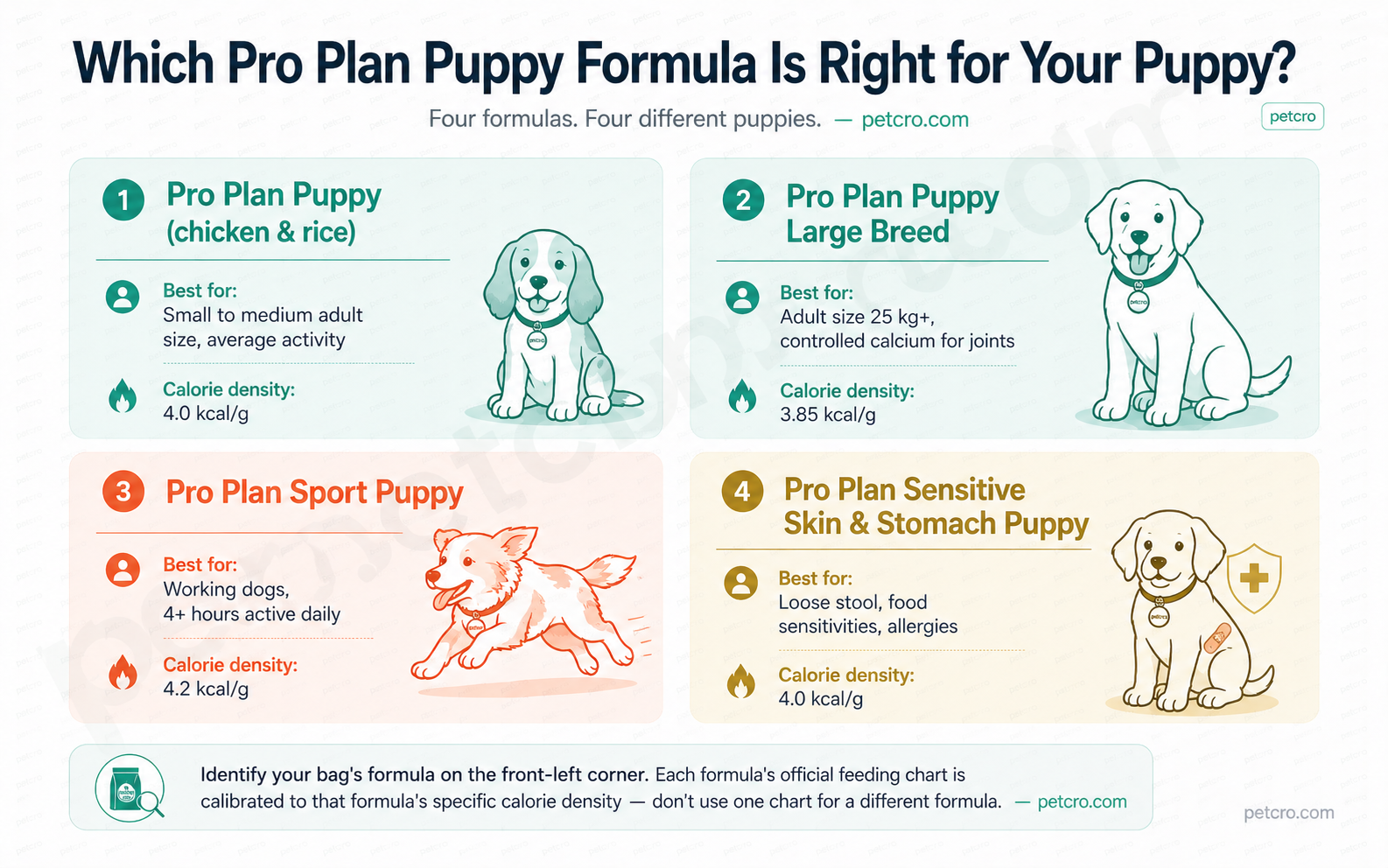
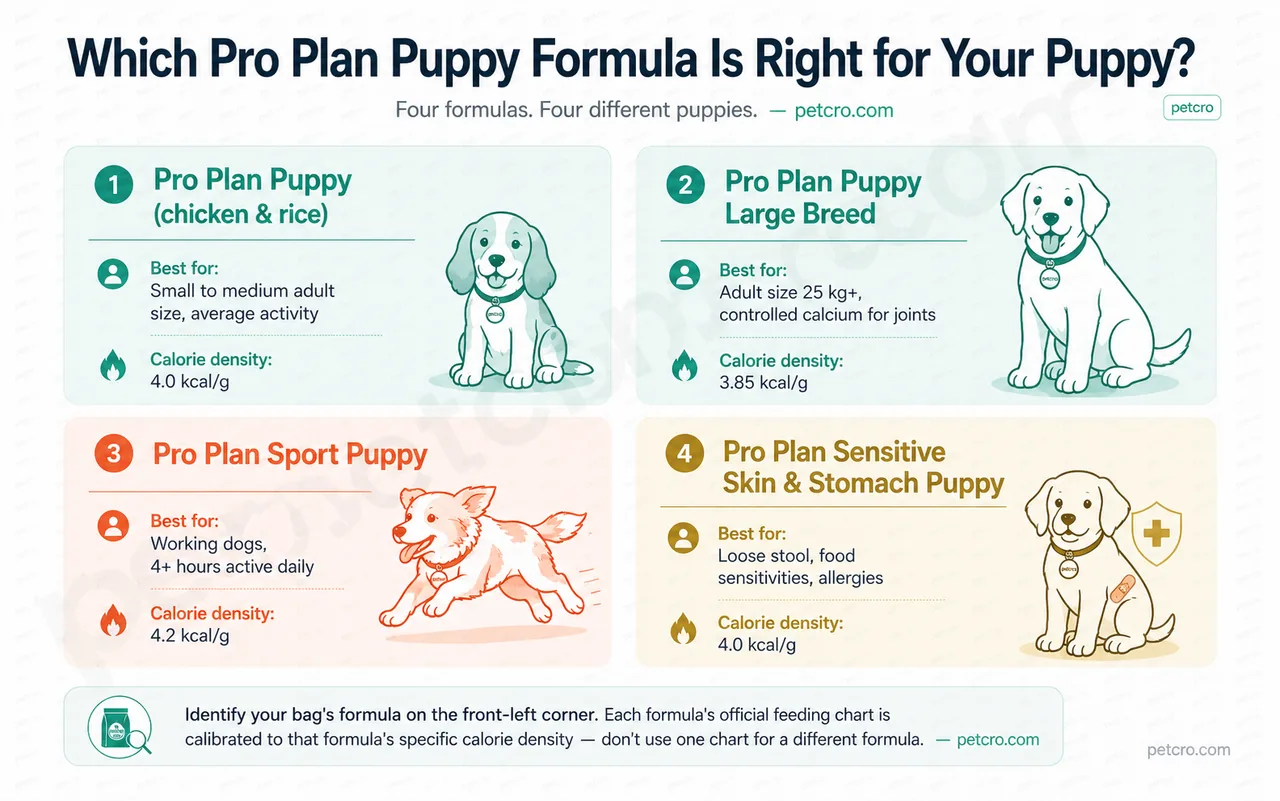
Before the chart matters, the formula matters more. Purina Pro Plan splits its puppy line into four main formulas, each calibrated for a different puppy:
| Formula | Best for | Calorie density (kcal/g, approx.) |
|---|---|---|
| Pro Plan Puppy (chicken & rice) | Small-to-medium adult size, average activity | 4.19 (4188 kcal/kg, per Purina May 2026) |
| Pro Plan Puppy Large Breed | Adult size 25 kg+ — controlled calcium, joint support | ~3.85 |
| Pro Plan Sport Puppy | Working / very active puppies (sheepdogs, retrievers in training) | ~4.2 |
| Pro Plan Sensitive Skin & Stomach Puppy | Loose stool, food sensitivities, allergies | ~4.0 |
Why this matters: the official chart on each bag is calibrated to that formula's calorie density. Don't use the chart from one Pro Plan bag for a different Pro Plan formula — Sport runs ~9% denser than the Large Breed formula and ~5% denser than Sensitive Skin & Stomach, so the same gram count over-feeds.
If you're not sure which one you have, the bag's front-left corner has the formula name in small print under the puppy photo.
The Pro Plan puppy feeding chart (by weight × age)
These values come directly from Pro Plan's published bag chart (verified against the printed feeding guide on Pro Plan Puppy Chicken & Rice Formula). Find the row matching your puppy's expected adult weight, then look up the column for their current age. Cells show ranges — start at the lower end and adjust up if your puppy is staying lean.
Pro Plan Puppy (regular, chicken & rice)
1 cup ≈ 112 g · 4188 kcal/kg · 456 kcal/cup
| Adult weight | 1½ – 3 months | 4 – 5 months | 6 – 8 months | 9 – 11 months | 1 – 2 years |
|---|---|---|---|---|---|
| 2 – 12 lb (1 – 5 kg) | ¼ – 1¼ cups (28 – 140 g) | ⅓ – 1¼ cups (37 – 140 g) | ½ – 1 cup (56 – 112 g) | ⅓ – 1 cup (37 – 112 g) | Feed as adult |
| 13 – 20 lb (6 – 9 kg) | ¾ – 1½ cups (84 – 167 g) | 1¼ – 1⅔ cups (140 – 186 g) | 1¼ – 1⅔ cups (140 – 186 g) | 1¼ – 1⅓ cups (140 – 149 g) | Feed as adult |
| 21 – 50 lb (10 – 23 kg) | ¾ – 2½ cups (84 – 279 g) | 1⅔ – 3 cups (186 – 335 g) | 1¾ – 2¾ cups (195 – 307 g) | 1⅔ – 2¾ cups (186 – 307 g) | Feed as adult |
| 51 – 75 lb (24 – 34 kg) | 1¼ – 2⅔ cups (140 – 298 g) | 3½ – 4 cups (391 – 446 g) | 3⅔ – 4¼ cups (409 – 474 g) | 3 – 4⅔ cups (335 – 521 g) | 2¾ – 3½ cups (307 – 391 g) |
| 76 – 100 lb (35 – 45 kg) | 1⅔ – 2⅔ cups (186 – 298 g) | 3⅓ – 4 cups (372 – 446 g) | 3⅔ – 4¼ cups (409 – 474 g) | 4⅓ – 5 cups (484 – 558 g) | 3⅔ – 4 cups (409 – 446 g) |
For dogs over 100 lb (45 kg) adult weight: add ¼ cup (28 g) at 1½–3 mo, ⅓ cup (37 g) at 4–5 mo and 6–8 mo, ⅓ cup (37 g) at 9–11 mo, and ¼ cup (28 g) at 1–2 yr per additional 10 lb (4.5 kg) over 100 lb.
Pro Plan Puppy Large Breed (50+ lb / 23 kg+ adult size)
For full Large Breed chart and the slow-growth-formula details, see our Pro Plan Large Breed Puppy Feeding Chart. The Large Breed bag has a different chart with extended age columns (12–24 months) calibrated for puppies who keep growing past 12 months. Don't use the regular Pro Plan Puppy chart above for a 50+ lb adult-projected puppy — calcium ratio differs.
Pro Plan Sport Puppy
For working dogs and high-drive breeds (Border Collies, Aussies, working retrievers). Higher protein and fat than regular Pro Plan Puppy. The Sport Puppy bag has its own feeding guide — check the printed chart on your specific bag, as values differ from the regular Puppy chart above due to the higher calorie density. As a rough guide, multiply your puppy's working hours by activity multiplier (see next section).
About these numbers: These come directly from Pro Plan's bag chart at 4188 kcal/kg, 456 kcal/cup. Pro Plan publishes wide cell ranges intentionally — the lower end is for less-active puppies on the smaller side of their adult-weight band, the upper end for active puppies on the larger side. Body-condition-score is the truth — adjust within (or outside) the range based on weekly recheck. The Kealy 2002 Purina lifespan study found that lifelong calorie restriction (lean feeding) extended canine lifespan by ~1.8 years with reduced osteoarthritis. For most puppies, starting at the middle of the range and adjusting to BCS produces the best long-term outcomes.
The real-world adjustment most owners miss
The bag's chart assumes "moderate activity" — a typical pet puppy with two daily walks. Real puppies vary a lot more than that.
Activity multipliers (apply on top of the bag chart)
Multiply the bag chart number by: × 0.85 for sedentary (indoor mostly, short potty walks, lots of crate time), × 1.0 for average (2 walks/day + normal play — the bag's assumption), × 1.15 for active (long walks, dog park, hikes most days), × 1.25 for working/sport (trained working dog, 4+ hours active daily).
A note on Pro Plan's chart structure: the bag's wide cell ranges already encode activity variation — the upper end of each cell is for the more-active end of the adult-weight band, the lower end for the less-active end. Use the multipliers above as a refinement once you've picked a number inside the range.
Example: a 10 kg adult-projected, 5-month-old puppy on regular Pro Plan Puppy is in the 21–50 lb / 10–23 kg row at 4–5 months → 1⅔ to 3 cups (186 – 335 g/day). A 10 kg adult is on the smaller side of that band, so start near the lower end (~190–210 g/day) for moderate activity. Sedentary → 0.85× (≈170 g). Active → 1.15× (≈230 g). Working → 1.25× (≈250 g, edging toward the upper end of the range).
The multiplier and the bag's range work together: the chart says "anywhere from 186 to 335 is reasonable for this dog at this age"; the multiplier helps you pick where in that range your specific puppy lands.
Body condition trumps the chart
Re-run the Body Condition Score check every two weeks during puppyhood. A BCS 4–5 (ribs felt through a thin layer of fat, visible waist from above) means you've got the portion right. A BCS of 6+ means cut the portion 10%; a BCS of 3 or below means add 10%.
This applies regardless of which Pro Plan formula you're on.
Why Pro Plan portions look smaller than other brands
If you switched from Purina One, Beneful, or another mainstream brand, the Pro Plan portion will look noticeably smaller for the same puppy. That's not a mistake.
Pro Plan kibble is denser — Purina publishes the chicken & rice formula at 4188 kcal/kg (≈4.19 kcal/g) vs the 3.4–3.6 kcal/g typical of mid-tier brands. Same calories, less volume.
Practical math:
- 200 g of regular puppy kibble (~3.5 kcal/g) = ~700 kcal
- 167 g of Pro Plan (≈4.19 kcal/g) = ~700 kcal — same calories, ~17% less volume
So if you're transitioning from a less-dense brand to Pro Plan and you keep feeding the same gram count, you'll actually be over-feeding by ~15%. Always recalculate when switching brands.
For the full math behind this, see our puppy feeding pillar guide.
Meal frequency by age (for any Pro Plan formula)
Same as our general puppy guidance:
| Age | Meals per day | Sample times |
|---|---|---|
| 8–12 weeks | 4 | 7am, 11am, 3pm, 7pm |
| 3–6 months | 3 | 7am, 12:30pm, 6pm |
| 6–12 months | 2 | 7am, 6pm |
| 12+ months | 2 | 7am, 6pm |
Keep last meal at least 3 hours before bedtime to avoid disrupting house-training.
When the chart isn't enough
The bag chart breaks down in three situations Pro Plan can't anticipate:
- Spayed / neutered puppies — caloric needs drop 20–30% within weeks of surgery. Don't keep feeding the pre-surgery portion or you'll see weight gain inside 6 weeks.
- Seasonal climate — winter outdoor puppies burn 10–15% more calories than summer indoor ones. Adjust seasonally.
- Recovering from illness — vets will give specific guidance, but most recovery puppies need 5–10% more calories during the first 2 weeks back on solid food.
In all three cases, the chart is a starting point, not a prescription.
This guide is general guidance, not veterinary advice. For your specific dog's nutrition, health, or behavior needs, consult your veterinarian.
Frequently asked questions
How much Pro Plan puppy food per day for a 10 kg puppy?
At 4–5 months on regular Pro Plan Puppy, the bag chart's 21–50 lb (10–23 kg) row says 1⅔ to 3 cups (186 to 335 g/day) — for a 10 kg adult-projected dog (lower side of the band) on moderate activity, start near the lower end at ~190–200 g/day, split across 3 meals. Run the feeding calculator for a more precise number factoring in your puppy's actual current weight and body condition.
Is Pro Plan Puppy Large Breed worth it for a 25 kg+ adult dog?
Yes. The controlled calcium ratios protect joint development for breeds like Labradors, Goldens, German Shepherds, and Boxers. Don't use regular Pro Plan Puppy for a large-breed dog past 4 months — the calcium content is too high for slow skeletal growth.
Can I feed Pro Plan Sport Puppy to a non-working dog?
Not ideal. Sport Puppy is calibrated for genuinely active dogs (4+ hours of work or training daily). Feeding it to a typical pet puppy means too many calories per gram for their actual activity level — they'll either gain weight or you'll be portioning so small they're constantly hungry.
When should I switch from Pro Plan Puppy to Pro Plan Adult?
Small/medium breeds: 12 months. Large breeds (25 kg+): 15–18 months. Giant breeds (40 kg+): 18–24 months. Run a 7–10 day gradual transition. See our when to switch guide for the full protocol.
Does Pro Plan publish their official feeding chart online?
Yes — see Purina's official feeding guides for each formula's specific guide. Our chart above is aligned with their published values but presented as a single comparison across formulas. For the very latest exact numbers on a specific bag, check the bag's printed chart — it overrides anything else.
Is Pro Plan worth the price for puppies?
Pro Plan Puppy is calorie-dense and uses higher-quality protein sources than mid-tier brands. The cost difference per meal is smaller than the price-per-bag suggests because portions are smaller. Whether the per-day cost is worth it is a personal call — but nutritionally, it's a strong choice for growth-stage puppies.
My puppy isn't finishing their Pro Plan portion. Am I overfeeding?
Possibly, especially for sedentary indoor puppies. Drop 10% and watch for a week. If they finish consistently and body condition stays at BCS 4–5, you've found the right portion. Don't push food a healthy puppy is refusing.
TL;DR — the Pro Plan feeding cheat sheet
- Identify your formula: regular Puppy, Large Breed, Sport, or Sensitive Skin & Stomach
- Use the matching chart above as your starting estimate
- Adjust −15% (sedentary) up to +25% (working/sport) for actual activity level
- Pro Plan portions look smaller than other brands — that's the calorie density, not under-feeding
- Body condition check every 2 weeks; the chart is wrong if BCS drifts from 4–5
- Re-calculate when switching brands or after spay/neuter
The chart on the back of your bag is right. It just doesn't know your puppy. The body condition check + activity adjustment turns "starting estimate" into "actually accurate."
Sources & further reading
- Purina Pro Plan official feeding guides (UK) — manufacturer's published feeding charts.
- WSAVA Global Nutrition Guidelines — the international veterinary standard for puppy energy requirements.
- AAFCO Dog Food Nutrient Profiles — the regulatory baseline Pro Plan tests against.
- Tufts Petfoodology: Reading a pet food label — independent guidance on what the AAFCO statement on a bag actually means.
- ASPCA Dog Nutrition Tips — vet-organisation guidance on life-stage feeding and food selection.
If your puppy has been prescribed a vet diet (kidney, allergy, weight management), follow your vet's guidance over any commercial feeding chart, including the one above.
More from Petcro's puppy nutrition cluster
- How Much to Feed a Puppy — the underlying calorie formula every brand chart is calibrated to.
- Purina Pro Plan Large Breed Puppy Feeding Chart — the controlled-calcium variant for 25 kg+ puppies.
- When to Switch Your Puppy to Adult Food — full transition timing by adult size.
- Feeding calculator — exact gram count for your specific puppy in 30 seconds.
Petcro is reader-supported. We may earn an affiliate commission when you click through links to products in this guide. Our editorial picks are independent of any commercial relationship with Purina or any other brand.