When to Start Training a Puppy on a Leash (the 4-Stage Timeline)
When to start training a puppy on a leash — indoor work from week 1 home, sidewalk walks after the first DHPP dose plus 7 days, full freedom at 16 weeks.

Start leash training a puppy at home as soon as they arrive — 8 weeks is fine. Indoor sessions with a flat collar and a 6-foot leash teach the basics. Outdoor walks on public ground wait for the AVSAB-recommended socialization window opening (first DHPP dose plus 7 days), with full freedom after the 16-week vaccination dose.
TL;DR: Leash training is two timelines layered: equipment habituation (collar then leash) starting day one home at 8 weeks, and walking-on-public-ground (sidewalks, parks) waiting for partial vaccination plus the AVSAB socialization gate at ~9–10 weeks. Indoor leash work is the foundation — short positive-reinforcement sessions, 2–3 times a day, 5 minutes each. Outside, carry-in-arms first, supervised same-yard time after, sidewalk walks once the first DHPP dose plus 7 days has passed, and full freedom (dog parks, pet stores) only after the 16-week vaccination dose locks in immunity.
Should I start leash training as soon as my puppy comes home?
Yes — at home, from day one. The mistake most owners make is conflating two different timelines: leash habituation (getting the puppy comfortable wearing a collar and being attached to a leash) and walking on public ground (taking the puppy outside on a leash for a walk). The first starts at 8 weeks. The second waits for vaccination milestones.
For the first 1–2 weeks home (typically 8–10 weeks of age), the goal is just acclimation:
Day 1–3: Collar on for short stretches (10–15 minutes), several times a day. The puppy scratches at it; that's normal. Reward calm behavior with treats. Leave the collar off overnight at this age.
Day 4–7: Add the leash, dragging behind the puppy indoors while you supervise. They learn that the leash following them isn't a threat.
Week 2 home: Pick up the end of the leash for 30-second intervals while they wander, then drop it. Build up to 1–2 minute "you-hold-it" segments.
No corrections. No yanking. The puppy learns that the collar + leash = treats + nothing scary. This is the foundation every later session builds on.
See the tips on how to crate train a puppy guide for the parallel containment training; both run in the same first-two-weeks-home window.
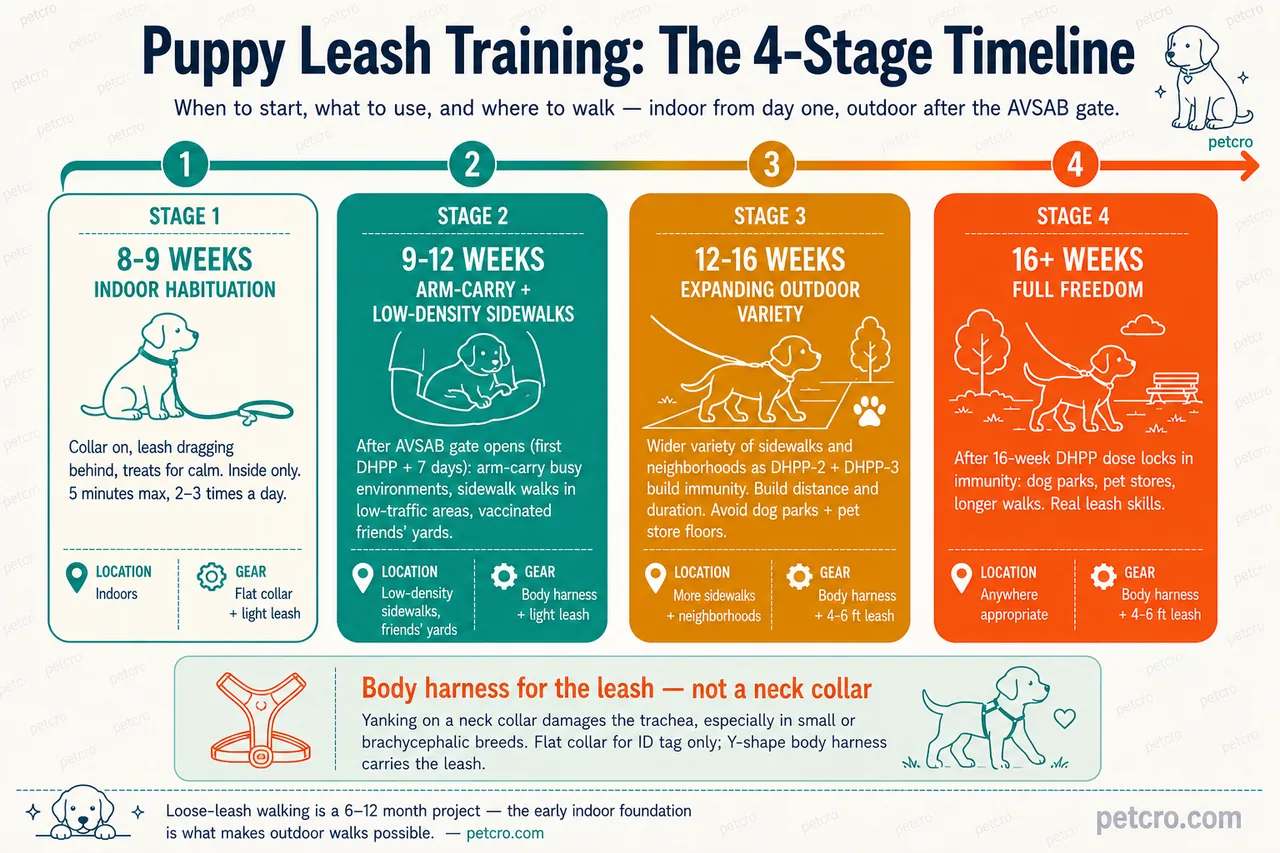
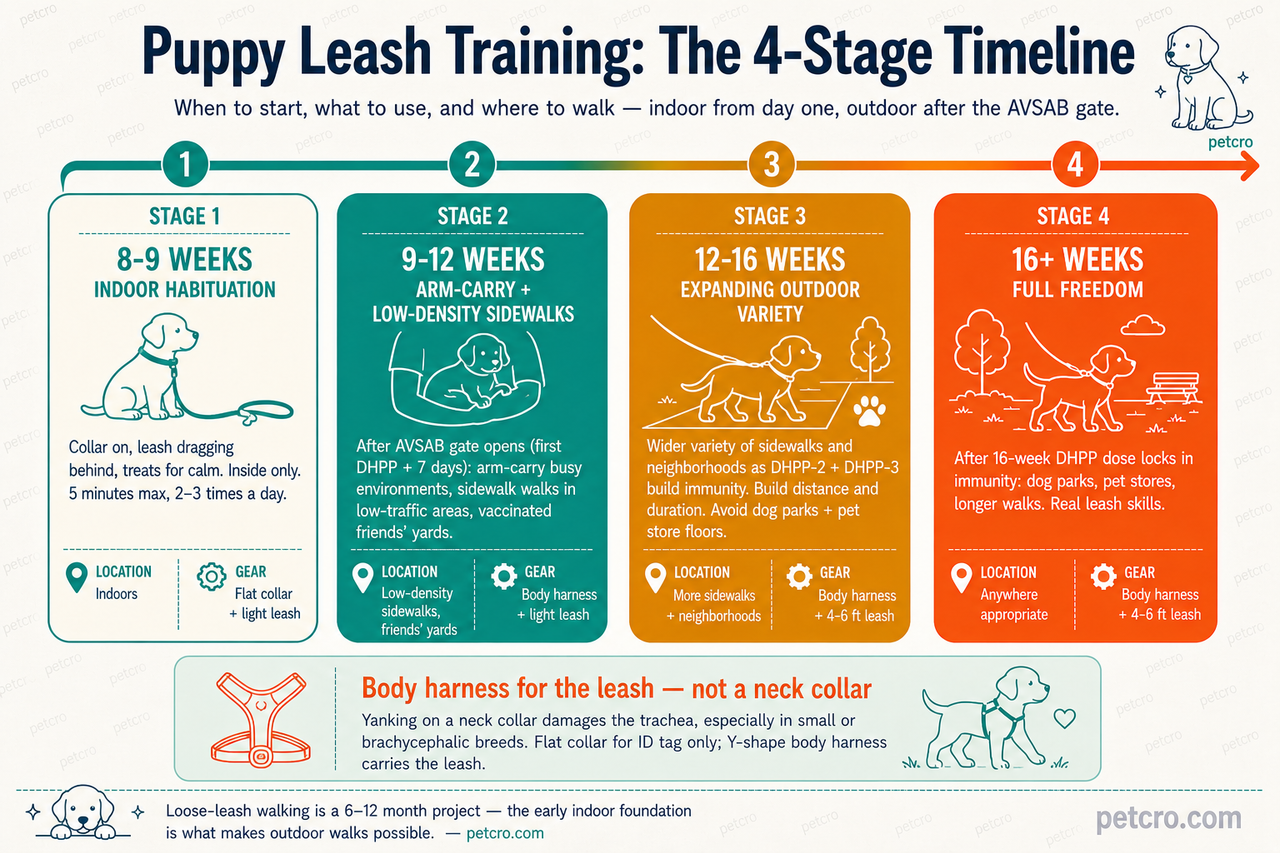
The 4-stage leash-training timeline by age
The whole arc, week by week:
Age | Stage | Where | Goals |
|---|---|---|---|
8–9 weeks | Indoor habituation | Inside the home | Collar on, leash dragging, treats for calm |
9–12 weeks | Carry-out + low-density sidewalks | Arm-carry outdoors + quiet sidewalks + vaccinated friends' yards | First outside exposure once the AVSAB gate opens; arm-carry plus low-density paw-to-ground walks |
12–16 weeks | Expanding outdoor variety | Wider variety of sidewalks and neighborhoods as DHPP-2 + DHPP-3 build immunity | Build distance and duration; still avoid dog parks and pet store floors |
16+ weeks | Full freedom | Anywhere — dog parks, pet stores, long walks | Real leash skills, longer durations |
The window between 9 and 16 weeks is where the AVSAB position statement (cited in the Merck Vet Manual) is most relevant: the puppy's critical socialization window closes around 12–14 weeks, but their immune system isn't fully locked in until the 16-week DHPP dose. Keeping the puppy isolated until 16 weeks under-socializes them; taking them to dog parks before 16 weeks risks parvo and distemper.
The compromise: indoor habituation only until the AVSAB gate opens (first DHPP plus 7 days, ~9 weeks); then arm-carry into busy environments, low-density paw-to-ground sidewalk walks, friend's vaccinated-dog yards, and structured puppy classes; dog parks and pet store floors only after the 16-week dose. See our puppy vaccination schedule chart for the full vaccine timeline.
Indoor leash training: weeks 1–2 home
The indoor foundation. Get this right and outside walks become much easier later.
Equipment for indoor work:
Flat collar (nylon or leather) sized to fit two fingers underneath
6-foot leash, standard fabric — not a retractable
High-value training treats, broken into pea-sized pieces
The basic session (2–3 times a day, 5 minutes each):
Put the leash on the puppy. Treat the moment the leash is attached. Calm = treat.
Take 2–3 steps. Don't pull. If the puppy follows you, treat and praise. If they don't, wait — don't pull, don't drag.
Reward orientation back to you. Any time the puppy looks at you, treat. You're building the "check in with me" habit that becomes loose-leash walking later.
Stop walking when the leash goes taut. Stand still. Wait for the puppy to release the pressure (turn back, sit, anything but pull). Then move forward again.
End on a calm note. Always finish before the puppy gets bored or distracted. Short and successful beats long and frustrating.
Eight-week-old puppies sleep 18–20 hours a day. Don't try to drill them — fit sessions around the puppy potty training schedule's eat → 15–30 minutes → potty → calm crate cycle.
When can a puppy walk outside on a leash?
This is the question with the real medical content behind it. The short answer: structured outdoor exposure can begin after the first DHPP dose plus a 7-day waiting period — roughly 9 weeks at the earliest. Free movement on public ground (dog parks, pet stores, busy sidewalks) waits for the 16-week vaccination dose to lock in immunity.
The AVSAB (American Veterinary Society of Animal Behavior) position statement on puppy socialization — referenced in the Merck Veterinary Manual — explicitly recommends that puppies should NOT be kept isolated until fully vaccinated, because the critical socialization window closes around 12–14 weeks. Missing that window produces dogs with lifelong fear and reactivity issues that are far harder to fix than parvo prevention.
Safe outdoor exposure before the 16-week dose:
✅ Carrying the puppy in your arms through busy environments (no paw-to-ground contact)
✅ Friend's fenced yard if their dogs are fully vaccinated and friendly
✅ Sidewalk walks in low-density residential areas (after first DHPP + 7 days)
✅ Structured puppy socialization classes run by trainers who require proof of first vaccination
✅ Carrying them into the vet office and outside any retail environment
NOT safe before the 16-week dose:
❌ Dog parks
❌ Pet store floors (Petco, PetSmart, etc.)
❌ Public city sidewalks with high dog traffic
❌ Apartment complex grass commonly used by other dogs
❌ Beaches, hiking trails, popular outdoor spaces
The risk: parvovirus survives in soil for months and is shed by infected (often asymptomatic) dogs. Unvaccinated puppies walking on contaminated ground can pick it up. The cost of an untreated parvo infection is 50%+ mortality. The cost of waiting until 16 weeks for outdoor walks is under-socialization. The compromise above threads the needle.
Collar, harness, or both — equipment by age and breed
Most puppies need both. The collar carries ID + rabies tag (required by most jurisdictions); the harness is what you clip the leash to.
For most puppies (medium and large breeds, no airway issues):
Flat collar with ID tag — wear-time only, never attach the leash to it for pulling
Y-shape body harness with a back clip — leash attaches here for walks
Why: yanking on a neck collar can damage the trachea and the cervical spine; a body harness distributes pressure across the chest
For small or brachycephalic breeds (French Bulldogs, Pugs, Yorkies, Chihuahuas):
Harness only — never attach a leash to a neck collar. Tracheal collapse and BOAS-related airway issues make neck pressure genuinely dangerous in these breeds.
For large breeds in early training (German Shepherds, Labs, Goldens before loose-leash walking is solid):
A front-clip harness (like the PetSafe Easy Walk or Ruffwear Front Range) redirects pulling rather than rewarding it. Useful between 4–8 months when puppies are strong enough to pull you but not yet trained.
Sizing note: puppies grow fast. Plan to upsize the collar 2–3 times in the first 6 months and the harness at least once. Check fit weekly — two fingers under the collar, two fingers under the harness chest strap. The new puppy checklist supply list covers what to budget for.
How to teach loose-leash walking — the 5-step method
Loose-leash walking is the goal that takes 6–12 months to fully cement. The fastest way there is positive reinforcement of orientation toward you, paired with the "stop when it's tight" rule.
Step 1: Set up
Standing or slow-walking indoors, leash in your left or right hand (whichever side you want the puppy on). Treats in the other hand.
Step 2: Reward orientation
Any time the puppy looks up at you, mark it ("yes!" or a clicker) and treat at your hip level. You're building the habit of checking in.
Step 3: Walk one or two steps
If the puppy follows, treat. If they don't move, wait — don't tug.
Step 4: Stop when the leash goes taut
The moment the puppy pulls, freeze. Don't yank back. Wait until the puppy releases the pressure (turns back, takes a step toward you, sits). Then move forward and treat the release.
Step 5: Build duration gradually
30 seconds of calm walking with no taut leash → treat. Then 1 minute. Then 2.
The mistake to avoid: letting them pull successfully. Every time a puppy pulls and the walk continues, they learn pulling works. Every time you stop, they learn pulling stops the walk. The rule is mechanical, not emotional.
For older puppies (4–6 months) who are already pulling because the habit set in, a front-clip harness plus this method will reset the pattern in 2–4 weeks of consistent application. The crate-training step-by-step guide covers the parallel calm-behavior reinforcement work.
Common leash-training mistakes
The patterns that turn a 3-week-foundation into a 1-year problem:
Yanking the leash for correction. Damages the trachea (especially in small breeds), teaches the puppy that the leash means pain, and doesn't fix pulling.
Letting them pull successfully. Walking forward while the puppy pulls reinforces pulling. Stop every single time.
First outdoor walks before the AVSAB gate. Paw-to-ground on public space before the first DHPP plus 7 days risks parvo/distemper.
Skipping collar habituation. Going straight to outdoor walks without the indoor foundation produces a puppy who panics or freezes on the first walk.
Retractable (flexi) leashes too early. They teach pulling-equals-more-leash and remove your ability to stop a sudden lunge. Use a fixed 6-foot leash until loose-leash walking is solid.
Long sessions. Eight-to-twelve-week-old puppies focus for 3–5 minutes max. Three short sessions beat one 15-minute session.
No treats. Loose-leash walking is taught with marker + reward. Going treat-free means the puppy has no reason to choose checking in over the more interesting environment.
Punishing fear. A puppy that freezes or refuses to walk is overwhelmed, not stubborn. Pulling them forward worsens the freeze.
If you've already made one of these, restart at the previous stage. The pattern is forgiving as long as you reset rather than push through.
What if my puppy refuses to walk or freezes on the leash?
Common between 8 and 12 weeks, and again during the secondary fear period around 4–6 months. The puppy plants their feet, refuses to move, and won't take treats outside.
Don't drag them. Pulling a frozen puppy forward intensifies the fear association with walking outside.
The protocol:
Sit down. Get to the puppy's level. Calm voice. Don't tower.
Wait. Give them 30–60 seconds to process the environment.
Treat any forward motion. Even a head turn toward the direction you want. Even a shift of weight. Build up gradually.
End on success. The moment the puppy takes one voluntary step forward, mark, treat, and end the session — carry them home if needed.
If the freezing persists for more than a few sessions in a row, three things to check:
Are they actually socialized enough yet? Carry-out exposure (in arms) before sidewalk walks softens the new-environment shock.
Is the collar/harness physically uncomfortable? Re-check the fit; some puppies refuse to walk in a too-tight harness.
Is there an unseen trigger? Loud trucks, big dogs nearby, slick floor. Move to a quieter spot and try again.
Persistent refusal past several sessions warrants a check with your vet or a Fear Free certified trainer. The ASPCA's general dog care resources cover stress and behavior basics.
This guide is general guidance, not veterinary advice. For your specific dog's nutrition, health, or behavior needs, consult your veterinarian.
Frequently asked questions
Can I leash train a puppy at 8 weeks?
Yes — at home. Eight weeks is the standard pickup age and the right time to start collar + leash habituation indoors. Outdoor walks on public ground wait for the first DHPP vaccination plus a 7-day window (per the AVSAB position statement). Until then, carry the puppy in your arms for outside exposure.
Is it safe to walk an unvaccinated puppy outside?
Carrying them in your arms is safe and recommended for socialization. Walking them paw-to-ground on public space is risky until the first DHPP dose plus 7 days have passed. Full freedom (dog parks, pet store floors, busy sidewalks) waits for the 16-week vaccination dose. Parvovirus and distemper survive in soil for months.
When can a puppy go for their first walk?
Their first paw-to-ground walk on public space should be after the first DHPP dose plus a 7-day waiting period — so roughly 9 weeks of age at the earliest. Keep these walks short (10 minutes), low-density (residential side streets, not busy sidewalks), and avoid areas with high dog traffic until the 16-week dose.
Should I use a collar or harness for leash training?
A flat collar for ID tags (rabies, name) and a Y-shape body harness for the leash. Never attach the leash to a neck collar for any breed that pulls — and especially never for small breeds or brachycephalic breeds where neck pressure causes real airway and tracheal injury risk. A front-clip harness helps with strong pullers from 4 months onward.
How long should leash training sessions be for an 8-week-old puppy?
Five minutes maximum, two to three times a day. Eight-week-olds sleep 18–20 hours a day and focus for only 3–5 minutes at a time. Three short successful sessions beat one long frustrating one. Build duration as the puppy ages — by 6 months, 15–20 minute walks are reasonable.
Why does my puppy refuse to walk on the leash outside?
Most likely overwhelm — new sights, sounds, and smells overload an 8-to-12-week-old puppy. The fix is patience: sit down with them, wait, treat any forward motion, end on success even if "success" is one voluntary step. Don't pull them. If refusal continues for several sessions, check the harness fit and consider whether carry-out exposure before sidewalk walks was skipped.
When will my puppy walk nicely on a loose leash?
Most puppies can do reliable loose-leash walking by 8–12 months with consistent daily practice. The foundation (orientation toward you, stop-on-taut-leash) takes about 2–4 weeks to install. Full reliability — calm walks past distractions, other dogs, food on the ground — is a 6-to-12-month project. Plan for steady progress, not overnight transformation.
TL;DR — the leash-training cheat sheet
Indoor leash work starts day one home at 8 weeks — collar habituation, then leash dragging, then short you-hold-it sessions
Outdoor paw-to-ground walks wait for the first DHPP dose + 7 days (the AVSAB socialization gate)
Full freedom (dog parks, pet stores, busy sidewalks) waits for the 16-week vaccination dose to lock in immunity
Once the AVSAB gate opens (first DHPP + 7 days), arm-carry the puppy into busy environments to use the critical socialization window before it closes around 12–14 weeks.
Flat collar for ID, body harness for the leash — never attach the leash to a neck collar, especially for small or brachycephalic breeds
Sessions stay 5 minutes max, 2–3 times a day at 8–12 weeks — build duration as the puppy ages
Stop when the leash goes taut, treat orientation back to you — these two rules are the entire foundation of loose-leash walking
Loose-leash walking is a 6-to-12-month project, not a weekend fix. The early work is what makes it possible.
Sources & further reading
American Kennel Club — Training Resources — general puppy training framework and equipment guidance.
ASPCA — General Dog Care — puppy socialization, training basics, behavior support.
Merck Veterinary Manual — Behavior of Dogs — citation source for the AVSAB position statement on puppy socialization and the critical socialization window.
PetMD — Dog Behavior — applied behavior and equipment guidance for early puppy training.
More from Petcro's new-puppy cluster
Tips on how to crate train a puppy — the parallel containment training that runs in the same first-two-weeks-home window.
Puppy vaccination schedule chart — full DHPP timeline, the 16-week-dose milestone, and the socialization-window medical context.
Puppy potty training schedule — daily eat → potty → crate rhythm that leash sessions fit around.
New puppy checklist — supply list for collar, harness, and leash sizing.
First night with a new puppy — pickup day routine before any leash work begins.
Petcro is reader-supported. We may earn an affiliate commission when you click through links to products in this guide. Our editorial picks are independent of any commercial relationship with any brand.