Dog Food for Diarrhea: What to Feed and When to See a Vet
Dog food for diarrhea: what to feed, what to buy, when a vet GI diet helps, the home bland-diet bridge, and the red flags that mean skip it.

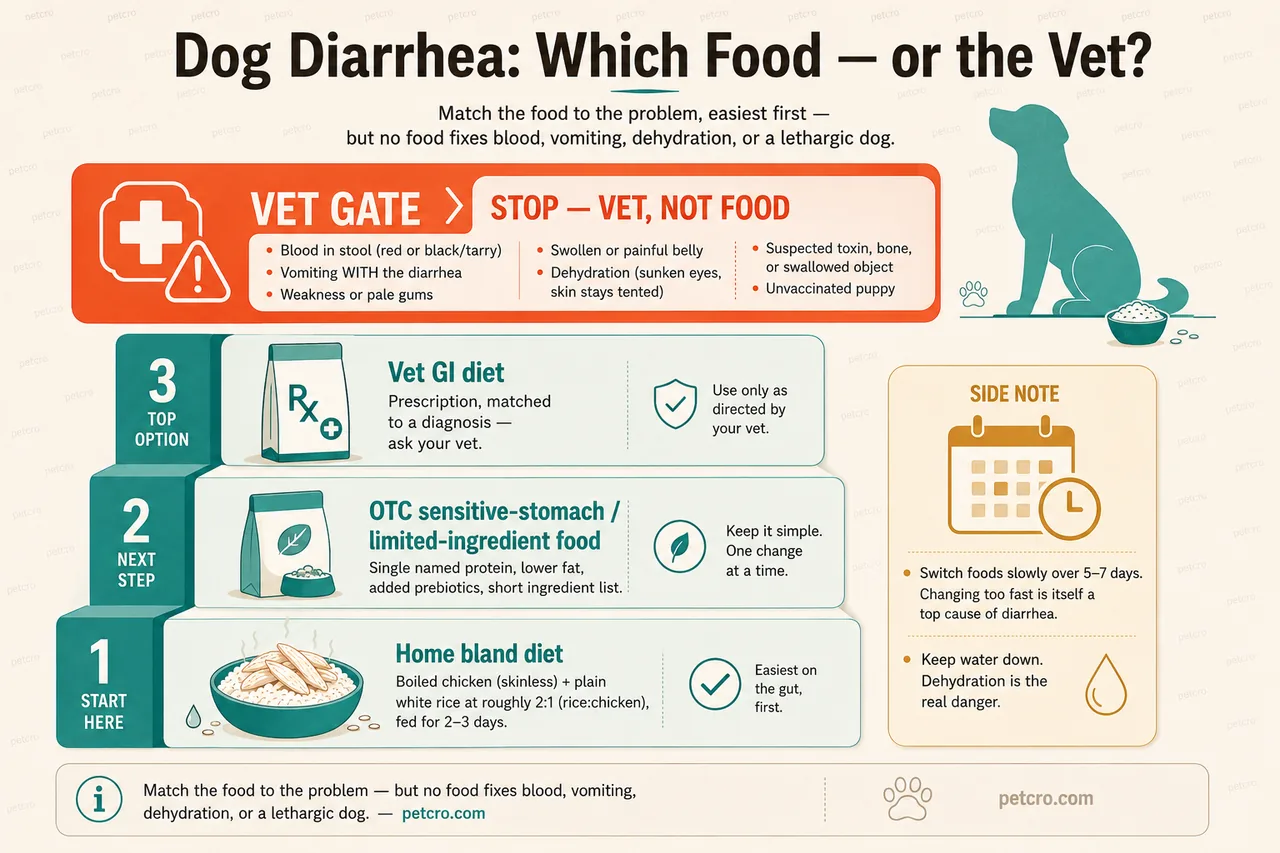
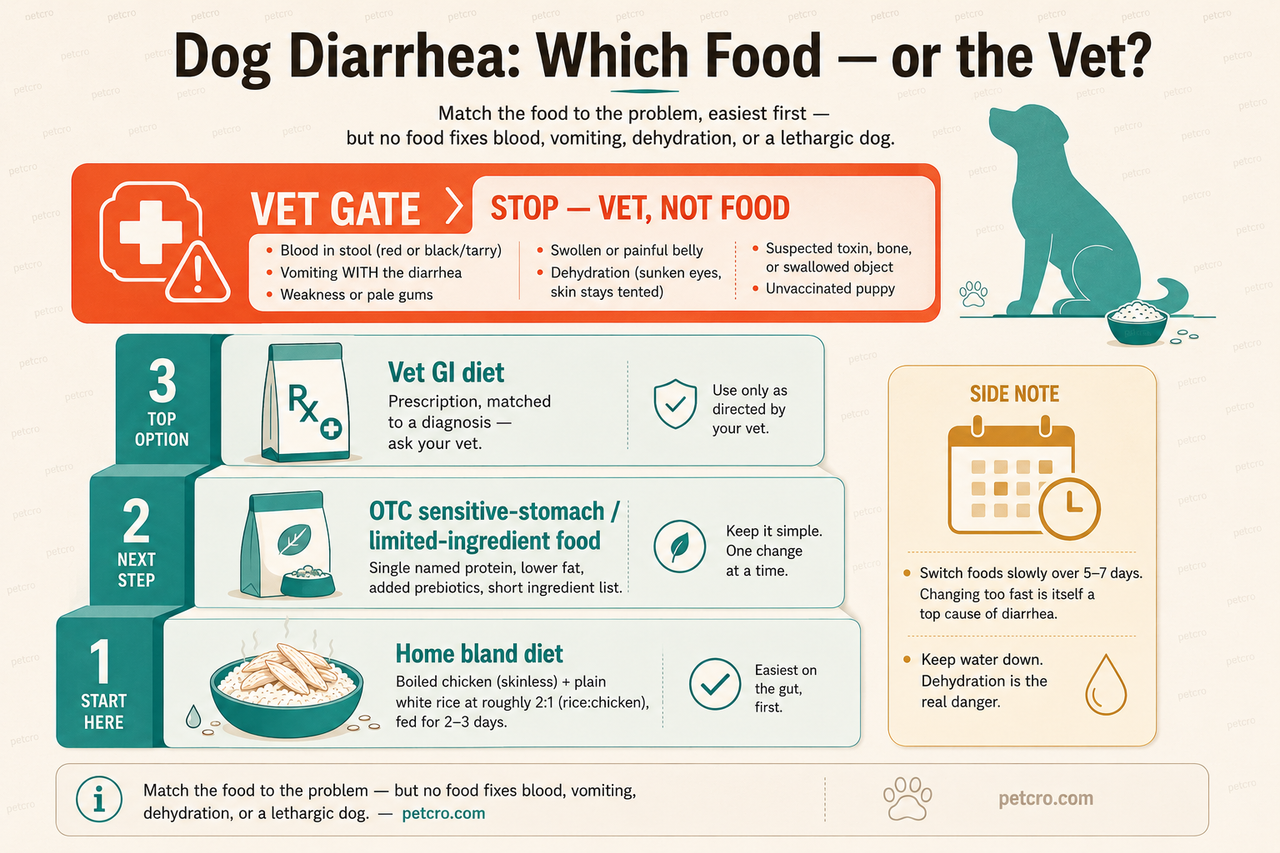
The best dog food for diarrhea is plain and highly digestible — low in fat and easy on the gut. A short home bland diet works for a mild one-off in an otherwise-well dog; a sensitive-stomach or vet GI formula suits an ongoing problem. But blood, vomiting, or a lethargic dog means food isn't the fix — call your vet.
TL;DR: For a brief bout in an otherwise-well dog, a highly digestible, low-fat food — a home bland diet of boiled chicken and white rice, or an over-the-counter sensitive-stomach formula — is the right call, switched in gradually over 5–7 days. For recurring diarrhea, a vet-prescribed gastrointestinal diet (after a diagnosis) is the real tool. No food fixes blood in the stool, vomiting plus diarrhea, dehydration, or a lethargic dog — that's a vet visit.
What kind of dog food for diarrhea actually helps?
You're not looking for a magic ingredient — you're looking for food that asks very little of an irritated gut. Three traits matter:
- Highly digestible — more of it is absorbed high up, so less reaches the colon to feed the problem.
- Low in fat — fat is the hardest macronutrient to digest and the most likely to loosen stool.
- Few, gentle ingredients — a single, lean protein and a simple carbohydrate, with no rich extras. Limited-ingredient and "sensitive stomach" foods are built around exactly this.
A little prebiotic fiber (beet pulp, psyllium, or pumpkin), in small amounts, helps firm things up and feed good gut bacteria. What you want to avoid is the opposite: high fat, novel rich ingredients, and a sudden change — all of which make diarrhea worse.
First, the safety check: when food won't fix it
Diet is supportive care. It does nothing for an infection, a swallowed object, a parasite, or a toxin — so before you change the bowl, rule these out. Authoritative sources — including the Merck Veterinary Manual and the AKC — treat diarrhea with the signs below as a vet visit, not a new bag of food.
| If you see this | Do this |
|---|---|
| 🔴 Blood in the stool (red, or black and tarry); vomiting and diarrhea together; weakness, collapse, or pale gums; a swollen, hard, or painful belly; profuse, watery diarrhea; sunken eyes or skin that stays tented; a suspected toxin, bone, or swallowed object; an unvaccinated puppy | Vet now — same-day, ER for collapse, pale gums, or a hard belly |
| 🟠 Won't drink, or early dehydration (tacky, dry gums); diarrhea lasting more than 24–48 hours; a puppy, tiny breed, senior, diabetic, or chronically-ill dog | Call your vet today — sooner if a puppy, tiny breed, diabetic, or unwell dog is also off food or flat (they dehydrate and crash faster) |
| 🟢 A bright, eating, drinking adult with soft-to-loose stool and no red-flag sign | A diet-led approach at home is reasonable — read on |
Bloody diarrhea in a puppy is parvo until proven otherwise (see puppy diarrhea and parvo), and diarrhea with vomiting can be the start of something serious — our dog throwing up white foam and dog vomiting blood guides cover when that combination is an emergency.
Over-the-counter sensitive stomach dog food: what to look for
For a dog with a generally touchy gut — ideally one your vet has already checked over — a store-bought "sensitive stomach" or limited-ingredient food is a sensible step up from regular kibble. Stool that keeps coming back, though, is a reason to call your vet first (per the table above), not to keep trying bags. Read the label for:
- A single, named animal protein (e.g. "chicken" or "salmon"), not a long mixed list.
- Lower fat than standard adult food.
- Digestibility cues — "highly digestible," rice or oatmeal as the carb, added prebiotics (chicory/inulin), or a probiotic.
- A short, recognizable ingredient list — fewer chances to hit something your dog reacts to.
These are maintenance foods, not medicine. They suit a dog whose stool is generally a little loose, not a sudden, dramatic bout — that's a vet call or a short rest-and-watch, not a food experiment (see the safety check above).
Veterinary gastrointestinal diets (and why they're prescription)
For ongoing or diagnosed digestive disease, the strongest tool is a therapeutic gastrointestinal dog food — the prescription GI diets your vet stocks. They're formulated to be exceptionally digestible, fat-controlled, and fiber-tuned, and several are backed by clinical feeding studies.
The reason they're prescription-only matters: they're matched to a diagnosis. Putting a dog on one long-term without knowing what you're treating can mask a problem that needs different care — which is why they sit behind a vet's recommendation rather than on the shelf. If your dog's diarrhea keeps coming back, ask your vet whether a GI diet (sometimes run as a structured food trial) is the right next step rather than buying one yourself.
The short-term home option: a bland diet
You don't always need to buy anything. For a brief, mild bout, the classic home bland diet — boiled skinless chicken and plain white rice, about 2 parts rice to 1 part chicken, no oil or seasoning, in small frequent meals for 2–3 days — gives the gut the same kind of break a bought food does, and you probably have the ingredients already. A little plain canned pumpkin (a teaspoon for a small dog, up to a tablespoon for a large one) as optional fiber, or a dog-specific probiotic, can help alongside it. Keep fresh water down throughout — dehydration is a real and fast-moving risk with diarrhea. It's a short bridge, not a long-term diet: transition back to balanced food once the stool firms — and if it isn't clearly improving within 24–48 hours (or gets worse), stop and call your vet rather than waiting out the full stretch, since homemade chicken and rice isn't balanced for long-term feeding.
How to switch dog food without making diarrhea worse
Here's the irony: changing food too fast is itself a top cause of diarrhea. So knowing how to switch dog food for diarrhea is half the battle — whichever food you land on, introduce it slowly:
| Days | New food | Old food |
|---|---|---|
| 1–2 | 25% | 75% |
| 3–4 | 50% | 50% |
| 5–6 | 75% | 25% |
| 7+ | 100% | — |
Go even slower — 10 days or more — for a dog with a known sensitive stomach, and if a stage triggers loose stool, hold there an extra day or two before moving on. A weight-and-activity baseline from our feeding calculator helps you portion the new food correctly once you're fully switched.
Foods and ingredients to avoid
While the gut settles, keep the bowl boring and cut the extras:
- Fatty, rich, or fried foods, table scraps, and high-fat treats — classic stool-looseners.
- A pile of new treats or chews at once — introduce one new thing at a time so you can spot a reaction.
- Dairy for many dogs (most are lactose-intolerant as adults), and overly sugary snacks.
- Anything on the toxic list — garlic, onion, grapes, xylitol and more can cause diarrhea and far worse; our toxic-foods reference is the fast lookup.
When a food change is the answer — and when it isn't
A diet change is the right fix when diarrhea is food-related: a recent switch, a sensitivity, a too-rich diet, or a chronic, food-responsive gut. In those cases the right food — chosen with your vet for recurring problems — usually resolves it.
It is not the fix for a sudden, severe, one-off bout (that's a rest-and-watch or a vet call, not a shopping trip), and it won't touch an infection, parasite, or obstruction. Puppies, seniors, and tiny breeds get a lower threshold for the vet either way: their margins are smaller and dehydration comes faster. Use our stool-health guide to track whether a food change is actually moving things in the right direction.
This guide is general guidance, not veterinary advice. For your specific dog's nutrition, health, or behavior needs, consult your veterinarian.
Frequently asked questions
What dog food is good for diarrhea?
The best dog food for diarrhea is highly digestible, low in fat, and made of few, gentle ingredients — a limited-ingredient or "sensitive stomach" formula, or for ongoing problems, a vet-prescribed gastrointestinal diet. For a short bout, a home bland diet of boiled chicken and plain white rice works just as well. Whatever you choose, switch to it gradually, and see a vet if there's blood, vomiting, or lethargy.
Is sensitive-stomach dog food good for diarrhea?
For mild or recurring loose stool, yes — sensitive-stomach foods are built to be digestible, lower-fat, and simple, which is exactly what an irritated gut needs. They're maintenance foods, not medicine, so they suit a generally touchy tummy rather than a sudden, dramatic bout. If diarrhea is severe, bloody, or paired with vomiting, skip the food experiment and call your vet.
What is a gastrointestinal (GI) dog food?
A GI or gastrointestinal diet is a therapeutic, vet-prescribed food formulated for digestive disease — extremely digestible, fat-controlled, and fiber-tuned, often backed by feeding trials. It's prescription-only because it's matched to a diagnosis; using one long-term without knowing what you're treating can hide a problem. Ask your vet whether one is right if your dog's diarrhea keeps returning.
How do I switch my dog's food to help with diarrhea?
Slowly. Changing food too fast is itself a common cause of diarrhea, so blend the new food in over 5–7 days — roughly 25% new for two days, then 50%, 75%, and finally 100%. Go slower (10+ days) for a sensitive dog, and if a stage loosens the stool, hold there an extra day before moving on. Keep water available throughout.
Will changing my dog's food fix the diarrhea?
It depends on the cause. If the diarrhea is food-related — a recent switch, a sensitivity, or a too-rich diet — the right food fixes it. If it's from an infection, a parasite, a swallowed object, or a one-off upset, food won't touch it. Recurring diarrhea is worth a vet-guided food trial; a sudden severe bout is a rest-and-watch or a vet call, not a shopping trip.
When should I see a vet instead of just changing the food?
Go to the vet — don't experiment with food — if you see blood (red or black/tarry stool), vomiting alongside the diarrhea, weakness or pale gums, a swollen or painful belly, or signs of dehydration, or if your dog is an unvaccinated puppy. Also call if the diarrhea lasts more than 24–48 hours, keeps coming back, or your dog is very young, old, tiny, or unwell.
TL;DR — the dog-food-for-diarrhea cheat sheet
- The right food is highly digestible, low-fat, and simple — a sensitive-stomach formula, a vet GI diet for ongoing cases, or a short home bland diet — but no food fixes blood, vomiting, dehydration, or a lethargic dog.
- Read labels for a single named protein, lower fat, added prebiotics, and a short ingredient list.
- Vet gastrointestinal diets are prescription-only because they're matched to a diagnosis — ask your vet for recurring diarrhea rather than self-prescribing.
- A home bland diet (chicken + white rice, 2–3 days) is a free, effective short-term bridge.
- Switch foods over 5–7+ days — changing too fast is itself a leading cause of diarrhea.
- Cut fatty foods, table scraps, dairy, and a pile of new treats while the gut settles.
If a sensible food change hasn't firmed things up in a couple of days, or the diarrhea keeps returning, that's a conversation with your vet — not another bag.
Sources & further reading
- Merck Veterinary Manual — Disorders of the Stomach and Intestines in Dogs — causes, danger signs, and the role of dietary management.
- AKC — Dog Diarrhea: Causes, Treatment, and Prevention — stool clues, home care, and the red flags that need a vet.
- AKC — Best Dog Food for Sensitive Stomachs — what makes a food gentle on the gut and how to read the label.
- petMD — Diarrhea in Dogs — overview, dehydration risk, and when diet helps vs when it doesn't.
- ASPCA — Animal Poison Control — (888) 426-4435, if a toxin or a swallowed item is on the table.
More from Petcro
- Puppy Diarrhea: Causes, Red Flags & the 48-Hour Rule — the puppy-specific guide, including when bloody diarrhea means parvo.
- Dog Throwing Up White Foam — when diarrhea comes with vomiting and foam.
- Dog Throwing Up Blood — the emergency end of the GI spectrum, and the black-stool connection.
- Stool-Health Guide — read your dog's stool color and consistency as the food change takes effect.
- Toxic Foods & Household Poisons Reference — what's dangerous, and what to do if your dog got into it.
Petcro is reader-supported. We may earn an affiliate commission when you click through links to products in this guide. Our editorial picks are independent of any commercial relationship with any pet-food brand.