Dog Throwing Up White Foam? Causes, the Bloat Test, and When to Worry
Dog throwing up white foam? Usually an empty stomach — but foam your dog can't bring up can mean bloat. The causes, the red flags, and when to call the vet.

A dog throwing up white foam once and then acting normal is usually mild — an empty stomach, or a swallow of grass. But the same foam can signal an emergency. The rule that matters most: it's the foam your dog can't bring up, paired with a swollen belly, that means bloat — and bloat is a same-hour emergency.
TL;DR: One bout of white or clear foam in a bright, alert dog that's still eating and drinking is usually harmless — often just bile and acid frothing up on an empty stomach. It becomes an emergency when the foam comes with unproductive retching (heaving but nothing comes up), a swollen or hard belly, blood, collapse, pale gums, a suspected poison, or a lethargic unvaccinated puppy. Foam color alone doesn't decide danger — your dog's other signs do.
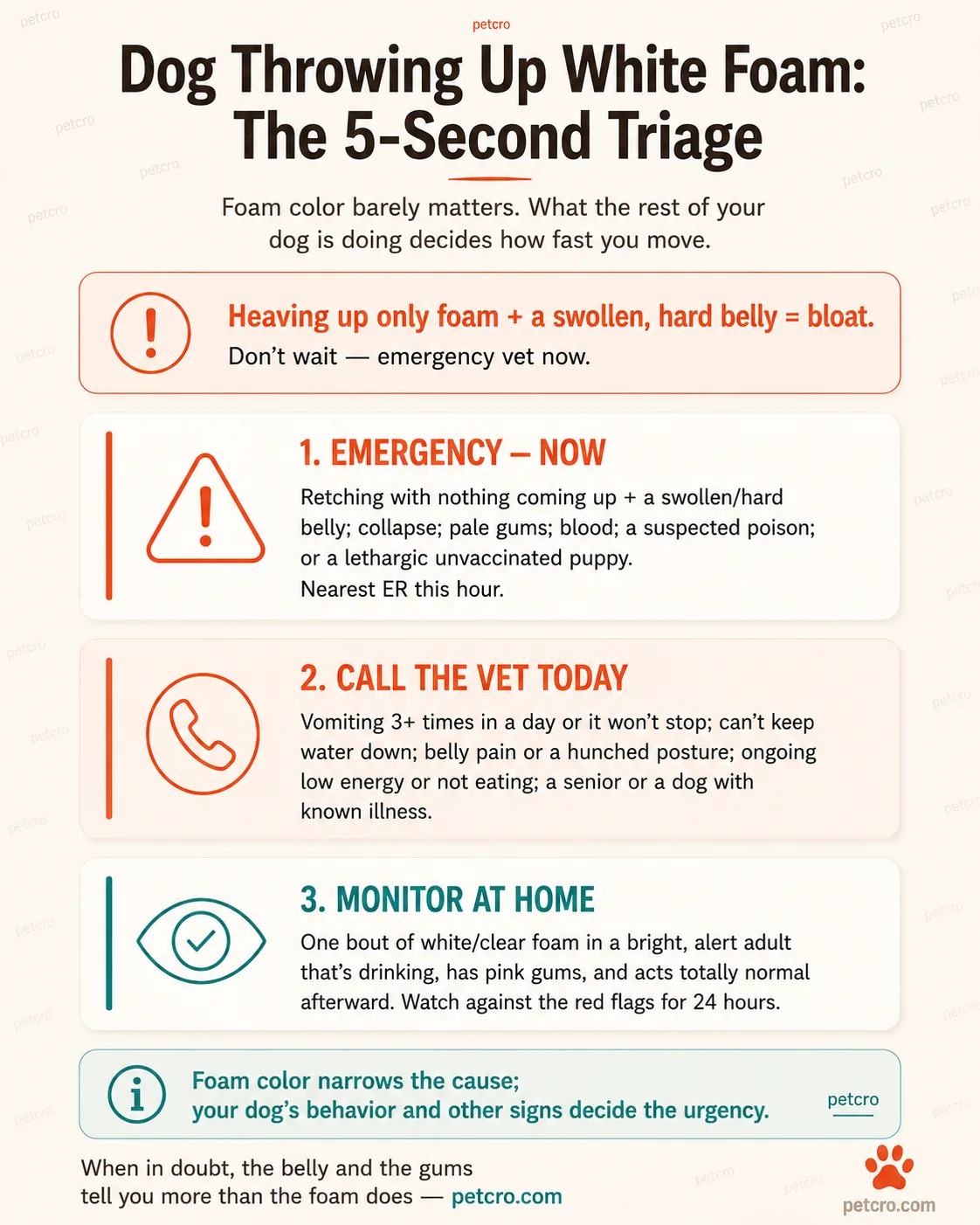
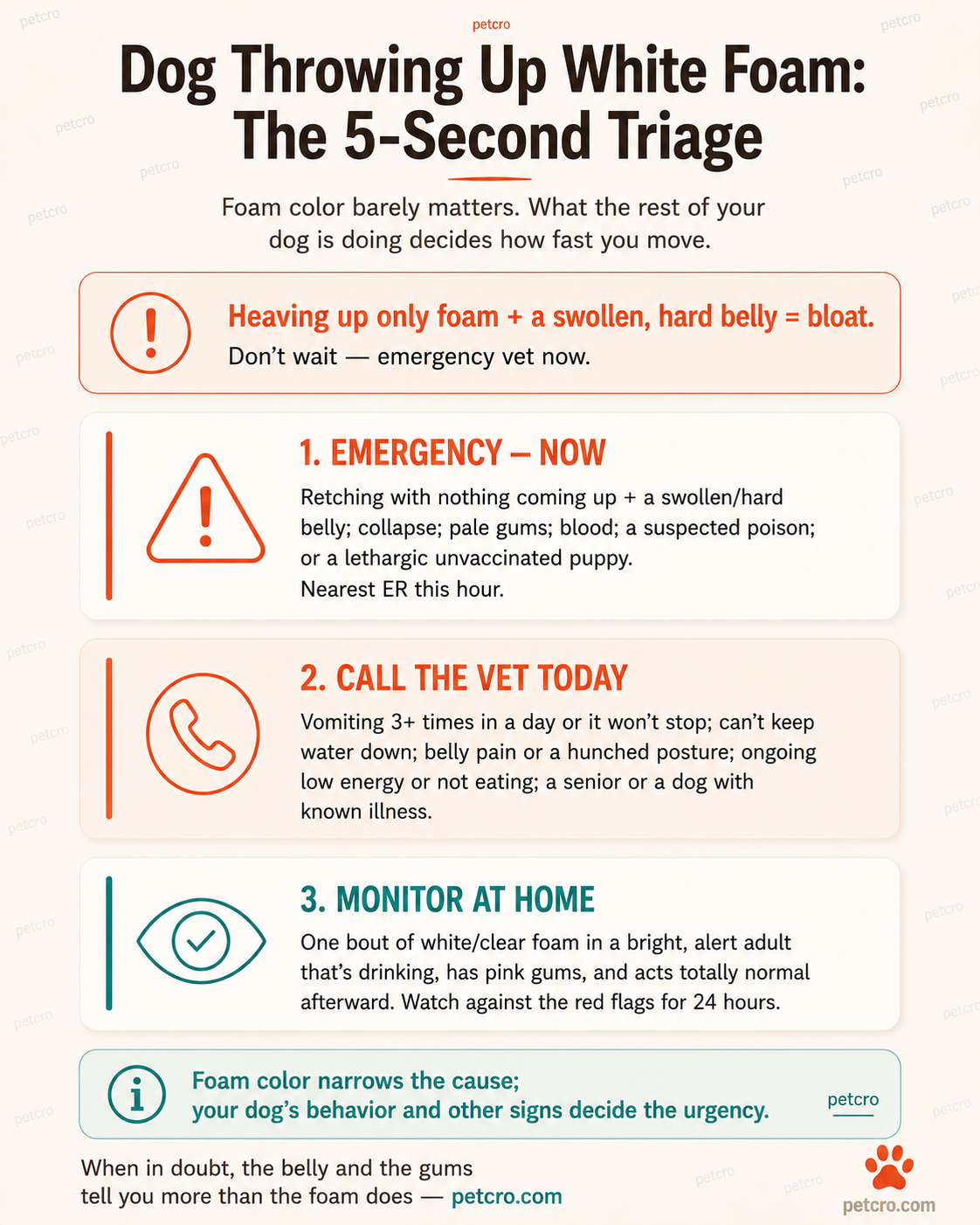
🚨 The fast version: Retching that brings up only foam plus a swollen, hard belly is the classic sign of bloat (GDV) — it can cause shock in an hour or two. Don't wait. Drive to the nearest emergency vet now.
Quick answer: when to worry (the 5-second triage)
If you're reading this with a foamy mess on the floor and a worried dog, start here. The biggest mistake owners make is letting a reassuring color override what the rest of the dog is telling them.
| Tier | What you're seeing | What to do |
|---|---|---|
| 🔴 Emergency — now | Retching with nothing coming up but foam + a swollen/hard belly; collapse; pale, white, or blue gums; trouble breathing; blood in the vomit (red or coffee-ground); known/suspected poison; an unvaccinated puppy that's also lethargic | Call the nearest ER vet and drive in this hour |
| 🟠 Call the vet today | Vomiting 3+ times in 24 hours or it won't stop; can't keep water down; belly pain or a hunched "praying" posture (especially after a fatty meal); ongoing lethargy or not eating; a senior or a dog with known organ disease | Phone your vet within 24 hours |
| 🟢 Monitor at home | One episode of white/clear foam in an otherwise bright, alert adult dog that's drinking, has pink gums, and acts completely normal afterward | Watch against the red flags for 24 hours |
The core rule: foam color does not equal danger — the dog's behavior and accompanying signs do. A bright dog that foams once and trots off for a drink is in a different world from a restless dog heaving up nothing.
First, rule out bloat — white foam your dog can't bring up is an emergency
This is the one detail every owner must get right — the difference between "monitor overnight" and "drive to the ER." What owners describe as "throwing up white foam" is very often unproductive retching: in bloat (gastric dilatation-volvulus, GDV), the stomach twists and seals at both ends, so the dog heaves repeatedly but brings up only foamy saliva — nothing else gets out.
The Merck Veterinary Manual describes the early picture as nonproductive retching, hypersalivation, and restlessness. VCA's emergency guidance puts it the same way — affected dogs "retch without producing anything" and "salivate profusely."
The signs that mean go now:
- Repeated heaving that brings up only foam or nothing at all
- A distended, hard, drum-tight belly — often a bulge behind the ribs, frequently most obvious on the left side
- Drooling, restless pacing, an anxious look — the dog can't get comfortable or settle
- Later and more ominous: rapid shallow breathing, pale gums, a weak pulse, collapse
Bloat moves fast. The American Kennel Club warns that "in only an hour or two, your dog will likely go into shock," and Merck reports mortality around 20% even in treated dogs, and 25–30% overall — with signs lasting more than about 6 hours before treatment being a bad prognostic sign. VCA frames the window plainly: immediate care "within minutes to a few hours" is required to save the dog's life. This is never a wait-and-see.
Highest-risk dogs are large and giant breeds with deep, narrow chests: Great Danes, German Shepherds, Standard Poodles, Weimaraners, Saint Bernards, Irish and Gordon Setters, Dobermans, and Basset Hounds. Risk climbs with one big daily meal, gulped food, and hard exercise right after eating. If that's your dog and you're seeing foam-you-can't-bring-up, treat it as bloat until a vet says otherwise.
Vomiting vs regurgitation vs coughing up foam — they're not the same
Here's the upgrade almost no competitor bothers to explain, and it changes both the cause list and the urgency. Three different things get reported as "my dog is throwing up white foam," and they come from three different places in the body.
| What it looks like | Where it comes from | |
|---|---|---|
| Vomiting (active) | Warning signs first — drooling, lip-licking, nausea — then forceful abdominal heaving brings up fluid, froth, or food | The stomach (empty-stomach bile, gastritis) |
| Regurgitation (passive) | No retching, no warning — material just falls out, often soon after eating, sometimes tube-shaped or foam-covered | The esophagus (megaesophagus, reflux) |
| Coughing up foam (respiratory) | A hard, dry, honking cough fit brings up white foam or phlegm afterward | The airways (often kennel cough) |
VCA defines true vomiting as "forceful contractions of the abdominal muscles." Cornell's Riney Canine Health Center draws the line on the passive kind: "regurgitation does not include retching… there's no warning, and it may indicate an esophageal problem." That matters because esophageal trouble carries an aspiration-pneumonia risk and needs different testing. And a dog that brings up foam after a coughing fit — especially one that was recently at boarding, daycare, grooming, or a dog park — is most likely dealing with a respiratory bug, not a stomach problem.
Get this label right and you've already narrowed the field.
What the color and timing of the foam tell you
White foam itself is low-information: it's ordinary stomach and mouth content — gastric mucus, saliva, and a little acid or bile — whipped with swallowed air into froth. It shows up in mild cases and true emergencies, which is why color can't be trusted alone — but it helps narrow things.
| What you see | What it usually means |
|---|---|
| White or clear foam, dog otherwise normal | Most often benign — empty stomach, mild reflux, or after eating grass |
| Yellow or green tinge | Bile is mixed in — classic empty-stomach (bilious) vomiting |
| Pink, red streaks, or frank blood | Bleeding somewhere in the upper gut — vet now |
| Brown or coffee-ground material | Digested blood, or something the dog ate — vet |
| Foam first thing in the morning / after a long gap | Bilious vomiting on an empty stomach (see below) |
| Foam right after eating, no retching | Think regurgitation — an esophagus issue, not the stomach |
| Repeated heaving, only foam comes up | 🚨 Bloat flag — see the emergency section above |
Use color to narrow, never to dismiss. A "reassuring" white never overrides a red flag.
The most common cause: an empty stomach (bilious vomiting)
If your dog throws up white or yellow foam in the early morning or after a long gap between meals, then acts completely fine, the likeliest answer is bilious vomiting syndrome. When the stomach sits empty too long, bile and acid pool and irritate the lining, triggering a foamy bring-up that contains no food.
The hallmark is that the dog is totally normal between episodes — good appetite, normal energy, no diarrhea, no weight loss, no swollen belly. It's a diagnosis of exclusion, so a vet rules out the serious stuff first.
The fix is refreshingly simple and one the big guides under-sell: shrink the empty-stomach window. The AKC's bilious vomiting guide — which quotes veterinary experts Dr. Craig Webb and Dr. Sara Jablonski — recommends feeding a portion of dinner as a late-night snack and splitting the day's food into smaller, more frequent meals. One nuance worth knowing: acid-reducers like famotidine or omeprazole often don't help here, because the real problem is gut motility, not excess acid. Stubborn cases may need a veterinary GI diet or a bedtime prokinetic (such as cisapride) — a conversation for your vet, not the medicine cabinet.
Other usually-mild causes
Most one-off foam episodes in a healthy adult dog trace back to something minor:
- Dietary indiscretion / mild gastritis — the dog ate garbage, scraps, or spoiled food. Merck notes "sudden onset of vomiting is characteristic of acute gastritis." Usually a short bout in an otherwise bright dog.
- Eating grass — dogs often crop grass and bring up a little white foam once. As an isolated event in a well dog, monitor and move on.
- Acid reflux (GERD) — stomach acid backing up irritates the esophagus, producing foam, gulping, lip-licking, and sometimes a chronic cough. Recurring signs deserve a vet visit.
- Motion sickness — common in young or anxious dogs; drooling on a car ride, then foam on an empty stomach. Settles once the motion stops; ask your vet about anti-nausea meds for travel.
- Kennel cough (a respiratory bug) — a honking cough fit can bring up foam or phlegm. The tell is recent boarding, daycare, grooming, or park exposure in a dog that's otherwise eating and active. See a vet if breathing is labored or your dog is feverish or off food.
The serious causes you can't miss
Besides bloat, a handful of causes turn foam from a nuisance into a same-day problem:
- Poisoning. Toxins — antifreeze, bleach and cleaners, rodenticides, xylitol, chocolate, grapes and raisins, onion and garlic, toxic plants, human medications — frequently announce themselves with foamy vomiting, drooling, weakness, tremors, or collapse. The AVMA notes that bleach and cleaning products can cause "stomach upset, drooling, vomiting or diarrhea," and severe burns if swallowed. Do not induce vomiting unless a vet or poison-control specialist tells you to — with caustics like bleach it causes more damage.
- Pancreatitis — often after a fatty or rich meal or a garbage raid. Merck lists severe-case signs as "loss of appetite, vomiting, weakness, abdominal pain, dehydration, and diarrhea." The hunched "praying" posture is a classic clue. Call the vet, especially after a high-fat treat.
- A swallowed object (GI obstruction) — a toy, bone, sock, or corn cob. The dog vomits repeatedly (foamy when the stomach is empty), can't keep water down, goes off food, and seems painful. Merck: signs "may include anorexia, regurgitation, vomiting, diarrhea, lethargy, or shock." Call now if you suspect it.
- Parvovirus in unvaccinated or partly vaccinated puppies. Cornell describes the pattern as "lethargy, depression, and loss or lack of appetite, followed by a sudden onset of high fever, vomiting, and diarrhea," often bloody. A vomiting, lethargic, under-vaccinated puppy is a same-day emergency — see our parvo symptoms guide.
- Advanced kidney disease in seniors — persistent vomiting plus lethargy warrants a prompt vet visit and bloodwork.
🧪 Did they eat something toxic? Do this now: (1) Note what and how much. (2) Call your vet, the nearest ER, or a poison hotline immediately — ASPCA Animal Poison Control at (888) 426-4435 or the Pet Poison Helpline at (855) 764-7661 (a consult fee may apply). (3) Don't make your dog vomit unless a professional directs you to. Not sure if what they ate is dangerous? Check our toxic foods and household-poisons reference, or look up the specific food — like chocolate, grapes, or xylitol.
Is it your dog's age, size, or breed?
Who your dog is changes the smart move:
- Puppies — an unvaccinated or partly vaccinated puppy with foam plus lethargy, fever, or diarrhea points toward parvo: same-day vet. And never fast a puppy like an adult — their tiny glucose reserves make low blood sugar a real risk. Keep feeding and call the vet. (More in our puppy throwing up guide.)
- Toy and small breeds (Chihuahua, Yorkie, Maltese, Pomeranian) — prone to hypoglycemia. VCA's guidance on low blood sugar notes signs like weakness, collapse, tremors, and seizures, with very low blood sugar being life-threatening. Don't fast them; feed often and call a vet.
- Large, deep-chested breeds — default to bloat-first thinking when foam comes with retching-and-nothing-up (see the emergency section).
- Seniors — more likely organ-related (kidney or liver). Persistent vomiting earns a vet visit and bloodwork, not home monitoring.
- Diabetic dogs (or any dog on insulin or meal-timed meds) — never fast; skipping food with insulin on board risks dangerous lows. Vomiting in a diabetic is a vet call.
Safe home care for a one-off episode — and preventing the next one
This protocol is only for a single white/clear-foam episode in an otherwise-healthy adult dog that's bright, alert, drinking, and has pink gums. If your dog is a puppy, toy or small breed, diabetic, a senior with known illness, or shows any red flag, stop here and call a vet.
Step 1 — Confirm it's safe to treat at home
Run your dog past the green-tier checklist: one episode, bright and alert, drinking, pink gums, no red flags. If anything fails, call your vet instead.
Step 2 — Rest the stomach briefly, but never withhold water
For an adult dog, a short food rest of about 6–12 hours is usually enough; don't exceed 24 hours without veterinary input. Keep fresh water available the whole time — Merck is explicit that "water should never be withheld unless the dog is receiving supplemental fluids." If gulping water restarts the vomiting, offer small amounts or a few ice chips every 20–30 minutes instead of taking it away.
Step 3 — Reintroduce food in tiny test amounts
After the rest period with no vomiting, offer a teaspoon-sized portion of something easily digestible. If it stays down, feed small portions every few hours rather than one big meal.
Step 4 — Use a gentle recovery diet, short-term only
A day or two of plain boiled chicken with rice is fine — but it isn't a balanced long-term diet. For anything longer, ask your vet about a GI diet, then transition back to normal food over 2–4 days.
Step 5 — Monitor for 24–48 hours and know when to stop
Watch energy, appetite, gum color, hydration, and whether the vomiting returns. If your dog isn't clearly improving within 48 hours, vomits repeatedly, or any red flag appears, stop home care and call the vet. Never give human medicines — Pepto-Bismol, ibuprofen, Tylenol, aspirin, Imodium — without veterinary direction.
Preventing a repeat: for empty-stomach (bilious) foam, feed smaller, more frequent meals plus a bedtime snack to shorten the overnight fast. Change foods gradually over 5–7 days, slow down fast eaters with a slow-feeder bowl, avoid hard exercise right after meals (it raises bloat risk), and keep garbage, fatty scraps, bones, and toxic foods out of reach.
This guide is general guidance, not veterinary advice. For your specific dog's nutrition, health, or behavior needs, consult your veterinarian.
Frequently asked questions
Why is my dog throwing up white foam?
White foam is usually stomach mucus, saliva, and a little acid or bile whipped with swallowed air into froth — most often from an empty stomach, mild reflux, or eating grass. But the same look can signal bloat, a swallowed object, or poisoning, so it's your dog's other signs — behavior, belly, gum color — that decide how worried to be.
Is white foam vomit a sign of bloat (GDV), and how do I tell?
It can be. In bloat, the stomach twists, so the dog retches repeatedly but only foamy saliva comes up, with a distended, hard belly, drooling, and restless pacing. That combination is a same-hour emergency — bloat can cause shock within an hour or two. Treat foam your dog can't bring up as bloat until a vet says otherwise.
My dog is throwing up white foam and not eating or seems lethargic — what does that mean?
Foam plus lethargy or refusing food is a warning sign, not a harmless one-off. It can point to pancreatitis, a swallowed object, an infection like parvo in puppies, kidney disease, or early bloat. Don't wait it out — call your vet the same day, and head to an ER if the belly is swollen or your dog is collapsing.
Why does my dog throw up white or yellow foam in the morning?
Early-morning or empty-stomach foam is usually bilious vomiting syndrome: bile and acid pool overnight and irritate the empty stomach. If your dog is otherwise normal, feed a small bedtime snack and split meals into smaller, more frequent portions. See a vet if it happens often or comes with any other sign.
Should I feed my dog after it throws up white foam, and what should I feed?
For a healthy adult dog after one episode, rest the stomach 6–12 hours (water always available), then offer a teaspoon of easily digestible food. A day or two of plain boiled chicken and rice is fine short-term, but it isn't a balanced long-term diet — ask your vet about a GI diet. Never fast puppies, toy breeds, or diabetics.
Could my dog be throwing up white foam because it ate something toxic — what do I do?
Possibly. Toxins like antifreeze, xylitol, chocolate, grapes, cleaners, and rodenticides can cause foamy vomiting. If you suspect it, call your vet, an ER, ASPCA Animal Poison Control at (888) 426-4435, or the Pet Poison Helpline at (855) 764-7661 right away. Do not induce vomiting unless a professional tells you to.
Why is my puppy throwing up white foam?
Puppies foam for the same mild reasons adults do, but the stakes are higher: an unvaccinated puppy with foam plus lethargy, fever, or diarrhea may have parvo — a same-day emergency. Never fast a puppy like an adult, since their small glucose reserves make low blood sugar a real risk. When unsure, call your vet.
TL;DR — the white-foam cheat sheet
- **Foam your dog can't bring up + a swollen, hard belly = bloat (GDV). Drive to the ER this hour — it can cause shock within an hour or two.**
- One bout of white/clear foam in a bright, alert, eating, drinking adult dog is usually mild — often empty-stomach bile.
- Color narrows the cause (white = mildest, yellow = bile, any blood = vet now), but behavior and other signs decide urgency, not color.
- Tell vomiting (active heaving) from regurgitation (passive, no warning) from coughing up foam (after a honking cough) — each has a different cause.
- Red flags = vet now: retching with nothing up, swollen belly, blood, collapse, pale gums, suspected poison, or a lethargic unvaccinated puppy.
- Home care is for healthy adult dogs only: short food rest (never withhold water), tiny bland test meals, monitor 24–48h — never for puppies, toy breeds, diabetics, or any red flag.
- Prevent empty-stomach foam with a bedtime snack and smaller, more frequent meals.
Sources & further reading
- Merck Veterinary Manual — Gastric Dilation and Volvulus (Bloat/GDV) — the load-bearing emergency reference: the nonproductive-retching triad, abdominal distension, shock progression, and mortality figures.
- Merck Veterinary Manual — Vomiting in Dogs — food-withholding and water guidance, teaspoon reintroduction, and the red flags that warrant a vet.
- AKC — Bloat (GDV) in Dogs — "shock in an hour or two," ~30% mortality, and the deep-chested at-risk breeds.
- AKC — Why Is My Dog Throwing Up White Foam? — the broad cause list and when-to-call-the-vet thresholds.
- AKC — Bilious Vomiting Syndrome in Dogs — the empty-stomach mechanism and the late-night-snack fix.
- Cornell Riney Canine Health Center — Vomiting — the vomiting-vs-regurgitation distinction and home-care basics.
- Cornell Baker Institute — Canine Parvovirus — the parvo pattern behind puppy vomiting.
- ASPCA — Animal Poison Control — (888) 426-4435, the call to make if a toxin is suspected.
More from Petcro
- Puppy Throwing Up: Causes, Color Clues, and the 48-Hour Rule — the puppy-specific sibling guide.
- Parvo Symptoms in Puppies — when vomiting is a life-threatening emergency.
- Puppy First Vet Visit — vaccination status and the parvo risk window.
- Toxic Foods & Household Poisons Reference — what's dangerous, and what to do if your dog ate it.
Petcro is reader-supported. We may earn an affiliate commission when you click through links to products in this guide. Our editorial picks are independent of any commercial relationship with any veterinary product or service.