Puppy Throwing Up: Causes, Color Clues, and the 48-Hour Rule
Puppy throwing up — the 8 common causes, what the color of vomit tells you, the red flags that mean vet today, and the 48-hour home-care rule for mild cases.

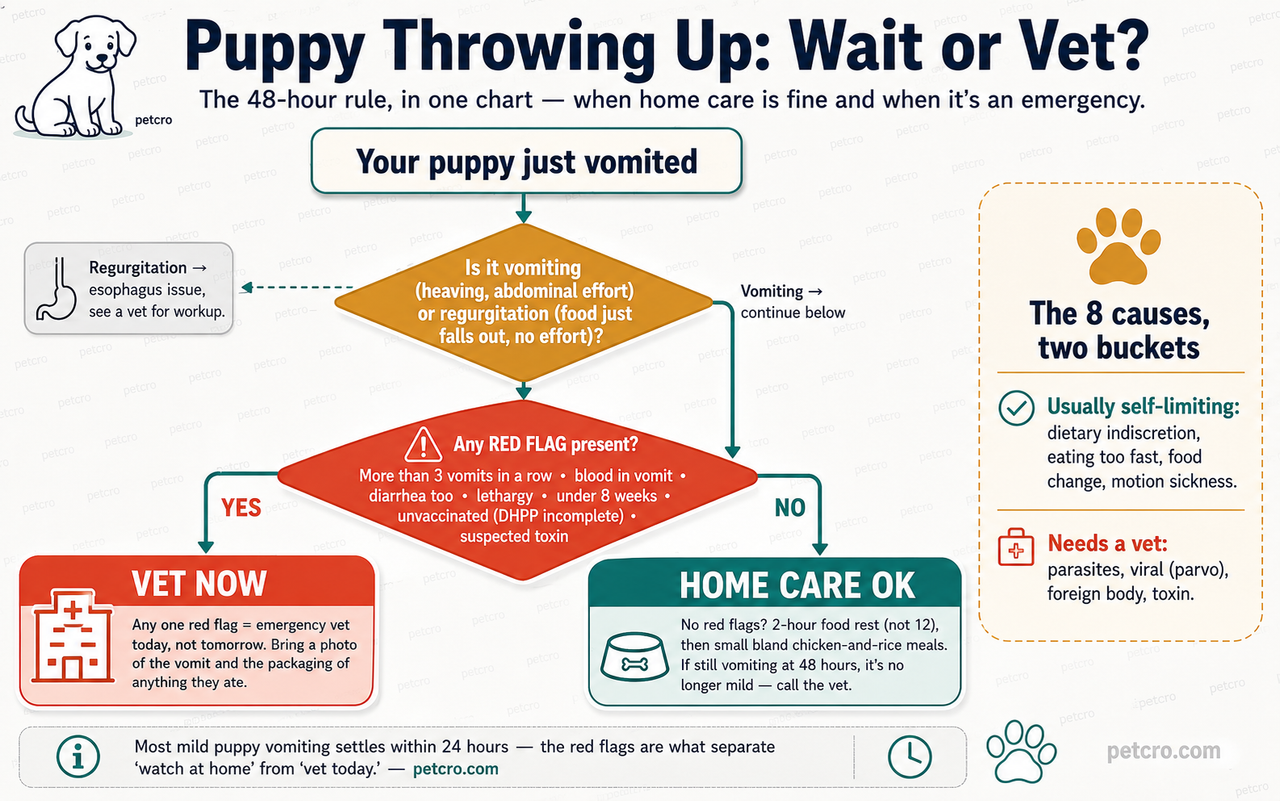
A puppy throwing up has 8 common causes — mostly mild, a few are emergencies. Mild cases settle in 24 hours with a brief food rest and bland reintroduction. The 48-hour rule: if it isn't resolving by then, or any red flag appears (blood, lethargy, fever, repeated vomits), call the vet — sooner if the DHPP series isn't complete.
TL;DR: A puppy that vomits once, perks back up, and keeps water down is usually fine — 2-hour food rest, then a small bland meal. Two or more vomits in a row, any blood, any lethargy, or any unvaccinated puppy with gut symptoms turns this into "vet now." Don't fast a puppy for hours like an adult dog; their glucose reserves are too small.
🚨 The fast version: Vomiting + diarrhea + lethargy in an under-vaccinated puppy = emergency vet today. See our parvo symptoms guide for the life-threatening pattern that hides behind early-stage vomiting.
Vomiting vs regurgitation — get this straight first
Many "my puppy is throwing up" calls turn out to be one of two completely different things, and the distinction changes what's wrong and what to do. The Merck Veterinary Manual draws the line: vomiting is active, forceful ejection of stomach contents with visible abdominal contractions; regurgitation is passive, with food sliding back up the esophagus without any heave.
Vomiting: heaving / retching before anything comes up; puppy looks distressed (lip-licking, drooling, hunched posture); partly digested food, yellow bile, white foam, or liquid.
Regurgitation: food just falls out, often within minutes of eating; no heaving, no abdominal effort, no distress; food looks tube-shaped and undigested; often happens with the head down.
Regurgitation isn't a stomach problem — it's an esophagus problem (megaesophagus, esophageal foreign body, or eating too fast in flat-faced breeds). Persistent regurgitation needs a vet workup but isn't the same emergency profile as vomiting. If that's what you're seeing, the puppy first vet visit guide covers what to expect at workup.
The rest of this guide is about vomiting.
What's making your puppy throw up — the 8 main causes
Puppies vomit easily. Their digestive systems are still developing, their gut microbiome is still stabilizing, and they eat things they shouldn't. Most of the time, it's mild and self-limiting. But the causes range from "ate too fast" to "viral infection with a 48-to-72-hour treatment window," so the first job is figuring out which kind you're dealing with.
1. Dietary indiscretion — the most common cause. Puppy ate something they shouldn't: garbage, table scraps, fatty food (cheese, butter, gravy). One or two vomits within hours of eating, no fever, puppy bright. Usually settles in 12 to 24 hours with a brief food rest.
2. Eating too fast — puppy inhales a meal so quickly it triggers a gastric stretch reflex and brings most of it back up within minutes. Vomit looks like undigested kibble in a small puddle. Puppy is fine immediately after. Slow-feeder bowls and smaller portions usually resolve it.
3. Food change too fast — switching kibble brands without a 5-to-7-day transition mix. Vomiting plus loose stool, no blood, puppy energetic. Slows down once you slow down the transition.
4. Motion sickness — common in puppies under 6 months because their inner-ear vestibular system isn't fully developed. Vomiting on car rides, often preceded by drooling and lip-licking. Usually settles as the puppy matures; a vet-prescribed antiemetic (maropitant) helps for travel.
5. Intestinal parasites — giardia, coccidia, hookworms, roundworms, whipworms, tapeworms. Vomiting may show up alongside diarrhea, weight loss despite normal eating, or a pot-bellied look. Needs a fecal test to identify and parasite-specific medication, not OTC dewormer alone.
6. Viral infections — parvovirus, distemper, canine coronavirus (CCoV — dog-specific GI virus, not related to COVID). Emergencies in unvaccinated puppies. Lethargy and appetite loss come first, then sudden onset of high fever, repeated vomiting, and profuse often-bloody diarrhea. The Cornell Baker Institute documents parvo's 3-to-7-day incubation followed by rapid escalation; the parvo symptoms guide covers the full picture.
7. Foreign-body obstruction — swallowed sock, toy fragment, bone shard, ribbon, hair tie, peach pit. Vomiting is often the loudest symptom — repeated, sometimes projectile, sometimes with no stool passing through. Needs imaging and possibly surgery. A puppy that vomits repeatedly and stops passing stool needs the vet today, not tomorrow.
8. Toxin ingestion — chocolate, xylitol, grapes/raisins, onion/garlic, antifreeze, household cleaners, ibuprofen, acetaminophen, certain houseplants. Vomiting is often the first sign the body is trying to clear a poison. Call the ASPCA Animal Poison Control on 1-888-426-4435 — the consult fee is far cheaper than a delayed case. See our common dog toxins reference.
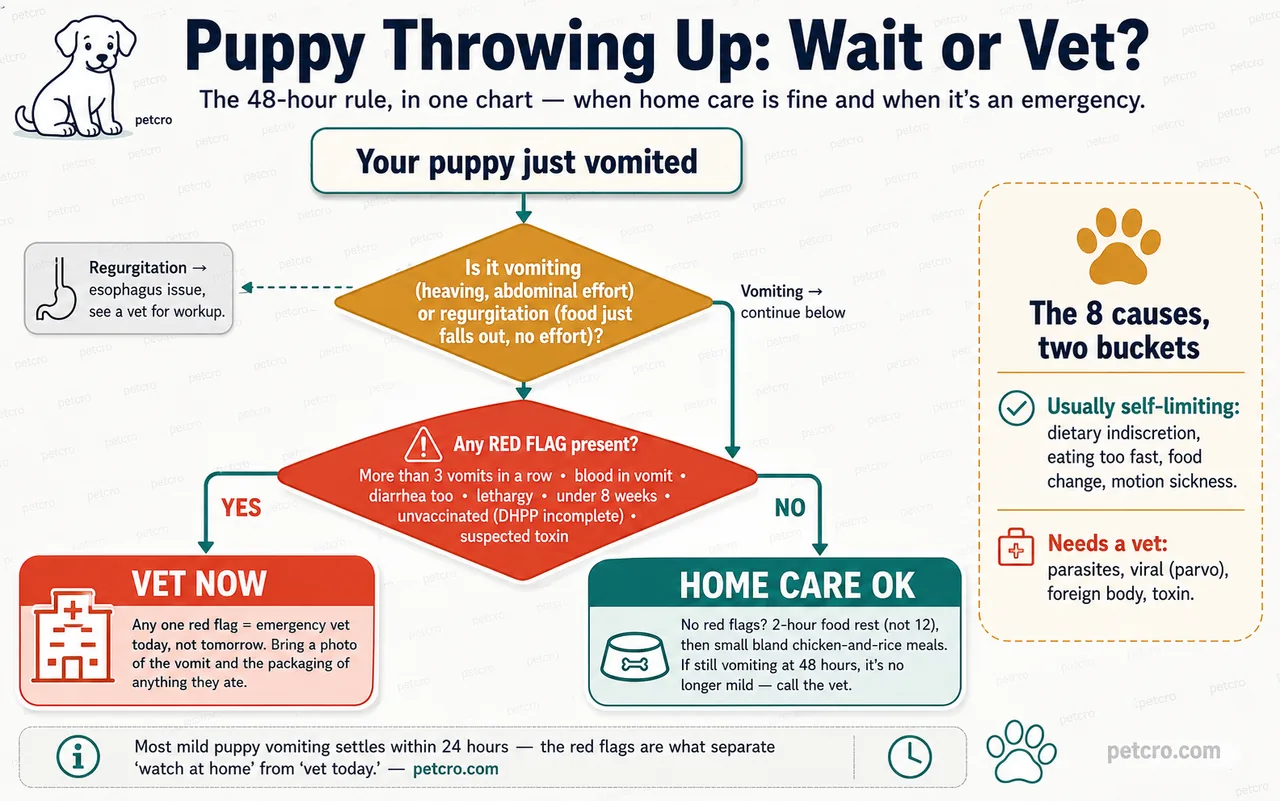
The 8 causes split into two practical buckets: the first 4 are usually self-limiting (you watch and feed sensibly), and the last 4 need a vet (parasites and viruses need diagnostics, foreign body needs imaging, toxin is a poison-control call). Below: how the vomit itself helps you tell which bucket you're in.
Reading the vomit — what color and content tell you
The look of what comes up isn't a diagnosis, but it narrows the field. Use this as a rough sorting guide, not a substitute for the red-flags checklist further down.
| What you're seeing | What it usually means |
|---|---|
| Undigested food, soon after a meal | Ate too fast, or food intolerance. Usually mild. Slow-feeder bowls help. |
| Partly digested food, hours after a meal | Dietary indiscretion or food change. Watch + bland reintroduction. |
| Yellow or green bile (often a thin liquid) | Empty stomach — common in early-morning vomiting. Smaller frequent meals usually fix it. Frequent bile vomiting can also signal pancreatitis; vet visit if more than once a week. |
| White foam | Acid reflux, empty stomach, or kennel cough (especially with coughing). One episode = monitor; repeated foam or any cough = vet. |
| Mucus only | Mild gastritis or stomach lining irritation. Usually resolves quickly with food rest. |
| Bright red blood (small amount) | Could be a mouth injury (swallowed blood), early gastric irritation, or early ulcer. Vet today — any blood in vomit gets called in, even a streak. |
| Bright red blood (larger volume, repeated) | Active GI bleeding. Emergency vet now. |
| Dark, coffee-grounds appearance | Partly digested blood from higher in the GI tract. Emergency vet now. |
| Grass and a single small vomit | Usually not concerning if the puppy is otherwise bright. Grass-then-vomit is a normal pattern; only worrying if repeated or the puppy seems unwell. |
One pattern that gets missed often: vomit smelling sweet or unusually sickly-sweet, especially in a young unvaccinated puppy, is a parvo-pattern signal vet techs recognize immediately. Combined with lethargy and any diarrhea, it's an emergency-vet trip today, not tomorrow.
The 48-hour rule — when to wait, when to call the vet
Most mild puppy vomiting cases resolve within 24 hours with home care. The 48-hour rule is the same bright-line cutoff we use for puppy diarrhea: if it isn't improving by then, what looked like a mild case isn't mild anymore, and you need a vet exam.
During the 48-hour window — what counts as a mild case worth observing:
- One or two vomits, well-spaced (more than an hour apart)
- Puppy is bright, alert, greeting you at the door
- Drinking water and keeping it down
- No blood in the vomit
- No diarrhea alongside
- No fever (normal puppy temperature is 101–102.5°F / 38.3–39.2°C)
- DHPP series is complete — past the 16-week dose, with immunity locked in
- Older than 8 weeks (younger or smaller puppies dehydrate too fast for any home-observation window)
If all of those are true, you have time to try a brief food rest and a careful reintroduction. See the 5-step protocol below.
At the 48-hour mark — what happens next:
- No vomiting for the last 24 hours and eating normally: you're past it. Resume normal feeding gradually over another 24 to 48 hours.
- Still vomiting occasionally: call the vet today. Mild vomiting that doesn't settle in 48 hours with bland reintroduction is no longer mild.
- Any red flag has appeared: stop waiting, call now.
The 48-hour rule isn't a guarantee — it's a structured way to give mild cases time to resolve without missing the window for serious ones. Younger puppies, unvaccinated puppies, and any puppy with red flags skip the wait entirely.
The red flags that mean go to the vet now
Any one of these in a vomiting puppy is an emergency. Don't push fluids by mouth, don't ride it out overnight — call the nearest emergency vet:
- More than 3 vomits in a row, or vomiting more than once an hour
- Repeated unproductive heaving (retches but nothing comes up) — can signal bloat, especially in deep-chested breeds
- Blood in vomit — bright red or dark "coffee-grounds"
- Diarrhea alongside — especially bloody, the parvo-pattern combination
- Lethargy — not greeting you, not interested in treats, not lifting their head
- Fever above 103°F (39.4°C) or sub-normal below 99°F (37.2°C)
- Dehydration signs — tacky or dry gums, sunken eyes, skin doesn't snap back when pinched (skin tent)
- Puppy under 8 weeks old — too little fluid reserve to wait
- DHPP series not complete — vomiting in an under-vaccinated puppy is presumed parvo until ruled out
- Suspected toxin — call ASPCA Animal Poison Control on 1-888-426-4435. Don't induce vomiting unless your vet specifically tells you to
Bring what you can: photo of the vomit, recent feeding log, brand/lot of any food changed this week, packaging from anything they may have eaten. Call ahead — most emergency vets will route a possibly-parvo puppy through a side entrance to protect other dogs in the waiting room.
Home care for mild puppy vomiting — the 5-step protocol
If your puppy passes the 48-hour-rule entry checks (one or two well-spaced vomits, bright between episodes, no blood, no diarrhea, no fever, DHPP series complete, over 8 weeks), home care is reasonable. The 5-step protocol:
Step 1 - Withhold food for 2 hours, not 12
Adult dogs can sometimes tolerate a 12-to-24-hour fast for acute GI upset. Puppies cannot — glucose reserves are small, especially in toy and small breeds, and a long fast risks hypoglycemia, which is its own emergency. A 2-hour food rest is the longest window most puppies should go between meals. Under 12 weeks or under 5 pounds, that window shrinks to about 1 hour.
Water stays available the whole time. Don't push fluids by syringe — risks aspiration if vomiting restarts.
Step 2 - Offer a small bland meal
After the 2-hour rest, offer a small portion of plain boiled boneless skinless chicken and plain white rice (1 part chicken to 2 parts rice). "Small" means a tablespoon or two for a 5-pound puppy, up to about a quarter of a normal meal for a larger puppy. Test the stomach with something easy to digest.
If it stays down 30 minutes, offer another small portion. Keep going with 4 small bland meals across the day, not 2 normal-size ones.
Step 3 - Add a strain-specific probiotic
The strongest canine evidence backs Enterococcus faecium SF68 (in Purina Pro Plan FortiFlora) for acute GI upset and Saccharomyces boulardii for antibiotic-associated cases. For the full strain breakdown and product picks, see our best probiotics for puppies guide. Skip generic "live cultures" or yogurt — they lack the CFU count and strain specificity to help.
Step 4 - Track frequency and content
Mental log of vomit count, content, and time. You're looking for the trend to flatten: fewer episodes, lighter content, longer gaps. By hour 12 to 24 you want zero vomiting and normal water intake. If it's still happening at hour 24 — even occasionally — the home-care window is closing.
If diarrhea also develops, switch to the puppy diarrhea protocol and call the vet sooner. Vomiting and diarrhea together dehydrate faster than either alone.
Step 5 - Transition back to normal food gradually
Once vomiting has stopped for 24 hours and the bland diet is staying down, transition back to your puppy's regular food over 3 to 5 days — 25% regular / 75% bland on day one, working up to 100% by day five. Sudden food shifts are a cause of vomiting on their own.
What does not work as home care:
- Pepto-Bismol — bismuth subsalicylate is aspirin-related and can be toxic to dogs at certain doses. The "pink Pepto" internet advice is wrong for puppies.
- Imodium (loperamide) — some breeds (collies, Australian shepherds, related herders) have an MDR1 mutation that makes loperamide neurotoxic; it also masks the symptoms you're trying to read.
- Pedialyte by mouth — doesn't address electrolyte loss at the scale puppy vomiting causes, and comes back up if vomiting restarts. IV fluids are the only effective rehydration.
- Fasting without bland reintroduction — dangerous in puppies in a way it isn't in adults.
- Waiting it out overnight — for unvaccinated puppies, overnight delay is the main reason cases get bad. Parvo is most treatable in the first 48 hours after symptoms.
When it's parvo — the cluster pillar callout
Parvo turns puppy vomiting from a home-care problem into a survive-the-week problem. The pattern: lethargy and appetite loss first (24-48 hours before gut symptoms), then sudden repeated vomiting, profuse often-bloody diarrhea, fever then hypothermia, rapid dehydration. Survival drops sharply 48 to 72 hours after first symptoms.
No probiotic, no bland diet, no home remedy treats parvo. Treatment is hospital-only — IV fluids, antiemetics (maropitant is standard), broad-spectrum IV antibiotics, sometimes plasma transfusion. Full clinical picture and 7-symptom progression in our parvo symptoms guide.
The 16-week DHPP dose plus 7-10 days of seroconversion locks in immunity. Until then, any vomiting should be treated as "rule out parvo first" rather than "try home care first." A SNAP parvo test runs in about 10 minutes at the vet's office.
Why puppies dehydrate faster than adult dogs
Worth understanding because dehydration is the actual mechanism that makes puppy vomiting risky. Three reasons puppies dehydrate faster:
1. Absolute fluid reserves are tiny. Neonatal puppies start at ~80% body water, declining toward the adult-dog ~60% norm with maturity. A 5-pound puppy losing 8% of body weight to vomiting can reach severe dehydration in hours, not days — adults have more reserve to compensate.
2. Glucose reserves are minimal. Puppies have less liver glycogen than adults. Combined with reduced intake during vomiting, they develop hypoglycemia faster — especially toy and small breeds. This is why fasting a puppy is dangerous in a way fasting an adult isn't.
3. Electrolyte balance is fragile. Vomiting costs hydrogen ions (stomach acid), sodium, potassium, chloride. Puppy kidneys are less efficient at compensating. Severe vomiting tips into metabolic alkalosis — opposite of diarrhea's acidosis pattern — and combining both accelerates the imbalance in both directions.
Practical takeaway: a puppy vomiting more than 3 times in a few hours, even if bright between vomits, is at real dehydration risk. The 48-hour rule isn't arbitrary — it's where puppy physiology hits the wall.
This guide is general guidance, not veterinary advice. For your specific dog's nutrition, health, or behavior needs, consult your veterinarian.
Frequently asked questions
Why is my puppy throwing up but acting normal?
Single-episode vomiting in a puppy that perks back up, drinks water, and acts normal is usually dietary indiscretion or eating-too-fast. Withhold food for 2 hours, offer a small bland meal, and watch for a second episode. If they vomit again within 24 hours, or any red flag appears (lethargy, blood, diarrhea, fever), call the vet.
What can I give my puppy for vomiting at home?
For mild cases in a fully-vaccinated puppy over 8 weeks: a 2-hour food rest, then plain boiled chicken and white rice (1 part chicken to 2 parts rice) plus a strain-specific probiotic like Purina Pro Plan FortiFlora. Skip Pepto-Bismol (potentially toxic), Imodium / loperamide (neurotoxic in MDR1 breeds), and yogurt (wrong CFU). When in doubt — especially under 12 weeks or unvaccinated — vet first.
Why is my puppy throwing up yellow bile?
Yellow or green bile usually means an empty stomach — common in early-morning vomiting after a long overnight gap. Fix: smaller, more frequent meals, including a late-evening snack. If bile vomiting happens more than once a week, or alongside lethargy or weight loss, it can signal pancreatitis or GI disease — vet workup. See also a dog throwing up yellow bile in adults.
Is it normal for a new puppy to throw up?
Mild vomiting in the first few days after bringing a puppy home is common — new-environment stress, different food, different water, travel. Settles in 24 to 48 hours as the puppy adjusts. Our bringing a new puppy home guide covers the 14-day arrival timeline. If vomiting persists past 48 hours or any red flag appears, that's a vet visit.
How long does puppy vomiting last?
Mild dietary cases resolve in 12 to 24 hours with a brief food rest and bland reintroduction. If it's still happening at 48 hours, it's no longer mild — vet exam. Parasites cause chronic intermittent vomiting that lasts weeks until treated. Viral infections progress fast — 48 to 72 hours from first symptoms is the critical window for parvo specifically.
When should I worry about puppy vomiting?
Call the vet when any of these is true: more than 3 vomits in a row, vomiting more than once an hour, blood in vomit, diarrhea alongside, lethargy, fever above 103°F or below 99°F, dehydration signs (tacky gums, sunken eyes, skin tent), puppy under 8 weeks, or DHPP series incomplete. Also call if symptoms persist past 48 hours. Any single red flag skips home care.
My puppy threw up food after eating — what do I do?
Vomiting undigested food shortly after a meal usually means the puppy ate too fast or overate. After a 2-hour break, offer half the usual portion and watch. Slow-feeder bowls and feeding separated from littermates usually resolve it. Repeated undigested-food vomiting can signal food intolerance — vet can recommend a hypoallergenic trial.
TL;DR — the puppy vomiting cheat sheet
- The 48-hour rule: if mild vomiting isn't fully resolved by hour 48, it's no longer mild — vet visit.
- 8 common causes: dietary indiscretion, eating too fast, food change, motion sickness, parasites, viral infections, foreign body, toxin — first 4 self-limit, last 4 need a vet
- Color/content map: bile = empty stomach; foam = acid or kennel cough; any blood = vet today; sweet smell + lethargy + diarrhea in unvaccinated puppy = parvo pattern
- Red flags = go to vet now: blood, more than 3 vomits in a row, lethargy, fever, sub-normal temperature, dehydration signs, diarrhea alongside, puppy under 8 weeks, DHPP series incomplete
- Home care: 2-hour food rest (NOT 12+ hours like adults), then small bland chicken-and-rice meals + strain-specific probiotic, transition back over 3-5 days
- Skip: Pepto-Bismol, Imodium/loperamide, oral Pedialyte at scale, long fasts — none are appropriate for puppy GI
- Parvo trumps everything in an unvaccinated puppy — survival drops sharply 48 to 72 hours after first symptoms appear; no home remedy treats it
If your puppy is sick rather than mildly off, the answer is the vet, not a longer wait.
Sources & further reading
- Merck Veterinary Manual — Vomiting in Dogs — clinical reference for the vomiting vs regurgitation distinction, red flags, and diagnostic workup.
- Cornell University Baker Institute — Canine Parvovirus — for the most serious cause of puppy vomiting.
- ASPCA — Animal Poison Control — 1-888-426-4435, the call to make if a toxin is suspected.
- AKC — Puppy Shots: A Complete Guide — for the DHPP schedule referenced throughout.
- Merck Veterinary Manual — Probiotics for Animals — clinical reference on probiotic mechanisms and evidence in companion animals.
More from Petcro's puppy health cluster
- Puppy Hiccups — the rhythmic "hic" that can look like vomiting but is harmless.
- Parvo Symptoms in Puppies — when vomiting is a life-threatening emergency.
- Puppy Diarrhea: Causes, Red Flags, and the 48-Hour Rule — sister symptom-hub post.
- Probiotics for Puppies with Diarrhea — 3-step decision protocol.
- Best Probiotics for Puppies (2026 Guide) — strain-by-strain picks.
- Puppy First Vet Visit — what to set up in the first week.
- Bringing a New Puppy Home — 14-day arrival timeline.
- Common Dog Toxins Reference — foods, plants, and household items toxic to dogs.
Petcro is reader-supported. We may earn an affiliate commission when you click through links to products in this guide. Our editorial picks are independent of any commercial relationship with any veterinary product or service.