Black Dog Poop: Is It Blood, or Something Harmless?
Black dog poop can be harmless — a dark diet, iron, or Pepto — or melena, digested blood that's a vet emergency. Here's how to tell, and when to worry.
Black dog poop has two very different explanations. Often it's harmless — a dark diet, an iron supplement, or a dose of Pepto-Bismol. But black, tarry, sticky stool can be melena: digested blood, usually from the upper gut, which is a vet emergency. The texture, and your dog's other signs, tell you which one you're looking at.
TL;DR: Black, tarry, sticky, shiny stool (melena) is digested blood, usually from the stomach or upper intestine — treat it as urgent, same-day vet care, especially with pale gums, vomiting, weakness, or a known toxin. Firm, normal-textured dark stool in a bright dog is usually just diet or a supplement — organ meat, a dark food, iron, or bismuth (Pepto-Bismol/Kaopectate), which turns stool black. When in doubt about the difference, treat it as blood and call your vet.
Is black dog poop dangerous?
It depends entirely on which kind of black you're seeing — and the good news is that texture plus your dog's other signs usually point clearly one way once you know what to look for.
| What you're seeing | What it usually means | What to do |
|---|---|---|
| 🔴 Black, tarry, sticky or shiny stool (like road tar), often with a strong metallic or foul smell — especially with pale gums, vomiting, weakness, appetite loss, or a possible toxin | Melena — digested blood, usually from the upper gut | Vet the same day; ER now if your dog is weak, pale-gummed, collapsing, or has a painful belly |
| 🟢 Firm, formed, normal-textured dark or blackish stool in a bright, well dog that's eating, drinking, and acting normally — after a dark meal, a supplement, or Pepto | A harmless dietary or medication cause | Note the recent food/meds. Only if the stool is firm and you can name the dark food or med, watch the next stool or two over the next day — but call your vet if you can't pin a cause, the texture turns tarry or sticky, or anything else changes. (Pepto and iron can irritate the gut themselves, so any tarriness means stop watching and call.) |
If you can't confidently place your dog's stool in the green row — or if there's any other sign of illness — treat it as the red row and call your vet. Digested blood is not something to wait out.
Melena: when black poop means digested blood
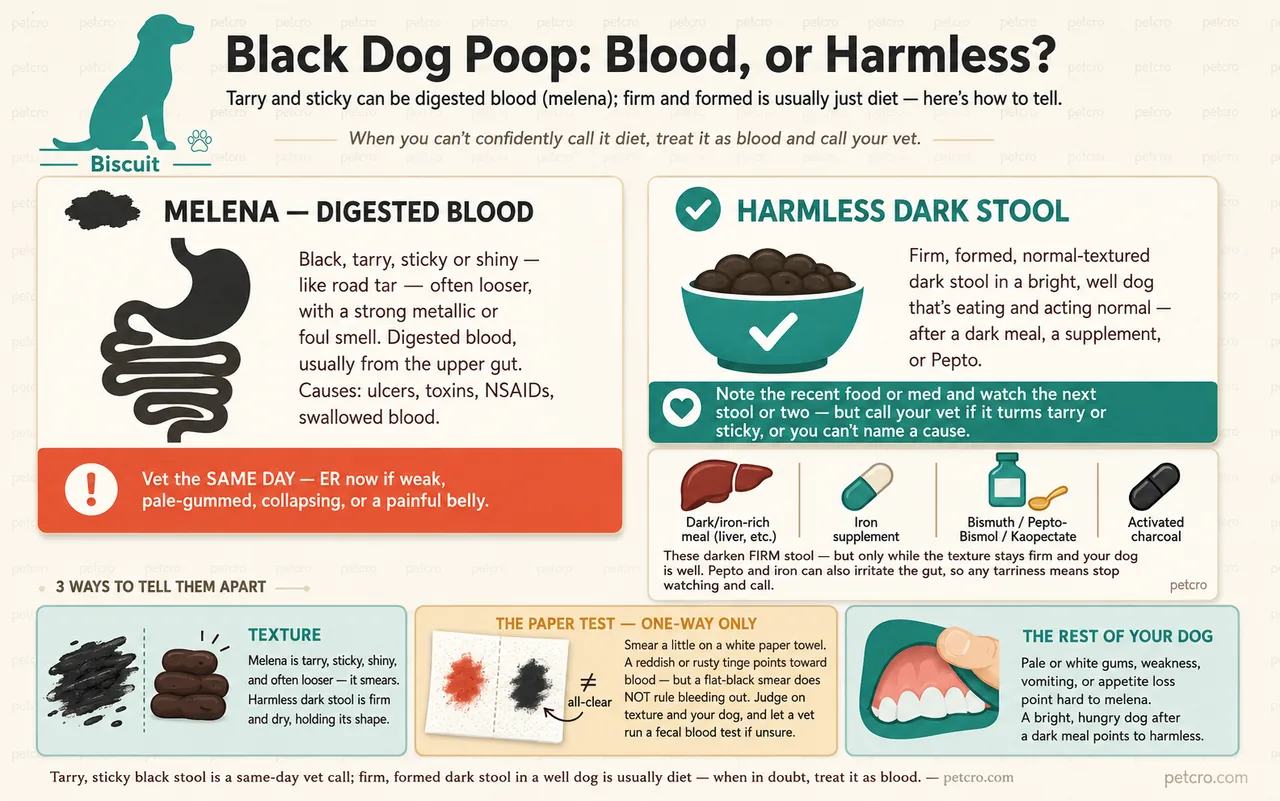
Melena is the medical name for stool that turns black and tarry because it contains digested blood. Blood that bleeds high in the tract — the stomach or small intestine — gets broken down as it travels, turning it dark, sticky, and tar-like by the time it comes out. That's the opposite of fresh red blood, which comes from lower down; our guide on bloody stool in dogs walks through the full red-vs-black decode.
Melena matters because the bleeding behind it is often serious — ulcers (frequently from human NSAIDs like ibuprofen), toxins, tumors, and more; that same red-vs-black guide covers every cause. The takeaway here is simpler: any genuine melena is a same-day vet visit — an emergency if your dog is also weak, pale-gummed, vomiting, or has a painful belly. Two causes are worth flagging on their own: anticoagulant rodenticide (rat bait) can cause internal bleeding while a dog still looks bright, so a possible exposure is an emergency (see our toxic-foods reference); and blood swallowed from higher up — including vomiting blood — can come out as melena.
Harmless reasons for dark dog poop
Plenty of black or very dark stool has nothing to do with bleeding. The common culprits:
- A dark or iron-rich diet — organ meats (especially liver), blood meal in some foods, raw or bone-heavy diets, and very dark foods like blueberries or blackberries can all darken stool.
- Iron supplements — a classic, well-known cause of black stool in dogs and people alike, but only when the stool stays firm and normal in texture.
- Bismuth subsalicylate — Pepto-Bismol or Kaopectate — reacts in the gut to turn stool black or gray-black for a day or two after a dose — again, only when the stool stays firm and normal in texture. (Only give these on your vet's advice; they contain salicylate, which isn't safe for every dog.)
- Activated charcoal — turns stool black for a day or two after dosing. But charcoal is given for poisonings — some of which (rat bait, an NSAID overdose) can themselves cause internal bleeding — so don't use it to explain away a tarry or loose black stool; if your dog is at all off, treat it as blood and call the vet who treated the toxin.
The tell with these is that the stool stays firm and normal in texture, and your dog is otherwise completely well — bright, eating, drinking, and acting like themselves.
How to tell melena from harmless dark stool
You don't need a lab to tell melena from a harmless dark stool in dogs. Three checks do most of the work:
- Texture. Melena is tarry, sticky, shiny, and often looser — it smears. Harmless dark stool is usually firm and dry, holding a normal shape.
- The paper test (one-way only). Smear a little stool on a white paper towel. A reddish or rusty-brown tinge points toward blood — but the reverse isn't reassuring: digested (melena) blood is often uniformly black and can smear with no red at all. A flat-black smear does not rule out bleeding, so judge mainly on texture and your dog's other signs, and let a vet run a fecal occult blood test if there's any doubt.
- The rest of your dog. This matters most. Pale or white gums, weakness, lethargy, vomiting (especially coffee-ground colored), appetite loss, or weight loss point hard toward melena. A bright, hungry, normal dog after a dark meal or a Pepto dose points toward harmless.
Then ask the obvious question: did anything change? A new dark food, a supplement, or a recent dose of Pepto-Bismol makes a benign cause far more likely — but it never rules out bleeding, so if your dog has any other sign, don't let the diet explanation talk you out of a vet call.
Why is my dog's poop black — quick recap
If your dog's poop is black, you're choosing between two buckets. Bucket one is blood (melena) — tarry, sticky, foul, often with other signs of illness, and always a vet matter. Bucket two is diet or medication — firm, normal-textured, in a well dog, after something dark went in. When the two are hard to tell apart, the safe default is to treat it as bucket one.
When to see the vet
Call your vet the same day for any stool you believe is truly tarry/melena, or any black stool you can't confidently explain — and go to an emergency clinic now if your dog also has pale or white gums, weakness or collapse, repeated vomiting, a swollen or painful belly, or a known toxin or rodenticide exposure. Bright, formed, clearly diet-related dark stool in a normal dog can usually wait for a routine mention, but a quick call to confirm is never wrong. Bring a photo, and a fresh sample if you can.
This guide is general guidance, not veterinary advice. For your specific dog's nutrition, health, or behavior needs, consult your veterinarian.
Frequently asked questions
Is black dog poop an emergency?
It can be. Black, tarry, sticky stool (melena) is digested blood, usually from the upper gut, and is at least a same-day vet visit — an emergency if your dog is also weak, pale-gummed, vomiting, or has a painful belly. Firm, normal-textured black stool in a bright dog after a dark meal, an iron supplement, or Pepto-Bismol is usually harmless, but a quick call to confirm is sensible.
What does black, tarry dog poop mean?
Black, tarry, sticky stool is called melena, and it means blood is being digested somewhere high in the tract — the stomach or small intestine. Common causes include ulcers (often from human NSAIDs), toxins like rat bait, swallowed blood, and tumors. Because the underlying bleeding can be serious, genuine melena always warrants a prompt vet visit.
Can food or supplements make my dog's poop black?
Yes. Organ meats, blood meal in some foods, dark foods like blueberries, iron supplements, and bismuth medications (Pepto-Bismol, Kaopectate) can all turn stool black or very dark. The difference from melena is that these stools stay firm and normal in texture, and the dog is otherwise completely well.
Can Pepto-Bismol turn my dog's poop black?
Yes — the bismuth in Pepto-Bismol and Kaopectate reacts in the gut and commonly darkens stool to black or gray-black for a day or two. It's expected and harmless in itself. Only give these medications on your vet's advice, though, since they contain salicylate that isn't safe for every dog.
How do I know if black poop is blood?
Look at texture, run a one-way paper test, and check your dog. Melena is tarry, sticky, and shiny; on white paper a reddish tinge suggests blood, but a flat-black smear does not rule it out (digested blood often smears black). It also tends to come with pale gums, lethargy, vomiting, or appetite loss. A firm, normal-textured black stool in a bright, hungry dog after something dark went in is more likely to be diet — but judge on texture and your dog's other signs, not the smear alone. When you can't tell, treat it as blood and call your vet.
My dog's poop is black but he's acting normal — should I worry?
A bright dog with a single firm, formed dark stool and a clear recent cause — a dark meal, iron, or a Pepto dose — is usually fine to watch closely. But "acting normal" doesn't rule out early bleeding, so if the stool is at all tarry or sticky, if you can't name a cause, or if a toxin is even possible, don't wait — call your vet the same day.
TL;DR — the black dog poop cheat sheet
- Black, tarry, sticky, shiny stool (melena) = digested blood = a same-day vet visit — and an emergency with pale gums, vomiting, weakness, or a painful belly.
- Firm, normal-textured dark stool in a bright, well dog is usually diet or medication, not blood.
- Common harmless causes: organ meat and dark foods, iron supplements, and bismuth (Pepto-Bismol/Kaopectate).
- Tell them apart by texture, the paper-towel test, and your dog's other signs — pale gums or lethargy point to blood.
- Anticoagulant rat bait can cause bleeding while a dog still looks bright — a possible exposure is an emergency.
- When you can't confidently call it diet, treat it as blood and phone your vet.
If the stool is tarry or your dog is off in any way, that's a same-day call — not a wait-and-see.
Sources & further reading
- Merck Veterinary Manual — Disorders of the Stomach and Intestines in Dogs — on GI bleeding, melena, and when dark stool needs a vet.
- AKC — Dog Diarrhea: Causes, Treatment, and Prevention — stool clues and the red flags that need veterinary care.
- petMD — Diarrhea in Dogs — stool color and consistency as health signals.
- Cornell Riney Canine Health Center — Diarrhea — a vet-school reference on causes and management.
- ASPCA — Animal Poison Control — (888) 426-4435, the call to make if a toxin like rodenticide is suspected.
More from Petcro
- Bloody Stool in Dogs: Red vs Black — the full decode of fresh red blood vs black, tarry melena.
- Bloody Diarrhea in Dogs — when blood in loose stool is an emergency.
- Dog Throwing Up Blood — upper-GI bleeding that can also show up as melena.
- Bland Diet for Dogs With Diarrhea — gentle feeding while a settled gut recovers.
- Stool-Health Guide — read your dog's stool color and consistency at a glance.
- Toxic Foods & Household Poisons Reference — what's dangerous, including rodenticides that cause internal bleeding.
Petcro is reader-supported. We may earn an affiliate commission when you click through links to products in this guide. Our editorial picks are independent of any commercial relationship with the brands we mention.