Bland Diet for Dogs With Diarrhea: Chicken, Rice & When to Skip It
Bland diet for dogs with diarrhea: the chicken-and-rice recipe, portions, how long to feed it, and the red flags that mean skip the rice and call your vet.

A bland diet for dogs with diarrhea is plain, low-fat, easy-to-digest food — boiled skinless chicken and plain white rice, no oil or seasoning — fed in small, frequent meals for a day or two to rest an irritated gut. It suits mild cases in an otherwise-well adult dog; blood, vomiting, or lethargy means call your vet.
TL;DR: For mild diarrhea in an otherwise-well adult dog, feed boiled skinless chicken and plain white rice (about 2 parts rice to 1 part chicken), no fat or seasoning, in small frequent meals for 2–3 days, then transition back to normal food over 3–5 days. Keep water available — dehydration is the real danger. Don't fast a puppy. And call your vet now — not the rice — if there's blood, repeated vomiting, a painful or swollen belly, weakness, or no improvement in 24–48 hours.
What a bland diet does for a dog with diarrhea
Diarrhea is the gut moving things through too fast and pulling in too much water. A bland diet helps because it asks very little of an inflamed digestive tract: it's low in fat (fat is the hardest macronutrient to digest and stimulates the pancreas), low in fiber and residue (less material to process), and highly digestible, so most of it is absorbed high up instead of feeding the problem lower down. The result is gentle calories that let the gut calm down and re-firm the stool.
It is supportive care, not a cure. It does nothing about parasites, an infection, a swallowed sock, or a toxin — which is why the first real question isn't "what's the recipe," it's "is this a case rice can fix at all?"
First, the safety check: when it's NOT a rice-and-chicken case
Most simple "garbage gut" or stress diarrhea settles with a few days of bland food. But a handful of signs mean the home shelf is the wrong tool — these need a vet, and several need one today. The Merck Veterinary Manual is clear that diarrhea with these features warrants prompt veterinary attention rather than home management.
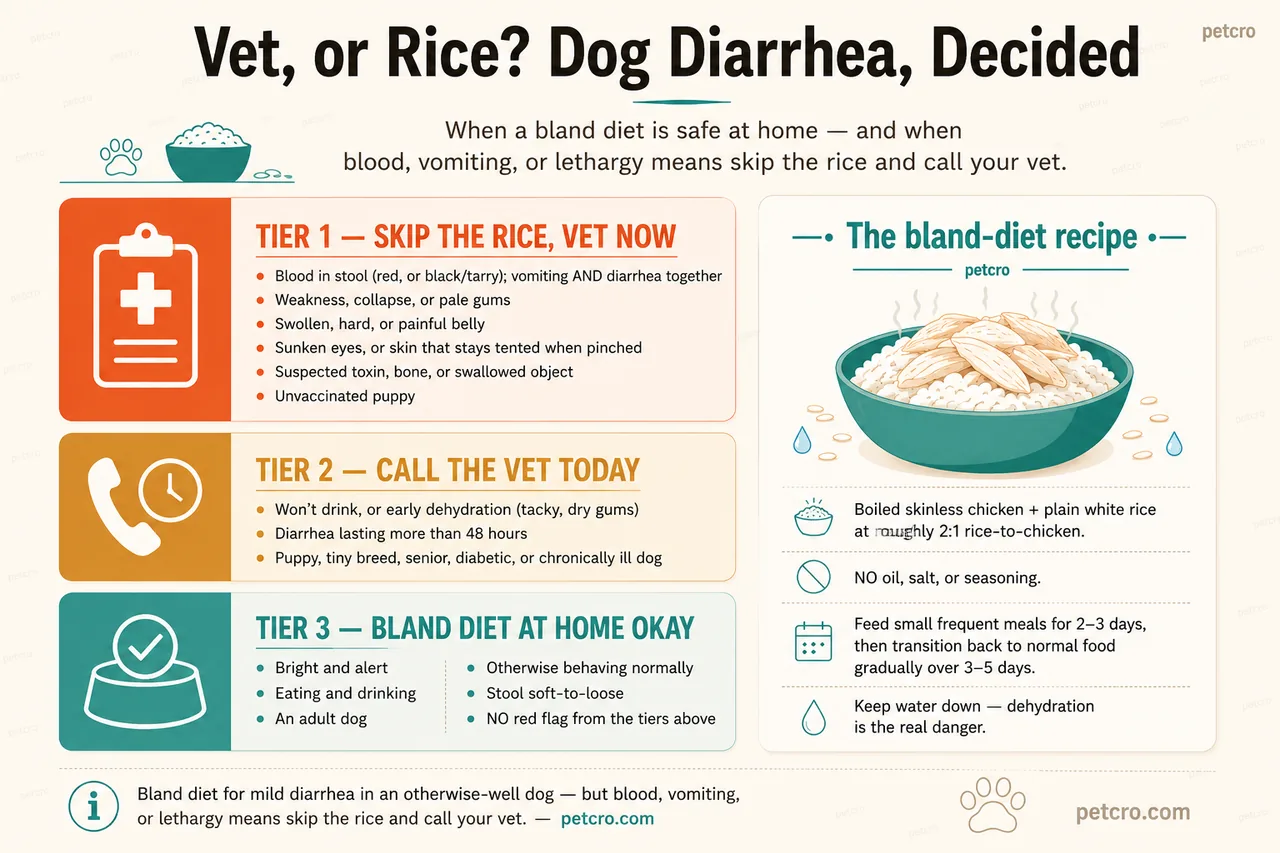
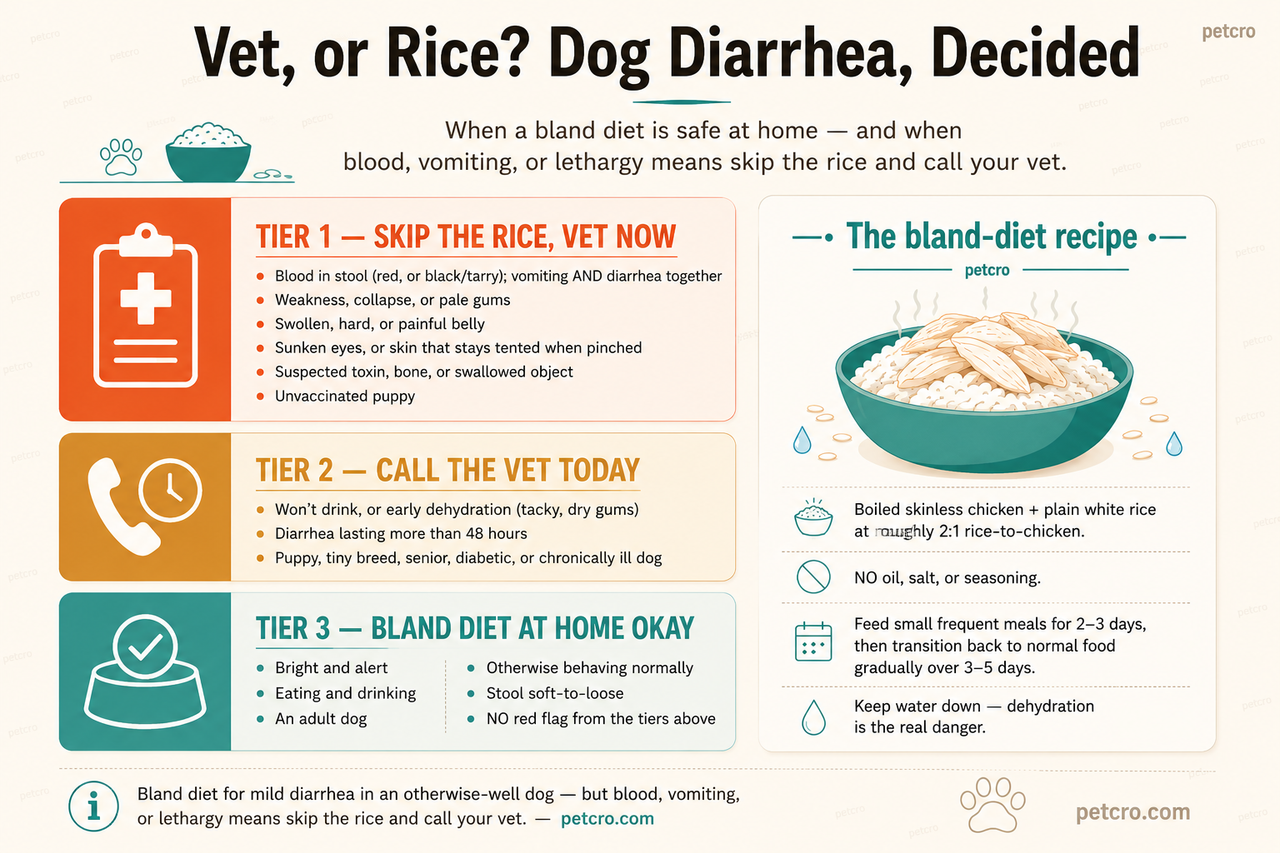
| If you see this | Do this |
|---|---|
| 🔴 Blood — fresh red, or black and tarry (melena); vomiting and diarrhea together; weakness, collapse, or pale gums; a swollen, hard, or painful belly; profuse, watery, "shooting" diarrhea; sunken eyes or skin that stays tented (moderate-to-severe dehydration); a known or suspected toxin, bone, or swallowed object; an unvaccinated puppy | Vet now — same-day, ER if pale gums, collapse, or a hard belly |
| 🟠 Won't drink, or early dehydration (tacky, dry gums); diarrhea lasting more than 48 hours; a young puppy, a tiny breed, or a senior/diabetic/chronically-ill dog | Call your vet today — same-day if your dog also seems weak, flat, or stops drinking |
| 🟢 A bright, playful adult that's eating, drinking, and otherwise normal, with soft-to-loose stool and no red-flag sign | A 2–3 day bland diet at home is reasonable — recheck below |
Two patterns deserve a special callout because owners wait on them and shouldn't: bloody diarrhea in a puppy is parvo until proven otherwise (see parvo and puppy-diarrhea), and diarrhea that arrives with vomiting can be the early shape of a more serious problem — our guides on throwing up white foam and throwing up blood cover when that combination is an emergency.
The bland diet recipe: chicken and rice, step by step
The default answer to what to feed a dog with diarrhea is boiled chicken and white rice. The whole point is plain — no oil, butter, salt, garlic, onion, or broth (garlic and onion are toxic to dogs; check anything you're unsure about against our toxic-foods reference).
- Cook plain white rice in water until soft — a little overcooked is fine. Use white rice, not brown; it's lower in fiber and easier on a runny gut.
- Boil skinless, boneless chicken breast in plain water until fully cooked through. No skin, no bones, no seasoning.
- Drain and shred the chicken, and tip off any fat or oily water. Let both cool to room temperature.
- Mix roughly 2 parts rice to 1 part chicken. The rice is the bulk; the chicken is for palatability and a little protein. Rice-heavy (the 2:1) is gentler on a runny gut; go 50/50 only if your dog won't eat the rice alone.
- Serve small portions, often — see the amounts below — and always have fresh water available.
Don't want chicken, or your dog won't eat it? Equally bland swaps: boiled lean ground beef, drained well of fat; boiled white fish (boneless); plain boiled potato with no skin; or a spoon of plain low-fat cottage cheese mixed in. The AKC's guidance on bland food for an upset stomach notes the same principle: simple, lean, unseasoned, temporary.
How much to feed, and how often
The instinct to give a big, comforting bowl backfires — a large meal stretches the gut and can restart the cramping. Feed small amounts, several times a day: roughly the same daily volume your dog normally eats, split into four to six small servings instead of one or two.
| Dog's weight | Per small meal (approx.) | Meals per day |
|---|---|---|
| Up to 10 lb | 2–4 tablespoons | 4–6 |
| 10–30 lb | ¼–½ cup | 4 |
| 30–60 lb | ½–1 cup | 3–4 |
| 60 lb+ | 1–1½ cups | 3–4 |
These are starting points, not prescriptions — begin on the low side, and if the first couple of small meals stay down and don't trigger more diarrhea, carry on. If you'd like a baseline for your dog's normal daily intake to portion against, our feeding calculator gives a weight-and-activity estimate.
How long should a dog stay on a bland diet?
Two to three days is the usual window. You're looking for the stool to firm up and stay firm for about 24 hours — then it's time to come back off it. A bland diet is intentionally incomplete (it isn't balanced for the long term), so it's a short bridge, not a destination.
Then transition back to normal food gradually, over 3–5 days, mixing a little more of the regular diet into the bland mix each day. Switching straight back to full kibble on day three is the single most common way to relapse the diarrhea you just fixed.
The other half of the answer is a stop sign: if the diarrhea hasn't clearly improved within 24–48 hours, comes back as soon as you re-introduce food, or worsens at any point, stop home-managing and see your vet. "It's been a week of chicken and rice" is a sentence vets hear often, and it usually means something the rice was never going to address.
Beyond chicken and rice: pumpkin, probiotics, and hydration
A few add-ins genuinely help, and one of them matters more than the food:
- Water — the priority. The real danger with diarrhea is dehydration. Keep fresh water available at all times and watch for tacky gums or a skin "tent" that's slow to flatten. A dog that won't drink, or that's losing more than they take in, needs the vet for fluids. Our stool-health guide helps you read consistency and color as you track recovery.
- Plain canned pumpkin. A spoonful of 100% pumpkin puree — not pie filling (pie filling has sugar and spices) — adds gentle, water-absorbing fiber. The AKC notes pumpkin can help firm a loose stool; think 1 teaspoon for a small dog up to 1–2 tablespoons for a large one, mixed in.
- Probiotics. A dog-specific probiotic can help re-balance gut bacteria during recovery. Use a product made for dogs rather than a human supplement, and ask your vet which they recommend.
What to skip on your own: human anti-diarrhea medicines. Don't reach for Imodium (loperamide) or Pepto-Bismol without veterinary direction — slowing the gut can trap an infection or toxin inside (and loperamide is outright dangerous for some herding breeds), and Pepto's bismuth turns the stool black, which can hide the very bleeding your vet is watching for.
Puppies, seniors, and small breeds: what changes
Who your dog is moves the line between "watch at home" and "call now":
- Puppies. Never fast a puppy, and don't wait diarrhea out — small reserves mean dehydration and low blood sugar come fast, and bloody or persistent diarrhea can be parvo. When in doubt with a young pup, call the vet first and feed bland only on their okay.
- Toy and small breeds. Same low-blood-sugar risk: feed small bland meals rather than fasting, and have a lower threshold for a vet call.
- Seniors and dogs with conditions (kidney, liver, diabetes, on medication). Diarrhea can destabilize an existing problem and dehydrate an older dog quickly — loop in your vet early rather than running a multi-day home experiment.
When the bland diet isn't working
If you've done everything right and the stool still isn't firming, the diet isn't the problem — it usually means the cause is something diet alone can't reach: parasites, an infection, a food intolerance, a swallowed object, or an underlying illness. Go back to your vet, and bring details: how long it's been, what the stool looks like (a photo helps), whether there's any blood or vomiting, your dog's energy and appetite, and anything they might have eaten. A fresh stool sample saves a step. That handoff — a real diagnosis — is what gets a stubborn case sorted.
This guide is general guidance, not veterinary advice. For your specific dog's nutrition, health, or behavior needs, consult your veterinarian.
Frequently asked questions
What can I feed my dog with diarrhea?
A plain, low-fat bland diet: boiled skinless chicken breast with plain white rice (about 2 parts rice to 1 part chicken), no oil, salt, or seasoning, in small frequent meals. Boiled lean ground beef, white fish, plain potato, or a little plain canned pumpkin work too. Keep water available, and only home-manage if your dog is otherwise bright with no blood, vomiting, or lethargy.
Is chicken and rice good for a dog with diarrhea?
Yes, for a mild case in an otherwise-healthy adult. Boiled chicken and white rice is low in fat and fiber and highly digestible, so it rests an irritated gut while still providing calories. Keep it plain and temporary — it isn't a complete diet, so use it for 2–3 days, then transition back to normal food. It won't fix parasites, infections, or a swallowed object.
How long does it take for a bland diet to work?
You'll often see the stool start to firm within a day, sometimes sooner. Feed the bland diet until stools are normal for about a day, then transition back to regular food over 3–5 days. If there's no clear improvement by 24–48 hours, the diarrhea worsens, or blood or vomiting appears, that's a vet visit — the cause likely needs more than diet.
Should I fast my dog with diarrhea?
Current vet guidance now leans toward feeding small bland meals early rather than fasting. A short food rest (up to 6–12 hours, with water always down) is optional for a healthy adult — but never fast a puppy, a toy breed, or a senior or diabetic dog, as they can drop their blood sugar dangerously. When in doubt, feed small and bland. Always leave water down — dehydration is the real risk.
Can I give my dog pumpkin for diarrhea?
Yes — plain 100% canned pumpkin (not pie filling, which has sugar and spices). It adds gentle, water-absorbing fiber that can help firm the stool. Use about a teaspoon for a small dog up to a tablespoon or two for a large one, mixed into the bland food. It's a helper, not a cure — if diarrhea persists past a couple of days, see your vet.
How much rice and chicken should I give a dog with diarrhea?
Feed roughly your dog's normal daily food volume, but split into four to six small meals and made of about 2 parts rice to 1 part chicken. As a rough start: 2–4 tablespoons per meal for a small dog, ¼–½ cup for a medium dog, and ½–1½ cups for a large dog (see the weight table above for tighter ranges). Begin on the low side to avoid overloading the gut.
When should I take my dog to the vet for diarrhea instead of feeding a bland diet?
Go to the vet — don't home-manage — if you see blood (red or black/tarry stool), repeated vomiting, weakness or pale gums, a swollen or painful belly, signs of dehydration, or diarrhea in an unvaccinated puppy. Also call if it lasts more than 48 hours or doesn't improve, or if your dog is very young, very old, tiny, or chronically ill.
TL;DR — the dog bland-diet cheat sheet
- A bland diet (boiled skinless chicken + plain white rice, ~2:1, no fat or seasoning) is for MILD diarrhea in an otherwise-well, hydrated adult dog — not for blood, vomiting, or a flat, lethargic dog.
- Feed small portions, 4–6 times a day; a big bowl restarts the cramping.
- Run it 2–3 days until stools firm, then transition back to normal food over 3–5 days — switching back too fast is the top cause of relapse.
- Hydration beats the recipe: keep water down, and a dog that won't drink or is dehydrated needs the vet for fluids.
- Plain canned pumpkin and a dog-specific probiotic can help; human anti-diarrhea meds (Imodium, Pepto) should not be given without your vet.
- Never fast a puppy, toy breed, or senior/diabetic dog — feed small bland meals and call the vet sooner.
If two to three days of plain food and water hasn't turned it around, the cause is something rice can't reach — that's the moment for the vet, not another bowl.
Sources & further reading
- Merck Veterinary Manual — Disorders of the Stomach and Intestines in Dogs — the owner-facing overview of causes, danger signs, and when home care is and isn't appropriate.
- AKC — Best Foods to Soothe Your Dog's Upset Stomach — the bland-diet rationale and the plain, lean, temporary principle.
- AKC — Dog Diarrhea: Causes, Treatment, and Prevention — color/consistency clues and the red flags that need a vet.
- petMD — Diarrhea in Dogs — symptom overview, dehydration risk, and home-care vs vet guidance.
- ASPCA — Animal Poison Control — (888) 426-4435, the call to make if a toxin or a swallowed item is on the table.
More from Petcro
- Puppy Diarrhea: Causes, Red Flags & the 48-Hour Rule — the puppy-specific guide, including when bloody diarrhea means parvo.
- Dog Throwing Up White Foam — when diarrhea arrives alongside vomiting and foam.
- Dog Throwing Up Blood — the emergency end of the GI spectrum, and the black-stool (melena) connection.
- Stool-Health Guide — read your dog's stool color and consistency as they recover.
- Toxic Foods & Household Poisons Reference — what's dangerous (garlic and onion included), and what to do if your dog got into it.
Petcro is reader-supported. We may earn an affiliate commission when you click through links to products in this guide. Our editorial picks are independent of any commercial relationship with any veterinary product or service.