Parvo Symptoms in Puppies (the 7 Signs + the 48-Hour Window)
Parvo symptoms in puppies — the 7 signs in order of appearance, the 48-72 hour window, and when to call the ER. Cornell + Merck + AAHA sourced.

Parvo symptoms in puppies appear 3 to 14 days after exposure and progress fast: lethargy and loss of appetite first, then severe vomiting, profuse and often bloody diarrhea with a distinctive smell, fever followed by hypothermia, and rapid dehydration. Any of these signs in an unvaccinated puppy — or one whose DHPP series isn't yet complete — is an emergency.
TL;DR: Parvo is a life-threatening viral infection. What actually kills puppies is the cascade — dehydration and septic shock from the gut damage the virus causes. The window between first symptoms and irreversible decline is 48 to 72 hours. Survival with hospitalized IV care runs 70 to 90 percent; survival without treatment drops to roughly 10 to 20 percent. There is no home remedy — if your puppy shows the symptoms below and isn't fully vaccinated, the move is the emergency vet, today, not tomorrow.
🚨 Emergency: Parvo infection is a life-threatening medical emergency. If your puppy shows any of the symptoms in this guide and hasn't completed the full DHPP series (the 16-week dose locks in immunity), call your vet or the nearest emergency vet immediately. Survival rates drop sharply 48 to 72 hours after first symptoms appear. Do not wait to see if it gets better.
How parvo presents — the 7 symptoms in order of appearance
Canine parvovirus (CPV-2) attacks the fastest-dividing cells in a puppy's body: the lining of the small intestine and the bone marrow. That's why the symptoms cluster around gut destruction and immune collapse. The order below is the typical progression described by the Cornell University Baker Institute and the Merck Veterinary Manual.
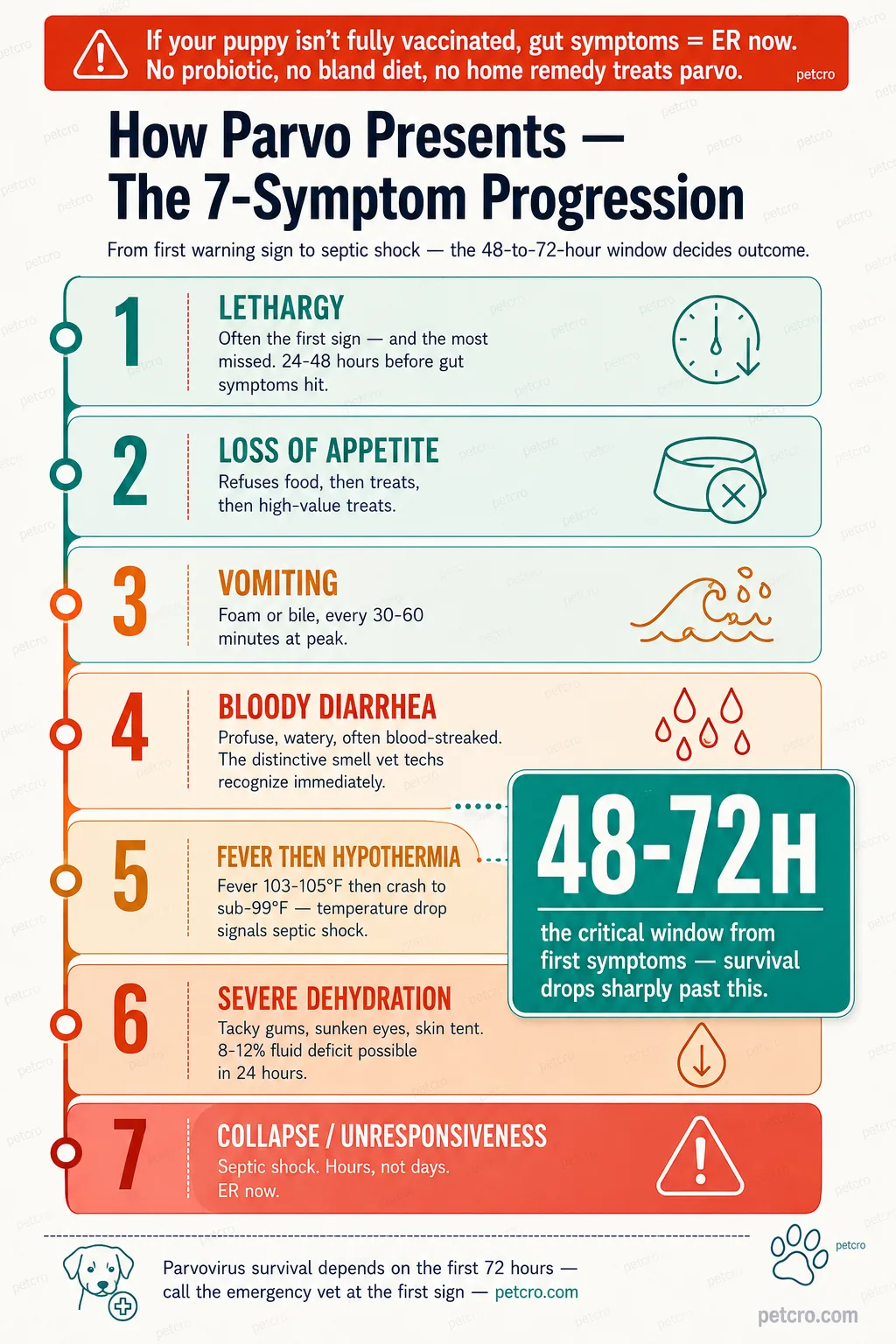
1. Lethargy. Often the first sign — and the most missed. A puppy who normally bounces at the door now stays in the crate, sleeps through meals, or doesn't lift their head when you walk in. This usually appears 24 to 48 hours before the gut symptoms hit. Call your vet at this stage and you buy your puppy the best survival odds in this entire guide.
2. Loss of appetite. The puppy refuses food, then refuses treats, then refuses the high-value stuff (chicken, cheese, peanut butter). A puppy who turns down a treat is a puppy whose body is shutting down digestion. Pair this with lethargy and you have two early signs in the same 24-hour window — that's the call-vet-now moment.
3. Vomiting. Starts as foam or bile (yellow). Becomes frequent — every 30 to 60 minutes is not unusual at peak. The vomiting itself causes rapid dehydration and is part of why parvo kills so fast. Oral anti-nausea drugs come back up at this stage of vomiting; the vet team will give them by IV. This symptom alone is enough to justify an ER visit in an unvaccinated puppy.
4. Diarrhea — often bloody, with a distinctive smell. This is the symptom most owners recognize. The diarrhea is profuse, watery, frequently contains blood (bright red or dark/tarry), and has a sweet-sick smell that vet techs describe as unmistakable once you've smelled it. The blood comes from the intestinal lining shedding into the gut.
5. Fever, then hypothermia. Early parvo runs a fever (often 103–105°F / 39.4–40.5°C — normal puppy temperature is 101–102.5°F). As the puppy crashes into septic shock from bacteria leaking through the destroyed gut wall, the temperature drops below normal — under 99°F / 37.2°C. In a puppy with parvo symptoms, a falling temperature is a critical sign — get to the ER immediately, regardless of what hour it is.
6. Severe dehydration. Watch for tacky or dry gums, eyes that look sunken, and skin that doesn't snap back when you gently pinch the scruff (skin tent). A dehydrated puppy can be 8 to 12 percent down on fluid in 24 hours of parvo vomiting + diarrhea. This is the proximate cause of death in most untreated parvo cases — the cascade the virus triggers, not the virus directly.
7. Weakness, collapse, or unresponsiveness. End-stage. The puppy can't stand, can't lift their head, or doesn't respond when you call them. This is septic shock and the timing window is now hours, not days. If you reach this stage, call ahead so the ER team can prep IV fluids and emergency care before you arrive.
If your puppy shows any combination of these symptoms — even just lethargy plus loss of appetite — call your vet now. Do not wait for the next symptom to confirm.
The 48 to 72 hour window — why timing matters
Parvo doesn't kill puppies the way most owners expect. The virus destroys intestinal lining and bone-marrow precursors, but it isn't the destruction itself that kills — it's the cascade that follows: fluid loss through vomiting and diarrhea → dehydration and electrolyte collapse → bacteria from the now-leaky gut entering the bloodstream → septic shock.
Across veterinary clinical references, the critical window after first symptoms is widely described as 48 to 72 hours. Puppies who get IV fluids, antiemetics, and antibiotics inside that window survive at rates of 70 to 90 percent depending on the source. Puppies who don't get treated — or get treated too late — survive at roughly 10 to 20 percent; Cornell's Baker Institute cites mortality reaching 91 percent in untreated cases.
That's why the answer to "should I wait and see if it passes?" is always no for an unvaccinated puppy with gut symptoms. The hours you spend waiting are the hours your puppy's survival odds are dropping.
Call your vet at the first sign — lethargy plus loss of appetite — not when the bloody diarrhea hits. The earlier symptom is the cheaper-to-treat symptom.
Symptoms that mean go to the ER now
Any one of these in an unvaccinated puppy — or one whose DHPP series isn't complete — is an emergency. Don't wait for an appointment, don't try to ride it out overnight, and don't try to push fluids by mouth — call the nearest emergency vet:
- Vomiting more than twice in an hour, or vomiting that won't stop
- Profuse watery diarrhea, often bloody or tarry
- The "parvo smell" — sweet-sick, distinctive, recognized by anyone who's worked in a vet ER
- Fever above 103°F (39.4°C) or sub-normal temperature below 99°F (37.2°C) — both directions are dangerous; normal puppy temperature is 101–102.5°F
- Sunken eyes, tacky or pale gums, skin that tents and stays tented
- Collapse, inability to stand, or unresponsiveness
- Any combination of lethargy + appetite loss in a puppy who hasn't completed the full DHPP series
If you can, take a fresh fecal sample (a teaspoon-sized amount in a sealed plastic bag) with you. The vet will run a SNAP parvo test on it within minutes of your arrival.
Call ahead. Most emergency vets will ask you to bring the puppy through a side entrance to avoid exposing other dogs in the waiting room. Parvo is extremely contagious and is shed in feces for weeks.
What parvo is NOT — distinguishing from other puppy stomach upsets
Not every puppy with diarrhea has parvo. The symptoms above overlap with several other conditions that are not life-threatening — but they also overlap with conditions that are. Only your vet can rule parvo in or out with a SNAP test and (sometimes) a confirmatory PCR.
Common puppy GI issues that look like early parvo:
- Dietary indiscretion — puppy ate something they shouldn't. Usually a single episode of vomiting or loose stool, no fever, puppy is otherwise bright.
- Food transition reaction — too-fast switch from one food to another. Soft stool, no blood, no vomiting, puppy is energetic.
- Intestinal parasites — giardia, coccidia (both protozoa), hookworms (helminth). Chronic intermittent diarrhea, often mucus-streaked, puppy may be losing weight but stays active. Treatable with parasite-specific medication — your vet identifies which from a fecal test.
- Stress colitis — diarrhea after a new home, vet visit, or boarding. Resolves in 24-48 hours, no systemic signs.
Conditions that can mimic parvo and are also emergencies:
- Gastrointestinal foreign body — swallowed sock, toy fragment, bone shard. Vomiting and lethargy but usually no diarrhea, no fever.
- Hemorrhagic gastroenteritis (HGE) — sudden bloody diarrhea, often in small breeds. Looks like parvo but isn't.
- Toxin ingestion — chocolate, xylitol, grapes or raisins, onion or garlic, antifreeze. See our common dog toxins reference if you suspect exposure.
The honest answer: you can't tell parvo, a foreign body, or HGE apart just by looking at the puppy. The SNAP test and the vet exam tell you. So when in doubt, the answer is "vet visit today" — not "wait until morning."
How vets diagnose parvo
Three diagnostic tools, used together at intake — SNAP first, with bloodwork and exam in parallel.
Tool 1 — In-house SNAP ELISA fecal antigen test
The standard first test. A small fecal sample, a 10-minute wait, a colored line if positive. Most US vets run this in-clinic with the IDEXX SNAP Parvo test or equivalent. Result available before you finish filling out paperwork.
Caveat: false negatives happen. Viral shedding can be inconsistent early in the clinical course, and the SNAP test has a sensitivity limit. If the test is negative but the puppy is clinically sick, vets often re-test in 12 to 24 hours or send out a PCR.
Tool 2 — Confirmatory PCR (if needed)
Sent to an outside diagnostic lab. More sensitive than the SNAP test, can distinguish CPV-2 strains, and useful when the SNAP is negative but clinical suspicion is high. Results in 24 to 72 hours.
Tool 3 — Bloodwork and physical exam
A CBC (complete blood count) almost always shows a low white blood cell count in parvo puppies — the virus attacks bone marrow. Chemistry panels assess electrolyte status, kidney function, and hydration. Physical exam catches dehydration severity (skin tent, gum tackiness, capillary refill time) and abdominal pain on palpation.
The combined picture — clinical signs + positive SNAP + low white count + age-appropriate vaccination history — is what makes the diagnosis.
Treatment: hospital-only, no home remedy
There is no at-home cure for parvo. The treatment is supportive — keep the puppy alive while their immune system fights the virus — and it requires IV access, around-the-clock monitoring, and parenteral medications. Expect a 3 to 7 day hospital stay, often longer.
What the vet team will do:
- IV fluids — the single most important treatment. Replaces fluid lost to vomiting and diarrhea, corrects electrolyte imbalance, supports blood pressure. Cannot be replaced by Pedialyte or subcutaneous fluids in a severely affected puppy.
- Antiemetics (anti-nausea drugs) — maropitant (Cerenia) and ondansetron, both IV. Stop the vomiting cycle so the puppy can hold fluids.
- Broad-spectrum IV antibiotics — not for the virus (antibiotics don't kill viruses), but for the secondary bacterial infection that crosses from the gut into the bloodstream as the gut lining fails. Without this, septic shock is the most common cause of death.
- Nutritional support — early enteral feeding (small amounts of a bland recovery food, often through a nasogastric tube) is now standard of care in veterinary ICUs, drawn from work by Mohr et al. (J Vet Intern Med, 2003) showing faster gut healing and shorter hospital stays.
- Plasma transfusion — used in severe cases to replace lost protein (chiefly albumin), which restores oncotic pressure when the gut is leaking protein into the lumen.
What does not work as a substitute for any of this:
- Pedialyte by mouth (comes back up immediately, doesn't address electrolyte loss at the scale parvo causes)
- Pepto-Bismol or other OTC anti-diarrheals (some are toxic to dogs; none address the underlying virus)
- "Wait and see" at home (the 48-72 hour window doesn't pause for owners to think it over)
- Antibiotics from your medicine cabinet (wrong drugs, wrong dose, wrong route of administration)
The realistic cost range for parvo treatment in the US is $1,500 to $5,000 depending on length of stay and severity. Pet insurance with accident-and-illness coverage written before symptoms appear will reimburse most of this; see our puppy first vet visit guide for what to set up in the first week.
If cost is the blocker, ask the vet about CareCredit, Scratchpay, or a payment plan — most emergency clinics are familiar with these conversations and can help. Some shelters and humane societies run parvo treatment programs for documented financial hardship.
Prevention: vaccination, isolation, decontamination
Parvo is preventable. Three layers stack on top of each other:
Layer 1 — Vaccination (DHPP series)
The DHPP vaccine includes the "P" for parvovirus. Three doses between 6 and 16 weeks, with the 16-week dose locking in immunity — that's when maternal antibodies have reliably faded enough for the puppy's own immune system to respond to the vaccine, per the AKC's puppy vaccination guide. A 1-year booster, then every 1–3 years for life.
Full schedule with dates by age in our puppy vaccination schedule chart, or use our interactive vaccination timeline tool to generate dates for your specific puppy's birthday.
Layer 2 — Isolation until the series is complete
Parvo isolation runs in two stages tied to the DHPP timeline.
Stage 1 — Before the first DHPP plus 7 days (typically 6 to 9 weeks): indoor only, plus your own yard if no unvaccinated or unknown-status dogs visit. No paw-to-ground walking on public space. Arm-carry into busy environments is fine for socialization exposure.
Stage 2 — After the first DHPP plus 7 days (the AVSAB socialization gate, typically around 9 weeks): structured socialization can begin per the American Veterinary Society of Animal Behavior (AVSAB) position statement — vaccinated friends' yards, puppy class on disinfected floors, low-density residential sidewalk walks, arm-carry into busy environments. Still avoid: dog parks, pet store floors, rest-stop grass, anywhere unvaccinated dogs go.
Full freedom — dog parks, pet store floors, busy sidewalks — waits for 7 to 10 days after the 16-week DHPP dose, when immunity is fully locked in.
The full new-puppy isolation protocol is in our bringing a new puppy home guide and the new puppy checklist.
Layer 3 — Decontamination if exposure happens
Parvovirus is one of the toughest viruses to kill. The Merck Veterinary Manual describes survival of roughly 6 months on indoor surfaces and up to a year on outdoor soil, and notes it resists most household disinfectants — vinegar and standard Lysol do not reliably kill it. The one thing that does work is bleach diluted 1:30 (1 part bleach to 30 parts water), with at least 10 minutes of contact time on hard surfaces. Soft surfaces (carpet, soil, fabric) cannot be reliably decontaminated — replacement or a year of sun exposure are the realistic options.
If a parvo-positive puppy has been in your yard — whether your own or a visiting dog — the yard is contaminated for months. Any new puppy entering that yard should have completed the full DHPP series and be at least 7 to 10 days past the 16-week dose before paw-to-ground access.
This guide is general guidance, not veterinary advice. For your specific dog's nutrition, health, or behavior needs, consult your veterinarian.
Frequently asked questions
What are the very first signs of parvo in a puppy?
Lethargy and loss of appetite, usually 24 to 48 hours before the gut symptoms hit. A puppy who stops greeting you at the door or refuses a high-value treat is showing the earliest parvo signs. These two together in an unvaccinated puppy — or one whose DHPP series isn't complete — are reason enough to call the vet today. Earlier care means dramatically better survival odds.
How long after exposure do parvo symptoms appear?
Symptoms typically appear 3 to 14 days after a puppy is exposed to the virus, with most cases showing up in the 5 to 7 day window. The puppy can shed virus in their feces for 4 to 5 days before symptoms start, then keep shedding for 2 to 3 weeks after recovery. That long shedding window is why isolation matters so much.
Can a vaccinated puppy still get parvo?
Yes, but rarely. Vaccinated puppies who finished the full DHPP series including the 16-week dose have roughly 95-99% protection per veterinary immunology consensus. The breakthrough cases usually involve puppies whose series was incomplete (missed the 16-week dose), exposed during the window before the final shot, or had medical conditions that prevented a good vaccine response. Talk to your vet if you have any doubt.
What does parvo poop look like?
Parvo diarrhea is watery, profuse, and frequently bloody — bright red or dark and tarry — with a sweet-sick smell that vet staff describe as immediately recognizable. The blood comes from the intestinal lining shedding into the gut as the virus destroys it. A single soft stool is not parvo. Frequent, watery, bloody diarrhea in an unvaccinated puppy is an emergency.
What is the survival rate for puppies with parvo?
With hospitalized treatment (IV fluids, antiemetics, antibiotics, nutritional support), survival rates run 70 to 90 percent depending on age and severity at presentation. Without treatment, survival drops to roughly 10 to 20 percent — Cornell cites mortality reaching 91 percent in untreated cases. The single biggest factor in outcome is how fast the puppy gets to the vet — the 48 to 72 hours after first symptoms are the difference between most-survive and most-don't.
Can humans get parvo from puppies?
No. Canine parvovirus (CPV-2) is species-specific to dogs and does not infect humans. Human parvovirus B19 (the "fifth disease" virus) is a completely different virus with no relationship to the canine version. You can safely handle and comfort a parvo puppy, though you should change clothes and wash thoroughly before contacting other dogs.
How much does parvo treatment cost?
In the US, hospitalized parvo treatment typically runs $1,500 to $5,000 depending on length of stay and severity. Cases needing plasma transfusion or extended ICU care can run higher. Pet insurance with accident-and-illness coverage written before symptoms appear reimburses most of it. If cost is a blocker, ask about CareCredit, Scratchpay, or payment plans — most emergency clinics are familiar with these options.
TL;DR — the parvo symptoms cheat sheet
- First signs are lethargy + loss of appetite — 24-48 hours before the gut symptoms hit. Call the vet at this stage for the best survival odds.
- The 7 symptoms in order: lethargy → appetite loss → vomiting → bloody diarrhea → fever then hypothermia → severe dehydration → weakness or collapse
- The critical window is 48 to 72 hours from first symptoms — survival drops sharply past that
- Survival with hospital care: 70 to 90 percent. Without it: 10 to 20 percent (Cornell cites mortality up to 91 percent)
- No home remedy works — treatment is IV fluids, antiemetics, IV antibiotics, and nutritional support, all hospital-only
- Vaccination is the only reliable prevention — three DHPP doses by 16 weeks, with the 16-week dose locking in immunity
- Parvovirus survives ~6 months indoors and up to a year on outdoor soil; bleach 1:30 with 10-min contact time is the most accessible reliable disinfectant for household use
If you came here because your puppy is showing one of these signs, close this tab and call your vet. Reading more is not the move; calling is.
Sources & further reading
- Cornell University Baker Institute — Canine Parvovirus — Baker Institute research summary and clinical references.
- Merck Veterinary Manual — Canine Parvovirus — clinical reference for diagnosis, treatment, and prognosis.
- AKC — Parvo in Puppies — owner-facing overview from the American Kennel Club, including breed-risk patterns.
- ASPCA — Pet Vaccinations — owner-facing guide to core and lifestyle vaccines.
- CDC — Healthy Pets: Dogs — CDC reference on canine disease and household sanitation. (Note: CPV-2 is not zoonotic; CDC references cover surface decontamination relevant to multi-pet households.)
- AKC — Puppy Shots: A Complete Guide — vaccination schedule, including the 16-week dose rationale.
More from Petcro's puppy health cluster
- Puppy Vaccination Schedule Chart — full DHPP + rabies + lifestyle vaccine schedule by age.
- Puppy First Vet Visit — what to set up in the first week, including pet insurance before symptoms appear.
- New Puppy Checklist — the cluster 2a anchor, including isolation protocol for unvaccinated puppies.
- Bringing a New Puppy Home — 14-day arrival timeline, including safe socialization before full vaccination.
- Vaccination Timeline Tool — interactive calculator that generates a printable schedule from your puppy's birthday.
Petcro is reader-supported. We may earn an affiliate commission when you click through links to products in this guide. Our editorial picks are independent of any commercial relationship with any veterinary product or service.