Dog Vomiting: Causes, Color Clues, and When to Worry
Dog vomiting decoded: vomiting vs regurgitation, the common causes, what the color means, the bloat emergency, home care, and the red flags that need a vet.
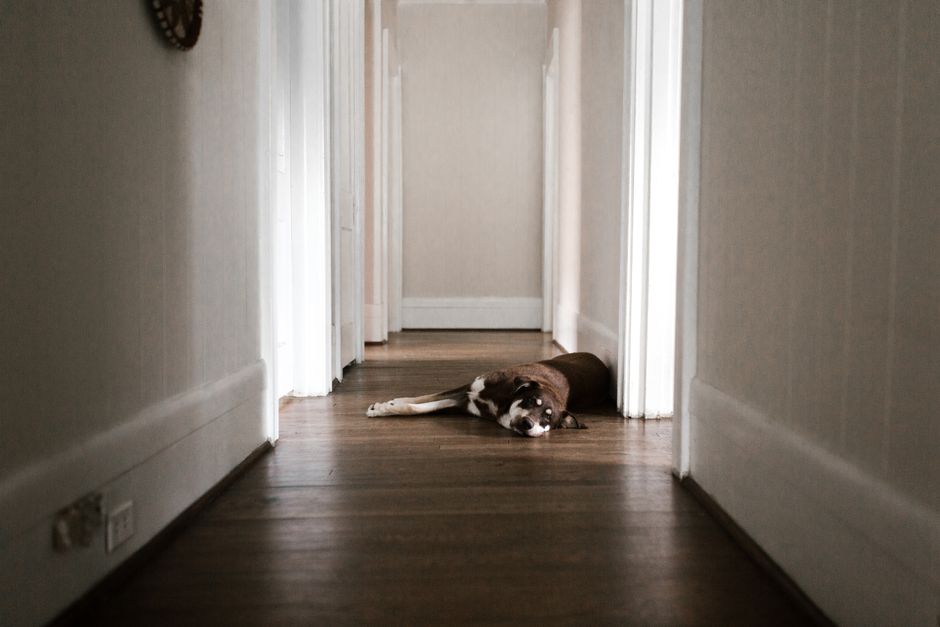
Dog vomiting is the active, forceful ejection of stomach contents — and a single vomit in an otherwise-bright, playful dog is often harmless. But repeated vomiting, blood, a swollen belly, or vomiting alongside diarrhea and lethargy points to something serious. Decode what came up, check for red flags, then decide: watch at home or call your vet.
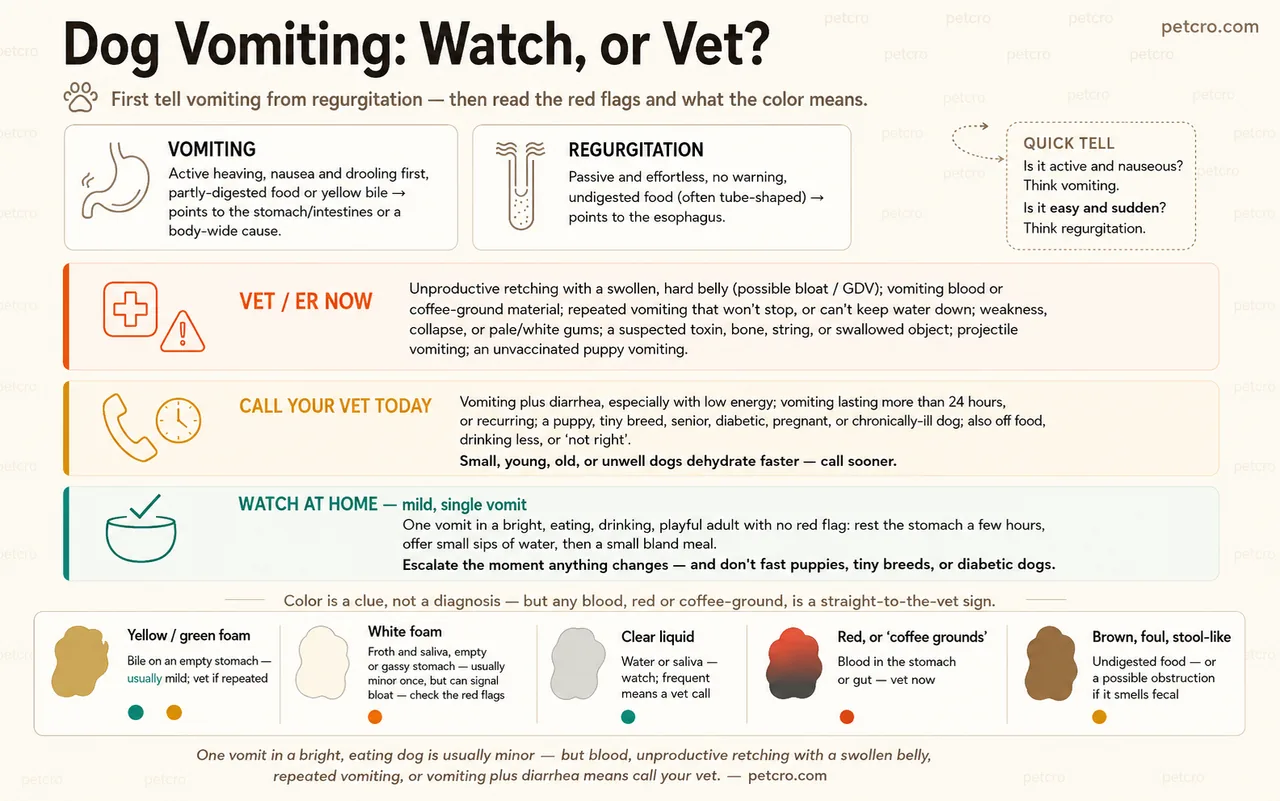
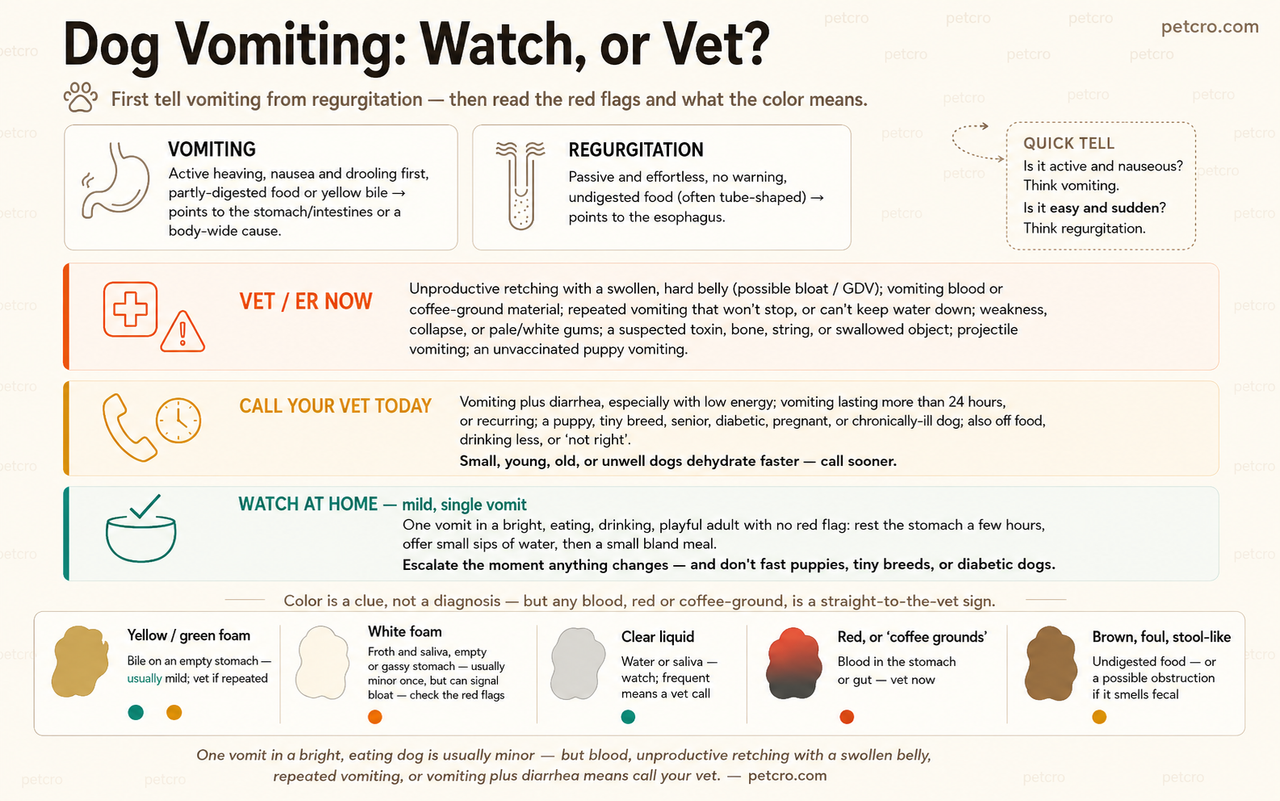
TL;DR: First, tell vomiting (active heaving, nausea, partly digested food or bile) from regurgitation (passive, undigested, no effort) — they point to different problems. A single vomit in a bright, eating dog is usually fine: rest the stomach a few hours while offering small, frequent sips of water, then a small bland meal. Treat unproductive retching with a swollen, hard belly as a bloat emergency — go now. Blood, repeated vomiting, a suspected toxin or swallowed object, or vomiting plus diarrhea and lethargy all mean call your vet.
Is your dog vomiting or regurgitating?
Before anything else, work out which one you're seeing — because they come from different places and mean different things. This is the first distinction a vet makes, and you can often make it at home.
Vomiting is an active event. Your dog looks nauseous first — drooling, lip-licking, restlessness, repeated swallowing — then heaves, with the belly and flanks visibly contracting, and brings up stomach contents. What comes up is partly digested and often yellow (bile) or foamy, and it can be acidic-smelling.
Regurgitation is passive and effortless. There's no heaving and no warning: undigested food or water just slides back up, often in a tube-like shape, usually soon after eating or drinking. It points to the esophagus (the tube to the stomach) rather than the stomach itself.
| Vomiting | Regurgitation | |
|---|---|---|
| Effort | Active heaving, belly contractions | Passive, effortless |
| Warning signs | Nausea, drooling, lip-licking first | None — sudden |
| Contents | Partly digested, may contain bile/yellow foam | Undigested food, often tube-shaped |
| Timing | Any time | Often right after eating |
| Points to | Stomach/intestines or a body-wide cause | Esophagus |
The Merck Veterinary Manual treats these as separate problems because they need different workups. If your dog is bringing up undigested food effortlessly and often, tell your vet you think it's regurgitation — it changes what they look for.
Dog vomiting: the most common causes
Most vomiting comes from the gut being irritated or overwhelmed, but plenty of body-wide problems announce themselves through the stomach too. The usual suspects:
- Dietary indiscretion — the number-one cause. Garbage, rich table scraps, a stolen fatty treat, grass, or something they shouldn't have eaten.
- A sudden diet change — switching food too fast irritates the gut. Transition new food gradually over 7–10 days instead (up to 14 for a sensitive stomach).
- Eating too fast or too much, then bringing it back up minutes later.
- Intestinal parasites — roundworms, hookworms, and others, especially in puppies.
- Infections — viral or bacterial, including parvovirus in unvaccinated puppies (a life-threatening emergency).
- A foreign body or obstruction — a swallowed toy, bone, sock, or string blocking the gut. This is a surgical emergency.
- Pancreatitis — inflammation of the pancreas, classically after a fatty meal, causing vomiting and belly pain.
- Toxins — many poisons trigger vomiting; check anything suspicious against our toxic-foods and household-poisons reference.
- Systemic disease — kidney disease, liver disease, and certain hormonal disorders often show up first as vomiting.
- Motion sickness — common in young dogs on car rides.
The AKC notes that because vomiting is a symptom of so many conditions — from trivial to critical — the surrounding signs (energy, appetite, blood, belly, diarrhea) matter far more than the vomiting alone.
Acute or chronic: a one-off or a pattern?
How the vomiting is spread out over time is one of the biggest clues to how worried to be.
Acute vomiting comes on suddenly. A single vomit — or a couple over an hour — in a dog who's otherwise bright, eating, and playful is often a passing upset that settles on its own. Sudden, repeated vomiting several times in a few hours needs a same-day vet call — and if it won't stop, or your dog can't keep even water down, that's a go-now emergency (see the emergency table below), not a wait-for-the-appointment one.
Chronic vomiting means it keeps happening over weeks — every few days, after meals, or intermittently. Even if each episode looks mild, a pattern like that deserves a proper workup, because it can signal food intolerance, chronic GI disease, or an organ problem your vet needs to investigate. A dog who vomits bile on an empty stomach every morning, for example, has a recognizable pattern our dog throwing up bile guide walks through.
Keep a simple log — when, how often, what came up, and what your dog ate — and bring it to the appointment. It shortens the guessing.
What the color and content tell you
The color of what your dog brings up is a clue to where it came from and how urgent it is — though color alone never gives a diagnosis. Use it to decide how fast to act, not to self-treat.
| What you see | Often means | What to do |
|---|---|---|
| Yellow or green foam/liquid | Bile — usually an empty stomach | Common and often mild; see dog throwing up bile. Vet if repeated or your dog is unwell |
| White foam | Froth and saliva, often an empty or gassy stomach | Usually minor once, but dog vomiting white foam can also signal bloat or other issues — check the red flags |
| Clear liquid | Water or saliva | Watch; frequent clear vomiting still means a vet call |
| Fresh red blood, or "coffee grounds" | Bleeding in the stomach or gut | Urgent — see dog throwing up blood and go to the vet |
| Brown, foul, or stool-like | Undigested food — or, if it smells fecal, a possible obstruction | Vet, especially if it smells like stool or your dog is straining |
The takeaway: yellow and white are usually the mild end and often just mean an empty stomach, while any blood — red or coffee-ground — is a straight-to-the-vet sign. But a bright, well dog that vomits once and bounces back matters less than a flat, off-food dog that vomits "harmless" clear liquid all day. Read the dog, not just the color.
Dog vomiting: when is it an emergency?
When to worry about dog vomiting comes down to a short list of red flags — and this is the part that decides your next hour. Veterinary sources including petMD and the AKC treat the following as reasons to stop watching and get help.
| If you see this | Do this |
|---|---|
| 🔴 Unproductive retching with a swollen, hard belly (possible bloat/GDV); vomiting blood or coffee-ground material; repeated vomiting that won't stop or can't keep water down; weakness, collapse, or pale/white gums; a suspected toxin, bone, string, or swallowed object; projectile vomiting; an unvaccinated puppy vomiting | Emergency — vet or ER now |
| 🟠 Vomiting plus diarrhea, especially with low energy; vomiting lasting more than 24 hours or recurring; a puppy, tiny breed, senior, diabetic, pregnant, or chronically-ill dog; also off food, drinking less, or "not right" | Call your vet today — sooner for the small, young, old, or unwell |
| 🟢 One vomit in a bright, eating, drinking, playful adult dog with no other red-flag sign | Rest the stomach and watch at home (below); escalate if anything changes |
Puppies, small breeds, seniors, and dogs with existing illness get a lower threshold every time — they dehydrate and crash faster, so what's a "watch" in a healthy adult is a "call today" in them. When you're unsure, err toward calling; a quick phone call to your vet or an ER for triage is fast and often low- or no-cost.
Why can't my dog vomit? Retching with a swollen belly
One vomiting-related emergency is important enough to pull out on its own, because owners often miss it: a dog that is trying to vomit but nothing comes up, retching over and over, with a distended, drum-tight belly, restlessness, drooling, and pacing.
This can be bloat — gastric dilatation-volvulus (GDV) — where the stomach fills with gas and twists. It is rapidly life-threatening and most common in deep-chested breeds (Great Danes, German Shepherds, Standard Poodles, Weimaraners, Boxers, Setters), often within a few hours of a large meal or heavy drinking followed by exercise. It can kill within hours.
There is no home treatment. If your dog is unproductively retching with a swollen, hard abdomen, this is a drive-to-the-ER-right-now situation — call ahead so they're ready. Do not wait to "see if it passes."
What to do at home for a mild, single vomit
If — and only if — your dog has cleared the red-flag check above (one vomit, bright, alert, no blood, no swollen belly, still themselves), a simple stomach rest is reasonable:
- Rest the stomach for a few hours. Pick up food briefly so the gut can settle — but keep it short. Puppies, small breeds, and diabetic dogs should not go long without food (they can drop their blood sugar), so ask your vet how long is safe for them rather than fasting them for hours.
- Offer small amounts of water. Don't let a nauseous dog gulp a full bowl — that often triggers another vomit. Small, frequent sips are gentler. If that first drink comes straight back up, stop offering it and call your vet — and if your dog repeatedly can't keep any water down, treat it as the go-now emergency described above.
- Reintroduce food small and bland. After a few hours with no more vomiting, offer a small bland meal — plain boiled skinless chicken and white rice; our bland diet for dogs with diarrhea has the exact ratios. Feed small amounts often, then transition back to normal food over a day or two. For a generally touchy stomach, our dog food for diarrhea guide covers gentler everyday options.
- Do not give human medicines on your own. NSAID painkillers (ibuprofen, aspirin) and acetaminophen (Tylenol) are outright dangerous to dogs — NSAIDs cause stomach ulcers and bleeding, and acetaminophen can cause fatal liver and red-blood-cell damage. Other human drugs, like antacids and anti-nausea medicines, are sometimes used in dogs, but only at a vet-directed dose — giving them yourself can mask a serious problem. Only give what your vet directs.
Home care is a short bridge for the mildest cases, not a substitute for a vet. If the vomiting repeats, blood appears, diarrhea sets in, or your dog's energy or appetite drops, stop watching and call.
Dog vomiting and diarrhea together: what it means
When vomiting and diarrhea arrive at the same time, take it more seriously than either alone. Losing fluid from both ends dehydrates a dog fast — dangerously so in puppies and small breeds — and the combination is a classic sign of parvovirus in unvaccinated puppies, of a nasty gut infection, and of acute hemorrhagic diarrhea syndrome (AHDS).
Treat vomiting plus diarrhea with low energy, blood in either, or a young/small/old dog as a same-day (or emergency) vet call rather than a home-care case. Bloody diarrhea in an unvaccinated puppy is parvo until proven otherwise, and any bloody, "raspberry-jam" diarrhea belongs in the bloody diarrhea in dogs emergency bracket. Our stool-health guide helps you describe the diarrhea accurately for the vet.
When to see the vet, and what to bring
If your dog needs the clinic, a little preparation makes the visit faster and the diagnosis sharper. The vomiting itself is only half the story; the details you noticed at home are the other half.
- Photograph or bag a sample of the vomit (and any diarrhea) — the color and content are genuinely useful, and hard to describe from memory.
- Write the timeline — when it started, how many times, what came up each time, and what changed (new food, treats, scavenging, access to medications, toxins, or small objects).
- Note the whole dog — energy, appetite, water intake, gum color, and whether the belly looks or feels swollen.
At the clinic, expect a physical exam and, depending on the picture, bloodwork (for organ disease, dehydration, and pancreatitis), a fecal test, and imaging — X-ray or ultrasound — to look for an obstruction or mass. A weight-and-portion baseline from our feeding calculator helps you get back on track once the cause is sorted.
This guide is general guidance, not veterinary advice. For your specific dog's nutrition, health, or behavior needs, consult your veterinarian.
Frequently asked questions
Why is my dog throwing up?
Most dog vomiting comes from a gut upset — dietary indiscretion (eating garbage or scraps), a too-fast food change, eating too quickly, parasites, or a passing infection. But it can also signal something serious: a swallowed object, pancreatitis, toxins, or organ disease. A single vomit in a bright, playful dog is usually minor; repeated vomiting, blood, or a flat, off-food dog needs a vet.
When should I worry about my dog vomiting?
Worry — and call your vet or an ER — if you see unproductive retching with a swollen belly (possible bloat), blood or coffee-ground vomit, repeated vomiting that won't stop, weakness or pale gums, a suspected toxin or swallowed object, or vomiting plus diarrhea with low energy. Puppies, small breeds, seniors, and unwell dogs need a vet sooner, because they dehydrate faster.
Is it normal for a dog to throw up yellow bile?
Yellow or green foam is bile, and it usually means an empty stomach — some dogs vomit bile in the early morning before eating. An occasional episode in an otherwise-well dog is often minor and can improve with a small bedtime snack. But repeated bile vomiting, or bile alongside lethargy or diarrhea, warrants a vet visit. Our dog throwing up bile guide covers it fully.
My dog vomited once but seems totally fine — do I need a vet?
Usually not immediately. One vomit in a dog who is bright, alert, eating, drinking, and otherwise normal is often a passing upset. Rest the stomach for a few hours, offer small sips of water, then a small bland meal. Call your vet if it happens again, if blood or diarrhea appears, or if your dog's energy or appetite drops.
How long is too long for a dog to keep vomiting?
Vomiting that continues beyond about 24 hours, or that recurs repeatedly, needs veterinary attention. But if your dog can't keep even water down, don't wait on the clock — treat it as a go-now emergency, because the inability to rehydrate brings on dangerous dehydration fast. Puppies, small breeds, seniors, and diabetic or pregnant dogs have a much lower threshold: for them, even a few hours of repeated vomiting is a reason to call the same day.
Should I withhold food and water when my dog is vomiting?
Rest the stomach from food for a few hours, then reintroduce small bland meals — but don't impose a long fast, especially on puppies or small dogs, who can drop their blood sugar. Don't withhold water; instead offer small, frequent sips so a nauseous dog doesn't gulp and vomit again. If your dog repeatedly can't keep even water down, don't wait — treat it as the go-now emergency described in the guide above.
TL;DR — the dog vomiting cheat sheet
- Unproductive retching with a swollen, hard belly is a bloat emergency — go to the ER now, especially in deep-chested breeds.
- Tell vomiting (active heaving, nausea, bile) from regurgitation (passive, undigested, effortless) — they point to different problems.
- One vomit in a bright, eating dog is usually minor: rest the stomach a few hours (but don't fast puppies, tiny breeds, or diabetic dogs), offer small sips of water, then a small bland meal.
- Blood (red or coffee-ground), repeated vomiting, a suspected toxin or swallowed object, or projectile vomiting all mean a vet now.
- Vomiting plus diarrhea dehydrates a dog fast — treat it as same-day, and as parvo in an unvaccinated puppy.
- Never give human medicines like ibuprofen, aspirin, or acetaminophen (Tylenol); they can cause ulcers, bleeding, or fatal organ damage in dogs.
Read the whole dog, not just the vomit: energy, gums, belly, and blood tell you more than color alone.
Sources & further reading
- Merck Veterinary Manual — Vomiting in Dogs — vomiting vs regurgitation, causes, and when it's serious.
- AKC — Dog Vomiting: Causes, Diagnosis, and Treatment — why vomiting is a symptom of many conditions, and the signs that matter.
- petMD — Vomiting in Dogs — overview, red flags, dehydration risk, and home-care limits.
- Merck Veterinary Manual — Disorders of the Stomach and Intestines in Dogs — the GI conditions behind vomiting and diarrhea.
- ASPCA — Animal Poison Control — (888) 426-4435, if a toxin or swallowed item is on the table (a consultation fee may apply).
If your dog is retching without producing anything and the belly looks swollen, don't wait — bloat (GDV) is an emergency that needs a vet in minutes, not hours.
More from Petcro's GI cluster
- Dog Throwing Up Yellow (Bile) — the empty-stomach bile pattern, decoded.
- Dog Throwing Up White Foam — when foam is minor and when it isn't.
- Dog Throwing Up Blood — the emergency end of vomiting, red vs coffee-ground.
- Stool-Health Guide — read your dog's stool when vomiting comes with diarrhea.
- Toxic Foods & Household Poisons Reference — what's dangerous, and what to do if your dog got into it.
Petcro is reader-supported. We may earn an affiliate commission when you click through links to products in this guide. Our editorial picks are independent of any commercial relationship with any pet-food brand.