Dog Throwing Up Yellow: What Bile Means and When to Worry
Dog throwing up yellow usually means bile on an empty stomach — often harmless. Here's the simple feeding fix and the red flags that mean call a vet.
A dog throwing up yellow is almost always bringing up bile — a fluid that backs up and irritates an empty stomach, often early morning or after a long gap between meals. In a bright, otherwise-well dog it's usually benign and eased by smaller, more frequent meals. But repeated vomiting, lethargy, or a painful belly means call your vet.
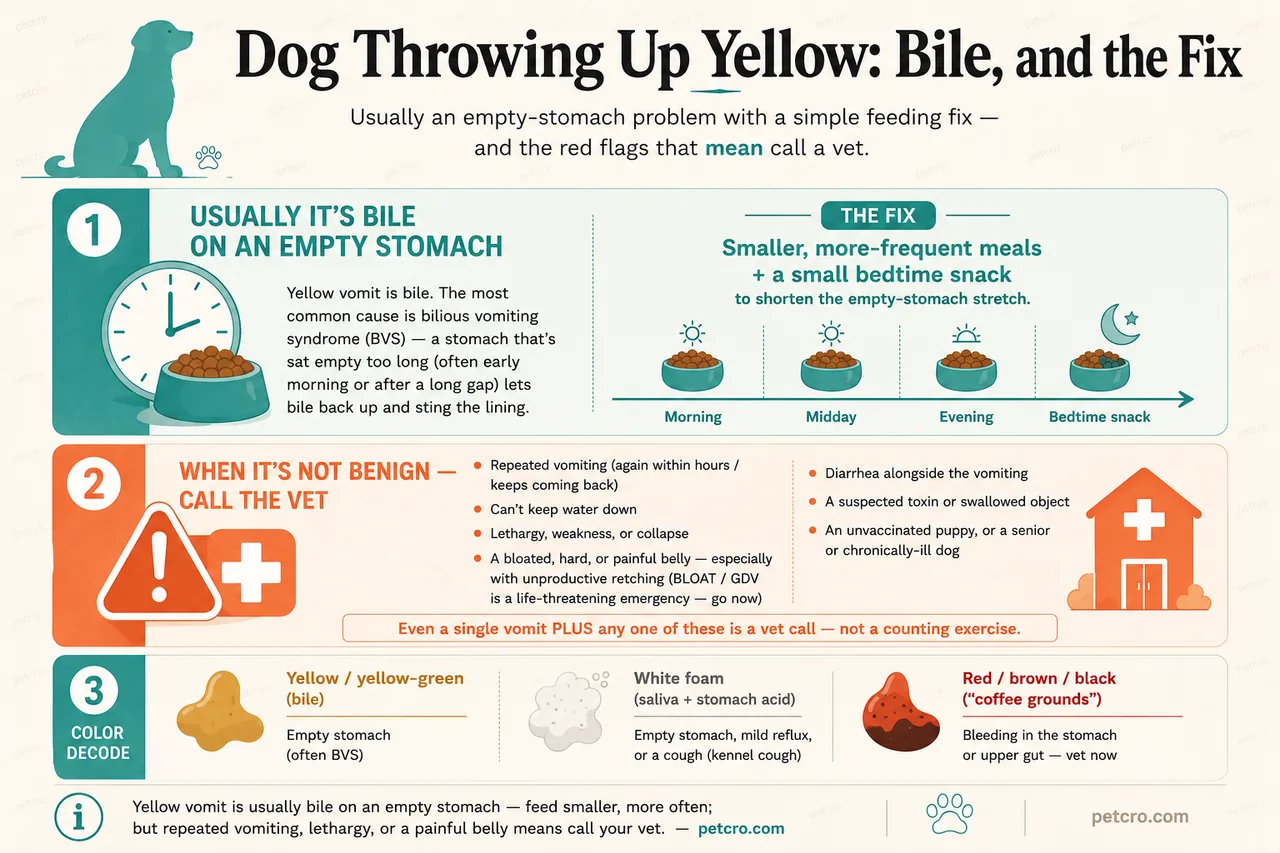
TL;DR: Yellow vomit is bile, and the most common cause is bilious vomiting syndrome — an empty stomach lets bile creep up and sting the lining. The fix is often as simple as smaller, more frequent meals plus a small bedtime snack. A single yellow heave in a happy, playful dog with none of the red flags below usually just needs brief stomach rest and a bland meal. But repeated vomiting, can't-keep-water-down, lethargy, a bloated or painful belly, diarrhea alongside it, or a suspected toxin all mean a vet visit — bloat is an emergency.
Why is my dog throwing up yellow?
That yellow (sometimes yellow-green) color is bile — a fluid the liver makes and the gallbladder releases into the small intestine to help digest fat. It isn't supposed to be in the stomach at all. When the stomach is empty, bile can flow backward into it, irritate the lining, and get vomited up, sometimes as a thin yellow liquid and sometimes as yellow foam mixed with saliva and swallowed air.
So yellow tells you what came up, not why. In a bright, well dog the why is usually harmless — but the same color also rides along with more serious problems, which is why the pattern around the vomiting — timing, frequency, and how your dog feels otherwise — matters far more than the color alone.
Veterinary sources such as the Merck Veterinary Manual and the AKC treat occasional, isolated vomiting in an otherwise-well dog as low-concern, while frequent, projectile, or symptom-laden vomiting warrants a prompt, often same-day, vet visit.
Bilious vomiting syndrome: the empty-stomach pattern
The single most common reason for a dog vomiting yellow bile is bilious vomiting syndrome (BVS). The hallmark is timing: it tends to happen on an empty stomach — classically first thing in the morning before breakfast, or late at night after a long stretch without food. The dog brings up a small amount of yellow bile or foam, then acts completely normal — bright, hungry, and ready to eat.
What's happening is mechanical and usually benign: with nothing in the stomach for hours, bile refluxes up from the intestine and irritates the empty lining. There's no infection, no obstruction, no poison — just an idle stomach reacting to bile. This is the textbook case of a dog vomiting yellow on an empty stomach, and it's more common in dogs fed only once a day and in those with a long overnight fast.
The simple feeding fix for bilious vomiting
Because BVS is driven by an empty stomach, the fix is to stop the stomach from sitting empty so long:
- Feed smaller meals, more often — split the same daily food into three or four portions instead of one or two large meals.
- Add a small bedtime snack — a few pieces of kibble or a spoon of bland food right before bed shortens the overnight fast that triggers morning bile.
- Try an earlier breakfast — if the heave is a dawn ritual, an earlier first meal can head it off.
- Keep portions consistent — sudden big meals or rich, fatty add-ons can backfire.
Use our feeding calculator to get your dog's correct daily amount, then divide it across the day rather than adding extra food. Call your vet sooner if the vomiting worsens, gets more frequent, or any red flag appears. Otherwise, if a recurring morning heave in an otherwise bright, normal dog hasn't settled after a week or so of split meals and a bedtime snack, book a vet visit — daily vomiting is worth a check even when your dog seems fine. Occasionally they'll suggest a short course of an acid reducer or a motility aid.
Yellow vomit isn't always BVS: the other causes
Bile is just the color of an empty stomach's contents, so yellow vomit also shows up with problems that have nothing to do with BVS. The list your vet thinks about includes:
| Cause | What hints at it |
|---|---|
| Dietary indiscretion | Got into the trash, a rich treat, or a diet change; often one-off |
| Pancreatitis | Repeated vomiting, a painful belly, fatty-meal trigger, lethargy |
| GI obstruction / foreign body | Persistent vomiting, can't keep water down, known chewer |
| Parasites or infections | Diarrhea alongside it, young or unvaccinated dog |
| Toxins | Known or possible exposure — a poison-control emergency |
| Kidney or liver disease | Older dog, ongoing vomiting, drinking/peeing changes, weight loss |
The thread through the dangerous causes is that the vomiting is repeated, projectile, or paired with other signs — not a single bile heave in a dog that's otherwise normal. That distinction, more than the yellow color, is what tells you whether to relax or pick up the phone.
When is yellow vomit NOT benign?
Treat yellow vomiting as a vet matter — not a wait-and-see — when any of these are present. Authoritative sources including the Merck Veterinary Manual and petMD describe these as the line between a minor upset and a real problem. And remember: even a single vomit plus any other red flag — lethargy, can't-keep-water-down — is a vet call, not a counting exercise.
- Repeated vomiting — it happens again within a few hours, keeps coming back, or continues past a single isolated heave.
- Can't keep water down — every drink comes back up (dehydration risk).
- Lethargy, weakness, or collapse — a flat, dull dog, not a bright one.
- A bloated, hard, or painful belly — especially with unproductive retching: bloat (GDV) is a life-threatening emergency — go now.
- Diarrhea alongside the vomiting — the combination dehydrates fast.
- A suspected toxin or swallowed object — don't wait for more signs.
- An unvaccinated puppy, or a senior or chronically-ill dog — smaller margins, faster crashes.
If the vomit is red, brown, or coffee-ground colored rather than yellow, that's possible bleeding, not bile — see our dog throwing up blood guide. And if it's mostly white foam rather than yellow, the cause leans more toward acid and saliva — our dog throwing up white foam guide covers that color.
Yellow vomit vs white foam vs blood: reading the color
Color is a useful first clue because it points at what came up:
| Color | Usually means | Most common driver |
|---|---|---|
| Yellow / yellow-green | Bile | Empty stomach (often BVS) |
| White foam | Saliva + stomach acid | Empty stomach, mild acid reflux, kennel cough |
| Red, brown, black, or "coffee grounds" | Blood | Bleeding in the stomach or upper gut — vet now |
Black, tar-like vomit, or black, tarry stool (called melena), is digested blood from the upper gut — also a same-day vet matter, not bile; our guide on blood in a dog's stool walks through bright red vs black/tarry and what each points to. Yellow and white foam, by contrast, overlap a lot — both point to an empty, slightly irritated stomach and both are often benign on their own. Blood is the one that changes the urgency entirely. Whatever the color, it's the surrounding signs — frequency, energy, appetite, belly comfort — that decide whether you're watching at home or heading in.
Home care for a one-off in a bright, playful dog
If your dog threw up yellow once, is otherwise bright, playful, and interested in food, and has none of the red flags above, a simple at-home approach is reasonable:
- Brief stomach rest — first, don't fast a puppy, a toy or tiny breed, a senior, a diabetic dog, or any dog with a chronic illness — they can crash or go hypoglycemic; skip the rest and call your vet instead. For a healthy adult, give the stomach a short rest by skipping the next meal for a couple of hours, not all day (water stays available), then offer a small bland meal. Because an empty stomach is what triggers bile in the first place, don't drag the rest out — if your dog is hungry and bright, feed the small bland meal sooner rather than later.
- Offer water in small amounts so they stay hydrated without overfilling an irritated stomach.
- Reintroduce food small and bland — a little boiled chicken and plain white rice, or another gentle meal, in small portions; our bland-diet guide walks through the ratios.
- Go back to normal gradually once the bland food stays down, then return to the regular diet.
Keep an eye on stool, too — if loose stool joins the picture, our stool-health guide helps you read it, and our puppy diarrhea guide covers the younger-dog version. If the vomiting repeats, your dog goes flat, or anything on the red-flag list appears, stop home care and call your vet.
What to avoid while the stomach settles
While you're sorting out a yellow-vomit episode, keep things boring and low-risk:
- No rich, fatty, or greasy foods — fat is a classic trigger for both vomiting and pancreatitis.
- No new treats, chews, or table scraps — reintroduce one plain thing at a time so you can spot a reaction.
- No human medications — never give over-the-counter anti-nausea or pain meds without your vet; many are toxic to dogs.
- Nothing from the toxic list — onion, garlic, grapes, xylitol, chocolate and more cause vomiting and worse; our toxic-foods reference is the fast lookup if you suspect exposure.
- Don't try to make your dog vomit — never induce vomiting at home (no hydrogen peroxide, salt, or anything else) unless a vet or poison control specifically tells you to; with caustics, sharp objects, or the wrong dog it can cause serious harm.
If you think your dog ate something poisonous, don't wait out the vomiting — call your vet or the ASPCA Animal Poison Control Center at (888) 426-4435 right away.
This guide is general guidance, not veterinary advice. For your specific dog's nutrition, health, or behavior needs, consult your veterinarian.
Frequently asked questions
Why is my dog throwing up yellow bile in the morning?
Morning yellow bile is the classic sign of bilious vomiting syndrome: after a long overnight fast, bile backs up into the empty stomach and irritates it. If your dog is otherwise bright and hungry, it's usually benign. The common fix is a small bedtime snack and an earlier or split breakfast to shorten the empty-stomach stretch.
Is it an emergency if my dog throws up yellow?
A single yellow heave in a bright, playful dog usually isn't an emergency. It becomes one when there's repeated vomiting, an inability to keep water down, lethargy or collapse, a bloated or painful belly, blood in the vomit, a suspected toxin, or it's an unvaccinated puppy or frail senior. Unproductive retching with a swollen belly means bloat — go to an ER now.
What does yellow dog vomit mean?
Yellow vomit means bile — a digestive fluid that backed up into an empty stomach and got brought up. The color tells you what came up, not the cause. Most often it's a harmless empty-stomach reflux, but yellow vomit can also accompany dietary indiscretion, pancreatitis, an obstruction, parasites, toxins, or organ disease, so the surrounding signs matter most.
How do I stop my dog from throwing up yellow bile?
Stop the stomach from sitting empty so long. Split the daily food into three or four smaller meals, add a small snack right before bed, and consider an earlier breakfast. Keep portions and food consistent. If a recurring morning heave doesn't settle within a week or so in an otherwise bright dog, book a vet visit and ask about an acid reducer or motility aid — and call sooner if the vomiting worsens or any red flag appears.
Should I feed my dog after it throws up yellow?
For a one-off in a bright dog, give the stomach a short rest of a couple of hours, not all day (keep water available), then offer a small, bland meal like boiled chicken and white rice. If it stays down, return to normal food gradually. Don't rest the stomach this way in a puppy, a toy or tiny breed, a senior, or a chronically-ill dog, and don't feed at all if vomiting is repeated — call your vet instead.
My dog is throwing up yellow foam — is that different from bile?
Not really — yellow foam is bile mixed with saliva and air, still pointing to an empty, irritated stomach. Plain white foam usually means saliva and stomach acid, though repeated white-foam retching can also point to a cough (kennel cough) or, with a swollen belly and unproductive heaving, early bloat. As with yellow, the deciding factor isn't the foam itself but whether vomiting repeats or comes with lethargy, a sore belly, or other red flags.
TL;DR — the dog-throwing-up-yellow cheat sheet
- Yellow vomit is bile from an empty stomach — usually bilious vomiting syndrome, and usually benign in a bright, hungry dog.
- The most common fix is feeding smaller, more frequent meals plus a small bedtime snack to shorten the empty-stomach stretch.
- A single yellow heave in a playful dog needs only brief stomach rest, then a small bland meal.
- Yellow can also ride with pancreatitis, obstruction, parasites, toxins, or organ disease — the surrounding signs decide urgency.
- Repeated vomiting, can't-keep-water-down, lethargy, a bloated or painful belly, or diarrhea alongside it means call the vet.
- Unproductive retching with a swollen belly is bloat — a true emergency; red or coffee-ground vomit is blood, not bile.
Yellow usually means an empty stomach, not a sick dog — but let your dog's energy, appetite, and belly, not the color, set the urgency.
Sources & further reading
- Merck Veterinary Manual — Disorders of the Stomach and Intestines in Dogs — vomiting causes, bile reflux, and the danger signs that need a vet.
- AKC — Dog Vomiting: Causes, Diagnosis, and Treatment — what vomit color and frequency mean, and when to worry.
- petMD — Why Is My Dog Throwing Up Yellow? Is It an Emergency? — yellow bile, dehydration risk, and home care vs vet care.
- AKC — Dog Diarrhea: Causes, Treatment, and Prevention — for when diarrhea joins the vomiting.
- ASPCA — Animal Poison Control — (888) 426-4435, if a toxin might be behind the vomiting.
If your dog is a young puppy, a tiny breed, a senior, or has a chronic illness, lower your threshold for calling the vet — they dehydrate and decline faster than a healthy adult.
More from Petcro
- Dog Throwing Up White Foam — the white-foam version, and how it differs from yellow bile.
- Dog Throwing Up Blood — when vomit turns red or coffee-ground and the urgency changes.
- Bland Diet for Dogs — the chicken-and-rice ratios for easing the stomach back to food.
- Puppy Diarrhea: Causes & Red Flags — the younger-dog GI guide, including parvo warning signs.
- Stool-Health Guide — read your dog's stool if loose stool joins the vomiting.
Petcro is reader-supported. We may earn an affiliate commission when you click through links to products in this guide. Our editorial picks are independent of any commercial relationship with any pet brand.