Probiotics for Puppies with Diarrhea: Strains + Red Flags
Probiotics for puppies with diarrhea — which strains have evidence, when they help, when to skip straight to the vet. Merck Vet Manual + AKC sourced.

Probiotics for puppies with diarrhea can shorten mild cases by 1 to 2 days when paired with a bland diet — the strains with the strongest canine evidence are Enterococcus faecium SF68 (FortiFlora) and Saccharomyces boulardii. They do not fix parvo, parasites, or toxin exposure — a sick-looking or bloody-diarrhea puppy needs the vet, not the supplement aisle.
TL;DR: Probiotics help mild puppy diarrhea — stress, food-change, or post-antibiotic — by stabilizing the gut microbiome while it heals. Pick a dog-specific product with named strains and live-CFU guarantees through the expiration date. They are not first-line treatment for any sick-looking puppy: lethargy, vomiting, blood in stool, or fever means call the vet, not the pet store. Most acute mild-diarrhea episodes settle in 24 to 48 hours with bland food and probiotics; anything beyond that is a vet visit.
Do probiotics actually work for puppy diarrhea?
Yes, for the right kind of diarrhea. The Merck Veterinary Manual's overview of probiotics in animals discusses shortened diarrhea duration, improved stool quality, and faster recovery from antibiotic-associated GI upset among the documented benefits across companion species. Canine-specific controlled studies back this up for mild acute cases. The effect is real but modest — think 1 to 2 days of faster resolution in a typical acute mild case, not an overnight cure.
What probiotics are good for:
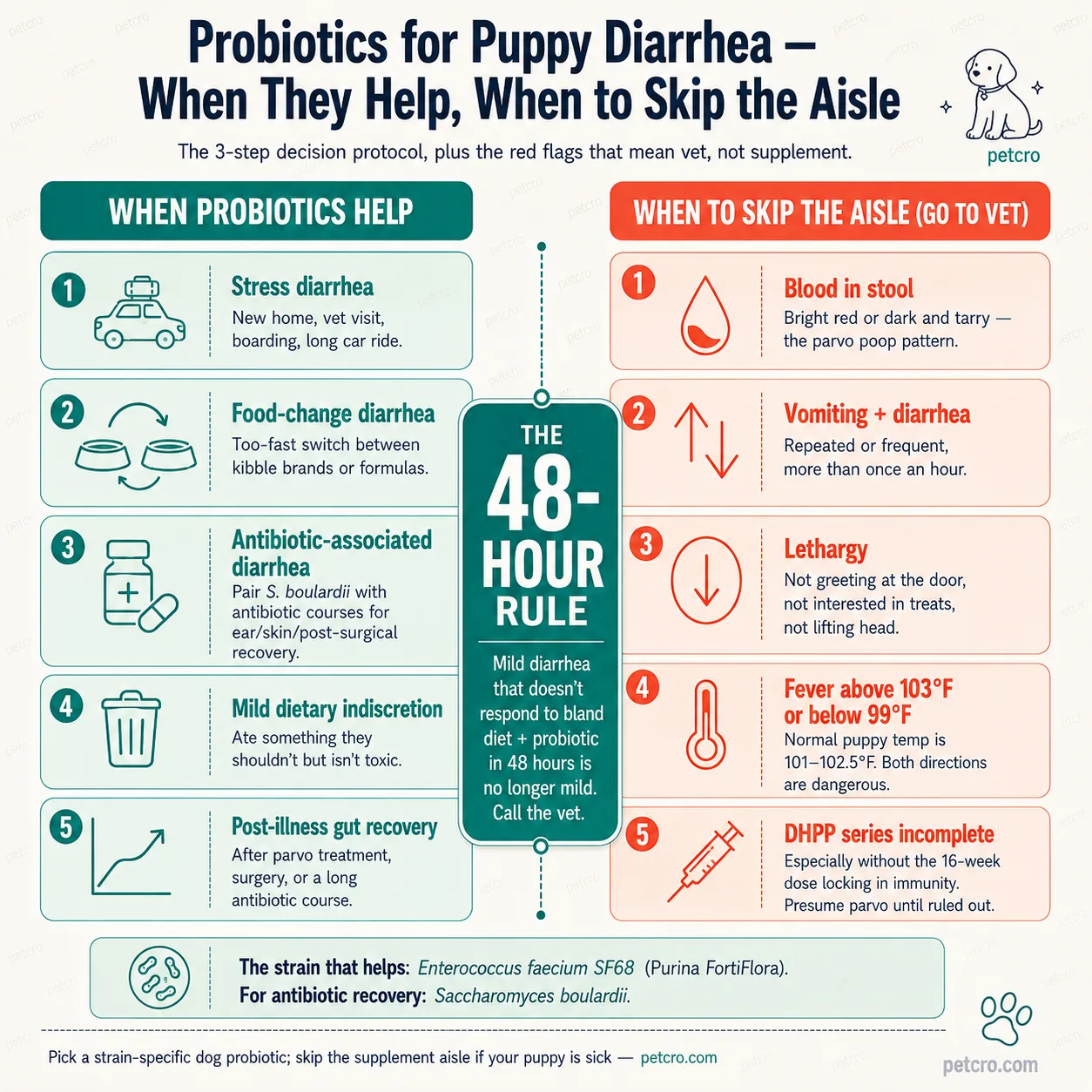
- Stress diarrhea — new home, boarding, vet visit, dog show, long car ride
- Food-change diarrhea — too-fast switch between foods or sudden new ingredient
- Antibiotic-associated diarrhea — when the puppy is on antibiotics for an ear infection, skin issue, or post-surgical recovery
- Mild dietary indiscretion — ate something they shouldn't but isn't toxic
- Post-parvo / post-illness gut recovery — once the puppy is past the acute phase and home
What probiotics are not good for:
- Active parvo, distemper, or other viral GI infections (those need hospital care — see our parvo symptoms guide)
- Intestinal parasites (need the right antiparasitic from your vet)
- Foreign-body obstruction (needs imaging and possibly surgery)
- Toxin ingestion (needs the poison-control hotline, not a supplement)
- Pancreatitis (acute or chronic), inflammatory bowel disease (IBD), exocrine pancreatic insufficiency (EPI), or other complex GI conditions (those have specific diagnostic and treatment paths)
The honest version: probiotics help your puppy's gut bounce back from a bad couple of days. They do not cure serious disease, and they do not replace a vet exam for any puppy showing systemic illness.
Which probiotic strains have evidence for dogs?
Strain matters more than brand. Two have the most consistent published canine evidence:
1. Enterococcus faecium SF68 (NCIMB 10415)
The most-studied probiotic strain in dogs. Marketed as Purina Pro Plan Veterinary Diets FortiFlora in the US — the strain with the strongest canine clinical evidence base, including studies in shelter puppies and adult dogs that document reduced diarrhea duration and improved stool quality. The Merck Veterinary Manual's probiotics overview discusses these effects across companion species.
2. Saccharomyces boulardii
A yeast (not a bacterium) commonly used in human medicine for antibiotic-associated diarrhea, increasingly studied in dogs. Standard antibiotics don't affect yeasts, so it survives antibiotic courses better than bacterial probiotics — useful when the puppy is already on antibiotics for something else. Available as canine-formulated supplements from veterinary brands; vets sometimes also recommend the human-grade product Florastor off-label for antibiotic-associated diarrhea in dogs. Check any product's label to confirm S. boulardii is actually named on the strain list.
Other strains with some evidence in dogs include Lactobacillus acidophilus, Bifidobacterium animalis AHC7 (in Iams ProActive Health), and multi-strain blends like Visbiome Vet — the 8-strain canine version of the formula sold for humans as VSL#3 until a 2016 brand split. The evidence base is thinner than for SF68 and S. boulardii but the products are generally considered safe.
What you want on the label:
- A named strain — Enterococcus faecium SF68, not just "Enterococcus" or "live cultures"
- CFU (colony-forming units) guaranteed through the expiration date, not just at time of manufacture
- A target species — "for dogs" or "for puppies and kittens," not a generic human product
- Storage instructions that match how it's stored at the store (refrigerated products should arrive cold)
What to skip:
- "Probiotic" yogurt for dogs (most yogurt has too few CFU, and many puppies — especially during a GI upset — are lactose-sensitive)
- Generic human probiotics without veterinary input (strain mix and dose are calibrated for human guts, not canine)
- Any product without strain names — that's a marketing tell that the company doesn't want you knowing what's actually in it
When to use a probiotic — the 3-step decision protocol
The decision tree is short. Use this sequence the moment your puppy has diarrhea:
Step 1 - Check the symptom severity
If your puppy has any of these, skip the probiotic and call the vet now:
- Blood in stool (bright red or dark/tarry — the "parvo poop" pattern)
- Vomiting alongside the diarrhea
- Lethargy, not greeting you at the door, not interested in treats
- Fever (above 103°F / 39.4°C) or sub-normal temperature (below 99°F / 37.2°C)
- Sunken eyes, tacky gums, skin that tents and stays tented (dehydration)
- Diarrhea persisting more than 48 hours despite bland diet
- Puppy under 8 weeks old (small puppies dehydrate very fast)
- Hasn't finished the DHPP series, especially without the 16-week dose
The above is the parvo-or-worse checklist. None of these are probiotic territory. See our parvo symptoms guide for the full emergency picture.
Step 2 - If symptoms are mild, start a 24-hour observation
The puppy is bright, eating, drinking, no vomiting, no blood, no fever — just looser stool than usual. This is the situation where probiotics earn their keep.
- Switch to a bland diet (plain boiled boneless skinless chicken + plain white rice, 1 part chicken to 2 parts rice, 4 small meals/day) for 24-48 hours
- Add the probiotic per the product's label — FortiFlora is 1 sachet daily; check the chart for multi-strain products
- Keep water available and watch how much they drink — dehydration is what hospitalizes puppies
- Note stool quality every 12 hours
Step 3 - Decision point at 24 hours
If the stool is firming up by hour 24, you're on the right track — continue the bland diet + probiotic for another 24 hours, then transition back to normal food over 3-5 days.
If the stool is no better — or actively worse — by hour 24, or any of the Step 1 red flags appear, call the vet. Mild diarrhea that doesn't respond to bland-diet-plus-probiotic in 48 hours is no longer mild.
How to give a probiotic to a puppy
The mechanics matter — a probiotic that the puppy spits out, vomits up, or never reaches the gut alive isn't a probiotic, just an expensive flavored powder.
Dose — follow the product's label. FortiFlora (the most widely recommended canine probiotic in US vet clinics) is 1 sachet daily regardless of body size, sprinkled over food; multi-strain products dose by weight, so check the chart. If the puppy is small and palatability is a concern, split the daily dose across two meals.
With food vs not — most canine probiotics are designed to be sprinkled on food. Food buffers stomach acid temporarily, which protects more live cultures on their way to the small intestine where they actually work. Pre-mixing into wet food or a small amount of unsalted bone-free broth works well.
Storage — read the label. Some probiotics (FortiFlora is one) are stable at room temperature. Others — particularly multi-strain refrigerated products — need to stay cold. Heat kills CFU, so don't leave the container in a hot car regardless of the storage class.
Duration — for acute diarrhea, a 5 to 10 day course is typical. For ongoing GI support (sensitive-stomach puppies, recent antibiotic course, post-parvo recovery), 3 to 4 weeks is reasonable. Long-term daily use isn't harmful but isn't typically necessary either; ask your vet if you're considering it past a month.
Side effects — mostly none. Occasional mild gas, transient soft stool in the first 2 to 3 days as the gut adjusts, very rarely a temporary appetite drop. Stop the product and call the vet if anything more dramatic happens.
OTC probiotics vs prescription (and the marketing trap in between)
There is no true "prescription" probiotic — probiotics are supplements, not drugs, so the FDA doesn't regulate them the way it regulates medications. What you have instead is a spectrum:
- Veterinary-channel probiotics (FortiFlora, Visbiome Vet, Proviable) — sold through vet clinics, online pet pharmacies, and some retail. Strain-specific, CFU-guaranteed through expiration, designed for dogs.
- Pet-store probiotics (Zesty Paws, PetHonesty, Pet Naturals) — widely available, lower price, quality varies. Look for named strains and CFU-through-expiration guarantees; skip products that hide the strain mix.
- Generic "live cultures" or yogurt-style products — generally not worth it for diarrhea. The CFU is too low and the strains aren't matched to canine guts.
The marketing trap is the middle tier — pet-store brands using authoritative-sounding language ("vet-formulated," "clinically tested," "10 billion CFU") without naming the actual strains or guaranteeing potency through expiration. The American Kennel Club's overview of canine probiotics also emphasizes strain-named products and CFU-through-expiration guarantees as the key selection criteria.
If your puppy's diarrhea is ongoing or you're not sure which product to choose, ask your vet during the visit — most clinics either stock or recommend a specific product they've seen work.
What probiotics will NOT fix
Worth repeating, because it's where owners lose puppies. Probiotics are gut-microbiome support. They do not treat:
- Parvo — life-threatening viral infection. Needs hospital IV fluids, antiemetics, antibiotics. See parvo symptoms. Survival drops sharply 48 to 72 hours after first symptoms appear.
- Giardia, coccidia, or worms — intestinal parasites need parasite-specific medication identified from a fecal test, not a probiotic. Probiotics may help the gut recover afterward.
- Foreign-body obstruction — swallowed sock, toy, or bone. Vomiting + lethargy + sometimes no stool at all. Needs imaging.
- Toxin ingestion — chocolate, xylitol, grapes/raisins, onion/garlic, antifreeze, household cleaners. Call the ASPCA Animal Poison Control (1-888-426-4435) or your vet immediately. See our common dog toxins reference.
- Pancreatitis or chronic GI disease — these have specific diagnostic workups and treatments. Probiotics may be part of long-term management but aren't the first step.
When in doubt, the answer is the same as in the parvo guide: vet visit today, not "wait until morning."
This guide is general guidance, not veterinary advice. For your specific dog's nutrition, health, or behavior needs, consult your veterinarian.
Frequently asked questions
What is the best probiotic for puppies with diarrhea?
Purina Pro Plan Veterinary Diets FortiFlora (containing Enterococcus faecium SF68) has the strongest published canine evidence for shortening acute diarrhea. Visbiome Vet — the 8-strain canine version of the original VSL#3 blend — is the leading multi-strain option for more stubborn or chronic GI cases. Both are sold through vet clinics and reputable online pet pharmacies. Ask your vet if you're unsure — they often have a preferred product for your puppy's specific situation.
How long do probiotics take to work in a puppy?
Most owners see stool quality start improving within 24 to 48 hours of consistent dosing alongside a bland diet. Full firming-up of stool typically happens by day 3 to 5 for an acute case. If you see no improvement in 48 hours, that's the signal to call the vet — mild diarrhea that doesn't respond to bland-diet-plus-probiotic in 48 hours is no longer mild.
Can I give my puppy human probiotics?
It's not the most effective choice, and some human formulations contain sweeteners or excipients you don't want in a puppy. Canine probiotics use strains tested in dog guts at doses calibrated to canine body size. Saccharomyces boulardii is one strain that does cross over — vets sometimes recommend the human-grade S. boulardii for antibiotic-associated diarrhea in dogs. Don't substitute on your own — ask your vet first.
Do probiotics prevent parvo?
No. Vaccination prevents parvo — three DHPP doses between 6 and 16 weeks, with the 16-week dose locking in immunity. Probiotics can support gut recovery in puppies who survive parvo, but they offer no protection against the virus itself. See our puppy vaccination schedule chart for the full immunization timeline.
How much yogurt can I give my puppy for diarrhea?
The short answer: don't rely on yogurt. Most yogurts have far fewer live cultures per serving than a purpose-made canine probiotic, and many puppies are lactose-sensitive (especially during a GI upset). A spoonful of plain unsweetened Greek yogurt is unlikely to harm a healthy puppy but is unlikely to help diarrhea meaningfully. Use a strain-specific dog probiotic instead.
Are probiotics safe long-term for puppies?
Generally yes — adverse effects in healthy puppies are rare. Mild transient gas or soft stool in the first 2 to 3 days is the most common reaction. Long-term daily use (months to years) is reasonable for sensitive-stomach puppies, recent antibiotic recoveries, or ongoing GI conditions, but it's worth checking with your vet — sometimes the underlying issue benefits more from a diagnostic workup than from indefinite supplementation.
Can a probiotic make diarrhea worse?
Rarely. Some puppies have a brief loosening of stool in the first 24 to 48 hours as the gut adjusts to the new microbes. If diarrhea worsens dramatically, blood appears, or vomiting starts after introducing a probiotic, stop the product and call the vet — that's not a probiotic reaction, that's something else going on.
TL;DR — the puppy probiotics cheat sheet
- Probiotics shorten mild puppy diarrhea by roughly 1 to 2 days when paired with a bland diet — not a cure, just faster recovery
- Strain matters: Enterococcus faecium SF68 (Purina FortiFlora) and Saccharomyces boulardii have the strongest canine evidence
- Look for a named strain, CFU guaranteed through expiration, and a dog-specific formulation
- Skip the probiotic and call the vet if there's blood, vomiting, lethargy, fever, sub-normal temperature, or symptoms past 48 hours
- Probiotics do NOT treat parvo, parasites, foreign bodies, toxins, or chronic GI disease — those need vet workups
- Sprinkle on wet food — food buffers stomach acid, protecting more live cultures on the way to the gut; 5–10 days for acute diarrhea, 3–4 weeks for GI recovery support
- Skip pet-store products that hide their strain mix or guarantee CFU only at manufacture, not through expiration
If your puppy's stool is no better in 48 hours, the answer is the vet, not a stronger probiotic.
Sources & further reading
- Merck Veterinary Manual — Probiotics for Animals — clinical reference on probiotic use, mechanisms, and evidence in companion animals.
- AKC — Probiotics for Dogs — owner-facing overview from the American Kennel Club, including strain guidance and product-selection criteria.
- Cornell University Baker Institute — Canine Parvovirus — context for one of the most serious causes of puppy diarrhea, where probiotics are emphatically not the answer.
- ASPCA — Animal Poison Control — call 1-888-426-4435 immediately if you suspect any toxin ingestion. There is a per-case fee but the call is worth it.
- AKC — Puppy Shots: A Complete Guide — the DHPP schedule referenced throughout this guide.
More from Petcro's puppy health cluster
- Parvo Symptoms in Puppies — when puppy diarrhea isn't probiotic territory at all.
- Puppy First Vet Visit — what to set up in the first week, including pet insurance before symptoms appear.
- Puppy Vaccination Schedule Chart — full DHPP + rabies + lifestyle vaccine schedule.
- Bringing a New Puppy Home — 14-day arrival timeline, including the bland-food settle-in window where probiotics often earn their keep.
- Feeding calculator — exact gram count for your puppy's age and weight, useful when reintroducing food after diarrhea.
Petcro is reader-supported. We may earn an affiliate commission when you click through links to products in this guide. Our editorial picks are independent of any commercial relationship with Nestlé Purina PetCare or any other brand mentioned.