Puppy Potty Training Schedule (Hour-by-Hour by Age)
Puppy potty training schedule — full hourly day at 8 weeks, 12 weeks, 4 months, and 6 months. Meal times, potty trips, crate stretches, overnight.
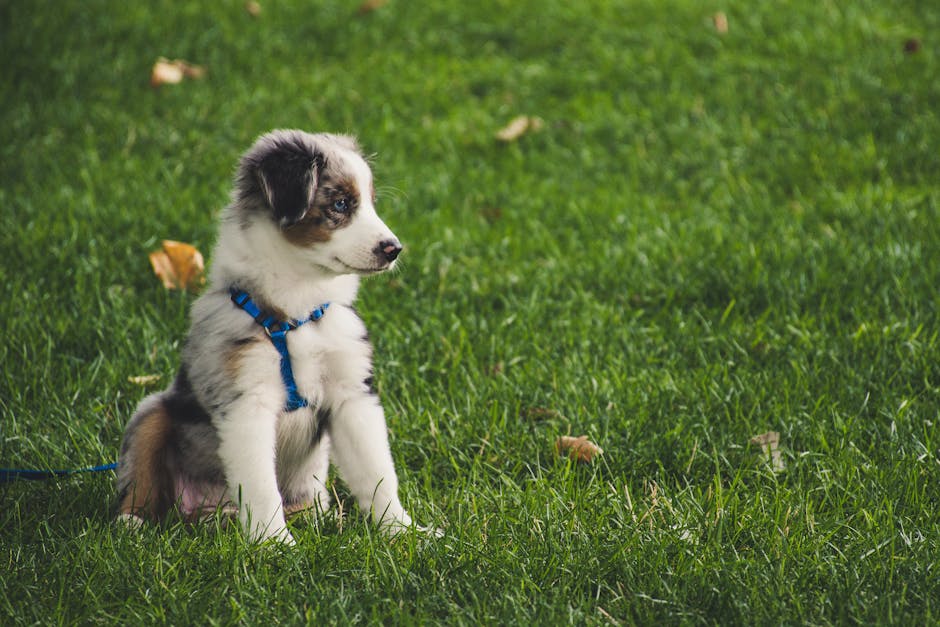
The puppy potty training schedule starts with four meals a day on a fixed clock, a potty trip every 90 minutes during the day, and one mid-night alarm in week 1. By 12 weeks the day stretches; by 16 weeks the bladder reaches four hours; by six months your puppy is on an adult routine.
TL;DR: A typical puppy potty training schedule rotates around four time anchors: wake, post-meal, post-nap, and pre-bedtime. At 8 weeks that's 8–12 potty trips a day; at 12 weeks 6–8; at 4 months 5–6; at 6 months 4–5 — bladder grows roughly one hour per month of age. Carry the puppy outside until the 16-week vaccination gate. The biggest predictor of how fast house-training locks in: consistency on the timing, not the method. 30 days locks the pattern in.
The puppy potty training schedule at a glance
Four time anchors drive every day, regardless of age:
Wake — first thing on waking, before anything else
Post-meal — 15–30 minutes after every meal
Post-nap — the moment the crate door opens
Pre-bedtime — 30 minutes before lights out
What changes by age is how many additional trips you slot between these anchors. Bladder capacity grows roughly 1 hour per month of age (8 weeks = 2 hours, 12 weeks = 3 hours, 16 weeks = 4 hours, capped around 6 hours for adults) — the American Kennel Club's potty training guide uses the same benchmark. Number of meals drops over the same window (4 → 3 → 2). Net effect: fewer trips per day as the puppy matures.
A note on counting: the per-age tables below show every potty event — including back-to-back pairs around mealtimes (e.g., pre-crate potty + post-meal potty 30 minutes apart). Real outdoor trips are often half that, since multiple events get consolidated into one walk to the toilet spot. The daily-trip ranges in the overview table count consolidated outdoor visits.
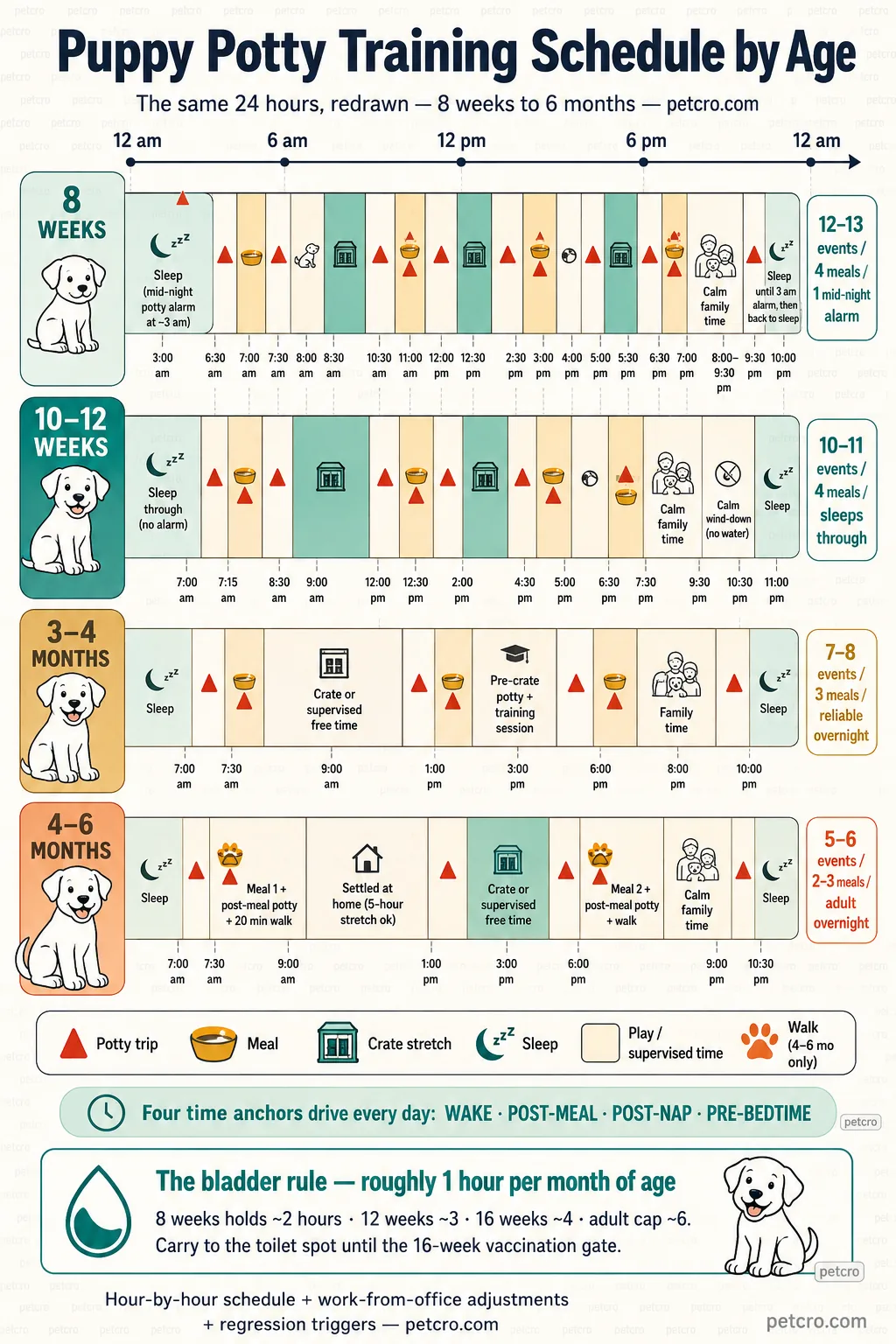
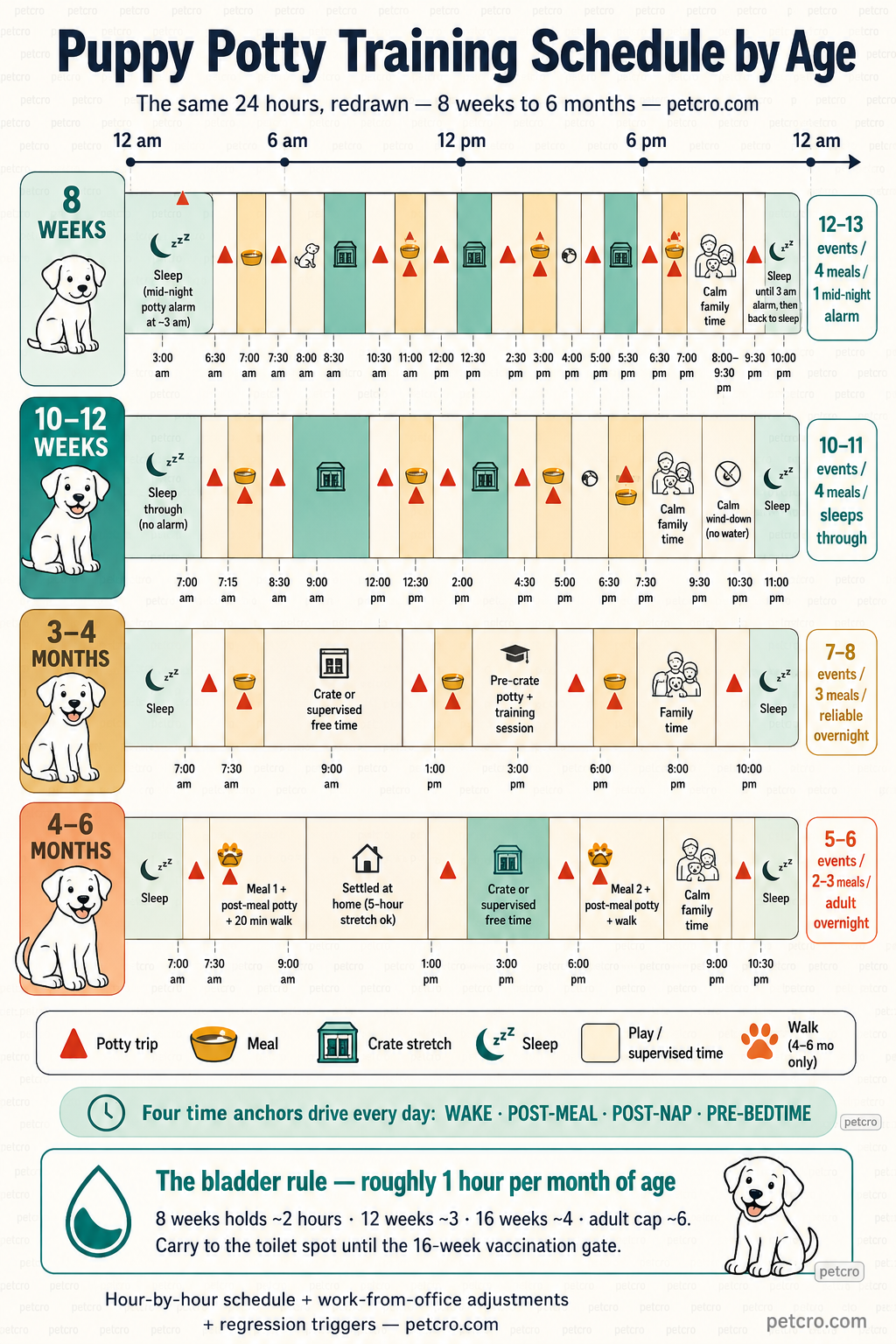
Age | Daytime trips | Overnight trips | Meals per day | Notes |
|---|---|---|---|---|
8 weeks | 8–12 | 1 mid-night alarm | 4 | First weeks home |
10–12 weeks | 6–8 | Sleeps through if last potty 11 pm | 4 (drop to 3 around 12 w) | First bladder jump |
3–4 months | 5–6 | Through-the-night reliable | 3 | First vet boosters complete |
4–6 months | 4–5 | Adult overnight | 3 (drop to 2 around 6 m) | Outdoor walks safe after 16 w vaccination gate |
6+ months | 4 | Adult overnight | 2 | Adult schedule |
For the crate-based mechanism that makes this work — why a properly-sized crate teaches bladder control — see the puppy potty training crate guide. For the 7-day crate intro that runs alongside the first week of this schedule, see tips on how to crate train a puppy.
The 8-week-old puppy potty training schedule
Four meals a day on the strict 4-hour cycle covered in the 8-week-old puppy feeding schedule. Bladder maxes out at 2 hours during the day, 4–5 hours overnight. Carry — don't walk — to the toilet spot for the first month: an 8-week-old's bladder won't survive a flight of stairs.
Typical 8-week day (anchor times match the feeding cycle):
Time | Activity |
|---|---|
6:30 am | Wake — carry straight to toilet spot. Set down, stand silent, wait. |
7:00 am | Meal 1 (soaked kibble), then 15–30 min calm → potty |
8:00 am | Short play (5 min), pre-crate potty |
8:30 am | Crate stretch (max 2 hrs) |
10:30 am | Potty |
11:00 am | Meal 2, 15–30 min → potty |
12:00 pm | Pre-crate potty |
12:30 pm | Crate stretch (max 2 hrs) |
2:30 pm | Potty |
3:00 pm | Meal 3, 15–30 min → potty |
4:00 pm | Family time, supervised play |
5:00 pm | Pre-crate potty |
5:30 pm | Crate stretch |
6:30 pm | Potty |
7:00 pm | Meal 4 (last meal — 3+ hours before bed), 15–30 min → potty |
8:00 pm | Calm family time |
9:30 pm | Last potty — 30 min before bed, then no water/food |
10:00 pm | Crate next to your bed |
~3:00 am | Mid-night alarm — silent carry to toilet, no play, back to crate |
6:30 am | Wake — repeat |
That's about 12–13 potty events in 24 hours — most consolidate into 8–12 outdoor trips. The hard rule: the moment the crate door opens, you go to the toilet spot first. Every single time, for the first 30 days. After ~30 days the pattern locks in and the puppy starts walking themselves to the door.
Small-breed / toy puppies (Yorkies, Chihuahuas, etc.) need 30–60 minute shorter intervals because the bladder is physically smaller. Add an extra mid-morning and mid-afternoon trip.
The 10–12 week puppy potty training schedule
Bladder capacity jumps to 3 hours daytime, 5–6 hours overnight — the first real stretching of the schedule. Most puppies now sleep through if the last potty is at 11 pm; you can drop the 3 am alarm by week 10–11. Still 4 meals a day, with the transition to 3 meals starting around 12 weeks per the feeding pillar.
Typical 10–12 week day:
Time | Activity |
|---|---|
7:00 am | Wake — still carry to toilet (puppy is still under-vaccinated until 16 w) |
7:15 am | Meal 1, 15–30 min → potty |
8:30 am | Short play, pre-crate potty |
9:00 am | Crate stretch (max 3 hrs) |
12:00 pm | Potty |
12:30 pm | Meal 2, 15–30 min → potty |
2:00 pm | Pre-crate potty + crate stretch |
4:30 pm | Potty |
5:00 pm | Meal 3, 15–30 min → potty |
6:30 pm | Supervised play / first short outings (vaccinated environments only) |
7:30 pm | Pre-crate potty + Meal 4 (last meal) |
9:30 pm | Calm family time |
10:30 pm | Calm wind-down — no water for the next hour |
11:00 pm | Last potty, then crate next to your bed — sleeps through to 7 am most nights |
About 10–11 events daily (6–8 consolidated outdoor trips). The schedule has visibly fewer cycles than 8 weeks because the puppy can hold longer between trips. Watch for "I can hold it" pride — puppies sometimes test whether they can extend the gap; respond by taking them out before they ask, not after.
The 3–4 month puppy potty training schedule
The first reliable through-the-night stretch arrives for most puppies in this window. Bladder = 4 hours daytime, 6–7 hours overnight. Down to 3 meals a day. The third DHPP booster (around 14–16 weeks — the immunity-locking dose) lands in this period — see the puppy vaccination schedule chart for the visit-by-visit timeline.
Typical 3–4 month day:
Time | Activity |
|---|---|
7:00 am | Wake → potty (can walk to spot now if 12+ weeks and small enough) |
7:30 am | Meal 1, 15–30 min → potty |
9:00 am | Crate stretch (max 4 hrs) or supervised free time |
1:00 pm | Potty + Meal 2 + 15–30 min → potty |
3:00 pm | Pre-crate potty + crate / training session |
6:00 pm | Potty + Meal 3 (still 3+ hours before bed) |
8:00 pm | Family time, calm exercise |
10:00 pm | Last potty before bed |
10:30 pm | Bed — sleeps through to 6:30–7 am |
About 7–8 events daily, consolidating into 5–6 outdoor trips. The schedule starts to feel more adult-like, with longer training/play windows between potty cycles.
This is the age window where most puppies start showing the pre-elimination signals (sudden quiet, circling, walking away). See the puppy potty training crate guide for the full list — catching these is what bridges from owner-initiated trips to puppy-initiated signals.
The 4–6 month puppy potty training schedule
Most puppies are reliably house-trained by month 6. Bladder = 5 hours daytime, 7–8 overnight. Transitioning to 2 meals a day around the 6-month mark per cluster feeding guidance. The 16-week vaccination gate clears in this window — outdoor walks on sidewalks and shared surfaces are now safe.
Typical 4–6 month day:
Time | Activity |
|---|---|
7:00 am | Wake → potty (walk to spot or yard) |
7:30 am | Meal 1 + 15–30 min → potty + 20 min walk |
9:00 am | Settled at home (5-hour stretch ok) |
1:00 pm | Potty + light meal/snack if still on 3 meals; otherwise just potty |
3:00 pm | Crate / supervised free time |
6:00 pm | Potty + Meal 2 (transition to 2 meals) + 15–30 min → potty + walk |
9:00 pm | Calm family time |
10:30 pm | Last potty |
11:00 pm | Bed — sleeps through |
About 5–6 events daily, consolidating into 4–5 outdoor trips. The puppy now signals reliably (bell, door stand, or whine — see the puppy potty training crate guide for bell training). Most owners can extend daytime crate stretches or move to a puppy-proofed room with the crate door open.
The overnight puppy potty training schedule
Overnight is where most owners crack the schedule. The pattern that holds:
Weeks 8–10: Crate next to your bed. Hand reachable through the bars. Set an alarm for one mid-night potty trip (e.g., 11 pm bedtime → 3 am alarm). Silent carry → toilet → silent carry back to crate. No play, no eye contact. Most owners drop the alarm by week 10.
Weeks 10–12: Most puppies sleep through if the last potty is at 11 pm and no water/food in the 1–2 hours before bed.
Months 3–4: Reliable through-the-night sleeping. If accidents start happening overnight after a month of clean nights, it's almost always a UTI or parasites — vet check rather than schedule change.
Months 4+: Adult overnight pattern. 8 hours of bladder-hold is the typical max.
If overnight accidents happen at any age: the schedule was wrong, not the puppy. Move the last potty later, move the bedtime alarm earlier, or check for a medical issue. Clean with an enzyme cleaner so the smell doesn't re-cue the spot — the new puppy checklist covers which cleaners work. Never scold or punish the accident; the AVSAB position against punishment in behavior modification confirms it delays house-training and produces sneaky elimination, not faster learning.
Adjusting the puppy potty training schedule for your work or lifestyle
The standard schedule assumes someone is home most of the day for the first month. Most puppy owners aren't in that situation. Honest options:
Full-time work (9-hour day + commute)
An 8-week-old can be crated for 2 daytime hours max. A 12-week-old, 3 hours. Full-time work + commute = 9+ hours, and no puppy under 6 months can physically hold that. Real options:
Hire a dog walker or puppy sitter for a midday break (1–2 trips, 30–60 min each)
Take 2 weeks off work for the first phase
Come home at lunch every day
Doggie daycare from 12+ weeks (when most facilities require Bordetella vaccination — see the puppy vaccination schedule chart)
Shift work / variable schedule
Pick an anchor schedule and stick to it. Puppies don't care which 24 hours you choose; they care that the wake/meal/potty cycles are consistent within whichever 24 hours.
Kids in the house
Adults run the schedule, kids supplement. Don't let a 7-year-old "be in charge" of the bedtime potty — the routine breaks within a week. Kids can do the play sessions and supervised potty trips during the day.
Apartment / no easy outdoor access
Use a balcony with a pee-pad station OR commit to outdoor-only and accept the trip count. Don't put pee pads inside the crate (defeats the den instinct entirely) — see the supplies trade-offs in the new puppy checklist.
When the puppy potty training schedule "regresses" — common triggers
Sometime around 3–6 months, many puppies have a sudden run of accidents after weeks of clean behavior. That's not regression — it's a trigger response. Common ones:
Recent vaccination — puppies often have lower bladder control for 24–48 hours after a vaccine due to mild fever and stress. See puppy not eating but acting normal for the typical post-vaccine recovery pattern.
New environment — moving house, visitors staying over, a new pet. Reset the schedule for 3–5 days; the puppy will re-stabilise.
Medical issue — UTIs, parasites, giardia. A previously-clean puppy who suddenly has frequent accidents needs a vet check, not a longer crate stretch. The Merck Veterinary Manual's behavior problems chapter is clear that elimination-disorder workups always rule out medical causes first.
Schedule drift — owner started taking the puppy out at irregular times, or someone in the household broke the routine. Tighten back up for 7 days.
Adolescence (5–8 months) — testing behavior. Hold the line on the schedule; don't punish; the phase passes within 4–6 weeks.
The general rule: a regression is a signal, not a personality. Look for the trigger; fix the trigger.
This guide is general guidance, not veterinary advice. For your specific dog's nutrition, health, or behavior needs, consult your veterinarian.
Frequently asked questions
What time should I start my puppy's potty training schedule each morning?
Anchor the wake time to your own — puppies adapt to whatever you pick, but they need it to be consistent. 6:30–7:00 am is typical for most families. The first 30 days are about teaching the puppy that wake = immediate potty. Vary the wake time and the connection takes longer to lock in. Once the pattern is set (~30 days), occasional schedule shifts are tolerated fine.
How often should an 8-week-old puppy go potty during the day?
Plan for 8–12 outdoor trips per 24 hours at 8 weeks: 6 anchor moments (wake / 4 post-meal / pre-bedtime) plus 2–6 mid-cycle trips after naps and play. The cycle is eat → 15–30 min → potty → calm crate stretch. By 12 weeks this drops to 6–8 trips; by 4 months 5–6; by 6 months 4–5. Bladder capacity grows roughly 1 hour per month of age.
Can I follow this schedule without a crate?
Yes, but expect house-training to take 4–6 months instead of the 6–8 weeks crate-trained puppies typically need. Without a crate, you lose the den instinct that makes the puppy choose to hold it — every accident becomes a chance to reinforce the wrong location. If you're committed to crate-free, use baby gates and constant supervision. The schedule itself stays the same; only the holding mechanism changes.
How long can a puppy hold their bladder overnight at each age?
8 weeks: roughly 4–5 hours (mid-night alarm needed week 1). 10–12 weeks: 5–6 hours (sleeps through if last potty is 11 pm). 3–4 months: 6–7 hours. 4–6 months: 7–8 hours. 6+ months: 8 hours (adult). Overnight stretches are longer than daytime because the puppy is asleep and not drinking — but only if you remove water 1–2 hours before bed.
My puppy was clean for a month and now has accidents — what changed?
Three causes, in order of likelihood: (1) a recent trigger — vaccination, new visitor, moved house. (2) Medical issue — UTI, parasites; warrants a vet visit if it lasts more than 48 hours. (3) Schedule drift — someone in the household has been less consistent. Reset the schedule for 7 days and watch. Don't punish — the regression is a signal, not a behavior.
When can I take my puppy on a walk outside?
Carry your puppy for toilet trips from day 1 — that's how house-training works. Walking on shared outdoor surfaces (sidewalks, parks, dog parks) waits until after the third DHPP dose at 16 weeks. Before that: vaccinated friends' yards, vaccination-gated puppy classes, and your own home only. The puppy vaccination schedule chart covers the full timing logic.
How do I adjust the puppy potty training schedule if I work full-time?
You can't fully — an 8-week-old needs a daytime break every 2 hours, and no puppy under 6 months can hold 9+ hours. Real options: hire a midday sitter or dog walker, take 2 weeks off for the first phase, come home at lunch, or use doggie daycare from 12+ weeks. Forcing the puppy to soil the crate because the day is too long unlearns the den instinct in 1–2 weeks — recovery takes far longer than the initial training would have.
TL;DR — the schedule cheat sheet
Four anchor times every day: wake, post-meal, post-nap, pre-bedtime
8 weeks: 8–12 daily trips + 1 mid-night alarm in week 1
12 weeks: 6–8 daily trips, sleeps through if last potty is 11 pm
3–4 months: 5–6 daily trips, reliable overnight
4–6 months → 6+ months: 4–5 trips dropping to 4 on an adult 2-meal schedule; outdoor walks safe after the 16-week vaccination gate
Bladder grows roughly 1 hour per month of age (8w=2h, 12w=3h, 16w=4h, cap ~6h) — carry to the toilet spot until 16 weeks
Regressions are triggers (vaccination, new environment, UTI), not personality — fix the trigger
The schedule itself is simple. The hard part is consistency for 30 days.
Sources & further reading
AKC — How to Potty Train a Puppy — kennel-club guide on house-training timing benchmarks and the den-instinct mechanism.
AVSAB Position Statements — the humane-training position that anchors the no-punishment rule on accidents.
Merck Veterinary Manual — Behavior Problems in Dogs — vet-reference chapter on house-training and elimination disorders.
ASPCA — Vaccinations for Your Pet — relevant to the 16-week walking gate that closes the puppy-only window.
Cornell Riney Canine Health Center — academic reference for canine behavior research.
More from Petcro's puppy training cluster
Puppy Potty Training Crate Schedule — the crate-based mechanism that makes this schedule work, plus the 6 daily potty triggers and the accident-response rules.
Tips on how to crate train a puppy — the 7-day crate intro protocol that runs alongside the first week of the schedule.
8-Week-Old Puppy Feeding Schedule — the 4-meal cycle that anchors the eat→potty rhythm.
Puppy Vaccination Schedule Chart — the 16-week vaccination gate that determines when outdoor walks become safe.
New Puppy Checklist (the actually useful version) — what to buy before day 1, including the right crate and enzyme cleaner.
Interactive new puppy checklist tool — tick items off as you buy them, with a personalised printable PDF.
Petcro is reader-supported. We may earn an affiliate commission when you click through links to products in this guide. Our editorial picks are independent of any commercial relationship with any brand mentioned.