First Night With a New Puppy (What to Expect, Step-by-Step)
First night with a new puppy — exactly what to expect, the hour-by-hour routine from arrival to lights out, and how to handle the inevitable 2 am crying.

The first night with a new puppy is mostly about setting expectations: 30–90 minutes of cumulative crying is normal, not failure. Set up the crate next to your bed before pickup, last meal three hours before bedtime, last potty thirty minutes before lights out. Plan for one mid-night silent-carry potty trip in week one.
TL;DR: The first night is about preparation, not perfection. Crate next to your bed (non-negotiable for the first 5–7 nights), three-sided cover, last potty 30 minutes before lights out, water pulled 1–2 hours before bed. Expect 30–90 minutes of cumulative crying — drop a finger through the bars during quiet moments, wait for a 5-second pause before opening the door, and accept one mid-night silent-carry potty trip in week one. Most puppies settle by night three. The puppy isn't broken if the start is rough — it's the default, and the rest of the week gets easier fast.
What should I expect the first night?
The typical pattern: 10–30 minutes of investigating the new space after lights out, 30–90 minutes of cumulative crying spread across the first 2–3 hours, one mid-night potty trip around 3 am, and a 6–7 am wakeup that feels too early. The puppy isn't broken. They left their littermates roughly 24–48 hours ago — separation distress is the default, not a behavior problem.
A few things to expect that surprise first-time owners:
- Crying happens in waves, not continuously. Most puppies cry, settle for a few minutes, cry again, settle longer, repeat. Total cry time is often 30–90 minutes split across several bursts; it is rarely a single 90-minute scream. The waves shorten and space out across the first week.
- An 8-week-old needs one mid-night potty trip. Bladder capacity grows roughly 1 hour per month of age during the day (8 weeks = 2 hours, 12 weeks = 3 hours, 16 weeks = 4 hours). Overnight stretches are longer because the puppy is asleep and not drinking — if you remove water 1–2 hours before bed. For an 8-week-old, that still maxes out around 4–5 hours, which is why you need one alarm.
- The morning energy is real. Most 8-week-old puppies are wide awake by 6 am ready to potty, eat, and play. Plan to be up. Coffee within reach of the crate is sensible.
- Day two is usually easier than day one. The puppy now has 24 hours of context — they know which spot is the potty, where the food bowl lives, what your voice sounds like. Most owners report a noticeably shorter cry on the second night.
This is the mainstream pattern. The American Kennel Club's new puppy guide and the ASPCA's general dog care advice both describe the first 48 hours as the highest-stress window for a new puppy — set expectations there.
What to set up before the puppy arrives
Have the entire setup done before pickup, not during. A new puppy in your arms is a terrible time to discover the crate divider is in the wrong slot.
The six things to have ready:
- Crate, placed next to your bed. Wire crate, three-sided cover (a breathable blanket works), divider set so the puppy has just enough room to stand, turn, and lie down — no more. The full sizing logic by adult weight is in the crate-sleeping setup guide. Crate goes in your bedroom for the first 5–7 nights. This is the single biggest predictor of how quickly the puppy settles.
- A small water bowl at the back of the crate (or just outside, if your divider doesn't allow it). Pull the water 1–2 hours before lights out.
- The "smells like home" trick. Ask the breeder or shelter to send a small unwashed blanket or t-shirt with the litter's smell on it. Put it in the crate. The familiar scent dramatically shortens settling time. If you forgot to ask, sleep with a new t-shirt for two nights before pickup so it smells like you — second-best alternative.
- A designated outdoor potty spot. Same spot every trip for the first 2 weeks. Pee-saturated grass is a feature, not a bug — the smell tells the puppy "this is the spot." If you're in an apartment, set up indoor pads near the door (not inside the crate — that defeats house-training entirely).
- Vet contact info on the fridge. Your regular vet, the nearest 24-hour emergency vet, and ASPCA Animal Poison Control (888) 426-4435. Knowing who to call beats Googling at 2 am.
- A dim nightlight in the bedroom. Total darkness is disorienting for an 8-week-old in a new space — a 5-watt warm bulb takes the edge off.
The full 30-item supply list is in the new puppy checklist. For tonight specifically, those six items above are the non-negotiables.
Your first hour together
The first hour sets the tone for the day. Two principles: low arousal, and predictable cycles.
When you walk through the door:
- Carry the puppy directly to the designated potty spot before anything else. Set them down, wait. Most puppies pee within 2–5 minutes of arrival because the car ride has stimulated their bladder. Praise quietly when they go.
- Then to the crate, door open, for 10 minutes of "look around." Don't put them in and close the door immediately. Let them sniff the crate, the blanket, the area around it.
- Skip the family greeting party. It's tempting to invite neighbors and grandparents over to meet the new puppy. Don't, for at least 48 hours. The puppy has had 24+ hours of stressful change already; a crowd of strangers spikes cortisol exactly when you need the puppy to settle. Family members in the household are fine — one at a time, quiet voices, let the puppy approach them rather than the other way around.
If you have children: sitting on the floor only (drops are a real risk on day one); let the puppy approach the kid, not the other way; and once the puppy retreats to nap, that retreat is sacred — 8-week-olds sleep 18–20 hours a day.
The cycle to anchor for day one and week one: eat → 15–30 min → potty → calm crate stretch. Same cycle the puppy potty training schedule builds the whole hourly routine around.
Dinner and the pre-bedtime routine — the 5-step protocol
The pre-bedtime routine is the most leverage-rich hour of pickup day. Get this right and the night is mostly fine; get it wrong and you're up every 90 minutes.
Step 1: Three hours before bed — Last meal
Use the breeder's or shelter's food for the first 5–7 days — switching on day one causes first-week diarrhea. Portion guidance is in the 8-week-old puppy feeding schedule or feeding calculator. Put the bowl down for 15–20 minutes, then pick it up. Free-feeding day one breaks house-training.
Step 2: 1–2 hours before bed — Pull the water bowl
This is the single biggest controllable variable for overnight bladder capacity. A puppy that drinks half a cup of water at 9:45 pm will need to potty at 12:30 am no matter how tired they are.
Step 3: 30 minutes before bed — Final potty trip
Stand quietly at the designated spot, no play, give them 5–10 minutes to do both ends if possible. If they only pee, that's fine — the bowel can usually hold overnight on day one because the digestive system is still settling.
Step 4: 20 minutes before bed — Calm play
Not high-arousal chase or tug — low-key sniffing games, a chew toy, gentle handling. The point is to take the edge off so the puppy is sleepy but not over-stimulated when you go to lights out.
Step 5: Lights out — Into the crate
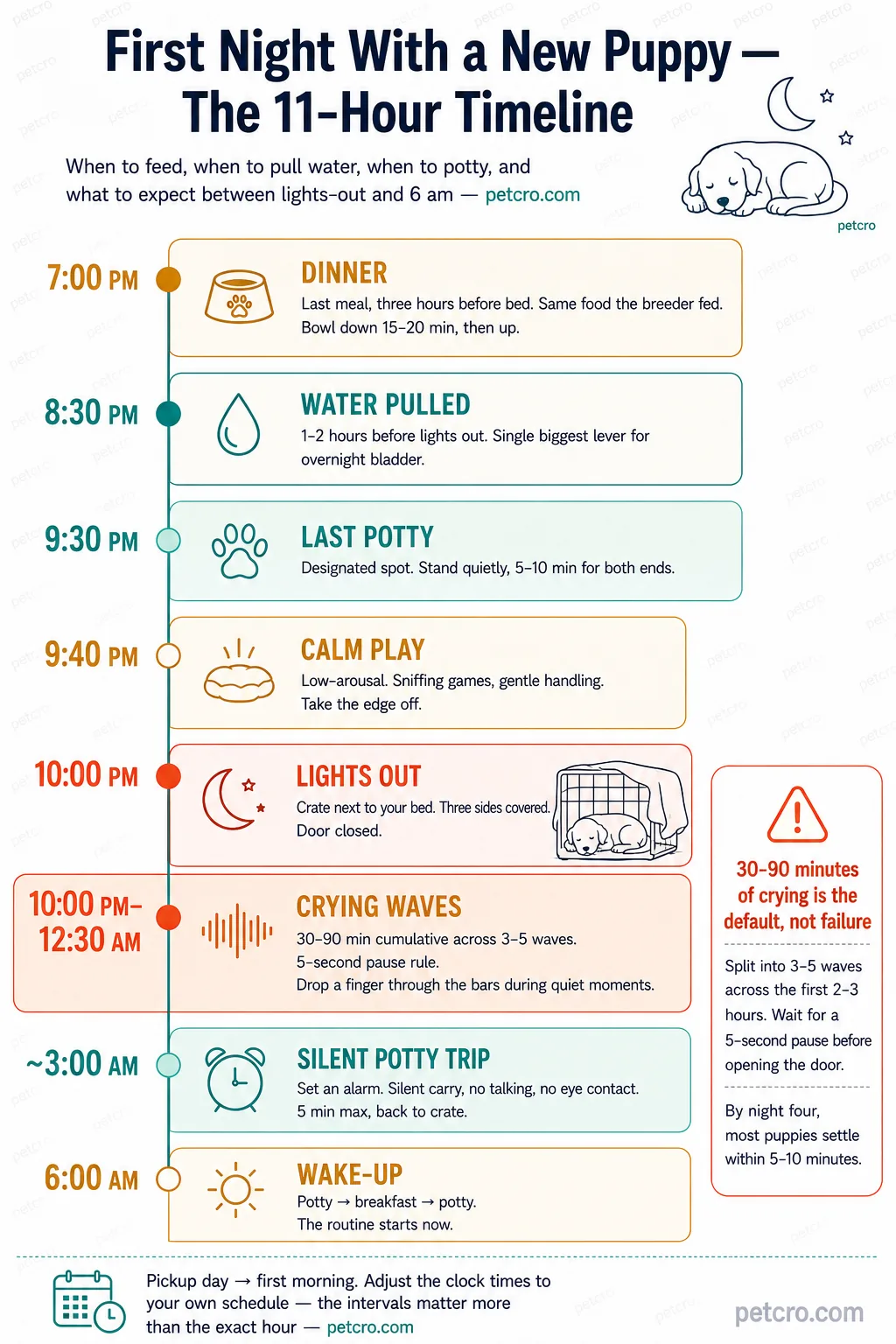
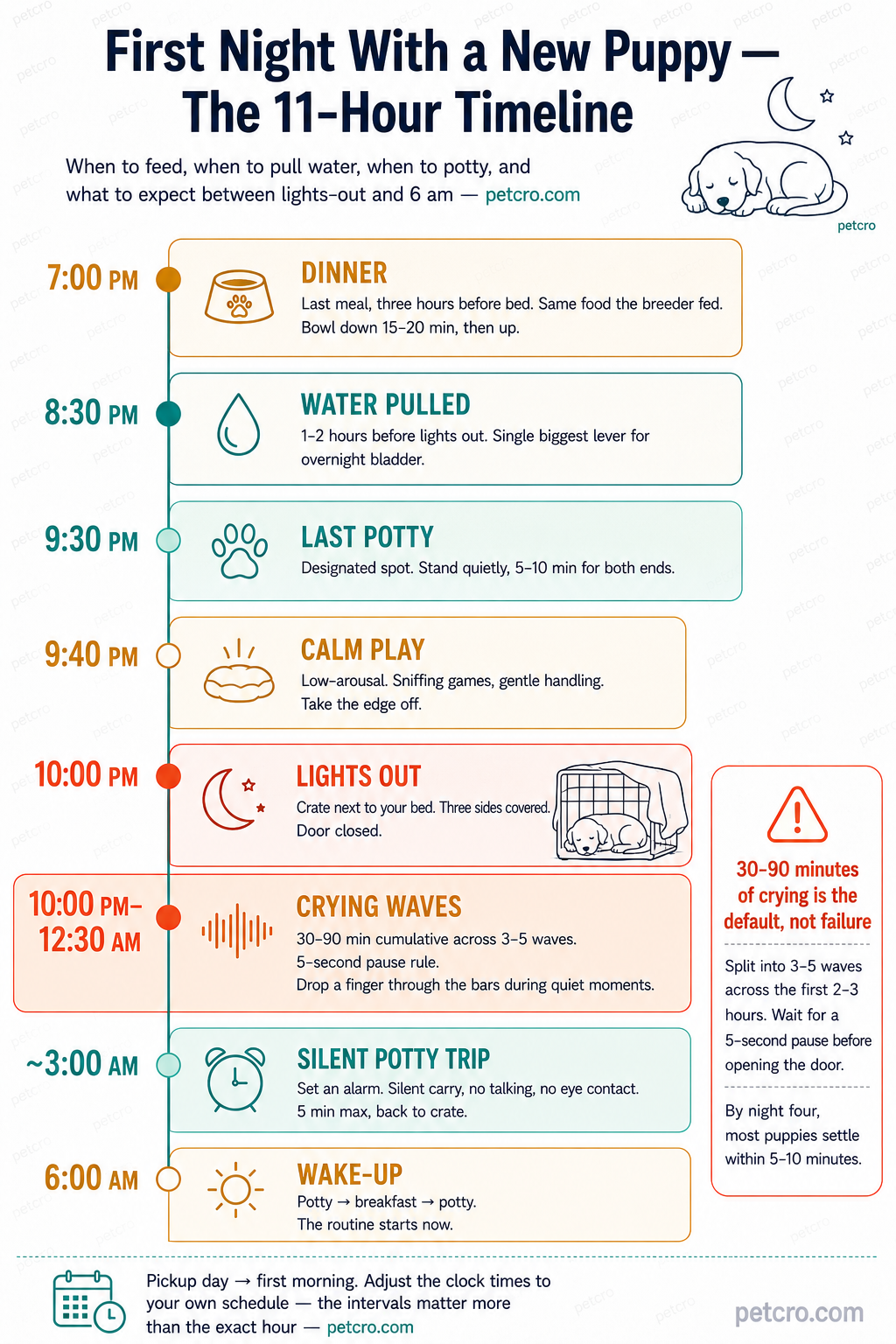
Puppy into the crate with the blanket from home, three sides covered, room dim. Don't make a production of it — quiet "bedtime," door closed, you climb into bed within arm's reach. A workable pickup-day schedule: dinner 7 pm, water pulled 8:30 pm, last potty 9:30 pm, calm play 9:40 pm, lights out 10 pm. Adjust to your own schedule, but the intervals matter more than the clock times.
Setting up the crate for the first night
Five things that change the outcome:
- Crate next to your bed, hand reachable through the bars (already covered, repeated because this is the single biggest factor).
- Three sides covered with a breathable blanket — den feel, door side open for visibility.
- The right size: stand without ducking, turn, lie down — no bigger. Use a divider sized for the puppy's current body.
- Thin mat or folded towel, not a plush bed for the first two weeks (most puppies shred them and you have a foreign-body emergency at 2 am).
- NO pee pad inside the crate — the puppy learns to soil one end and sleep at the other.
Sizing by adult weight (toy through giant), the full table, and crate placement reasoning are all in crate sizing and placement details. The crate you buy now should fit the eventual adult, with a divider for the current body.
Lights out — what do I do when they cry?
Some crying in the first 3–7 nights is normal — the puppy is adapting to leaving their littermates. The protocol that works:
- Get into bed quietly. No goodnight speech, no peeking back at the crate every 30 seconds — the puppy reads your behavior.
- Drop a finger through the bars during quiet moments. No talking, no eye contact, no treats. Reassurance, not reward.
- Wait for a 5-second pause before opening the door for ordinary whining — opening during the noise teaches that whining opens doors. Exception: if the puppy whines for 15+ minutes straight without settling, take them out for a silent toilet trip (no play, no eye contact), then back to the crate. Extended cries that don't taper are often a real bladder signal.
- Cumulative crying on night 1 is often 30–90 minutes, split into 3–5 waves, and typically drops by half each subsequent night.
What NOT to do (turns a 3-night problem into a 3-week problem): taking the puppy into your bed "just for tonight," yelling or banging on the crate, moving them to a different room when they cry, or opening the door during a whine to "check on them."
If a puppy is still screaming 30+ minutes a night after night 5: check for ignored bladder need (8-week-old maxes at 4–5 hours overnight), over-stimulation before bed, or crate placement that drifted out of the bedroom. The crate-training step-by-step guide covers the 7-day intro in detail.
The first-night 2 am potty trip
An 8-week-old puppy will almost certainly need one mid-night potty trip in week one. The protocol:
- Set an alarm for 3 am (or roughly 4–5 hours after lights out). Better to wake the puppy than wait for the bladder to wake them — the latter comes with a soiled crate.
- Silent carry to the toilet spot. No talking, no lights on, no walking (puppies stop and play if walked).
- Stand quietly while they go. 5 minutes max. If they don't go, head back.
- Silent carry back to the crate. No play, no eye contact, no treats. Lights out.
Most puppies drop the alarm voluntarily by week 10–11. By 12 weeks, daytime bladder hits ~3 hours and overnight 5–6 hours — they sleep through.
A few first-week edge cases: if the puppy poops at 3 am and it's loose, the diet transition may be too fast (slow it down per the feeding schedule's 7-day food-switch protocol). If the puppy refuses to potty during the silent trip, carry back without fuss — some puppies don't need the mid-night trip. Small-breed and toy puppies (Yorkies, Chihuahuas, Maltese) have physically smaller bladders — subtract 30–60 minutes from each overnight stretch and plan two alarms for week one.
Morning routine — set the rhythm from day 1
The morning of day two is where the routine starts. Whatever you do at 6:30 am is what the puppy expects every morning for the next 6–12 months. Set it up the way you want it to stay.
The morning sequence: 1) wake at the puppy's natural time (5:30–7 am for most 8-week-olds), 2) carry straight to the potty spot — don't let them walk on the floor first, 3) praise quietly when they go (soft verbal mark, no treat in week one), 4) back inside for breakfast, bowl down 15–20 min then up, 5) potty trip again 15–30 min after breakfast. The cycle from the full potty schedule by age starts now: eat → 15–30 min → potty → calm crate stretch.
The mistake to avoid: making mornings about play. New puppies are exhausted; they'll accept potty + food + nap as the morning order. Family bonding moves to later in the day.
Common first-night mistakes
The patterns that turn a 3-night problem into a 3-week problem. Most are recoverable in 5–7 nights of resetting the routine.
- "Just for tonight" mistakes. Puppy in your bed, on the floor outside the crate, or in a child's room. What happens tonight becomes the expectation for tomorrow.
- Water bowl left out late. Bladder fills overnight, 2 am trip becomes 12:30, 2:30, AND 4:30 am. Pull water 1–2 hours before bed.
- Switching food on arrival day. Diet-change diarrhea is the most common cause of first-week GI upset. Make the switch over 7 days starting day 3.
- Inviting visitors over. 8 visitors in 48 hours overwhelms the puppy. Immediate household only for the first 48 hours.
- Pee pads inside the crate. Defeats house-training; pads go outside the crate.
- No calm-down window. Going from high-energy play directly to lights-out doesn't work. 20 minutes of low-arousal activity first.
- Cracking on the crying. Even once. First time you open the door during a whine, you've taught the puppy that whining works.
If you've already made one of these, reset on night two and trust the protocol from night four onward.
When should I call the vet on night one?
Call the vet (or emergency vet after hours) for any of these: persistent vomiting (more than 2 episodes in 6 hours, or with blood); severe diarrhea or any bloody stool; refused water for 6+ hours while alert; labored breathing, blue or grey gums, or open-mouth panting at rest (especially in Frenchies, Pugs, Bulldogs); lethargy that gets progressively worse; seizure-like activity (toy-breed hypoglycemia can present this way in the first 48 hours); suspected ingestion of something toxic — call ASPCA Animal Poison Control at (888) 426-4435 or check the dog-toxic hub for the specific item.
NOT vet-call territory (just monitor): crying in the crate, a bit of soft stool on day one, sleeping more than you expected (8-week-olds sleep 18–20 hours/day), skipping one meal on arrival day, mild reverse sneezing in small breeds.
The puppy-proofing guide has the room-by-room hazard sweep — worth re-checking the room the crate is in before lights out.
This guide is general guidance, not veterinary advice. For your specific dog's nutrition, health, or behavior needs, consult your veterinarian.
Frequently asked questions
Should I sleep next to the crate on the first night?
Yes — for the first 5–7 nights, the crate goes in your bedroom within arm's reach of where you sleep. Hearing you breathe and smelling you a few feet away is the single biggest predictor of how quickly the puppy settles. Sleeping in your bed (not on the floor next to the crate) is fine — floor-level positioning often escalates the crying.
What if my puppy won't stop crying on the first night?
Some crying is the default — 30–90 minutes split across 3–5 waves is typical. Drop a finger through the bars during quiet moments (no talking), wait for a 5-second pause before opening the door for ordinary whining, and only do a silent-carry potty trip if the crying continues 15+ minutes without taper. After night 5 with persistent 30+ minute cries, check bladder need, over-stimulation, or crate placement.
Should I let my new puppy sleep in my bed on the first night?
No — taking the puppy into your bed teaches them that crying gets them out of the crate, making nights two and three louder and longer. It also breaks house-training (puppies don't have bladder control to share a bed). The crate-next-to-bed setup gives the closeness without the trade-offs. If the crate truly isn't working after 7 honest nights, see the alternatives section in the crate-sleeping guide.
What time should the first night start?
Aim for a normal adult bedtime (10–11 pm), not "let's go to bed at 8 pm to get this over with." Pushing bedtime earlier doesn't shorten the night — the puppy still wakes at their natural 6 am. A workable pickup-day plan: arrive home midday, calm afternoon, dinner at 7 pm, last potty at 9:30 pm, lights out at 10 pm.
How long does the first-night crying last?
Cumulative crying on night one is often 30–90 minutes, split into 3–5 waves across the first 2–3 hours. Most puppies are sleeping by midnight. Night two is usually noticeably shorter — half the cumulative cry of night one is a common pattern. By night four or five, most puppies settle within 5–10 minutes of lights out. If cries get longer across nights instead of shorter, the protocol is being broken somewhere (usually crying-opens-the-door).
Do I need to wake the puppy up for a mid-night potty trip?
For an 8-week-old in week one, yes — set an alarm roughly 4–5 hours after lights out. Better to wake the puppy than wait for the bladder to wake them with a screaming, soiled-crate wakeup. By 10–11 weeks, most puppies drop the alarm voluntarily and sleep through. Toy breeds may need two mid-night trips in week one.
What if my puppy poops in the crate on the first night?
It happens — usually means the crate is too big, the last potty trip was too long ago, or the diet transition was too fast. Clean with an enzymatic cleaner (NOT ammonia — smells like urine to dogs and reinforces the wrong location). Tighten the divider, push the mid-night alarm earlier, slow the food transition. Silent cleanup, no scolding, back to the routine.
TL;DR — the first-night cheat sheet
- Have the crate set up next to your bed before pickup — crate placement is the single biggest predictor of how quickly the puppy settles
- Last meal three hours before bed; pull water 1–2 hours before bed; last potty 30 minutes before lights out
- Lights out at a normal adult bedtime (10–11 pm), not earlier — pushing bedtime earlier doesn't shorten the night
- 30–90 minutes of cumulative crying split across 3–5 waves is the default, not failure
- 5-second pause before opening the door for ordinary whining; silent-carry potty trip only after 15+ minutes of non-tapering cry
- One mid-night potty trip in week one is normal for an 8-week-old (4–5 hour bladder; bladder grows roughly 1 hour per month of age)
- Most puppies settle within 5–10 minutes by night four; the second night is usually half the cumulative cry of the first
Night one is the worst night by design. Set the routine — the puppy catches up inside a week.
Sources & further reading
- American Kennel Club — Puppy Information — general new-puppy care and timeline.
- ASPCA — General Dog Care — overview of the first weeks home.
- ASPCA Animal Poison Control — (888) 426-4435 — first-call number if your puppy ingests something questionable.
- Merck Veterinary Manual — Behavior of Dogs — separation-distress and crate-training research background.
- WSAVA Global Veterinary Community — Puppy Guidelines — global veterinary association reference for first-month puppy care.
More from Petcro's new-puppy cluster
- Should a puppy sleep in a crate? — the full reasoning for the crate-sleeping setup used above.
- Tips on how to crate train a puppy — the 7-day crate-intro protocol.
- Puppy potty training schedule — hour-by-hour potty routine by age.
- New puppy checklist — the 30-item supply list and 14-day prep window.
- 8-week-old puppy feeding schedule — meal timing and portions for the first weeks home.
- Puppy proofing your home — room-by-room hazard sweep before pickup.
- Feeding calculator — exact gram count for your specific puppy in 30 seconds.
Petcro is reader-supported. We may earn an affiliate commission when you click through links to products in this guide. Our editorial picks are independent of any commercial relationship with any brand.