Should a Puppy Sleep in a Crate? (And for How Long)
Should a puppy sleep in a crate? Yes — here's where to put it, how long they can hold overnight by age, and when to stop crating at night.
Should a puppy sleep in a crate? Yes — for at least the first six months, with the crate next to your bed for the first 5–7 nights. The crate uses a dog's den instinct for house-training, prevents overnight accidents, and gives a quiet anchor while they adapt. Most transition out between 6–12 months.
TL;DR: Crate sleeping isn't punishment — it's the fastest, lowest-stress way to house-train a puppy and prevent overnight injury. Put the crate next to your bed for the first week, use a divider so the puppy can't soil one corner and sleep at the other, and follow the bladder rule of roughly one hour per month of age (8 weeks = 2 hours daytime, 4–5 hours overnight). Most puppies transition to sleeping out of the crate between 6 and 12 months, after several consecutive weeks of clean nights and reliable house-training signals.
Should a puppy sleep in a crate? The direct answer
Yes — for the first six months at minimum. Three reasons, in order of importance:
- House-training works because of the crate. Dogs have a strong den instinct: they avoid soiling the space where they sleep. A properly-sized crate (just big enough to stand, turn, and lie down) makes the puppy hold their bladder until you take them out. Without a crate, every overnight accident reinforces the wrong location. House-training takes 6–8 weeks with a crate; 4–6 months without.
- Safety overnight. An 8-week-old puppy left loose at night will chew power cords, eat shoes, swallow socks (a common foreign-body emergency in puppies), or fall down stairs. The crate is a passive safety device while you sleep.
- A quiet anchor during a stressful transition. Your puppy just left their littermates 48 hours ago. A small, covered, predictable space gives them something familiar to retreat to — most puppies settle faster in a three-sided-covered crate than in an open room.
This is the mainstream position. The American Kennel Club's crate training guide and the ASPCA's general dog care advice both treat crate sleeping as standard new-puppy practice. The crate isn't forever: most puppies sleep out reliably by 6–12 months, though many keep using it as a chosen rest spot for years.
Where should the crate go at night?
For the first 5–7 nights, the crate goes in your bedroom, within arm's reach of where you sleep. This is non-negotiable for night-one success.
Why next to your bed:
- You hear the legitimate potty alarm at 3 am. An 8-week-old needs one mid-night toilet trip in week one (see the 8-week-old puppy feeding schedule for the full anchor cycle). Sleeping in another room guarantees you miss it.
- The puppy isn't truly alone. The single biggest contributor to night-one screaming is isolation panic, not crate-aversion. Hearing your breathing and smelling you a few feet away cuts the stress dramatically. Most puppies settle within 20 minutes of lights out when the crate is next to the bed.
- You can respond to genuine distress vs. attention-testing. A finger through the bars during a quiet whimper reassures without rewarding. You can't do that from down the hall.
After the first week, begin moving the crate further from your bed in 30 cm increments over 7–14 days — toward the door, then hallway, then its long-term spot. Moving too early is the most common night-training mistake; see the calm-week crate-training protocol.
Where NOT to put it:
- Laundry room or garage — cold, isolated, and the puppy will scream for hours.
- Near a forced-air vent or radiator — temperature swings keep them awake.
- In line of sight of a window or noisy street — stimulus they can't reach causes frustration whining.
- In the kids' room — tempting for the kids, but the bedtime potty cycle breaks within 3 days.
How long can a puppy sleep in a crate overnight?
Bladder capacity grows roughly 1 hour per month of age during the day (8 weeks = 2 hours, 12 weeks = 3 hours, 16 weeks = 4 hours, capped around 6 hours for adults). Overnight stretches are longer because the puppy is asleep and not drinking — if you remove water 1–2 hours before bed.
| Age | Daytime hold | Overnight hold | What overnight looks like |
|---|---|---|---|
| 8 weeks | 2 hours | 4–5 hours | One mid-night alarm needed in week 1 (e.g., 11 pm → 3 am → 6:30 am) |
| 10–12 weeks | 3 hours | 5–6 hours | Sleeps through if last potty is 11 pm; alarm drops by week 10–11 |
| 3–4 months | 4 hours | 6–7 hours | Reliable through-the-night sleeping |
| 4–6 months | 5 hours | 7–8 hours | Adult overnight pattern |
| 6+ months | 6 hours | 8 hours | Adult — most owners can stop crating overnight if house-training is solid |
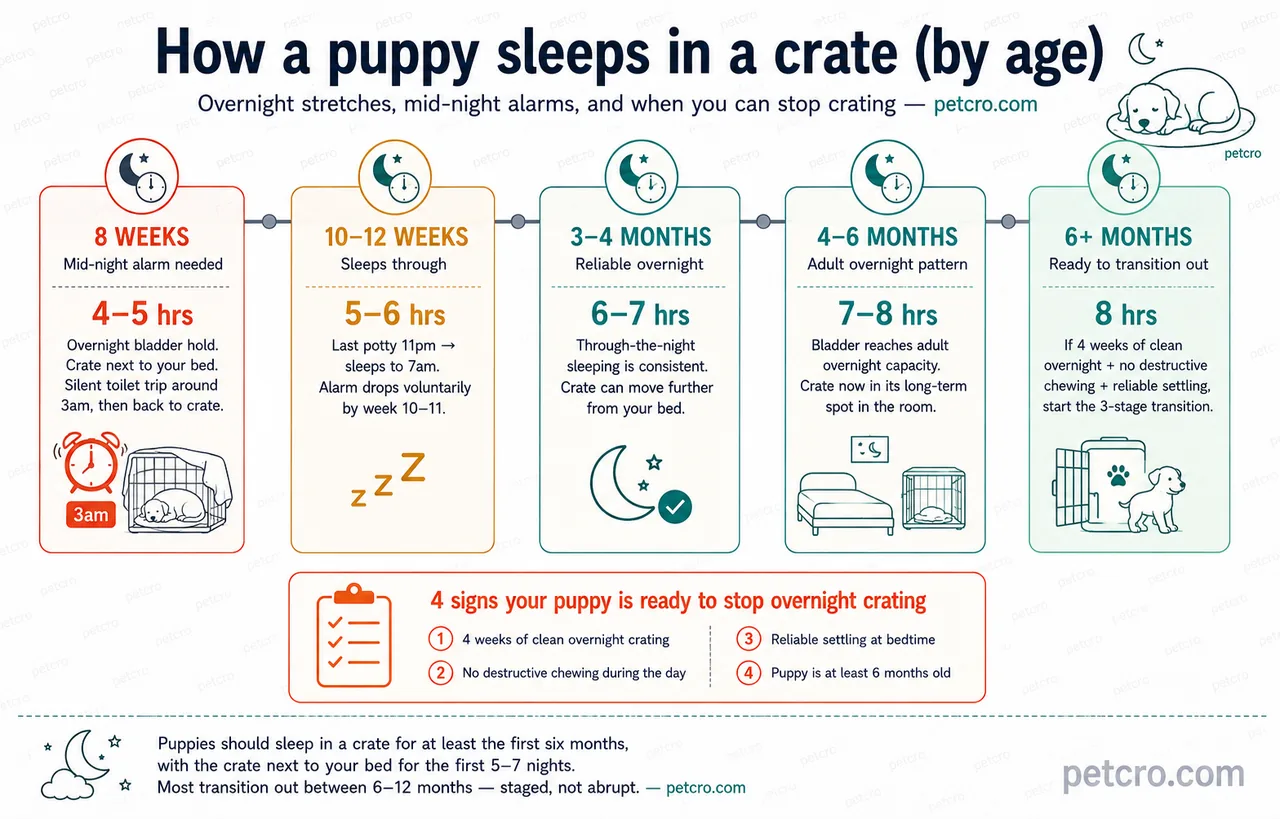
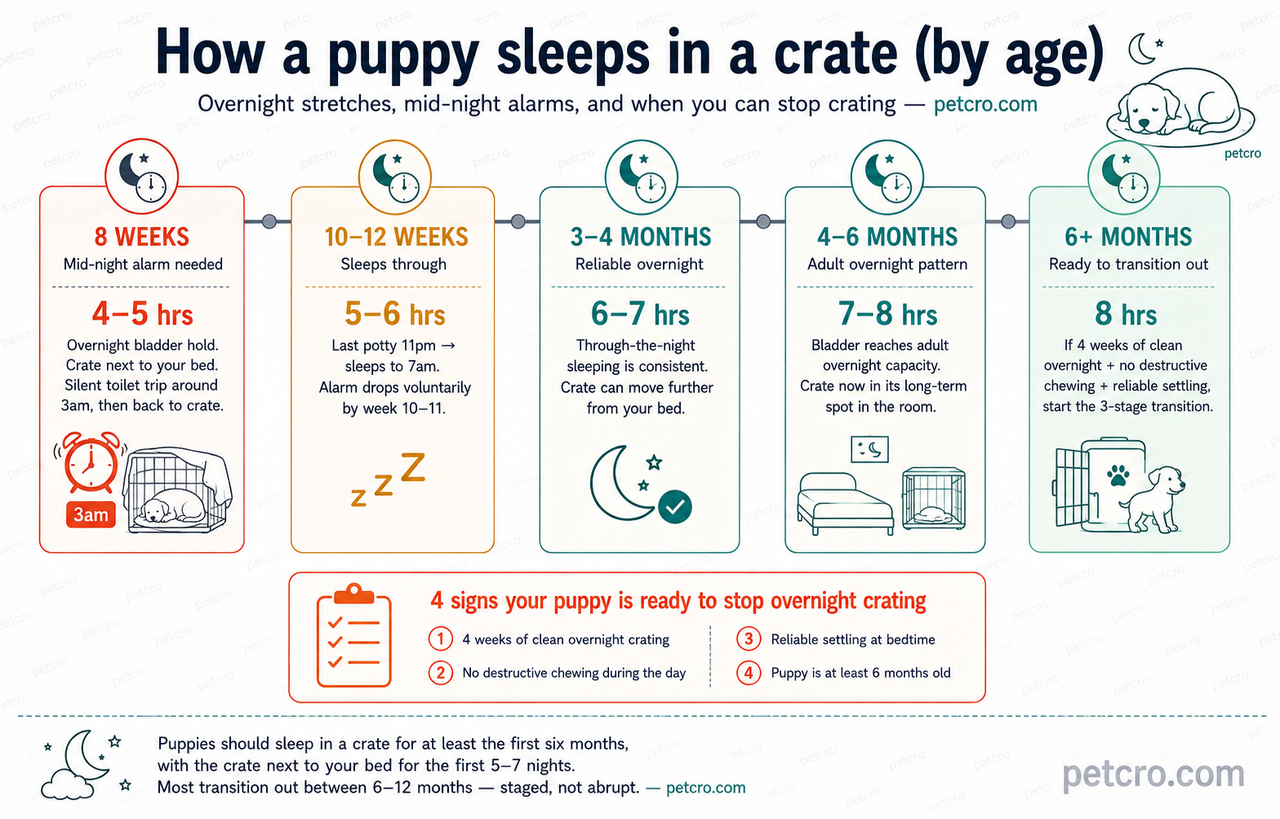
The mid-night alarm rule for week 1: silent carry to the toilet spot, no play, no eye contact, silent carry back to the crate. The point is to give the bladder relief, not to start a night routine — talking, playing, or treats reinforce waking up. Most puppies drop the alarm voluntarily by week 10–11.
A few caveats:
- Small-breed / toy puppies (Yorkies, Chihuahuas, Maltese, etc.) have physically smaller bladders. Subtract roughly 30–60 minutes from each row. An 8-week toy puppy may need two mid-night trips for the first week.
- Pull water 1–2 hours before bed. Last meal 3+ hours pre-bedtime, last potty 30 minutes before lights out — especially important if the puppy eats soaked kibble or wet food (higher water content).
- Never crate longer than the bladder can handle. Forcing an 8-week-old to hold 7 hours by ignoring the alarm is how you unlearn the den instinct — the puppy gives up, soils the crate, and house-training resets. Recovery takes weeks longer than the original training would have. Detailed in our hour-by-hour puppy potty schedule.
What size crate does a puppy need for sleeping?
The right crate is big enough for the puppy to stand without ducking, turn around, and lie down on their side — and no bigger. Extra space defeats the den instinct: the puppy soils one corner and sleeps in the other, undoing the house-training mechanism in 2–3 nights.
The way most owners solve this: buy a crate sized for the puppy's adult weight with a divider panel. Start the divider close to the front so the puppy has just enough room; move it back as the puppy grows. One crate for the dog's lifetime, not three.
| Adult size | Adult weight | Crate length |
|---|---|---|
| Toy | under 6 kg / 13 lb | 60 cm / 24 in |
| Small | 6–11 kg / 13–25 lb | 75 cm / 30 in |
| Medium | 11–23 kg / 25–50 lb | 90 cm / 36 in |
| Large | 23–34 kg / 50–75 lb | 105 cm / 42 in |
| XL | 34–45 kg / 75–100 lb | 120 cm / 48 in |
| Giant | 45+ kg / 100+ lb | 135 cm / 54 in |
Pick the row that covers the upper end of your breed's adult weight range.
A few sizing rules that catch people out:
- Measure the breed standard, not the breeder's claim. "She'll be small" gets disproved a lot. Round up if uncertain.
- Don't put a pee pad inside the crate. The puppy learns to soil one end and sleep at the other — defeats house-training entirely. If you need a backup, put the pad just outside the crate door or in an attached x-pen.
- Wire crates beat soft-sided for night use. Soft crates are for cars and travel; chewers destroy them in week 1. Wire is washable, visible (no surprises), and chew-resistant.
The crate-shopping logic and a 30-item supply checklist are in the new puppy checklist.
Is it cruel to make a puppy sleep in a crate?
No — when done correctly. Crate sleeping is mainstream veterinary-behaviorist guidance, not a controversy. The welfare concern is misuse, not the crate itself.
What "correctly" means:
- Properly sized (above). Too big undermines the den; too small is genuinely cruel.
- Not used as punishment. The crate is the puppy's safe space, not a time-out. Never crate a puppy "because they were bad" — they associate the crate with the punishment and the whole system breaks.
- Time limits respected. Crating an 8-week-old for 7 daytime hours while you're at work is too long and the puppy will soil. See the bladder table above and the puppy potty training schedule's "full-time work" section.
- No isolated overnight crating in week 1. Crate next to your bed, not in another room.
- Quiet, dark, and predictable. Three-sided cover, dim room, consistent bedtime. Most settling problems come from over-stimulation, not the crate.
The AVSAB position statements and the Merck Veterinary Manual's behavior chapter treat humane management tools — including properly-used crates — as appropriate for house-training and safety. Puppies raised without crates can be fine; they typically just take longer to house-train and carry more overnight risk in the first months.
When can a puppy stop sleeping in a crate?
Between 6 and 12 months for most dogs. The age isn't the trigger — the readiness signals are. All four of these should be true before you stop overnight crating:
- Four consecutive weeks of clean overnight crating (no accidents in or out of the crate).
- No destructive chewing during the day. If the puppy still chews shoes or table legs unsupervised, they will do it overnight when given the chance.
- Reliable settling at bedtime — the puppy goes into the crate, lies down, and sleeps without prolonged whining. (Some quiet sighs are normal.)
- The puppy is at least 6 months old. Earlier than this, bladder capacity isn't reliably 8 hours yet.
The transition itself:
- Stage 1: Leave the crate door open at night. Puppy still sleeps in the crate (the den habit is strong) but learns the door isn't a barrier. Run this for 1–2 weeks.
- Stage 2: Add a dog bed next to the crate. Most dogs use the crate for naps and the bed once they're ready.
- Stage 3: Remove the crate (or move it to a daytime spot). The dog now uses the bed.
Skipping straight from "crate door closed" to "no crate" typically triggers accidents and chewing for 1–3 weeks while the dog re-learns the rules. Many adult dogs continue to use the crate as a chosen rest spot for life — it becomes optional from 12 months onward, not necessarily removed.
What if my puppy cries in the crate at night? The 5-step protocol
Some crying in the first 3–7 nights is normal — the puppy is adapting to leaving their littermates. Most settle within 5–20 minutes once the routine feels consistent. The pattern that works:
Step 1: Last potty 30 minutes before bed
No water in the hour before, and tire them out with calm play (not high-arousal) for 20 minutes pre-bedtime.
Step 2: Crate next to your bed
Hand reachable through the bars. This is the single biggest variable for first-week settling.
Step 3: Drop a finger through the bars during a quiet whimper
No talking, no eye contact, no treats. Reassurance, not reward.
Step 4: Wait for a 5-second pause before opening the door
For ordinary whining, opening during the noise teaches the puppy that whining opens doors. Exception: 15+ minutes of nonstop whining is usually a real bladder signal — take them out for a silent toilet trip (no play, no eye contact), then back to the crate.
Step 5: Sleep through the recovery period
Most puppies whine, sleep, whine again, then settle. Cumulative crying on night 1 is often 30–90 minutes for many puppies, and typically drops by half each subsequent night.
If a puppy is still screaming for 30+ minutes a night after night 7 with this protocol, one of three things is happening:
- Crate placement wrong — moved out of the bedroom too early, or near a vent / window.
- You cracked on night 1 or 2 — opened the door during a whine, picked them up, or moved them into your bed. The puppy now knows the strategy works. Reset and accept 5–7 more nights of training.
- Genuine separation anxiety or medical issue — rare but real. Flag the vet at the next visit, especially if accompanied by excessive panting, drooling, or pacing during the day.
The full night-one walk-through and the 7-day intro protocol are in our crate-training step-by-step guide. Punishment-based responses (yelling, banging on the crate) delay learning, not speed it up.
Alternatives if crate sleeping isn't working for you
A handful of households genuinely can't make crate sleeping work — thin-walled apartments, medical anxiety in the dog, or deep crate-aversion after a botched intro. Honest alternatives, in descending order of how well they preserve house-training:
Exercise pen (x-pen) attached to the crate — best alternative. The puppy has more space but a defined zone with a pee pad on one end and the crate (door open) at the other. Slower house-training than crate-only but workable. Used widely in apartment settings.
Baby-gated bedroom or bathroom — second-best. The puppy is loose in one small puppy-proofed room. Loses the den instinct (the room is too big for the no-soil rule to engage), but you avoid the crate. Expect 4–6 months of intermittent accidents and chewing instead of 6–8 weeks.
Puppy in the owner's bed — strongly discouraged. You become the den, which means the puppy can never sleep alone — future travel, vet stays, and boarding all get harder. If you must, plan to transition the puppy out by 12 weeks; the longer you wait, the harder it gets.
What's not in any guidance: free-range puppy access to the whole house overnight at 8 weeks. Crates, x-pens, and baby-gated rooms are all considered appropriate management; "no containment at all" is not.
This guide is general guidance, not veterinary advice. For your specific dog's nutrition, health, or behavior needs, consult your veterinarian.
Frequently asked questions
Should a puppy sleep in a crate the first night?
Yes — with the crate next to your bed, within arm's reach. The first night is the highest-stress moment of the puppy's transition home; isolation in another room reliably produces an hours-long screaming session and a sleep-deprived household. Hand reachable through the bars, last potty 30 minutes before lights out, no water for the hour before. Expect 30–90 minutes of intermittent whining; that's normal night-one adaptation, not a sign the crate is wrong.
Should a puppy sleep in a crate during the day?
Yes, in 2–3 hour stretches that match their daytime bladder capacity. The full schedule by age — when to crate, when to potty, when to play — is in our puppy daytime schedule by age. Daytime crating is a safe-management tool while you can't actively supervise; it isn't a place to leave an 8-week-old for 6+ hours while you work. If your day is longer than the bladder allows, hire a midday sitter or accept that house-training will take longer.
Can a puppy sleep in a crate with a blanket?
Yes — a flat, washable blanket sized to the floor is fine for most puppies after week 1. In week 1, use only a low-pile fleece pad or nothing: many young puppies chew or swallow loose fabric. By 10–12 weeks, once you know whether your puppy chews bedding, you can upgrade to a thicker pad or blanket. Never use squeaker toys, stuffies with plastic eyes, or anything destroyable as overnight crate bedding — choking risk during unsupervised hours.
How long until my puppy stops crying in the crate at night?
Three to seven nights of properly-run crate training, with the crate next to your bed and the protocol above. Puppies who scream past 10 nights usually have one of three issues: crate moved out of the bedroom too early, owner cracked on night one or two (taught the puppy that whining works), or a genuine separation-anxiety pattern that needs vet input. Full troubleshooting in the 7-day crate-introduction protocol.
Where should a puppy sleep at 8 weeks?
In a properly-sized crate placed next to your bed, with the divider set so the puppy has just enough room to stand, turn, and lie down. Eight weeks is the age where the den instinct is strongest, the puppy has just left their littermates, and the bladder hold is shortest (2 hours daytime / 4–5 hours overnight). Bedroom-adjacent crate sleeping for the first 1–2 weeks, then a staged move to the puppy's long-term spot.
Is it OK to let a puppy sleep in my bed?
It's a personal call rather than a safety one for healthy adult dogs, but for puppies it has real downsides. The puppy never learns to sleep alone (boarding, travel, and vet stays become harder), you wake at every movement, house-training takes much longer because the den instinct never engages, and overnight injury risk is higher (falls from the bed, getting tangled in bedding). If you want a bed-sleeping adult dog eventually, the gentler path is crate-trained as a puppy, then transition to bed at 12+ months.
Can two puppies sleep in the same crate?
No — even littermates from the same home should sleep in separate crates. Shared crating slows house-training (either puppy soiling contaminates both), can hinder individual bonding to the owner, and doubles overnight risk. Two crates side by side is the standard two-puppy setup — supports each puppy's individual adaptation while still letting them see and smell each other.
TL;DR — the puppy crate sleeping cheat sheet
- Yes, puppies should sleep in a crate — at least for the first 6 months, ideally a wire crate sized to adult weight with a divider panel
- Crate next to your bed for the first 5–7 nights, no exceptions — isolation in another room is the #1 reason night-one fails
- Bladder rule: roughly 1 hour per month of age daytime; overnight is longer (8 weeks = 4–5 hours, 12 weeks = 5–6, 4 months = 6–7, adult = 8)
- Never put a pee pad inside the crate — it teaches soiling one end and sleeping at the other, undoing house-training
- Some crying is normal nights 1–7; opening the door during a whine teaches whining works and resets the clock
- Transition out of overnight crating around 6–12 months once house-training is reliable and chewing has stopped — staged, not abrupt
The crate is the spine of house-training and overnight safety. Set it up right on night one and the next twelve years are easier.
Sources & further reading
- American Kennel Club — Crate Training — kennel-club guide to introducing the crate and the staged-duration protocol.
- ASPCA — General Dog Care — owner-friendly framework for the first weeks home, including overnight setup.
- Merck Veterinary Manual — Behavior Problems in Dogs — vet-reference chapter on house-training, the den instinct, and management tools.
- Cornell Riney Canine Health Center — academic reference for canine behavior and welfare research.
- PetMD — Dog Behavior — vet-reviewed content library on canine behavior including crate use, separation anxiety, and house-training.
If your puppy has a medical condition affecting bladder control, a history of trauma, or is older than four months when adopted, the crate-introduction timeline shifts — check the specifics with your vet at the first visit. The AVSAB position statements on humane training are a useful primer for anyone uncertain about confinement tools.
More from Petcro's puppy training cluster
- Tips on how to crate train a puppy — the 7-day crate-introduction protocol that pairs with this guide for first-week setup.
- Puppy potty training crate — the crate-based mechanism that teaches bladder control + the 6 daily potty triggers.
- Puppy potty training schedule — hour-by-hour day from 8 weeks to 6 months, with overnight protocols.
- New puppy checklist (the actually useful version) — what to buy before day 1, including which crate, divider, and bedding to use.
- 8-week-old puppy feeding schedule — the strict 4-hour cycle that anchors the eat → potty → crate routine.
- Interactive new puppy checklist tool — tick crate, bowls, and bedding off as you buy them, with a personalised printable PDF.
Petcro is reader-supported. We may earn an affiliate commission when you click through links to products in this guide. Our editorial picks are independent of any commercial relationship with any brand mentioned.