How Much Water Should a Puppy Drink? (By Weight, Age, and Activity)
How much water should a puppy drink — daily ounces by weight, age guidance from weaning to 16+ weeks, and how to spot dehydration or overhydration.

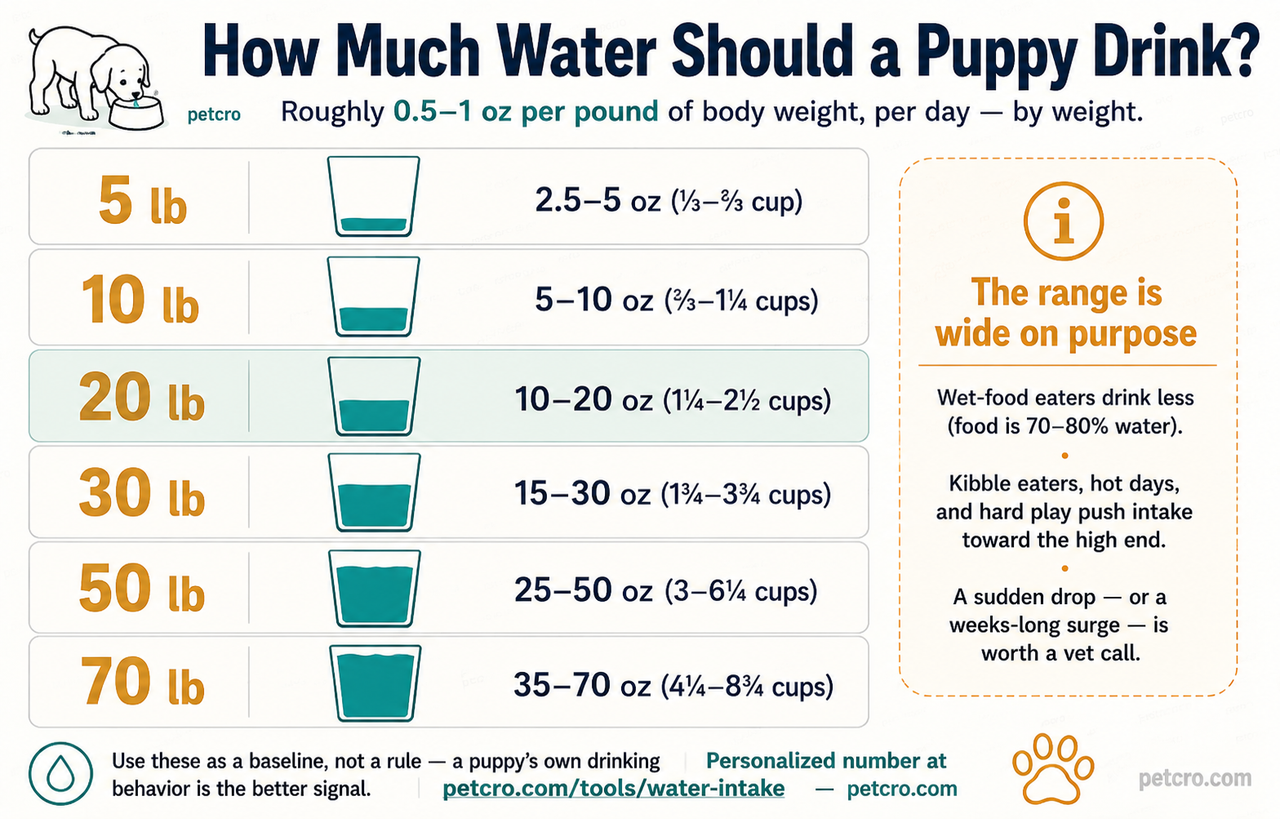
A puppy should drink roughly 0.5 to 1 ounce of water per pound of body weight per day — a 10-pound puppy needs 5 to 10 ounces, a 30-pound puppy 15 to 30. The range shifts with age, food, and activity. Both ends matter: too little tips into dehydration, too much in a short window tips into water intoxication.
TL;DR: Aim for 0.5–1 oz per lb of body weight per day. Closer to the high end if your puppy eats kibble, plays hard, or it's hot out. Closer to the low end if they eat wet food. Use our water intake calculator for a personalized number. If they gulp a full bowl after pool play, that's the water-intoxication risk — break up sessions.
🚨 The fast version: A sudden drop in drinking (or a sustained surge over several weeks) is worth a vet call. Drinking too little for 24+ hours risks dehydration; drinking much more than usual for several weeks running is a sign something else is going on (diabetes, kidney disease, Cushing's).
The quick answer — daily water by weight
Healthy puppies regulate their own water intake reasonably well when fresh water is available, but it helps to know what "normal" looks like so you can spot trouble. The simple formula: half an ounce to one ounce of water per pound of body weight, per 24 hours.
| Puppy weight | Daily water (low end) | Daily water (high end) |
|---|---|---|
| 5 lb | ~2.5 oz (⅓ cup) | ~5 oz (⅔ cup) |
| 10 lb | ~5 oz (⅔ cup) | ~10 oz (1¼ cups) |
| 20 lb | ~10 oz (1¼ cups) | ~20 oz (2½ cups) |
| 30 lb | ~15 oz (1¾ cups) | ~30 oz (3¾ cups) |
| 50 lb | ~25 oz (3 cups) | ~50 oz (6¼ cups) |
| 70 lb | ~35 oz (4¼ cups) | ~70 oz (8¾ cups) |
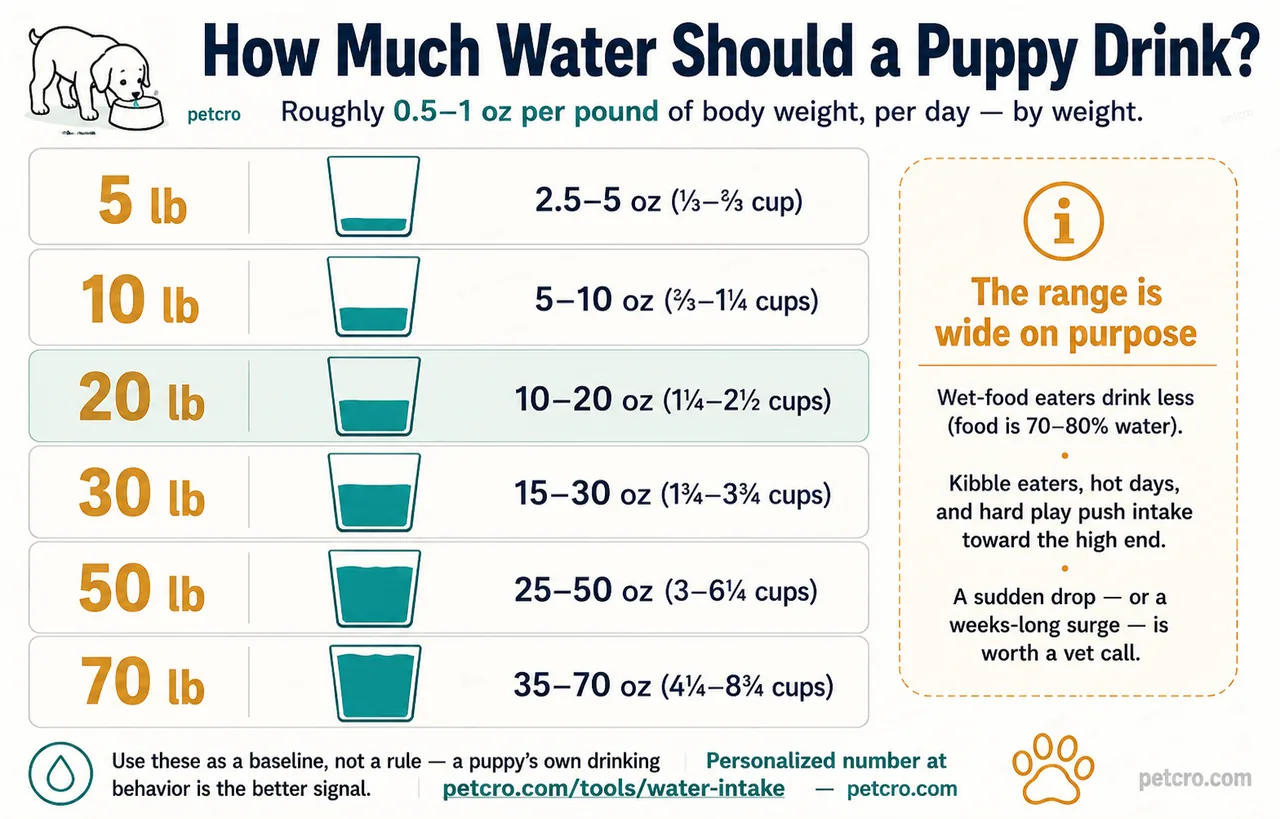
The low end of the range applies to puppies eating wet food (which is 70–80% water itself, so they drink less from the bowl). The high end applies to dry-kibble eaters in warm weather or after an active play session. For a personalized number that factors your puppy's age, weight, food type, and activity, use our water intake calculator — same formula, plugged in for your specific dog.
For context: adult dogs sit closer to a flat 1 oz per lb per day. Puppies vary more — growing tissue holds more water, and small bodies dehydrate faster.
The formula behind the table (and when to adjust it)
The veterinary consensus, repeated across the American Kennel Club, Merck Veterinary Manual, and most clinical references, is 0.5 to 1 oz per pound of body weight per day as the baseline for puppies past weaning. That range is wide on purpose — water needs shift constantly with conditions.
Five factors push the number up or down within (and sometimes beyond) the range:
1. Food type. Kibble is roughly 10% water; wet food is 70–80% water. A puppy eating only wet food may drink half what a kibble-fed littermate of the same size drinks, and that's normal. A mixed diet falls between.
2. Air temperature and humidity. Hot weather increases water loss through panting (dogs barely sweat through their skin). On an 85°F+ day, expect water intake to rise 30–50% above baseline.
3. Exercise and activity. A puppy running zoomies for half an hour will need significantly more water than one napping all afternoon. Long walks, beach trips, or fetch sessions can double the typical day's intake.
4. Growth phase. Puppies in their fastest growth phase (typically weeks 8–16) need more water to keep up with tissue synthesis. Toy breeds finish this surge earlier; large and giant breeds run a slower growth curve.
5. Health status. Vomiting, diarrhea, or fever increase fluid loss — see our puppy diarrhea guide and puppy throwing up guide for the home-care decision trees. On the other side, some conditions (diabetes, kidney disease, Cushing's) cause excessive thirst as a symptom; we cover that further down.
Use the calculator for a personalized number, but know that the formula isn't precision medicine — it's a starting estimate. A puppy's own behavior is a more reliable signal than any calculation.
How water needs change by age
Puppy water needs aren't constant — they shift as the puppy moves through weaning, the rapid-growth phase, and the post-DHPP maturity window.
Under 4 weeks — should still be nursing
Neonatal puppies get nearly all their hydration from their mother's milk (or, in orphan cases, a properly formulated puppy milk replacer — not cow's milk). A nursing puppy that's gaining weight steadily and producing normal urine is hydrated correctly without a water bowl involved. If you're hand-raising a litter, follow your vet's feeding-volume guidance — the amounts depend on age, weight, and the specific replacer and can't be eyeballed.
4 to 8 weeks — weaning and bowl introduction
As puppies wean (typically starting around 3–4 weeks, finishing by 7–8 weeks), they begin lapping water from a shallow dish. Lay out a low, stable, non-tippy bowl in the same area as their food. Most puppies figure it out within a few days of seeing littermates do it.
At this stage, expect erratic intake — they're learning. Don't panic if a single day's measurement looks low; what matters is the trend across a week.
8 to 16 weeks — the rapid growth phase
This is the most water-intensive stretch of puppyhood. New solid-food diet, fast tissue growth, frequent zoomies, and (typically) more time outdoors all push intake up. Aim for the higher end of the 0.5–1 oz/lb range in this window, especially if you've switched to dry kibble.
This is also the DHPP-series window — puppies typically get vaccinations every 3–4 weeks. The bringing a new puppy home guide covers the 14-day arrival schedule, including how to set a hydration baseline you can track.
16 weeks and beyond — settling toward adult patterns
Once the 16-week DHPP dose lands and the immune system stabilizes (the AAHA 2022 Canine Vaccination Guidelines anchor this milestone for the puppy series), water intake patterns settle. Most puppies past this point drink in predictable rhythms — a morning surge, smaller midday sips, an evening drink after dinner. A clear break from that pattern — drinking much less for a day, or noticeably more for weeks — is worth a vet check.
When activity, heat, and food type change the number
The formula assumes a moderate-activity puppy in average conditions. Three common adjustments:
Hot weather. On days above 80°F, plan for 20–40% more water than your puppy's baseline. After active outdoor time, refill the bowl as soon as they come in — but don't let an overheated puppy down a full bowl in one go (why that matters is in the water-intoxication section below).
Heavy exercise. A 30-minute fetch session can double a puppy's intake immediately afterward. Offer water during long walks or play — every 15–20 minutes, in small amounts. A portable bottle-and-bowl is worth it for owners who walk often.
Wet vs dry food. Switching a puppy from wet to dry food causes a measurable rise in bowl drinking — sometimes a 50–100% increase. That's not a problem; their total water intake (food + drink) stays roughly the same. If you've recently switched to kibble, expect more bowl visits and don't read it as polydipsia.
Signs your puppy isn't drinking enough — dehydration check
Three quick at-home tests are validated by the American Kennel Club and standard veterinary practice:
1. Gum check. Healthy puppy gums are pink and moist. Run a finger along the gum line — if it feels tacky or sticky, that's mild-to-moderate dehydration. Dry and pale gums = severe dehydration, vet today.
2. Skin tent. Gently pinch and lift the loose skin between your puppy's shoulder blades, then let go. Hydrated skin snaps back in about a second. Skin that takes 2 seconds or longer to settle = dehydration. Skin that holds a "tent" shape = severe dehydration, emergency vet.
3. Capillary refill time. Press a finger against your puppy's upper gum until it turns white, then release. The pink color should return in 1–2 seconds. Longer than 2 seconds = poor circulation, often dehydration; longer than 3 seconds = emergency.
Other signs to watch for:
- Sunken or dull eyes
- Lethargy or unusual quietness
- Loss of appetite alongside reduced drinking
- Concentrated, dark-yellow urine, or noticeably less peeing than usual
- Panting at rest, even in a cool room
A puppy showing any combination of these alongside reduced drinking for 12+ hours needs a vet visit. Dehydration progresses faster in puppies than adults — we cover the physiology in our puppy throwing up guide. In an under-vaccinated puppy, reduced drinking alongside any GI symptoms is a parvo-pattern flag; the parvo symptoms guide has the full picture.
When drinking too much is a sign of something else
Healthy puppies sometimes go through phases of extra drinking — hot weather, growth spurts, a recent food change, more outdoor play. Brief surges are normal.
What's not normal: a sustained, weeks-long increase in drinking beyond the usual baseline. Veterinarians call this polydipsia, and it's a recognized clinical symptom of several underlying conditions:
- Diabetes mellitus — high blood sugar pulls water across cell walls into urine; thirst rises to compensate. Usually paired with weight loss despite normal eating.
- Kidney disease — failing kidneys can't concentrate urine, so the puppy loses more water than normal in pee and drinks more to keep up.
- Cushing's disease (hyperadrenocorticism) — excess cortisol increases thirst and appetite. More common in older dogs but possible in younger ones, especially if on long-term steroids.
- Diabetes insipidus — a separate condition from diabetes mellitus; affects the kidneys' ability to retain water. Rare but treatable.
- Liver disease — affects multiple body systems including water balance.
- Pyometra — uterine infection in intact (unspayed) female puppies past their first heat. Excessive thirst + vaginal discharge + lethargy = emergency vet.
The pattern that triggers a vet workup: drinking visibly more than usual for several weeks, especially with any other change (weight loss, more frequent urination, changes in appetite, behavior shifts). A urinalysis and basic blood panel rule in or out most of these in a single vet visit — see our puppy first vet visit guide for what to ask about.
Water intoxication — when too much in one session is an emergency
One thing most puppy-water guides skip past in a sentence: water intoxication is rare but real, and puppies are at higher risk than adults because of their small size.
The mechanism. When a puppy consumes a large volume of water in a short period — often during pool play, lake fetch, hose chasing, or sprinkler running — the sodium in their bloodstream gets diluted faster than the kidneys can excrete the excess water. The clinical name for this low-sodium state is hyponatremia. Cells throughout the body absorb water and swell — and brain cells, trapped inside the rigid skull, have nowhere to expand. The result is rapid neurological deterioration.
High-risk scenarios
Most clinical water-intoxication cases share a pattern: high-volume water exposure with the puppy actively swallowing.
- Swimming pool play — puppies who bite at water, dive after toys, or open their mouths while swimming swallow a surprising amount in a short time
- Lake or river fetch — chasing a thrown toy means lunging into water repeatedly
- Garden hose chasing — puppies who treat the hose stream as a toy can take in startling volumes
- Sprinkler chasing — same pattern
- Snow eating in large quantities — less common but possible in cold-climate winters
- Recovery from heavy exercise — a hot, exercised puppy who guzzles a full bowl too fast
Signs of water intoxication
Symptoms develop within minutes to a few hours of overdrinking and progress rapidly. Any combination of these after a high-volume water session is an emergency vet trip:
- Lethargy out of proportion to the activity
- Loss of coordination — stumbling, unsteady gait
- Vomiting (often clear water)
- Bloating — visibly swollen belly
- Glazed or unfocused eyes
- Pale gums (vs. healthy pink)
- Excessive salivation
- Dilated pupils
- Restlessness or unusual quietness
Late-stage signs are seizures, difficulty breathing, and loss of consciousness — by which point survival is far less likely. Don't wait — any puppy showing the early signs after pool, lake, or hose play needs the vet today, not tomorrow.
Prevention — the 5 things that matter
These aren't paranoid restrictions; they're the routine advice vet techs at beach- and lake-adjacent hospitals give every new puppy owner.
Step 1 - Schedule water-play breaks
For pool, lake, or active hose play, plan a 10-minute break every 15–20 minutes. Get your puppy out, towel them off, let them rest in shade. The break interrupts the gulping cycle.
Step 2 - Avoid pressurized water sources
Garden hoses on full blast, sprinklers, pressure washers — the volume pushed into a puppy's mouth in a few seconds is more than they can process. Use a regular bowl or a low-pressure spray.
Step 3 - Skip flat or weighted water toys
Flat retrieval toys force a wide-mouth bite that scoops water in. Choose round or floating toys instead.
Step 4 - Watch for water-toy obsession
Some puppies fixate on the hose, sprinkler, or pool water itself as the toy. Redirect to a regular ball or tug toy if you see this pattern.
Step 5 - Refill after exercise gradually
A hot, exercised puppy who finds a full water bowl will try to drink it all in one go. Pour about a quarter of their daily allowance, let them drink, wait 10 minutes, then top up.
What NOT to do
Common bad advice you'll see in pet forums and older guides:
- Don't restrict water access overnight. Healthy puppies drink small amounts overnight; restricting risks dehydration. The "no water after 7pm so they don't pee at night" advice causes more problems than it solves. Crate-training overnight peeing is solved through schedule + bladder development, not dehydration.
- Don't add anything to water unless your vet recommends it. No salt, no sugar, no Pedialyte at scale — it doesn't replace electrolytes fast enough during illness, and comes back up if the puppy is vomiting.
- Don't use ice cubes as a primary "treat" — large pieces of ice can crack puppy teeth, and the cold-shock from a chunky ice cube post-exercise can contribute to gastric upset in some dogs.
- Don't let the bowl get grimy. Wash it daily — biofilm builds up faster than people expect, and a slick film inside a bowl is a sign it's overdue. (Material guidance is in the bowl notes below.)
- Don't switch to bottled water "to be safe." Tap water in most developed-country municipalities is fine for puppies. Bottled water is expensive and provides no measurable benefit over filtered tap. Exception: well water with known contamination — get it tested.
Puppy bowl quick notes
- Material: stainless steel is the easiest to sanitize and doesn't develop scratches that harbor bacteria. Ceramic (lead-free, food-safe glaze) is fine. Plastic is the least durable choice and harbors bacteria fastest.
- Height: floor-level is the safer default for deep-chested breeds — raised bowls have been associated with higher bloat risk in some studies.
- Cleaning: refill 1–2× daily, wash the bowl daily.
- Travel: collapsible silicone bowls fit in a coat pocket — worth having for any warm-weather walk over 20 minutes.
This guide is general guidance, not veterinary advice. For your specific dog's nutrition, health, or behavior needs, consult your veterinarian.
Frequently asked questions
How often should a puppy drink water?
Most puppies past 8 weeks drink in 3 to 5 sessions a day — usually a morning surge, smaller midday sips, and an evening drink after dinner. The key is access, not schedule: fresh water should always be available. Younger puppies (4 to 8 weeks) drink more frequently in smaller amounts as they learn the bowl.
My puppy won't drink water — what do I do?
Try offering water from a different bowl (some puppies refuse plastic), in a different location, or with a few small pieces of plain boiled chicken floating to make it interesting. Make sure the bowl is clean. If your puppy hasn't drunk anything for 6+ hours, or shows any dehydration signs (tacky gums, lethargy), call the vet — for puppies, that's not a wait-and-see window.
How much water is too much for a puppy?
The high end of normal is roughly 1 ounce per pound of body weight per day. Drinking 50% more than that for several weeks running is the polydipsia pattern that warrants a vet workup. Drinking a large volume in one session (pool play, hose chasing) is the water-intoxication risk — that one is an immediate emergency if symptoms appear within hours.
Can puppies drink tap water?
Yes — tap water in most municipal supplies is safe for puppies. If your area has known water quality issues (lead, agricultural runoff, well water without recent testing), use filtered tap or get the water tested. Bottled water provides no benefit over filtered tap for the cost.
Should I give my puppy ice cubes?
Small ice chips on a hot day are fine and many puppies enjoy them. Avoid large chunks — they can crack baby teeth, and the temperature shock can contribute to gastric upset in some dogs. Crushed ice in a bowl works better than ice cubes for cooling.
Why is my puppy drinking so much water all of a sudden?
A few normal causes: hot weather, recent switch to dry food, increased exercise, a growth spurt. A few worth a vet call: sustained drinking beyond normal for 2+ weeks, paired with more frequent peeing, weight loss, or appetite changes. Diabetes, kidney disease, and Cushing's disease all present this way.
Should I withhold water at night to prevent accidents?
No. Healthy puppies don't drink large volumes overnight, and restricting water risks dehydration. Crate training and bladder development handle overnight peeing — not dehydration. Pull the water bowl up only if your vet specifically recommends it for a medical reason.
TL;DR — the puppy water cheat sheet
- The formula: 0.5 to 1 ounce of water per pound of body weight per day. Use our calculator for a personalized number.
- Wet food eaters drink less from the bowl (food is 70–80% water); kibble eaters drink more
- Hot weather + heavy exercise can push intake 30–100% above baseline
- 3 quick dehydration tests: gum check, skin tent, capillary refill time
- Sustained over-drinking (weeks-long) is polydipsia — vet workup for diabetes/kidney/Cushing's
- Water intoxication is rare but real — pool, lake, hose play are the high-risk scenarios; 10-minute breaks prevent it
- Skip: overnight water restriction, additives, large ice cubes, plastic bowls, "safer" bottled water
If your puppy is drinking much less for 24+ hours, or much more across several weeks running, the answer is the vet — not waiting it out.
Sources & further reading
- American Kennel Club — Is Your Puppy Drinking Enough Water? — owner-facing reference for the per-pound formula and the three dehydration tests.
- Cornell Riney Canine Health Center — Cornell College of Veterinary Medicine's owner-facing resource on canine health, including hydration and water-related conditions.
- Merck Veterinary Manual — Nutritional Requirements of Dogs — clinical reference on water as a nutrient.
- AKC — Puppy Shots: A Complete Guide — the DHPP schedule referenced throughout.
- ASPCA — Animal Poison Control — 1-888-426-4435, for any suspected toxin call.
More from Petcro's puppy health cluster
- Puppy Hiccups — gulping water too fast is a common trigger.
- Water Intake Calculator — personalized daily ounces by weight, age, food type, and activity.
- Puppy Throwing Up — when low fluid intake or fluid loss signals something serious.
- Puppy Diarrhea — the 8-cause overview and 48-hour home-care decision tree.
- Parvo Symptoms in Puppies — when reduced drinking is part of a life-threatening pattern.
- Puppy First Vet Visit — what to ask about hydration baselines at the first appointment.
- Bringing a New Puppy Home — 14-day arrival timeline including the bowl-introduction window.
This guide is general guidance, not veterinary advice. For your specific dog's hydration, health, or behavior needs, consult your veterinarian.
Petcro is reader-supported. We may earn an affiliate commission when you click through links to products in this guide. Our editorial picks are independent of any commercial relationship with any veterinary product or service.