When to Feed a Puppy (meal timing + frequency from 8 weeks to adult)
When to feed a puppy: 4 meals at 8 weeks, dropping to 3 at 12 weeks, 2 at 6 months. Plus the wake-up rule, last-meal timing, and spacing between meals.

Most puppies do best on 4 meals/day from 8–12 weeks, 3 meals/day from 3–6 months, 2 meals/day from 6 months onward. Feed within 30–60 minutes of waking, schedule the last meal at least 3 hours before bedtime, and space meals 4 hours apart minimum for small breeds under 12 weeks. Times matter less than consistency.
TL;DR: When to feed a puppy is two questions — how many meals (drops from 4 → 3 → 2 across the first year) and what time of day (anchor to your own wake/sleep schedule, ~30 min after wake-up, last meal 3 hr before bed). Skip free-feeding — scheduled meals make house-training easier, prevent obesity, and let you spot appetite changes early. Run the feeding calculator for a portion specific to your puppy.
Meal frequency by age (the only table you need)
This is the canonical drop-down schedule, applicable to every healthy puppy regardless of breed or formula:
| Age | Meals per day | Why |
|---|---|---|
| 6–12 weeks | 4 meals | Tiny stomachs (50–80 ml capacity), peak growth (3× adult MER), unstable blood sugar especially in toy breeds |
| 3–6 months | 3 meals | Stomach has grown, growth multiplier dropping toward 2× adult MER, blood sugar more stable |
| 6–12 months | 2–3 meals | Most puppies transition to 2 meals around 6 months. Large breeds + fast eaters benefit from 3 meals through 9 months |
| 12+ months | 2 meals | Adult feeding pattern. Small/medium breeds finish growth ~12 months; large/giant breeds stay on 2 meals through their longer growth window (15–24 months) |
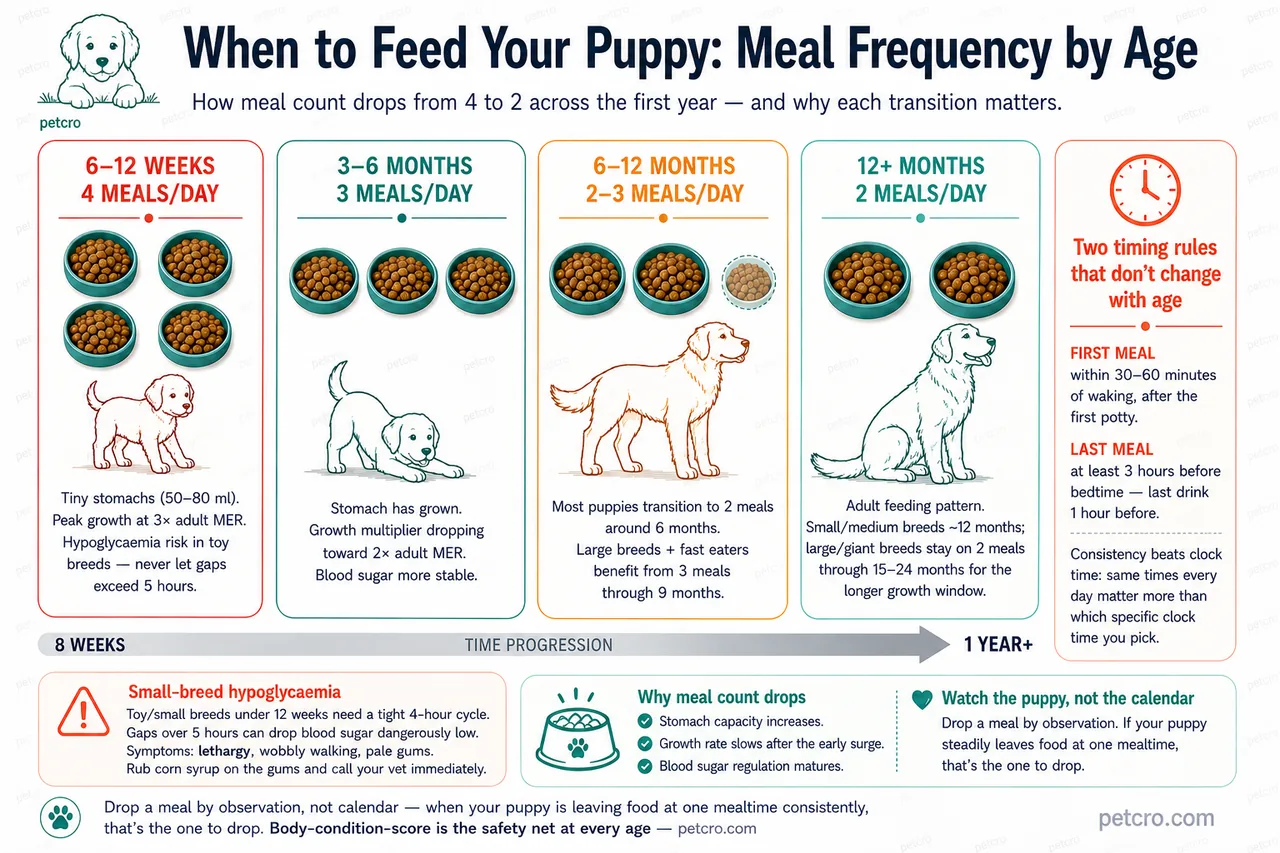
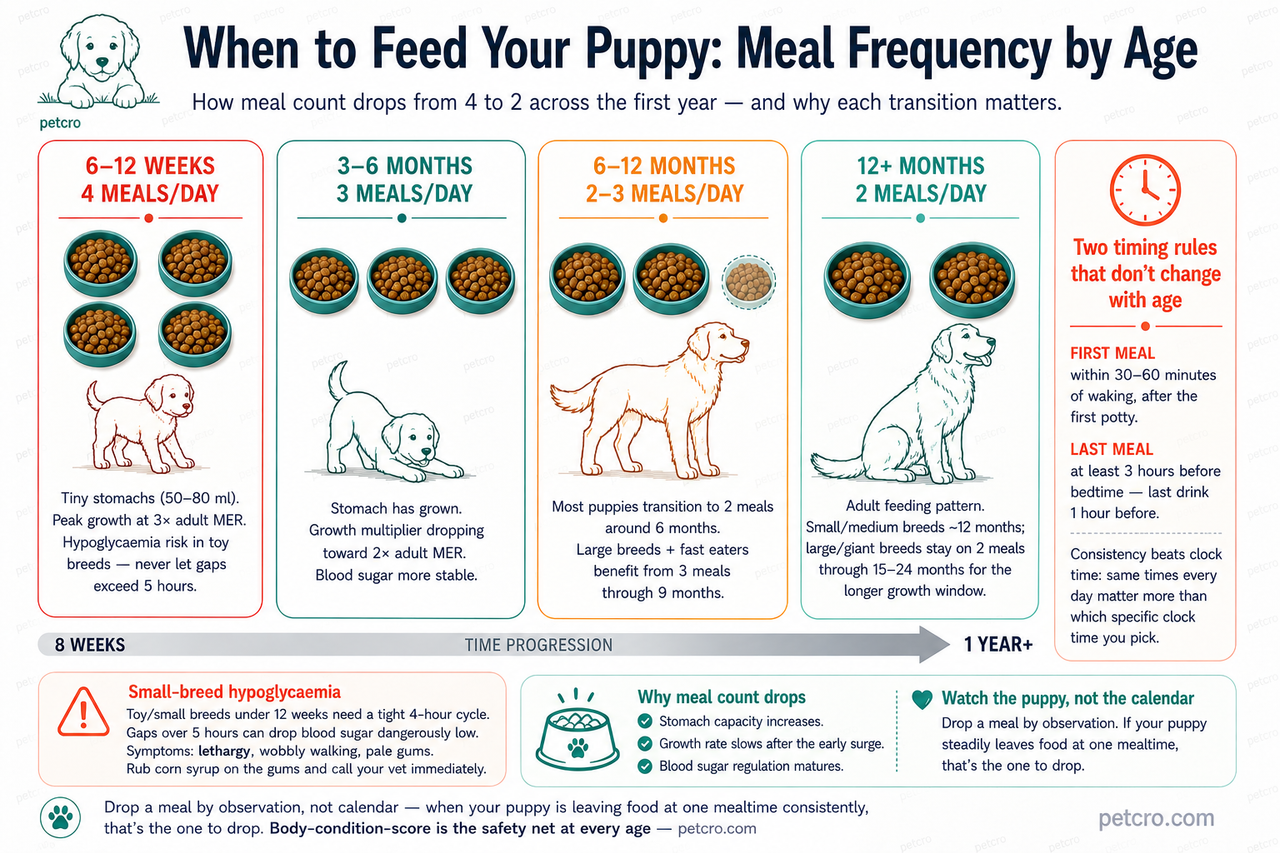
The drop happens by observation, not calendar. If your puppy is leaving food in the bowl at one meal consistently or seems uninterested at the same time each day, that meal is the one to drop. For the full mechanics of the 4-meal stage, see our 8-week-old puppy feeding schedule.
The morning rule — feed within 30–60 minutes of waking
Puppies wake up hungry. Their overnight blood sugar is at the day's lowest point (especially for small breeds), and the first meal sets the rhythm for the rest of the day.
The simple rule: first meal within 30–60 minutes of waking, after the first morning potty. Specifically:
- Wake up → carry puppy straight to the potty spot (don't make them walk, accidents happen on the floor first)
- Reward potty success
- Brief water break
- Meal 1 — ideally in the same spot, same bowl, same timing every day
This 30-60-minute window is also when the AKC puppy feeding fundamentals guide recommends starting structured feeding for new puppies. Consistency teaches the puppy "morning = food + potty + calm time," which is the spine of house-training.
For working owners: pick wake-up + meal times that match your weekday schedule, then stick to them on weekends too. A puppy who eats at 7am Monday-Friday and 10am on Saturday gets confused stomachs and inconsistent potty patterns.
The last-meal rule — 3+ hours before bedtime
Late dinners cause overnight accidents. Food enters the small intestine 30–60 minutes after a meal; the colon fills 4–8 hours later; and a young puppy can't physically hold a full bladder + colon for 8+ hours. Feed close to bedtime and you're scheduling a 3am wake-up.
The simple rule: last meal at least 3 hours before lights-out, last water 1 hour before. So if your puppy goes to bed at 10pm:
- Last meal: 7pm (or earlier)
- Last drink: 9pm
- Final potty break: 9:45pm
- Lights-out: 10pm
This buys you a roughly 6–8 hour overnight window before the next potty. From 8–12 weeks expect one 3am wake-up regardless of timing — bladder capacity isn't there yet. By 4–5 months most puppies sleep through.
Why scheduled meals beat free-feeding
Free-feeding (food available all day) is convenient but it hurts puppies in three documented ways:
- Obesity risk. Puppies eat past calorie targets when food is constantly available. The WSAVA Global Nutrition Guidelines consistently flag free-feeding as a contributor to puppy overweight, especially for large breeds where rapid growth raises orthopaedic disease risk.
- Lost training signal. Mealtime is the highest-value reward window. Puppies who eat scheduled meals are more food-motivated for the training session that comes after; free-fed puppies treat food as ambient and respond less.
- No early-warning system. A scheduled puppy who skips a meal is a clear "something's wrong" signal — a free-fed puppy might be eating less for days before you notice. See our guide on puppy not eating but acting normal for what skipped meals actually mean.
Set portions per meal (use the feeding calculator or your bag chart), put the bowl down for 15–20 minutes, then pick it up — eaten or not. Most puppies adapt to this rhythm within 3–5 days.
Minimum spacing between meals
Don't compress the schedule too tight. Two reasons:
- Small-breed hypoglycaemia. Toy and small breeds under 12 weeks (Yorkies, Chihuahuas, Maltese, Pomeranians, miniature breeds in general) need a tight 4-hour feeding cycle. Their liver glycogen reserves are tiny — gaps over 5 hours can drop blood sugar into hypoglycaemic territory. Symptoms: lethargy, wobbly walking, pale gums. Rub a teaspoon of corn syrup on the gums and call your vet immediately.
- Digestion overlap. A puppy stomach takes 4–6 hours to fully empty between meals. Feeding the next meal before the previous has cleared can cause vomiting or loose stool from over-stretching.
For the typical 8-week, 4-meals-a-day puppy, target a 4-hour cycle minimum (e.g., 7am / 11am / 3pm / 7pm). For a 4-month-old on 3 meals, 5–6 hour spacing is fine (e.g., 7am / 1pm / 7pm).
Feeding around exercise
Two timing windows to avoid:
- Don't feed within 30 minutes BEFORE vigorous play or walks. Food in the stomach during high-impact movement can cause vomiting; for deep-chested large breeds, it's a documented contributor to gastric dilatation-volvulus (bloat). The Merck Veterinary Manual guidance on bloat consistently lists feed-then-exercise as a primary risk factor.
- Don't feed within 60 minutes AFTER vigorous play. Let blood return from muscles to the digestive system before adding a meal. Puppies who eat immediately after a hard play session are more likely to vomit.
Practical sequence for a typical day with one big walk: walk → cool-down (15 min) → water → wait 30 min → meal. If your schedule forces you to walk right before a mealtime, shift the meal 30 minutes earlier or later.
When to drop from one meal-frequency stage to the next
The transitions (4 → 3 meals around 12 weeks, 3 → 2 meals around 6 months) are guided by observation, not calendar:
- 4 → 3 meals: drop the lunchtime meal when the puppy starts leaving food in the bowl at lunch consistently for 3+ days, or when they're noticeably less interested in the midday meal vs morning/evening. Usually around 12–16 weeks for medium breeds, 10–14 weeks for small breeds.
- 3 → 2 meals: drop one of the three meals when growth has clearly slowed (weight gain rate dropping; check our body-condition score tool for a 60-second visual). Usually 6–9 months. Large breeds often stay on 3 meals through 9 months — their longer growth window benefits from spread-out energy intake.
- 2 → 1 meal/day: generally not recommended for any dog. Adult dogs on 2 meals/day have more stable blood sugar, lower bloat risk, and better satiety than once-daily-fed dogs.
For the full transition timeline including formula switches, see when to switch your puppy to adult food.
Special situations — daycare, working from home, shift work
The schedule above assumes a typical 7am wake / 10pm bedtime owner. Real life is messier:
- Working-from-home owner: easier to do 4 meals at 8 weeks. The puppy benefits — your job benefits less. Keep meals on a tight clock (alarms help), or you'll drift to free-feeding without meaning to.
- Office-going owner: 4-meal schedule needs help. Either a midday neighbour/dogwalker for the lunch meal, or a programmable feeder for one of the daytime meals. Drop to 3 meals as early as the puppy tolerates (some are ready at 10–11 weeks).
- Shift worker: anchor meals to YOUR consistent wake/sleep times, not the clock. If you wake at 4pm and sleep at 8am, that's the puppy's schedule. Consistency beats convention.
- Daycare days: confirm the daycare feeds at the same times your home routine does, with the same food. Inconsistency is the #1 cause of loose stools in daycare puppies.
This guide is general guidance, not veterinary advice. For your specific dog's nutrition, health, or behavior needs, consult your veterinarian.
Frequently asked questions
What time should I feed a puppy in the morning?
Within 30–60 minutes of waking, after the first potty break. Specific clock time matters less than consistency — pick a time that works for your wake-up routine and stick to it on weekends too. A puppy fed at 7am M-F and 10am on Saturday gets confused stomachs and inconsistent potty patterns.
Can I feed a puppy 5 meals a day instead of 4?
You can, but you don't need to. The 4-meal schedule from 8–12 weeks is calibrated to puppy stomach capacity (50–80 ml at 8 weeks) and growth-curve calorie needs. Adding a 5th meal usually means smaller portions per meal that don't satisfy hunger and risk over-feeding total calories. The exception: very small toy breeds (Chihuahuas, Yorkies) just home at 8 weeks may benefit from 5 small meals to prevent hypoglycaemia, but this is a vet-supervised choice, not a default.
Should I feed a puppy before or after a walk?
After. Feeding within 30 minutes before vigorous activity can cause vomiting, and for deep-chested large breeds is a documented bloat risk per the Merck Veterinary Manual. Wait 60 minutes after a hard play session before the next meal. For a typical schedule: morning potty → short walk → cool-down → meal. This sequence also makes the meal the highest-value reward, which helps with recall training.
What's the latest I should feed a puppy at night?
At least 3 hours before bedtime. So if lights-out is 10pm, last meal at 7pm. Earlier is fine; later means overnight accidents. For very young puppies (8–10 weeks), even 3-hour spacing won't fully prevent a 3am wake-up — bladder capacity isn't there yet.
My puppy seems hungry between meals — should I add a snack?
Probably not. Begging behaviour is usually behavioural, not biological. If your puppy is on a portion calculated for their adult-weight target × age (per the feeding calculator) and growing on the breed curve, they're getting enough food. The fix for between-meal hunger is structured chew toys, training-treat-based redirects, or moving the next meal slightly earlier — not free-feeding extra.
How do I switch from 4 meals to 3 meals?
By observation, not calendar. When the puppy starts leaving food at lunch consistently (3+ days in a row of half-eaten lunches), drop that meal. Add the lunch portion to breakfast and dinner — same total daily food, fewer feedings. Most puppies are ready around 12–16 weeks; small breeds sometimes earlier.
Does the time I feed a puppy affect their growth rate?
Indirectly, yes. Puppies fed scheduled meals (vs free-fed) maintain better body condition, which keeps growth on the WSAVA-recommended curve. Calorie restriction within the WSAVA range is documented to extend lifespan in the Kealy 2002 Purina lifespan study — by ~1.8 years for lean-fed Labradors (JAVMA 220:1315). Time-of-day matters less than total calories + portion control.
TL;DR — the meal-timing cheat sheet
- Frequency: 4 meals (6–12 weeks) → 3 meals (3–6 months) → 2 meals (6+ months). Drop a meal by observation, not calendar
- First meal: within 30–60 minutes of waking, after the first potty
- Last meal: at least 3 hours before bedtime; last drink 1 hour before
- Minimum spacing: 4 hours between meals for small breeds under 12 weeks (hypoglycaemia)
- Around exercise: no food 30 min before, 60 min after — bloat risk for large breeds
- Free-feeding: avoid — scheduled meals improve house-training, training response, and let you spot appetite changes early
- Consistency > perfection: same times every day matter more than the specific clock time
Whatever schedule you choose, weigh portions and check body condition weekly — the body-condition score tool is a 60-second sanity check.
Sources & further reading
- WSAVA Global Nutrition Guidelines — international vet standard for puppy meal frequency + portion structure.
- AAFCO Dog Food Nutrient Profiles — regulatory baseline for what "complete and balanced for growth" actually means on a bag.
- AKC Puppy Feeding Fundamentals — meal-frequency-by-age guidance from the American Kennel Club.
- Merck Veterinary Manual: Gastric Dilatation-Volvulus (Bloat) — clinical guidance on feed-then-exercise risk for deep-chested breeds.
- Tufts Petfoodology: Puppy Feeding — independent vet nutrition guidance on portion control + meal frequency.
If your puppy has been prescribed a vet diet (allergy, weight management, GI), follow your vet's specific schedule over any general guidance — including this one.
More from Petcro's puppy nutrition cluster
- How Much to Feed a Puppy — the underlying calorie math by weight × age (the quantity question, where this post covers the timing question).
- 8-Week-Old Puppy Feeding Schedule — the 4-meal stage in full detail with soak instructions + hypoglycaemia watch.
- When to Switch Your Puppy to Adult Food — the 12+ month transition (different question — formula change, not meal frequency).
- Puppy Not Eating But Acting Normal — when a skipped meal is fine vs when it's a vet visit.
- Feeding calculator — exact gram count for your specific puppy in 30 seconds.
Petcro is reader-supported. We may earn an affiliate commission when you click through links to products in this guide. Our editorial picks are independent of any commercial relationship with any brand.