Raw Diet for Puppies (the honest case for and against)
Raw diet for puppies — the honest case for and against. The 80/10/10 rule, the calcium/phosphorus problem most owners miss, and when raw is unsafe.

Raw feeding for puppies is one of the most polarised topics in pet nutrition. The pro-raw community treats kibble as borderline poison. The veterinary establishment treats raw as borderline negligence. Most owners just want to do the right thing for their puppy and end up confused about which side is actually telling the truth.
This guide gives you the honest version: what raw diets actually are, what the proponents get right, what they get wrong, what the vet establishment gets right, what they overstate, and the puppy-specific concerns that matter regardless of which side you land on.
It's longer than most articles in our cluster because the topic deserves it. If you're considering raw for a puppy, read the whole thing before committing. Half-information on raw feeding is worse than no information.
TL;DR: A nutritionally complete raw diet can work for puppies, but the failure modes are serious — calcium/phosphorus imbalance causes lifelong skeletal damage, bacterial contamination causes more vet visits than commercial food, and most home-prepared raw diets are not actually balanced. Commercially-prepared raw (frozen, AAFCO-tested) is the lowest-risk option. DIY raw for puppies should not be attempted without a board-certified veterinary nutritionist's recipe. Puppies under 8 weeks, immunocompromised puppies, pregnant or lactating mothers, households with vulnerable humans, and giant-breed puppies in fast-growth phase are categories where raw is genuinely not appropriate.
What "raw diet" actually means (three versions)
The term gets used loosely. There are three distinct approaches, and the risks vary significantly between them.
1. BARF (Biologically Appropriate Raw Food)
The framework Dr Ian Billinghurst proposed in the 1990s. Roughly 60–80% raw meat + bone, plus vegetables, fruits, and supplements. Aims to mimic what wild dogs would eat. The most commonly-followed model in home-prep raw communities.
2. Prey Model (also called "Whole Prey")
Aims to feed the dog exactly what a wild canid would eat — whole prey animals or their proportional equivalents. Typically 80% muscle meat / 10% raw bone / 10% organ (with 5% being liver). No vegetables, no supplements. Strictest version of raw feeding.
3. Commercially-Prepared Raw
Frozen or freeze-dried raw food made by manufacturers (Stella & Chewy's, Primal, Instinct, etc.). Formulated to AAFCO standards for "complete and balanced" — the same regulatory baseline as kibble. Tested for pathogens. Most expensive but lowest-risk.
The risk profile is roughly: Commercial raw < BARF < Prey Model < DIY without research. Knowing which version someone means by "raw" matters more than the raw-vs-kibble argument itself.
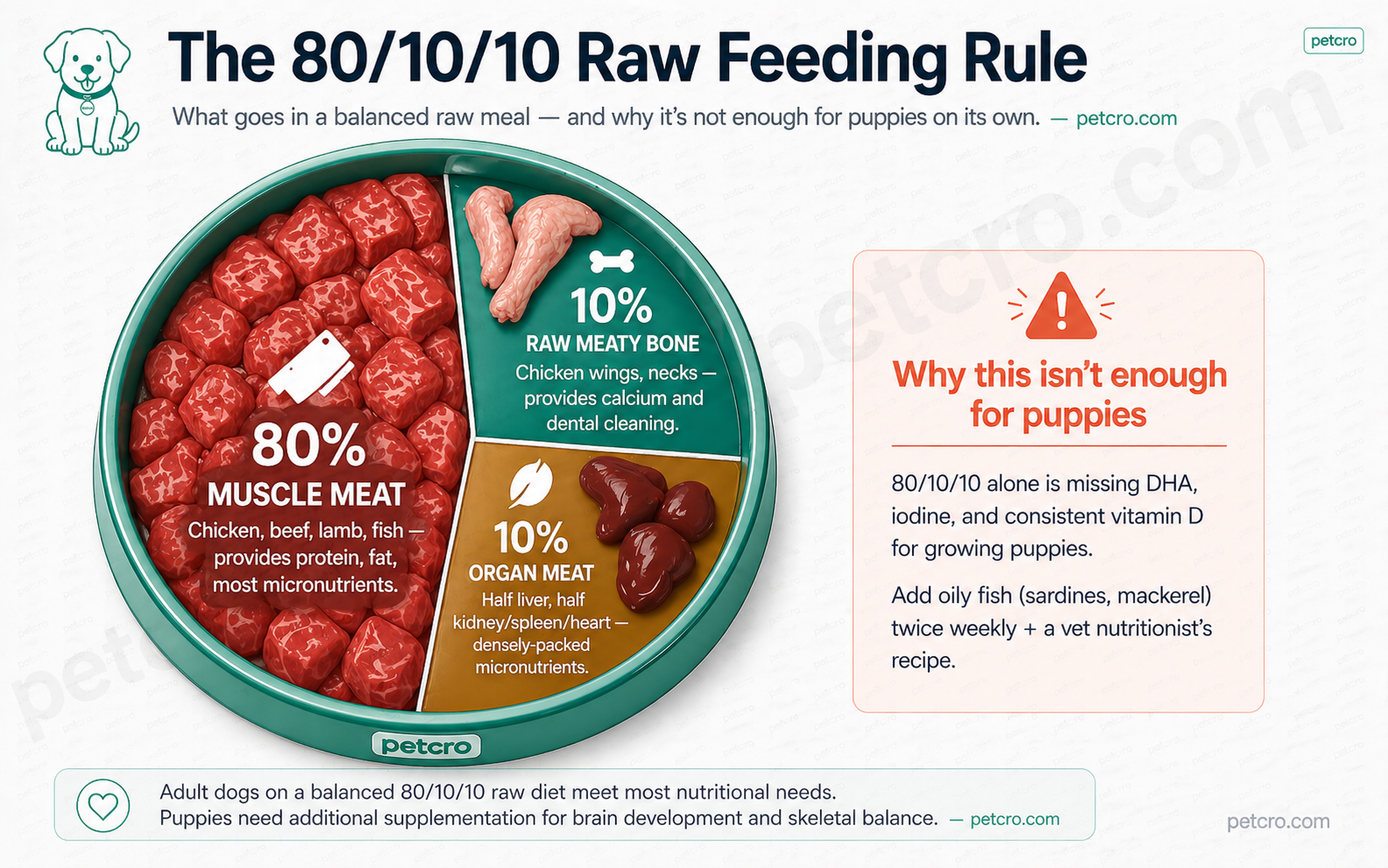
The 80/10/10 rule (and why it matters for puppies)
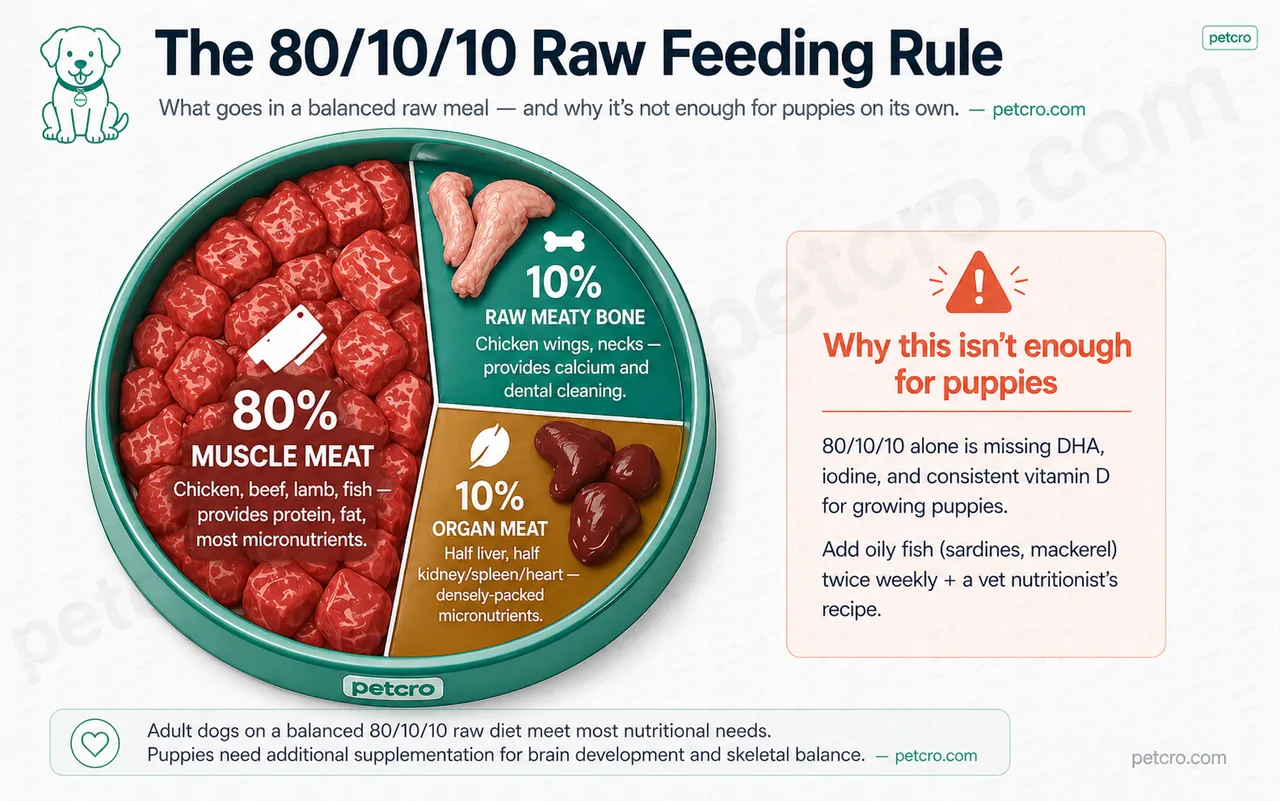
If you've spent any time in raw-feeding communities, you've seen the 80/10/10 ratio. It's the cornerstone of prey-model feeding:
- 80% muscle meat — chicken, beef, lamb, fish, etc. Provides protein, fat, and most micronutrients.
- 10% raw meaty bone — chicken wings, necks, turkey necks. Provides calcium, phosphorus, and dental cleaning.
- 10% organ — half liver, half other organs (kidney, spleen, heart). Densely-packed micronutrients.
For adult dogs, 80/10/10 done correctly is roughly nutritionally complete. For puppies, it's not enough on its own — and that's where most home-prep raw diets fail.
Puppy-specific concerns:
- Calcium/phosphorus ratio must sit between 1.2:1 and 1.4:1 for proper bone development. Too much calcium (over-bone diets) accelerates growth and damages joints in large breeds. Too little (muscle-meat-heavy diets) causes nutritional secondary hyperparathyroidism — a treatable but serious condition where bones literally weaken from lack of calcium.
- DHA / omega-3 fatty acids — essential for brain development. Pure muscle-meat-and-bone diets are low in these unless oily fish (sardines, mackerel) is included regularly.
- Iodine — most non-commercial raw diets are deficient. Long-term iodine deficiency causes thyroid issues.
- Vitamin D — varies hugely between meat sources. Easy to undershoot.
A puppy on a "balanced" raw diet from a reputable source (Stella & Chewy's puppy formula, for example) gets around these issues because the manufacturer tests and supplements. A puppy on a home-prep raw diet without a veterinary nutritionist's recipe almost certainly does not.
The case for raw (what the proponents get right)
Setting aside the noise, there are real, evidence-backed benefits to a properly-formulated raw diet:
- Stool quality often improves. Many dogs on raw produce smaller, firmer, less smelly stools. This is real and consistent across the literature — likely because raw diets contain less plant fiber and more digestible animal protein.
- Coat condition can improve in dogs with food sensitivities. Removing common kibble allergens (corn, wheat, certain protein sources) sometimes resolves itching, recurrent ear infections, and dull coats. Whether the improvement is from "raw" specifically or just from removing the allergen is hard to separate.
- Dental health from chewing raw bones. Crushing through chicken wings or necks does scrape teeth in a way kibble doesn't. The vet establishment generally agrees this is real, with caveats (more on bones in a minute).
- Higher protein digestibility. Raw protein is more digestible than cooked or extruded protein. Whether this translates to meaningful health benefits or just slightly different stool weight is debatable.
What this evidence does not support:
- That raw "cures" cancer (no)
- That kibble causes inflammation (largely no, unless the dog has a specific intolerance)
- That kibble is "ultra-processed garbage" (mostly no — high-quality kibble has decades of nutritional testing behind it)
- That dogs are "biologically designed" for raw (only loosely true — domestic dogs have evolved 7 copies of the AMY2B amylase gene specifically for digesting starches, unlike wolves)
The case against raw (what the vet establishment gets right)
The American Veterinary Medical Association, the Canadian Veterinary Medical Association, and the WSAVA Global Nutrition Guidelines all advise against raw feeding for the average pet owner. Their concerns:
- Bacterial contamination is real. Studies consistently find Salmonella, Listeria, and E. coli in commercial raw products at rates 10–25% higher than kibble. This is a risk to the dog, the household (especially small children, pregnant women, immunocompromised members), and the supply chain.
- Nutritional imbalance is the norm in DIY raw. A 2013 JAVMA study (Stockman et al., 242(11):1500–1505) evaluated 200 published home-prepared dog diet recipes — including 129 written by veterinarians — and found 95% of them nutritionally inadequate against NRC or AAFCO maintenance profiles. If a vet-written recipe has those odds, an owner-curated raw diet has worse.
- Bone splintering risks. Raw bones are softer than cooked, but still cause bowel obstructions and tooth fractures with non-trivial frequency. The "raw bones are safe, cooked bones are dangerous" framing is too simple.
- No demonstrated long-term benefit. No peer-reviewed study has shown raw-fed dogs live longer, have fewer chronic diseases, or outperform kibble-fed dogs on any major health metric. The "anecdotally my dog thrives" evidence is real but uncontrolled.
What this critique does not support:
- That all raw diets are dangerous (commercial AAFCO-tested raw is genuinely safe)
- That kibble is universally optimal (it isn't, especially for dogs with specific sensitivities)
- That no evidence-based vet ever endorses raw (some do, with caveats — Dr Marty Becker, Dr Karen Becker — though both have commercial raw lines)
When raw is genuinely not appropriate for a puppy
There are categories where raw is a clear no, regardless of which side of the debate you sit on:
1. Puppies under 8 weeks
The mother's milk handles nutrition until weaning. Don't introduce raw before solid food is established at 8 weeks minimum.
2. Immunocompromised puppies
Puppies recovering from parvo, distemper, surgery, or any condition that suppresses immune function. Their gut barrier is weakened — bacterial contamination that a healthy puppy clears can become serious infection.
3. Pregnant or lactating mothers
Bacterial loads pass to puppies via placenta and milk. Vet-prescribed kibble or commercial raw with extended pathogen testing only.
4. Households with vulnerable humans
Pregnant women, children under 5, anyone immunocompromised (chemotherapy, HIV, transplant recipients) shouldn't share a kitchen with raw pet food preparation. Cross-contamination via surfaces is the documented risk.
5. Giant-breed puppies in fast-growth phase
The calcium/phosphorus margin is tightest here. Get the ratio wrong on a Great Dane between 4 and 12 months and you're looking at developmental orthopaedic disease that's often irreversible. Don't DIY raw for a giant-breed puppy.
In any of these cases, the answer is commercial puppy food (or commercial AAFCO-tested raw) with vet sign-off — not BARF or prey-model home preparation.
If you're going to feed raw, do it right
For owners who've weighed the evidence and want to proceed, here's what minimum-viable safe raw feeding for a puppy looks like:
Pick a complete commercial raw formula first
Stella & Chewy's Puppy, Primal Pup, Instinct Raw Boost Mixers — these are AAFCO-tested for puppy growth. They're more expensive than kibble (3–5×) but they remove the nutritional balance question entirely. Start here for at least the first 6 months before considering home-prep.
Get a veterinary nutritionist's recipe if going DIY
Board-certified veterinary nutritionists (DACVIM-Nutrition) write custom raw recipes for ~$200–500. Worth every dollar if you're committed to raw long-term — without one, you're statistically very likely to under- or over-supply something critical.
Run the calorie math the same way as kibble
Raw is roughly 1.2–1.5 kcal/g (vs 3.5 kcal/g for kibble). That means roughly 2.3–2.9× the gram weight for the same caloric intake. Use our feeding calculator and select the "Raw / BARF" food type — it adjusts for density automatically.
Watch body condition more carefully
Run the Body Condition Score check every two weeks during the first three months on raw. Raw-fed puppies sometimes either over-eat (energy-dense organs are very palatable) or under-eat in early transition (bacterial taste differences). Either way, body condition is the source of truth, not the bag.
Handle food safety like you would raw chicken for yourself
Wash hands after every prep. Disinfect surfaces with bleach. Store frozen until thaw, then refrigerate maximum 24 hours. Don't leave bowls out — uneaten raw goes back in the fridge or in the bin within 30 minutes.
Plan for the puppy → adult transition
Puppy raw formulas have higher calcium and DHA than adult formulas. Switch to adult raw at the same age you'd switch to adult kibble (see our when to switch guide). Don't keep an adult dog on puppy raw indefinitely.
Cost comparison (the honest math)
A common pro-raw claim is "it's cheaper than premium kibble." That's only true in specific conditions.
| Diet type | Cost per day for a 15 kg puppy | Annual cost |
|---|---|---|
| Mid-tier kibble (Purina One, Iams) | $0.80–1.20/day | $300–440 |
| Premium kibble (Pro Plan, Hill's Science Diet) | $1.50–2.20/day | $550–800 |
| Commercial raw (Stella & Chewy's puppy) | $4.50–7.00/day | $1,650–2,550 |
| DIY raw (sourced from human-grade meat) | $2.00–3.50/day | $730–1,280 |
| DIY raw (sourced from local butcher offcuts + bulk organ) | $1.20–2.00/day | $440–730 |
Commercial raw is significantly more expensive than premium kibble. DIY raw can match or beat premium kibble on cost, but only if you have the time to source ingredients carefully and the discipline to follow a balanced recipe. Most owners who try DIY-raw-to-save-money end up either spending more time than they expected or compromising on the recipe — usually both.
This guide is general guidance, not veterinary advice. For your specific dog's nutrition, health, or behavior needs, consult your veterinarian.
Frequently asked questions
Is raw food really better for puppies than kibble?
Honestly: maybe slightly, in specific cases (food sensitivities, dental issues). For most puppies, a high-quality commercial puppy food meets every nutritional need with substantially less risk than DIY raw. The "raw is better" claim is widely overstated.
Can I mix raw and kibble in the same meal?
The pH-of-stomach argument against mixing has been largely debunked — modern research shows dogs digest mixed meals fine. The bigger concern is portion math: if half the bowl is kibble at 3.5 kcal/g and half is raw at 1.5 kcal/g, you need different gram weights for the two. Our feeding calculator handles mixed feeding.
What about freeze-dried raw vs frozen raw?
Nutritionally similar when rehydrated. Freeze-dried is more shelf-stable and travel-friendly. Frozen raw is cheaper per calorie but requires freezer space and 24-hour thaw planning. Both can be AAFCO-complete if from a reputable manufacturer.
Is bone safe for puppies?
Raw bones only — never weight-bearing bones (femurs, knuckle bones) — and only under supervision. Chicken wings, chicken necks, turkey necks are typical starting points for puppies over 12 weeks. Never cooked bones; they splinter dangerously regardless of size. If your puppy gulps food, raw bones are a choking risk and probably not appropriate.
Will my puppy's poop change on raw?
Yes — and dramatically. Raw diets produce smaller, firmer, lighter-coloured stools that often turn chalky-white and crumbly within 24 hours of being passed. Many raw-fed owners count this as a benefit. It's not a sign of nutritional adequacy though — bone-heavy diets produce the same chalky stool whether the rest of the diet is balanced or not.
Can I feed raw to a giant-breed puppy?
Strongly recommend against DIY raw for Great Danes, Mastiffs, Newfoundlands, etc. The calcium-phosphorus precision required during their fast-growth phase is hard to achieve without a vet nutritionist's recipe. Commercial raw labelled for large-breed puppy growth is a safer option, but most large-breed-puppy owners stick with proven kibble formulas like Pro Plan Large Breed Puppy or Royal Canin Large Breed Puppy until adulthood.
Does raw cause salmonella in dogs?
Healthy adult dogs clear bacterial loads of Salmonella and similar pathogens that would make a human very sick. Puppies, immunocompromised dogs, and dogs on antibiotics are the higher-risk groups. The bigger documented concern is household contamination — surfaces and shared bowls — rather than the dog itself.
TL;DR — the honest raw-feeding cheat sheet
- Commercial AAFCO-tested raw = lowest-risk version, most expensive
- DIY raw without a vet nutritionist's recipe = statistically likely to be unbalanced
- Calcium/phosphorus ratio must stay 1.2:1 to 1.4:1 for puppy skeletal health
- Pregnant mothers, immunocompromised puppies, giant breeds in growth phase: don't DIY raw
- Run the feeding calculator — raw needs ~2.3–2.9× the gram weight of kibble for the same calories
- Body condition every two weeks is your truth signal
- Switch to adult raw on the same timeline as adult kibble — not later
The honest version: raw can work for puppies. It just has more failure modes than kibble. Choose the version of raw that matches your willingness to do the supporting work — commercial if you don't want to think about it, DIY only if you've got a real recipe and the discipline to follow it.
Sources & further reading
- WSAVA Global Nutrition Guidelines — the international veterinary position on raw feeding (cautious).
- Tufts Petfoodology: Raw meat-based diets — risks and recommendations — independent vet-nutritionist analysis covering pathogen, nutritional, and home-recipe risks.
- ASPCA Dog Nutrition Tips — vet-organisation guidance on growth-stage feeding and the cautions around home-prepared diets.
- AAFCO Dog Food Nutrient Profiles — the regulatory standard any "complete and balanced" raw must meet.
If you're committed to long-term raw feeding for your puppy, a one-time consult with a board-certified veterinary nutritionist (DACVIM-Nutrition) is the single highest-value decision you can make. Roughly $200–500. Compare that to a lifetime of vet bills from a skeletal issue caused by an unbalanced diet — easy math.
More from Petcro's puppy nutrition cluster
- How Much to Feed a Puppy — the underlying calorie formula raw and kibble both calibrate to.
- Purina Pro Plan Large Breed Feeding Chart — the controlled-calcium kibble alternative most vets recommend over DIY raw for large breeds.
- When to Switch Your Puppy to Adult Food — full transition timing by adult size.
- Feeding calculator — exact gram count for your specific puppy on raw, kibble, or mixed.
Petcro is reader-supported. We may earn an affiliate commission when you click through links to products in this guide. Our editorial picks are independent of any commercial relationship with any brand.