Iams Puppy Food Chart (the everyday-pick guide)
The Iams ProActive Health puppy feeding chart by weight and age, the activity adjustment most owners miss, and a clear answer on when to upgrade.

The Iams puppy food chart starts with daily portions by adult weight and current age, then adjusts −15% (sedentary) to +20% (active) for activity level. Use the chart matching your formula (Smart Puppy Original, Smart Puppy Large Breed, or Smart Puppy Small Breed), split into 3–4 meals depending on age, and weigh weekly to confirm growth.
This guide gives you the full chart by formula and adult weight, the activity adjustment most owners miss, and a clear answer to the question shoppers actually have when they're standing in the aisle: is Iams enough food for my puppy, or do I need to upgrade to Pro Plan or a vet line?
TL;DR: Iams ProActive Health Smart Puppy is calorie-dense (~3.7 kcal/g), AAFCO-tested for growth, includes DHA from fish oil, and is adequate for the vast majority of companion puppies. Use the bag chart as a starting point, then adjust −15% (sedentary) to +20% (active) for actual energy level and weigh your puppy weekly. The biggest mistake owners make isn't choosing Iams over a premium brand — it's free-feeding instead of weighing portions. Run our feeding calculator for a portion specific to your puppy.
Which Iams formula is your puppy on?
Iams's ProActive Health puppy line has three main formulas. They differ mostly in macronutrient split and kibble size — calorie densities are within 5% of each other, but the protein-to-fat ratio and the calcium balance shift in ways that matter for some puppies. Don't carry numbers from one bag to another.
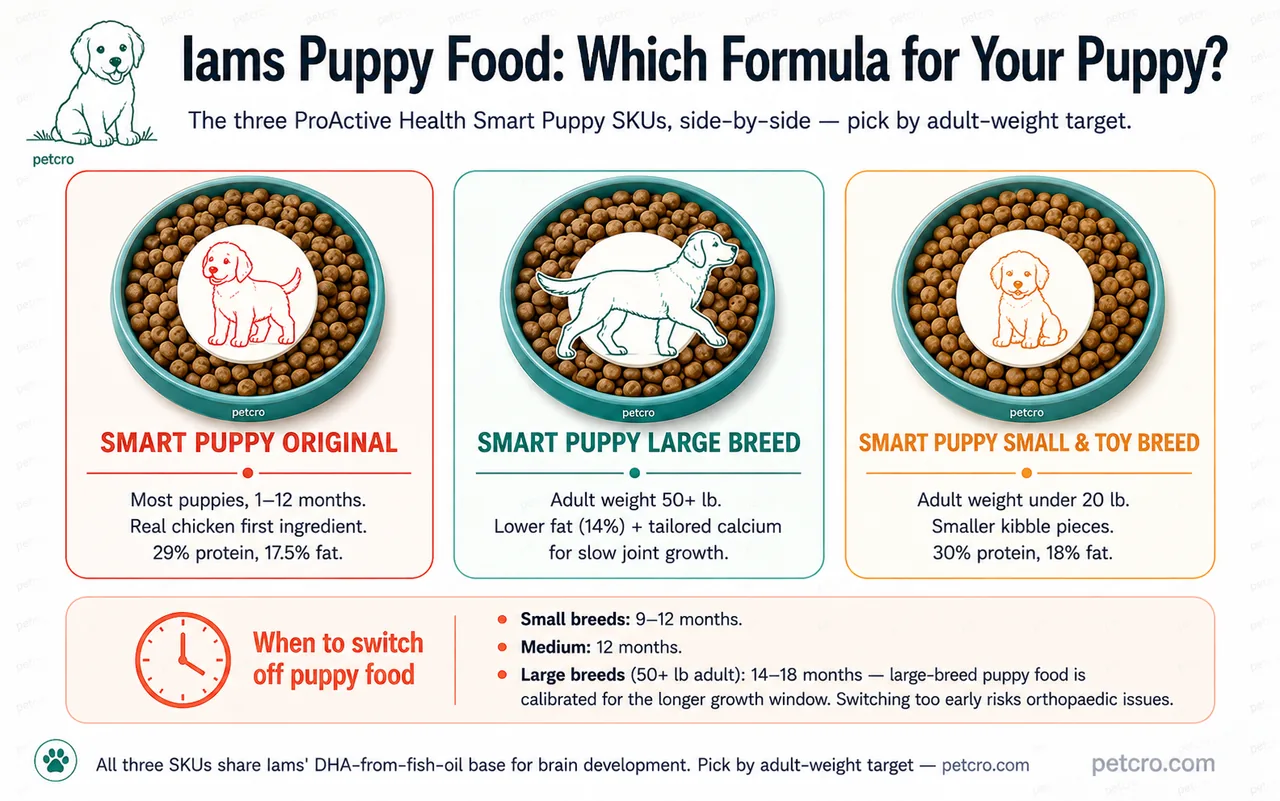
| Formula | Best for | Crude protein / fat (min) | kcal/g | Notable feature |
|---|---|---|---|---|
| Smart Puppy Original (chicken) | Standard pick — small-to-medium adult size | 29% / 17.5% | ~3.65 | Real chicken first ingredient; DHA from fish oil |
| Smart Puppy Large Breed | Adult weight 50+ lb / 23 kg+ | 28% / 14.0% | ~3.63 | Lower fat + controlled calcium for slower skeletal growth |
| Smart Puppy Small Breed | Small/toy adult sizes (chart covers 1–30 lb adult) | 30% / 18.0% | ~3.80 | Smaller kibble pieces; slightly more calorie-dense |
Why this matters: the Large Breed formula isn't lower-calorie (it's only ~0.5% less dense than the Original) — the differentiation is in fat content (14% vs 17.5%) and controlled calcium for slow skeletal growth. Lean energy + balanced calcium is what large-breed puppies need to grow at a healthy pace. Sustained over-feeding from using the wrong formula's chart, or using the standard formula on a large-breed puppy, is one of the documented contributors to developmental orthopaedic disease.
If you're not sure which one you bought, the formula name is on the front of the bag below the Iams wordmark.
The Iams puppy feeding chart (by weight × age)
These values come directly from Iams's published bag charts (verified against the printed feeding guides on Iams ProActive Health Smart Puppy formulas). Find the row that matches your puppy's expected adult weight, then look up the column for their current age. Split the daily total across 3–4 meals depending on age.
Smart Puppy Original (small-to-medium adult size)
1 cup ≈ 105 g · 3654 kcal/kg
| Adult weight | Weaning – 3 months | 3 – 6 months | 6 – 9 months | 9 – 12 months |
|---|---|---|---|---|
| 3 lb / 1 kg | ¾ cup (79 g) | ⅔ cup (70 g) | ½ cup (53 g) | Transition to adult |
| 5 lb / 2 kg | 1 cup (105 g) | 1 cup (105 g) | ¾ cup (79 g) | Transition to adult |
| 10 lb / 5 kg | 2 cups (211 g) | 1⅔ cups (175 g) | 1⅓ cups (140 g) | Transition to adult |
| 15 lb / 7 kg | 2½ cups (263 g) | 2¼ cups (237 g) | 2 cups (211 g) | Transition to adult |
| 20 lb / 9 kg | 3¼ cups (342 g) | 2¾ cups (290 g) | 2⅓ cups (246 g) | Transition to adult |
| 30 lb / 14 kg | 4¼ cups (447 g) | 3¾ cups (395 g) | 3¼ cups (342 g) | 2⅔ cups (281 g) |
| 40 lb / 18 kg | 5⅓ cups (562 g) | 4⅔ cups (491 g) | 4 cups (421 g) | 3¼ cups (341 g) |
| 50 lb / 23 kg | 6¼ cups (658 g) | 5½ cups (579 g) | 4⅔ cups (491 g) | 3¾ cups (395 g) |
Smart Puppy Large Breed (50+ lb / 23 kg+ adult size)
1 cup ≈ 104 g · 3633 kcal/kg
| Adult weight | Weaning – 3 months | 3 – 6 months | 6 – 9 months | 9 – 12 months | 12 – 24 months |
|---|---|---|---|---|---|
| 5 lb / 2 kg | 1¼ cups (130 g) | — | — | — | — |
| 10 lb / 5 kg | 2 cups (208 g) | 1¾ cups (182 g) | — | — | — |
| 15 lb / 7 kg | 2⅔ cups (278 g) | 2⅓ cups (243 g) | — | — | — |
| 20 lb / 9 kg | 3⅓ cups (347 g) | 2¾ cups (286 g) | 2½ cups (260 g) | — | — |
| 30 lb / 14 kg | 4½ cups (468 g) | 4 cups (416 g) | 3⅓ cups (347 g) | 2¾ cups (286 g) | — |
| 40 lb / 18 kg | 5½ cups (573 g) | 4¾ cups (494 g) | 4 cups (416 g) | 3⅓ cups (347 g) | 3 cups (312 g) |
| 50 lb / 23 kg | 6½ cups (677 g) | 5¾ cups (599 g) | 4¾ cups (494 g) | 4 cups (416 g) | 3½ cups (364 g) |
| 60 lb / 27 kg | 7½ cups (781 g) | 6½ cups (677 g) | 5½ cups (573 g) | 4⅔ cups (486 g) | 4 cups (416 g) |
| 70 lb / 32 kg | — | 7⅓ cups (763 g) | 6¼ cups (651 g) | 5¼ cups (547 g) | 4⅓ cups (451 g) |
| 80 lb / 36 kg | — | 8¼ cups (859 g) | 7 cups (729 g) | 5⅔ cups (590 g) | 5 cups (521 g) |
| 100 lb / 45 kg | — | 9⅔ cups (1006 g) | 8¼ cups (859 g) | 6¾ cups (703 g) | 5¾ cups (599 g) |
| 120 lb / 54 kg | — | — | 9⅓ cups (972 g) | 7¾ cups (807 g) | 6⅔ cups (694 g) |
Smart Puppy Small Breed (small/toy adult sizes through 30 lb)
1 cup ≈ 119 g · 3798 kcal/kg · 454 kcal/cup
| Adult weight | Weaning – 3 months | 3 – 6 months | 6 – 9 months | 9 – 12 months |
|---|---|---|---|---|
| 1 lb / 0.5 kg | ¼ cup (30 g) | ¼ cup (30 g) | ¼ cup (30 g) | Transition to adult |
| 3 lb / 1 kg | ⅔ cup (79 g) | ½ cup (60 g) | ½ cup (60 g) | Transition to adult |
| 5 lb / 2 kg | 1 cup (119 g) | ¾ cup (89 g) | ¾ cup (89 g) | Transition to adult |
| 10 lb / 5 kg | 1⅔ cups (198 g) | 1½ cups (179 g) | 1¼ cups (149 g) | 1 cup (119 g) |
| 15 lb / 7 kg | 2¼ cups (268 g) | 2 cups (238 g) | 1⅔ cups (198 g) | 1⅓ cups (159 g) |
| 20 lb / 9 kg | 2¾ cups (327 g) | 2⅓ cups (278 g) | 2 cups (238 g) | 1⅔ cups (198 g) |
| 30 lb / 14 kg | 3¾ cups (446 g) | 3¼ cups (387 g) | 2¾ cups (327 g) | 2¼ cups (268 g) |
Reading the chart: find the row that matches your puppy's expected adult weight (not their current weight). If you don't know the breed's adult average, use your veterinarian's growth-curve estimate or the AKC puppy feeding fundamentals guide. For mixed breeds, average the parent breeds' adult weights.
About these numbers: These come from Iams's published bag chart, verified against the feeding guide printed on each formula's bag. They're the manufacturer's recommendation for an average puppy. Body-condition-score is the truth, not any chart — adjust ±10% based on weekly recheck. If your puppy is on the lean side at recheck (ribs visible, no fat layer), increase by 10%. On the chunky side (no waist visible from above), decrease by 10%. The Kealy 2002 Purina lifespan study found that lifelong calorie restriction (lean feeding) extended canine lifespan by ~1.8 years with reduced osteoarthritis — for large-breed puppies especially, erring lean during growth is generally protective.
The activity adjustment most owners miss
Iams's bag chart is calibrated for "average" puppy activity — roughly 30–60 minutes of moderate movement per day. Almost no real puppy hits exactly that.
Use this rough adjustment after looking up the chart number:
| Your puppy's day | Adjustment |
|---|---|
| Crate most of day, short potty walks (couch puppy) | −15% |
| Standard 2–3 walks + indoor play | 0% (the chart is right) |
| Hour+ of active play, training sessions, runs | +10% |
| Working puppy in training, multiple hours of activity | +15 to +20% |
A 30 lb adult-projected puppy at 6 months on Smart Puppy Original = 342 g/day per the bag chart. Subtract 15% for a low-activity day → 290 g. Add 10% for a high-energy day → 376 g. That's an 85 g/day swing depending on what the puppy actually did.
The fastest way to know if your portion is right: weigh your puppy weekly and watch the trajectory, not the absolute number. Steady week-over-week growth that follows the breed's published curve = your portion is correct. Plateauing → too little. Belly hanging or pinch-fold of fat over the ribs → too much. Use our body-condition score tool for a 60-second check.
Iams vs Pro Plan vs Hill's: which one should you choose?
This is the question that drives most search volume around "iams puppy food chart" — owners are price-shopping but want to know if Iams is "good enough" or if they should pay more.
The honest answer: Iams is fine for most puppies. All three lines are AAFCO-tested for growth, and Iams ProActive Health Smart Puppy specifically includes DHA for brain development and a real-chicken-first ingredient list — features that used to be premium-only.
The differences:
| Spec | Iams Smart Puppy | Pro Plan Puppy | Hill's Science Diet Puppy |
|---|---|---|---|
| Crude protein (min) | 29% | 28% | ~30% |
| Crude fat (min) | 17.5% | 18% | ~19% |
| Calorie density | ~3.65 kcal/g | ~4.19 kcal/g | ~3.75 kcal/g |
| First ingredient | Chicken | Chicken | Chicken meal |
| DHA for brain development | Yes | Yes | Yes |
| Glucosamine for joints | No | Yes | No |
| Price (approx. 30 lb / 13.6 kg, US, mid-2026) | ~$45 | ~$57 | ~$65 |
Pick Iams Smart Puppy if your puppy is a normal-energy small-to-medium breed mix and you want DHA + a real-chicken-first ingredient list at a mid-tier price point. Most companion puppies do completely fine on the Iams ProActive Health line.
Pick Pro Plan if you have a working breed, an athletic puppy who'll hit the high end of the activity scale, or want glucosamine support for joint development. The denser calorie profile (~4.19 vs ~3.65 kcal/g) also means smaller portions per meal — useful if you're managing a small bowl or a fast eater.
Pick Hill's Science Diet if your vet has specifically recommended it (often the case in U.S. veterinary clinics), or if you want the closest mainstream brand to a vet-line feel without going to a true therapeutic diet.
For the full Pro Plan breakdown by formula, see our Purina Pro Plan puppy feeding chart. For the underlying calorie math every brand chart is calibrated to, see our pillar guide on how much to feed a puppy. For the value-tier comparison, see our Puppy Chow feeding chart.
How long do you stay on Iams puppy food before switching?
Iams ProActive Health Smart Puppy is designed to take a puppy from weaning (around 6 weeks) through adulthood. The transition timing depends on adult size:
- Small breeds (under 10 kg / 22 lb adult): switch around 9–12 months
- Medium breeds (10–25 kg / 22–55 lb adult): switch around 12 months
- Large breeds (25 kg+ / 55+ lb adult): stay on Smart Puppy Large Breed until 15–18 months to support slow skeletal growth
Note: the standard Smart Puppy Original is not calibrated for large-breed puppies. If you have a Labrador, German Shepherd, Golden Retriever, or larger, switch to the Large Breed formula early — the controlled calcium-to-phosphorus ratio matters through 18 months in a way that doesn't show up until adulthood.
For the full timeline by breed, see when to switch your puppy to adult food.
When you're ready to switch, do a 7-day transition (75% old / 25% new for 2 days, then 50/50, then 25/75, then 100% new) to avoid stomach upset. For an 8-week-old puppy just starting solid food, see our 8-week-old puppy feeding schedule for soak instructions and meal timing.
This guide is general guidance, not veterinary advice. For your specific dog's nutrition, health, or behavior needs, consult your veterinarian.
Frequently asked questions
Is Iams enough nutrition, or do I need premium puppy food?
For most puppies: yes, Iams ProActive Health Smart Puppy is enough. It's AAFCO-tested for growth, includes DHA from fish oil for brain development, and lists real chicken as the first ingredient. The premium tiers (Pro Plan, Hill's Science Diet, Royal Canin) add benefits like higher calorie density, glucosamine for joints, and breed-specific formulas — but they're not strictly necessary for normal-energy companion puppies. A puppy on Iams with the right portions, fresh water, and regular vet care will develop normally. Save the premium spend for working breeds, large breeds, or known sensitivities.
My puppy is always hungry on Iams — is the portion too small?
Possibly, but check three things first. (1) Weigh your puppy weekly — if growth is on the breed curve, the portion is right and the begging is behavioral, not hunger. (2) Adjust for activity (+10–15% if your puppy is high-energy). (3) Confirm the right bag chart — Smart Puppy Original and Large Breed have different gram counts. If after a month the body-condition score (BCS) is below 4/9 and the puppy is still constantly food-seeking, increase by 10% and recheck in 2 weeks. Persistent hunger combined with weight loss → vet visit; could be a parasite or absorption issue.
Can I mix wet food with Iams kibble?
Yes, but reduce the dry portion to compensate. Wet food typically has 70–80% moisture, so 100 g of wet food contributes only 70–110 kcal vs the ~370 kcal in 100 g of Iams Smart Puppy. A useful rule: replace dry with wet at roughly 3:1 by weight to keep calories matched — e.g., 90 g of wet food (~90–110 kcal) replaces 25 g of kibble (~90 kcal). Most owners over-feed when mixing — weigh both portions.
How often should a puppy on Iams eat per day?
By age: 6 weeks – 3 months → 4 meals; 3–6 months → 3 meals; 6–12 months → 2–3 meals; 12+ months → 2 meals. Splitting the daily total across more meals when young keeps blood sugar stable and reduces stomach upset. Stick to scheduled meals, not free-feeding — controlled portions are the single most important factor in healthy puppy weight.
My puppy has loose stools on Iams. Should I switch?
Try a 7-day re-introduction first — sudden food changes are the #1 cause of loose stools, even within the same brand. If you're already on Iams consistently and stools are loose, the formula may not suit your puppy's gut. Move to a sensitive-stomach formula like Pro Plan Sensitive Skin & Stomach Puppy, or talk to your vet about a limited-ingredient diet. If stools don't firm up within 2 weeks of any change, see a vet — could be parasites, food allergy, or an underlying GI issue.
What's the difference between Iams Smart Puppy Original and Smart Puppy Large Breed?
The differentiation is macronutrient split and calcium balance, not calorie count. Original has 17.5% fat and 29% protein; Large Breed drops fat to 14% and protein to 28%, with calcium tightly controlled to support slow skeletal development in dogs that will mature past 50 lb. Calorie densities are within ~0.5% of each other (~3.65 vs ~3.63 kcal/g), so portion sizes are similar. Use Original for any puppy under 50 lb projected adult weight; switch to Large Breed once you know your puppy is heading past 50 lb — usually visible by 4 months.
Is by-product meal in Iams a problem?
No. Iams ProActive Health Smart Puppy lists chicken as the first ingredient, with chicken by-product meal further down. "By-product meal" sounds worse than it is — it's organ meat (liver, kidney, heart) and bone, ground and rendered. It's actually highly nutrient-dense; in many cultures, organ meats are considered the most nutritious parts of the animal. Both AAFCO definitions and ASPCA dog nutrition tips confirm by-product meals are a legitimate, nutrient-dense protein source. Brands that lead with "no by-products" are using marketing optics, not biology.
TL;DR — the Iams cheat sheet
- Identify your formula: Smart Puppy Original, Large Breed, or Small Breed
- Use the matching chart above as your starting estimate
- Adjust −15% (sedentary) to +20% (active) for actual activity level — the bag chart assumes "average," and almost no real puppy is average
- Iams Smart Puppy includes DHA + real chicken first — features that used to be premium-only — and is AAFCO-tested for growth
- Weigh your puppy weekly and watch the trajectory; portion is right when growth follows the breed curve
- For working breeds, large breeds (25 kg+ adult), or athletic puppies, the price jump to Pro Plan is justified — Iams is calibrated for normal-energy companion puppies
- Switch to adult food at 9–12 months (small/medium) or 15–18 months (large) using a 7-day transition
Whatever brand you pick, the formula on the bag matters less than getting the portion right.
Sources & further reading
- WSAVA Global Nutrition Guidelines — the international veterinary standard for puppy energy requirements.
- AAFCO Dog Food Nutrient Profiles — the regulatory baseline Iams ProActive Health tests against.
- AKC Puppy Feeding Fundamentals — breed-aware feeding guidance from the American Kennel Club.
- Tufts Petfoodology: Reading a pet food label — independent guidance on what the AAFCO statement on a bag actually means.
- ASPCA Dog Nutrition Tips — vet-organisation guidance on life-stage feeding, including the by-product meal question.
If your puppy has been prescribed a vet diet (allergy, weight management, GI), follow your vet's guidance over any commercial feeding chart, including the one above.
More from Petcro's puppy nutrition cluster
- How Much to Feed a Puppy — the underlying calorie formula every brand chart is calibrated to.
- Purina Pro Plan Puppy Feeding Chart — the premium-tier comparison, formula by formula.
- Purina Puppy Chow Feeding Chart — the value-tier alternative, positioned below Iams on price.
- When to Switch Your Puppy to Adult Food — full transition timing by adult size.
- 8-Week-Old Puppy Feeding Schedule — meal timing + soak instructions for a brand-new 8-week-old.
- Feeding calculator — exact gram count for your specific puppy in 30 seconds.
Petcro is reader-supported. We may earn an affiliate commission when you click through links to products in this guide. Our editorial picks are independent of any commercial relationship with Iams or any other brand.