Golden Retriever Puppy Feeding Chart (8 weeks–16 months, by weight & age)
Golden Retriever puppy feeding chart — grams per day by age and adult weight, plus the activity adjustment most owners miss.

A Golden Retriever puppy needs roughly 1110–1200 kcal/day at 4 months and 1350–1480 kcal/day at 8 months. On typical large-breed puppy kibble (≈3.70 kcal/g), that's about 300–325 g/day at 4 months and 365–400 g/day at 8 months. Exact amounts depend on adult-weight target, age, and activity level. Body condition score (BCS) trumps the chart.
TL;DR: Golden Retrievers are a large-breed dog with an AKC standard adult weight of 25–34 kg (55–75 lb); most pet Goldens settle in the 25–32 kg range. They're high-food-drive and gain weight easily — keeping yours lean from puppyhood is the highest-leverage thing you can do for hip health and lifespan, both of which are breed-specific concerns. The chart below uses the AKC adult-weight standard, AAFCO growth-stage minimums, and the WSAVA / NRC puppy energy formula. Run our feeding calculator for a portion that's tuned to your specific puppy in 30 seconds, or our puppy weight predictor if you're not sure how big yours will get.
Golden Retriever adult-weight quick reference
These are the AKC breed-standard adult weight ranges. Most Golden Retrievers settle within or near them. Small variations are normal — but if your adult dog is well outside the range (under 23 kg or over 36 kg), mention it at the next vet visit to rule out underlying issues.
| Range (kg) | Range (lb) | |
|---|---|---|
| Male | 29–34 kg | 65–75 lb |
| Female | 25–29 kg | 55–65 lb |
The chart further down covers the 25–32 kg band where the majority of pet Goldens land. If your puppy is tracking to the upper end of the AKC male standard (32–34 kg adult), use the 32 kg row as a starting point and add 3–5% — and check body condition every 2 weeks to confirm.
Size band: Large (25–40 kg adult) — that's what determines puppy-food formula choice (see when to switch puppy to adult food for the cutoff for Golden Retrievers).
The Golden Retriever puppy feeding chart (g/day, by adult weight × age)
Calorie needs come from the NRC / WSAVA puppy formula: daily energy requirement (DER) is a multiple of resting energy requirement (RER, where RER = 70 × bodyweight_kg^0.75). The DER multiplier tapers smoothly as the puppy approaches adult weight — about 3.0× RER at weaning (~15% of adult weight) and falling toward 1.6× as the puppy reaches adult size. We use the percent-of-adult-weight transition rather than raw age because a large breed hits those landmarks at a different age than a toy or giant.
We've translated that into grams of typical large-breed puppy kibble (≈3.70 kcal/g). Round to the nearest 5 g and split across the meal count below.
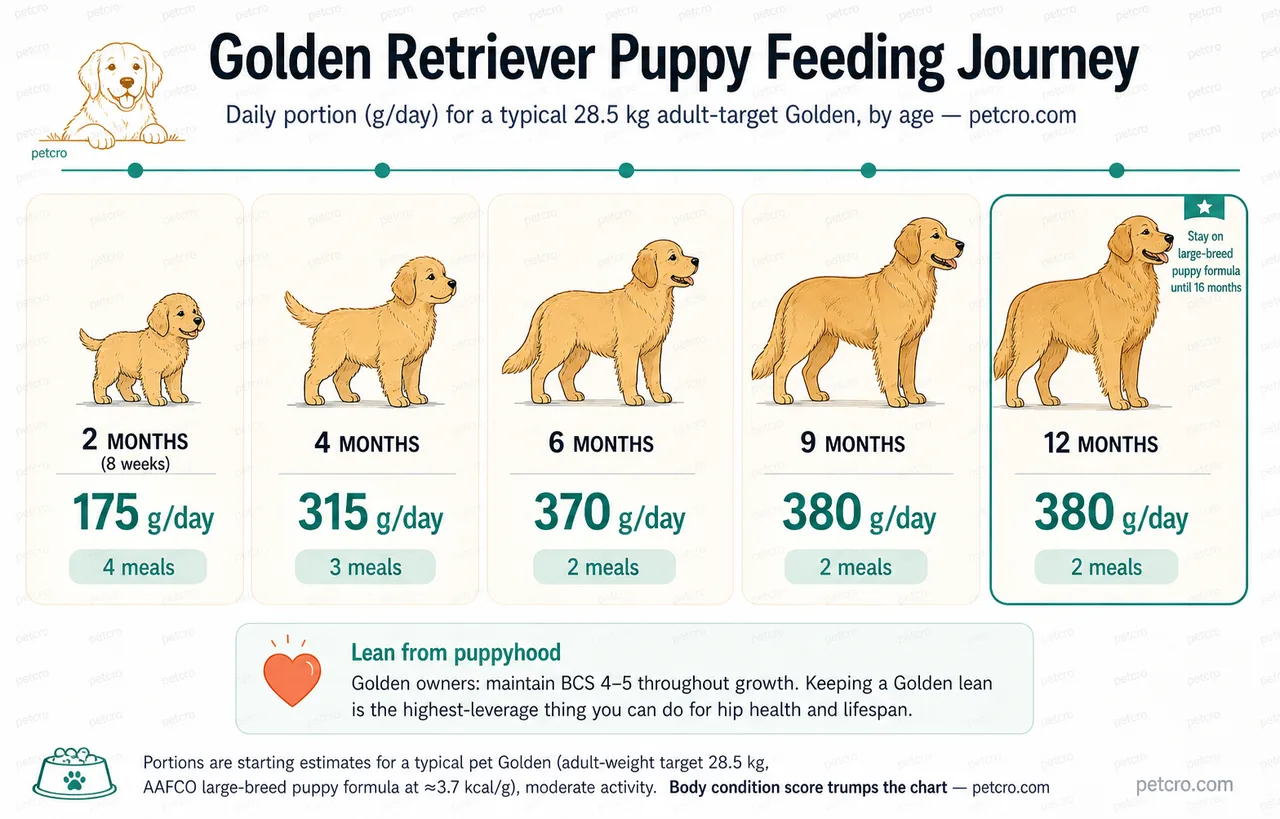
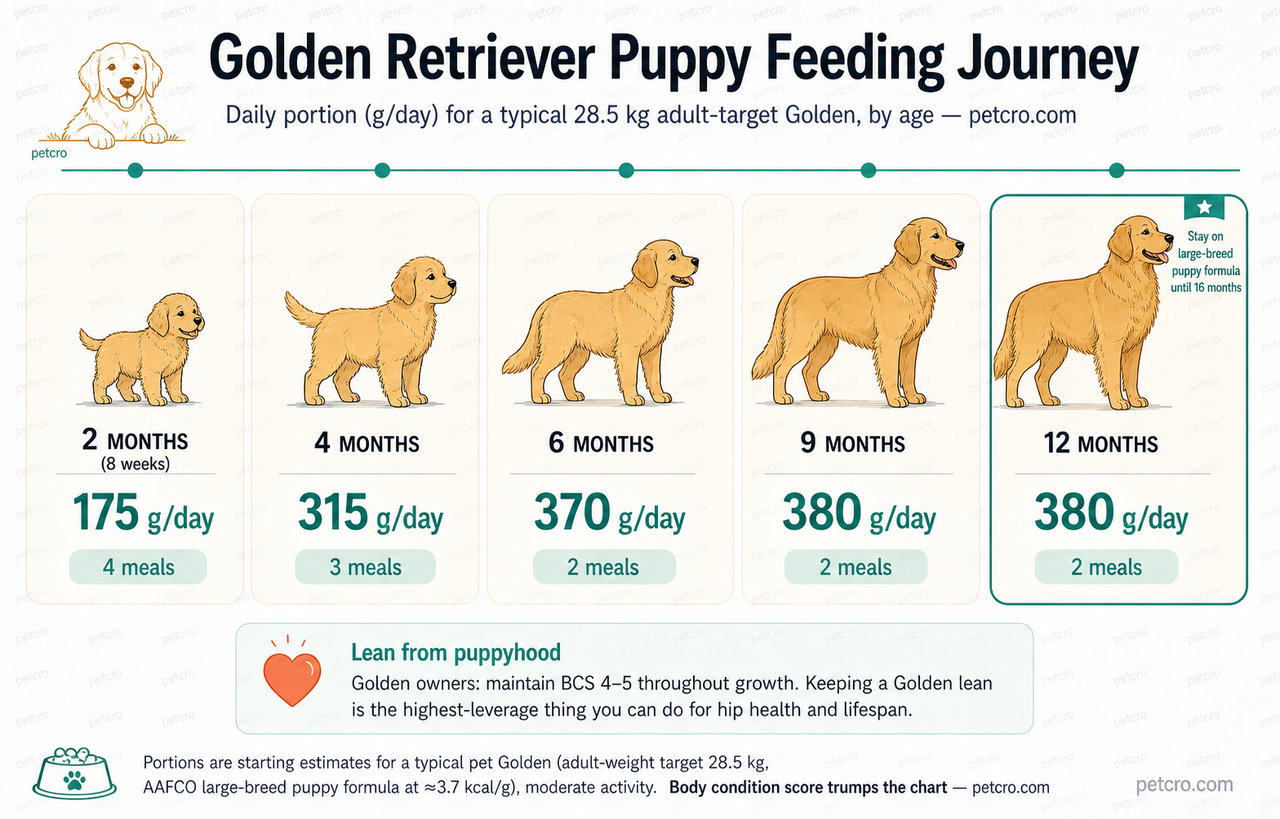
Feeding chart — moderate activity, average puppy
| Adult weight (kg) | 2 mo (g/day) | 4 mo (g/day) | 6 mo (g/day) | 9 mo (g/day) | 12 mo (g/day) |
|---|---|---|---|---|---|
| 25 | 160 | 280 | 335 | 345 | 340 |
| 27 | 170 | 300 | 355 | 365 | 365 |
| 30.5 | 185 | 325 | 385 | 400 | 395 |
| 32 | 190 | 340 | 400 | 415 | 410 |
How to read this: find your puppy's adult weight (not current). If you don't know, our puppy weight predictor estimates it from current weight + age + breed. Cross-reference age in months to read off g/day. Split across meals per the table further down.
Why these numbers are lower than the bag chart: commercial puppy-food charts (Pro Plan, Hill's, Royal Canin) typically recommend 20–30% more food than the WSAVA / NRC formula at the same age. They err on the high side to avoid under-feeding complaints — and most puppies eat more than the strict NRC recommendation without issue. Use the chart above as a conservative starting estimate. If your puppy's body condition score (BCS) drops below 4 after 2 weeks, increase 10–15%. The bag chart is also fine — both are starting points, not prescriptions.
Adjust for activity
| Activity level | Description | Multiplier |
|---|---|---|
| Sedentary | Indoor mostly, short potty walks, lots of crate time | × 0.85 |
| Average | 2 walks/day, normal household play (chart default) | × 1.0 |
| Active | Long walks, dog park, hikes most days | × 1.15 |
| Working / sport | Trained working dog, 4+ hours active daily | × 1.25 |
So a 28.8-kg adult-weight Golden Retriever puppy at 6 months on average activity gets about 370 g/day; bump that to 425 g/day if active or drop to 315 g/day if sedentary.
Meal frequency by age
Same as our general puppy guidance, calibrated for Golden Retrievers:
| Age | Meals per day | Notes |
|---|---|---|
| 8–12 weeks | 4 | Small stomachs, fast metabolism |
| 3–6 months | 3 | Drop from 4 meals to 3 once stool is consistently firm |
| 6–12 months | 2 | Most Golden Retrievers do well on 2 meals from 6 months |
| 12+ months | 2 | Most Golden Retrievers switch to adult food around 16 months (15–18-month range). |
Keep the last meal at least 3 hours before bedtime so house-training stays on track.
Golden Retriever-specific feeding considerations
Cancer rates make lean weight non-negotiable
Golden Retrievers have one of the highest cancer rates among purebred dogs — hemangiosarcoma and lymphoma lead the list, and the Morris Animal Foundation's ongoing Golden Retriever Lifetime Study has documented this consistently across thousands of enrolled dogs. The underlying genetics are mostly out of an owner's hands, but maintaining a lean body condition (BCS 4–5 out of 9) is the highest-leverage longevity intervention owners actually control. The seminal Purina Lifespan Study (Kealy et al. 2002, Journal of the American Veterinary Medical Association) ran on 48 paired Labrador littermates — the calorie-restricted dogs (fed 25% less than their pair-mate) lived a median 1.8 years longer. The study was Labrador-specific but its lean-weight-extends-lifespan finding is applied broadly across breeds, and for a Golden — already at a 10–12 year baseline lifespan — that 1.8 years is a meaningful chunk.
Hip and elbow dysplasia — and why food matters
Per the Orthopedic Foundation for Animals' published statistics, around 1 in 5 Golden Retrievers shows abnormal hip phenotype. Elbow dysplasia is also a concern in the breed though at notably lower rates. Skeletal development during puppyhood directly influences whether dysplasia becomes symptomatic — and growth rate is what you control with food. Large-breed puppy formulas keep calcium ≤1.8% on a dry-matter basis (the AAFCO ceiling for "large size, 70+ lb adult" growth) and calorie density modestly lower than standard puppy food, which slows growth into a healthier curve. Standard or "all-life-stages" puppy food doesn't have this calcium control and is the wrong choice for a Golden.
Slower maturation than Labs
A Golden Retriever takes about 16 months to reach physical adult size — typically 1–2 months longer than a Lab. Don't switch to adult food at 12 months just because the bag suggests it. Stay on large-breed puppy formula until at least 15 months, ideally 16–18 depending on growth-plate closure. Going early shortchanges the protein and DHA the puppy still needs.
When to switch to adult food
Golden Retrievers are a large breed, so adult food typically starts around 16 months (range: 15–18 months). Going earlier risks under-providing the higher-protein, controlled-calcium ratios growing puppies need; going later risks weight gain on calorie-dense puppy formulas.
See our full guide: when to switch puppy to adult food.
Best food formulas for Golden Retriever puppies
We don't pick a single "best" brand — what matters is the formula tier (large-breed puppy vs. all-life-stages, sensitive-stomach vs. standard) and that it's AAFCO growth-tested for the right size class.
- Purina Pro Plan Large Breed Puppy — see our Pro Plan Large Breed feeding chart. AAFCO growth-tested for large-breed (70+ lb adult), controlled calcium, calorie density ≈3.93 kcal/g (3934 kcal/kg per Purina). The default-recommended tier for Goldens.
- Blue Buffalo Life Protection Puppy — see our Blue Buffalo chart. Available in standard and a dedicated Large Breed Puppy SKU; pick the large-breed variant for a Golden. AAFCO growth-tested.
- Royal Canin Golden Retriever Puppy — breed-specific kibble shape and a fatty-acid profile tuned to Golden coat needs. Some owners swear by it, others find the price hard to justify versus the Pro Plan Large Breed option above. Both meet AAFCO growth standards.
- Hill's Science Diet Puppy Large Breed — solid third option, comparable nutrition to Pro Plan Large Breed.
- Purina Puppy Chow — see our Puppy Chow feeding chart. Not size-specific; not the right pick for a Golden Retriever because it doesn't have the controlled calcium that large-breed growth needs. Fine for medium and small breeds.
The "best" formula is whichever AAFCO large-breed-growth-tested kibble your puppy tolerates and stays at BCS 4–5 on. Don't switch brands chasing perceived improvements — switching causes more GI upset than any sub-tier difference fixes.
Body condition trumps the chart
Re-run a Body Condition Score (BCS) check every 2 weeks during puppyhood. A BCS of 4–5 (out of 9) means you've got the portion right — ribs felt easily through a thin fat layer, visible waist from above, slight tummy tuck from the side.
For Golden Retrievers specifically: their thick double coat hides a thickening waistline far better than a short-coated breed's would. Palpate the ribs directly through the coat — what looks like a slim silhouette is often a fluffy coat over an overweight dog.
A BCS of 6+ means cut the portion 10%; BCS 3 or under means add 10%. Check again in 2 weeks.
Common feeding mistakes for Golden Retriever puppies
- Standard puppy food instead of large-breed. The calcium ratio in standard puppy formulas can promote skeletal issues during the longer Golden growth period — go large-breed-specific until 15+ months.
- Switching to adult food at 12 months. Goldens reach physical adult size around 16 months; switching too early shortchanges the protein and DHA needed for the final growth stretch.
- Free-feeding. Goldens are food-motivated and will out-eat what they need. Measure each meal.
- Treats as the silent calorie load. A handful of training treats can add 100+ kcal. Include treats in the daily total — typically capped at 10% of calories.
- Bag-chart blind faith. Pro Plan, Hill's, and Royal Canin charts assume "average activity" — a sport Golden needs more, a couch Golden needs less.
- Skipping body condition checks. Twice-monthly BCS checks catch weight drift before it becomes a vet conversation.
- Picking food on protein numbers alone. Above the AAFCO minimum, more protein doesn't mean a better puppy formula. Controlled calorie density and correct calcium matter more for a Golden than chasing a flashy macro.
This guide is general guidance, not veterinary advice. For your specific dog's nutrition, health, or behavior needs, consult your veterinarian.
Frequently asked questions
How much should a Golden Retriever puppy eat per day?
A Golden Retriever puppy at 4 months on average activity needs around 280–340 g/day of large-breed puppy kibble (≈3.7 kcal/g), split across 3 meals. By 9 months, daily intake rises to around 345–415 g/day on 2 meals — gram count goes up because the puppy is bigger, even though calories per kg of body weight are dropping. The exact amount depends on adult-weight target (29–34 kg male, 25–29 kg female per AKC), activity level, and body condition. Run our feeding calculator for a portion tuned to your specific puppy.
When should I switch my Golden Retriever from puppy to adult food?
Most Golden Retrievers switch around 16 months (15–18-month range, depending on growth-plate closure and adult weight). Large-breed puppy formulas have specific calcium-to-phosphorus ratios that matter for skeletal development — switching too early risks under-providing those nutrients. See our full when-to-switch guide for a 7–10 day transition protocol.
How many meals a day for a Golden Retriever puppy?
4 meals/day until 12 weeks, 3 meals/day from 3–6 months, then 2 meals/day from 6 months onwards. Golden Retrievers do well on 2 meals into adulthood. Their bloat (GDV) risk is lower than deep-chested breeds like German Shepherds or Standard Poodles, so meal frequency for a Golden is mostly about routine and house-training, not anatomy.
What's the best puppy food for a Golden Retriever?
There isn't a single "best." What matters is that the food is AAFCO growth-tested for large-breed dogs (70+ lb adult), has controlled calcium (≤1.8% on a dry-matter basis), and your puppy tolerates it (firm stool, BCS 4–5, healthy coat). Pro Plan Large Breed Puppy is the safe default; Royal Canin Golden Retriever Puppy is breed-specific if you want that; Hill's Science Diet Puppy Large Breed is comparable. Avoid non-large-breed-specific puppy food. If your puppy has known GI sensitivities or food allergies, talk to your vet before switching brands.
How much do Golden Retrievers weigh by age?
At 26 weeks (≈6 months) a typical Golden Retriever puppy is about 65% of adult weight. For a 28.8-kg adult, that's around 18.7 kg at 6 months. Use our puppy weight predictor for an exact estimate from your puppy's current weight + age + breed.
My Golden Retriever puppy isn't finishing meals — am I overfeeding?
Possibly. Goldens are typically high food-drive — they're a working retriever line, only slightly less food-obsessive than Labs — so a Golden refusing food often means they've simply already had enough that day. Drop the portion 10% and watch for a week. If body condition stays at BCS 4–5 and stool is firm, you've found the right amount. Don't push food a healthy puppy is refusing.
Should I free-feed or scheduled-feed my Golden Retriever puppy?
Scheduled meals, not free-feeding. Goldens are food-motivated and free-feeding is the most common path to the breed-level obesity that contributes to so many of their hip and joint issues later in life. Scheduled meals also make house-training, BCS tracking, and medication-timing far easier.
TL;DR — the Golden Retriever feeding cheat sheet
- Adult weight: 25–34 kg (55–75 lb) per AKC; most pet Goldens land in 25–32 kg, size band large
- Meals: 4 → 3 → 2 at 12 weeks / 6 months
- Switch to adult food at 16 months (15–18-month range)
- Use the chart above as a starting estimate, then adjust −15% (sedentary) to +25% (working/sport) for activity and re-check body condition every 2 weeks
- Golden owners: lean from puppyhood is the single biggest thing you can do for hip health and lifespan — measure every meal, and check ribs through the coat.
- Run our feeding calculator for an exact gram count for your specific puppy
Sources & further reading
- AKC Golden Retriever official breed standard — adult-weight ranges and breed standard.
- Hill's Pet Nutrition: Dog care guides — vet-nutritionist-led guidance on large-breed puppy growth and feeding.
- WSAVA Global Nutrition Guidelines — the puppy energy-requirement formula behind the chart.
- AAFCO Dog Food Nutrient Profiles — growth-stage minimums for puppy food labelling.
- NRC Nutrient Requirements of Dogs and Cats (2006), National Academies Press — the underlying RER / DER math.
- Kealy, R. D., et al. (2002). "Effects of diet restriction on life span and age-related changes in dogs." Journal of the American Veterinary Medical Association, 220(9), 1315–1320 — the lifespan-extension finding from lifelong calorie restriction.
- Morris Animal Foundation Golden Retriever Lifetime Study — multi-year longitudinal study of cancer incidence and lifespan in U.S. Goldens.
- Golden Retriever Club of America breed standard reference — cross-checks AKC adult-weight ranges.
More from Petcro's puppy feeding cluster
- How much to feed a puppy — pillar guide — the master feeding article all chart posts feed back into.
- When to switch puppy to adult food — full transition protocol by size class.
- Golden Retriever first-year guide — month-by-month timeline, training, health watch-outs.
- Puppy weight predictor — estimate adult weight from current weight + age + breed.
- Feeding calculator — exact gram count for your specific puppy in 30 seconds.
Petcro is reader-supported. We may earn an affiliate commission when you click through links to products in this guide. Our editorial picks are independent of any commercial relationship with any pet-food brand.