Blue Buffalo Puppy Feeding Chart (formula by formula)
The Blue Buffalo puppy feeding chart by weight and age, plus the activity adjustment most owners miss and a quick comparison to Pro Plan.
The Blue Buffalo puppy feeding chart maps your puppy's adult weight to a daily portion, then adjusts for age and activity. Use the chart matching your formula (Life Protection, Wilderness, Basics, or Tastefuls), split into 3–4 meals depending on age, and weigh weekly to confirm growth. Approximations below; verify against your bag.
This guide gives you the chart by formula and adult weight, the activity adjustment the bag chart skips, and a clear answer to the question shoppers actually have when they're standing in the aisle: is Blue Buffalo a step up from Purina, or just a step sideways?
TL;DR: Blue Buffalo Life Protection Formula (LPF) Puppy is 3707 kcal/kg (≈3.71 kcal/g), AAFCO-tested for growth, with deboned chicken as the first ingredient + DHA. Slightly less calorie-dense than Pro Plan; protein roughly matches Puppy Chow but with whole-protein-first sourcing instead of by-product meal. Use the bag chart matching your formula (LPF, Wilderness, Basics, or Tastefuls), then adjust −15% (sedentary) to +20% (working) for activity level and weigh your puppy weekly. Run our feeding calculator for a portion specific to your puppy.
Which Blue Buffalo formula is your puppy on?
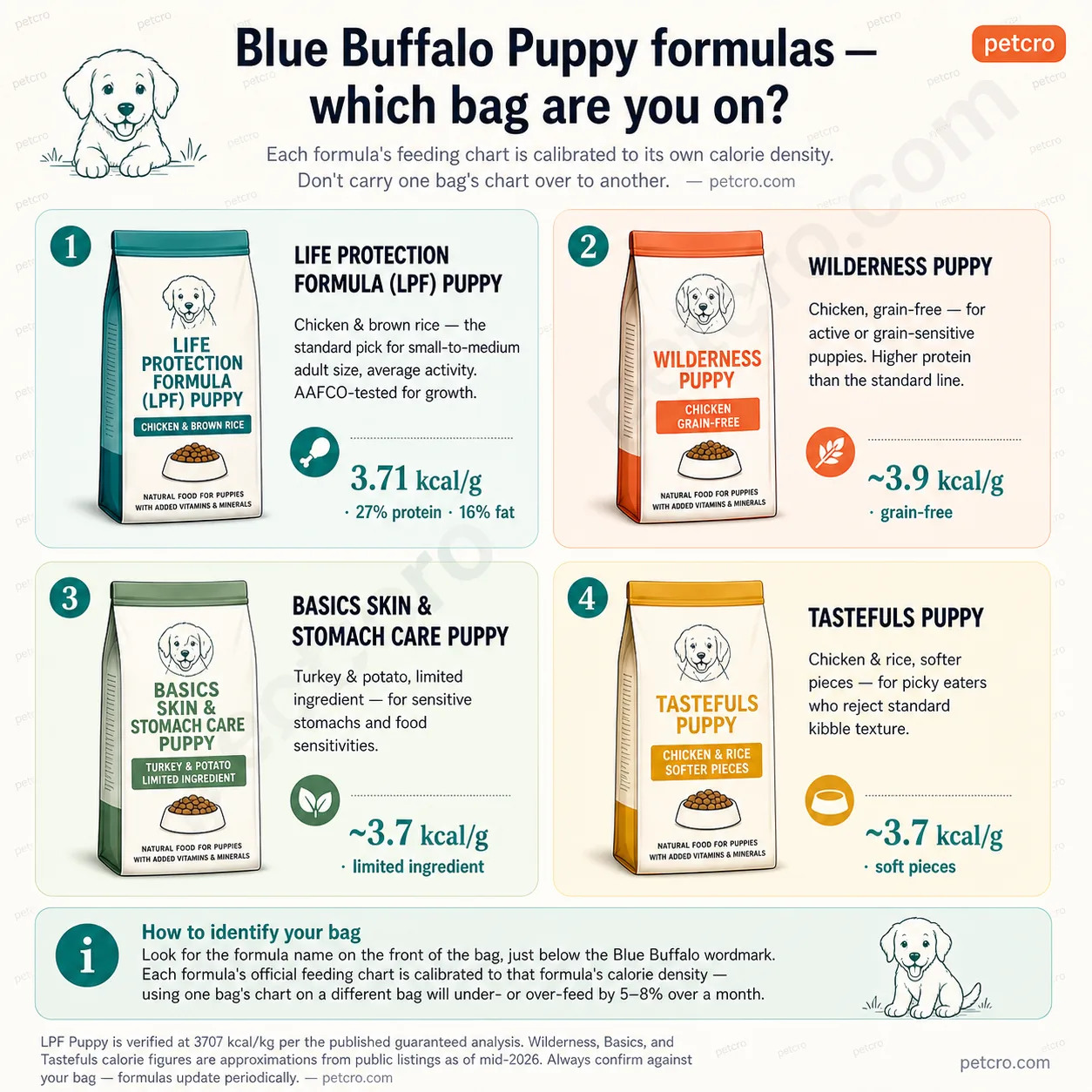
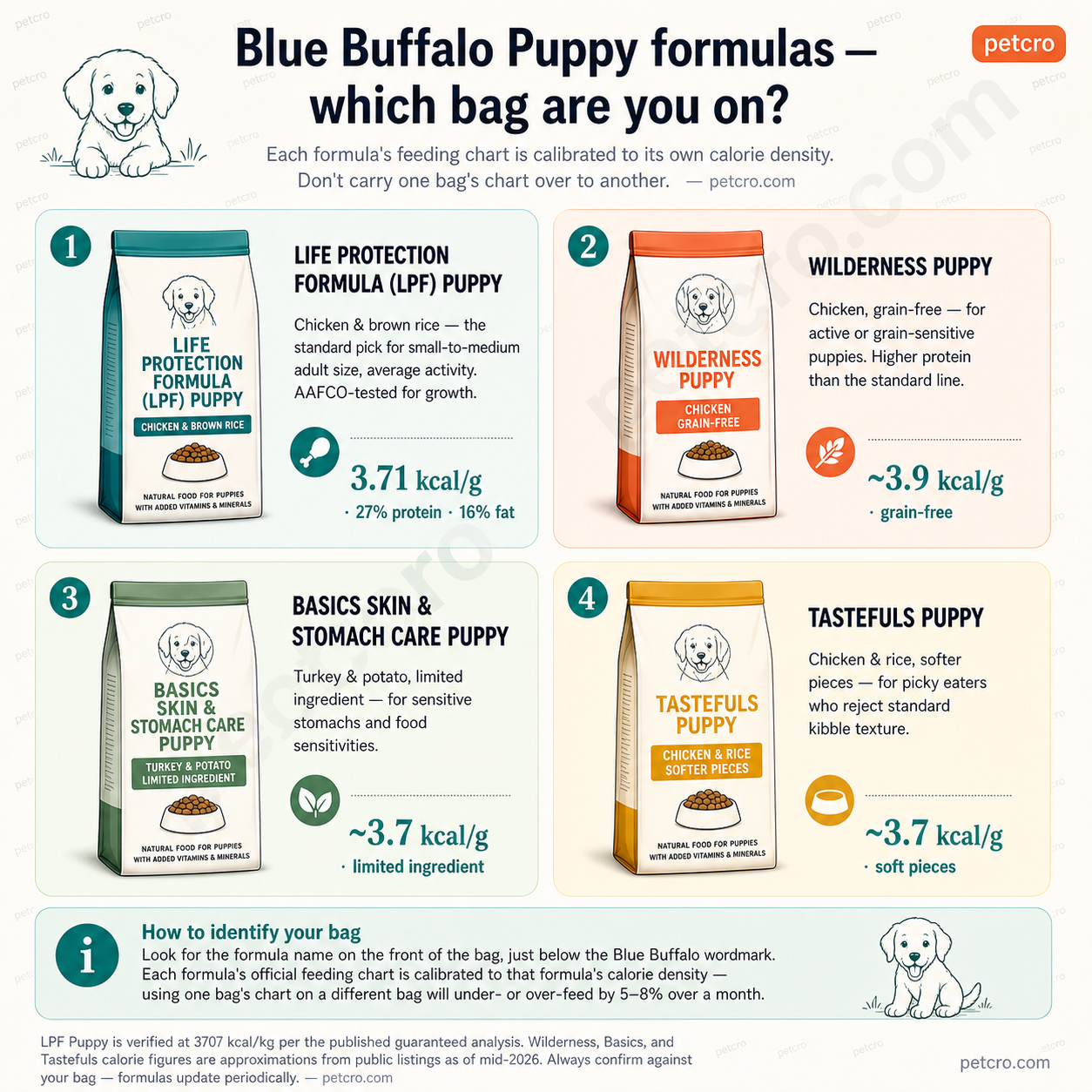
Blue Buffalo runs four main puppy lines. The bag charts differ slightly because calorie density and protein/fat targets vary. Don't carry numbers from one bag to another.
| Formula | Best for | Approx. kcal/g (as published 2026) | Bag size |
|---|---|---|---|
| Life Protection Formula (LPF) Puppy (chicken & brown rice) | Standard pick — small-to-medium adult size, average activity | 3.71 (3707 kcal/kg, per Blue Buffalo May 2026) | 5 / 15 / 30 lb |
| Wilderness Puppy (chicken, grain-free) | Higher-protein, grain-sensitive puppies | ~3.9 | 4.5 / 11 / 24 lb |
| Basics Skin & Stomach Care Puppy (turkey & potato, limited ingredient) | Sensitive stomachs, food sensitivities, first-allergen-trial | ~3.7 | 4 / 11 / 22 lb |
| Tastefuls Puppy (chicken & rice) | Picky eaters — softer pieces, slightly milder formula | ~3.7 | 4 / 11 / 22 lb |
Why this matters: the official chart on each bag is calibrated to that formula's calorie density. Don't use the chart from one Blue Buffalo bag for a different Blue Buffalo formula — Wilderness is roughly 5% denser than Basics, and the same gram count over-feeds across that gap over a month.
If you're not sure which one you have, the formula name is on the front of the bag below the "Blue Buffalo" wordmark. Always confirm kcal/cup against the bag — Blue Buffalo updates formulas occasionally and the published numbers in this guide are approximations sourced from the brand's public listings as of mid-2026.
The Blue Buffalo puppy feeding chart (by weight × age)
These are conservative starting estimates aligned with Blue Buffalo's published AAFCO-tested values for the LPF Puppy formula. Round to the nearest 5 g for daily totals, then split across 3–4 meals depending on age. Numbers are starting points — confirm against the chart printed on your specific bag.
Life Protection Formula (LPF) Puppy — chicken & brown rice
These values come directly from Blue Buffalo's published bag chart for the LPF Puppy formula. 1 cup ≈ 105 g, 3707 kcal/kg.
| Adult weight | 1 – 3 months | 3 – 5 months | 5 – 7 months | 7 – 12 months |
|---|---|---|---|---|
| Up to 5 lb (≤2 kg) | ¾ – 1 cup (79 – 105 g) | ½ – ¾ cup (53 – 79 g) | ½ – ¾ cup (53 – 79 g) | ¼ – ½ cup (26 – 53 g) |
| 6 – 10 lb (3 – 4 kg) | 1 – 1¾ cups (105 – 184 g) | ¾ – 1 cup (79 – 105 g) | ¾ – 1 cup (79 – 105 g) | ½ – ¾ cup (53 – 79 g) |
| 11 – 20 lb (5 – 9 kg) | 1¾ – 2¾ cups (184 – 289 g) | 1 – 1¾ cups (105 – 184 g) | 1 – 1¾ cups (105 – 184 g) | ¾ – 1½ cups (79 – 158 g) |
| 21 – 40 lb (10 – 18 kg) | 2¾ – 4½ cups (289 – 473 g) | 1¾ – 3 cups (184 – 315 g) | 1¾ – 2¾ cups (184 – 289 g) | 1½ – 2½ cups (158 – 263 g) |
| 41 – 60 lb (19 – 27 kg) | 4½ – 6¼ cups (473 – 656 g) | 3 – 4¼ cups (315 – 446 g) | 2¾ – 3¾ cups (289 – 394 g) | 2½ – 3¼ cups (263 – 341 g) |
Wilderness Puppy (grain-free, higher protein)
The Wilderness Puppy bag has its own feeding chart distinct from LPF Puppy. Calorie density runs slightly higher (~3.9 kcal/g vs LPF's 3.71), so gram counts run roughly 5–8% lower than the LPF chart above for the same adult weight × age cell. Check the printed chart on your specific Wilderness Puppy bag for exact values.
Reading the chart: find the row that matches your puppy's expected adult weight (not their current weight). If you don't know the breed's adult average, use your veterinarian's growth-curve estimate or the AKC puppy feeding fundamentals guide. For mixed breeds, average the parent breeds' adult weights.
About these numbers: These come directly from Blue Buffalo's bag chart for the LPF Puppy formula at 3707 kcal/kg. Blue Buffalo publishes wide cell ranges intentionally — the lower end is for less-active puppies on the smaller side of their adult-weight band, the upper end for active puppies on the larger side. Body-condition-score is the truth — adjust within (or outside) the range based on weekly recheck. The Kealy 2002 Purina lifespan study found that lifelong calorie restriction (lean feeding) extended canine lifespan by ~1.8 years with reduced osteoarthritis. For most puppies, starting at the middle of the range and adjusting to BCS produces the best long-term outcomes.
For large-breed puppies (25 kg+ adult weight), Blue Buffalo also offers an LPF Large Breed Puppy variant with controlled calcium and slower-growth calibration — same skeletal-protection logic as Pro Plan Large Breed Puppy. Don't use standard LPF Puppy past 4 months for a 25 kg+ projected adult.
The activity adjustment most owners miss
The bag chart is calibrated for what Blue Buffalo calls "moderate activity" — 30–60 minutes of moderate movement per day. Almost no real puppy hits exactly that number.
Adjust the chart number by activity level: −15% for sedentary (mostly crated, short potty walks), 0% for typical (2–3 walks + indoor play — the bag's assumption), +10% for active (hour+ of play, training, runs), +15–20% for working puppies in training.
A note on Blue Buffalo's chart structure: the bag's wide ranges already encode some activity variation. Use the multipliers as refinement once you've picked a number inside the range. Example: a 10 kg / 22 lb adult-projected, 6-month-old puppy on LPF Puppy is in the 21–40 lb / 10–18 kg row at 5–7 months → 1¾ to 2¾ cups (184 – 289 g/day). A 10 kg adult is on the smaller side of the band, so start near the lower end (~185–200 g) for moderate activity. Sedentary → 0.85× (~160 g). Active → 1.10× (~210 g, mid-range).
The single fastest way to know if your portion is right: weigh your puppy weekly and watch the trajectory, not the absolute number. Steady week-over-week growth that follows the breed's published curve = your portion is correct. Plateauing → too little. Belly hanging or pinch-fold of fat over the ribs → too much. Use our body-condition score tool for a 60-second check.
Blue Buffalo vs Pro Plan vs Puppy Chow: how does the math actually compare?
This is the question that drives most of the search volume on "blue buffalo puppy feeding chart" — owners are cross-shopping and want to know if Blue Buffalo is a meaningful step up from Purina, or just different marketing on a similar product.
The honest answer: all three are AAFCO-tested for puppy growth and meet the minimum nutrient requirements. The differences are real but smaller than the price gap suggests.
| Spec | Puppy Chow Complete | Blue Buffalo LPF Puppy | Pro Plan Puppy |
|---|---|---|---|
| Crude protein (min) | 27.5% | 27% | 28% |
| Crude fat (min) | 12.0% | 16% | 18% |
| Calorie density | ~3.6 kcal/g | 3.71 kcal/g (3707 kcal/kg) | 4.19 kcal/g (4188 kcal/kg) |
| First ingredient | Chicken by-product meal | Deboned chicken | Chicken |
| DHA for brain development | No | Yes | Yes |
| Glucosamine for joints | No | No | Yes |
| Grain-free option | No | Yes (Wilderness) | No |
| Price (≈30 lb / 13.6 kg, May 2026, US retail) | ~$26 | ~$48 | ~$57 |
Pick Blue Buffalo LPF if you want whole deboned protein as the first ingredient, your puppy has a sensitive stomach (the Basics line is grain-and-novel-protein focused), or you specifically want a brand without by-product meal. Most companion puppies do completely fine on it.
Pick Pro Plan if you have a working breed, a large-breed puppy needing the controlled-calcium plus glucosamine, or you want the highest calorie density (smaller scoops at the same calories).
Pick Puppy Chow if you're on a tight budget and your puppy is a normal-energy small-to-medium breed mix. AAFCO-tested for growth, just less calorie-dense and lacking DHA.
For the underlying calorie math all three brands calibrate to, see our pillar guide on how much to feed a puppy.
Meal frequency by age (for any Blue Buffalo formula)
Same as the broader puppy guidance — Blue Buffalo doesn't change the schedule:
| Age | Meals per day | Sample times |
|---|---|---|
| 8–12 weeks | 4 | 7am, 11am, 3pm, 7pm |
| 3–6 months | 3 | 7am, 12:30pm, 6pm |
| 6–12 months | 2 | 7am, 6pm |
| 12+ months | 2 | 7am, 6pm |
Keep last meal at least 3 hours before bedtime to avoid disrupting house-training.
When the chart isn't enough
The bag chart breaks down in three situations Blue Buffalo can't anticipate:
- Spayed / neutered puppies — caloric needs drop 20–30% within weeks of surgery. Don't keep feeding the pre-surgery portion or you'll see weight gain inside 6 weeks.
- Seasonal climate — winter outdoor puppies burn 10–15% more calories than summer indoor ones. Adjust seasonally.
- Recovering from illness — vets will give specific guidance, but most recovery puppies need 5–10% more calories during the first 2 weeks back on solid food.
In all three cases, the chart is a starting point, not a prescription.
This guide is general guidance, not veterinary advice. For your specific dog's nutrition, health, or behavior needs, consult your veterinarian.
Frequently asked questions
How much Blue Buffalo puppy food per day for a 10 kg puppy?
For a 10 kg / 22 lb adult-projected dog at 3–5 months on LPF Puppy, the bag chart 21–40 lb row says 1¾ to 3 cups (184 – 315 g/day). A 10 kg adult is on the smaller side of the 21–40 lb band, so start near the lower end (~190–215 g) for moderate activity, split across 3 meals. Run the feeding calculator for a more precise number factoring in activity and body condition. Confirm against the chart on your specific bag — Blue Buffalo updates formulas periodically.
Is Blue Buffalo good for puppies, or is the marketing better than the food?
Blue Buffalo is AAFCO-tested for growth and uses whole deboned protein as the first ingredient. It's a legitimate premium-tier puppy food. The brand has had recalls in the past (notably 2010 and 2015) — same as most major pet food brands; no evidence of a current quality issue. For most companion puppies, LPF Puppy works well. The price gap to budget tier (Puppy Chow) is real; the gap to Pro Plan is smaller and largely a calorie-density and DHA/glucosamine difference.
Should I feed Blue Buffalo Wilderness instead of LPF for a puppy?
Wilderness is grain-free and higher protein. For most puppies, LPF is the safer default — the FDA's investigation into grain-free diets and dilated cardiomyopathy (DCM) in dogs is ongoing, and unless your puppy has a documented grain sensitivity, the grain-inclusive LPF gives you a longer track record. Talk to your vet before choosing grain-free.
My puppy isn't finishing their Blue Buffalo portion. Am I overfeeding?
Possibly, especially for sedentary indoor puppies. Drop 10% and watch for a week. If they finish consistently and body condition stays at BCS 4–5 on the 9-point scale, you've found the right portion. Don't push food a healthy puppy is refusing.
When should I switch from Blue Buffalo Puppy to Adult food?
Small/medium breeds: around 12 months. Large breeds (25 kg+ adult): 15–18 months. Giant breeds (40 kg+): 18–24 months. Run a 7–10 day gradual transition. See our when to switch guide for the full protocol.
Does Blue Buffalo publish their feeding chart online?
Yes — see bluebuffalo.com for each formula's specific guide. Our chart above is aligned with their published values but presented as a single comparison across formulas. For the latest exact numbers, the bag's printed chart overrides anything else.
My puppy has loose stools on Blue Buffalo. Should I switch?
Try a 7-day re-introduction first — sudden food changes are the #1 cause of loose stools, even within the same brand. If you're already on Blue Buffalo consistently and stools are loose, the formula may not suit your puppy's gut. Try Basics Skin & Stomach Care Puppy (limited-ingredient turkey and potato — easier on sensitive stomachs). If stools don't firm up within 2 weeks of any change, see a vet — could be parasites, food allergy, or an underlying GI issue.
TL;DR — the Blue Buffalo cheat sheet
- Identify your formula: LPF, Wilderness (grain-free), Basics (limited-ingredient), or Tastefuls
- Use the matching chart above as your starting estimate
- Adjust −15% (sedentary) to +20% (working) for actual activity level — the bag chart assumes "average," and almost no real puppy is average
- Blue Buffalo LPF sits between Puppy Chow (budget) and Pro Plan (premium-density) — whole-deboned-chicken first ingredient + DHA included, slightly less calorie-dense than Pro Plan
- Weigh your puppy weekly and watch the trajectory; portion is right when growth follows the breed's published curve
- For large-breed puppies (25 kg+ adult), use LPF Large Breed Puppy specifically — controlled calcium for slow skeletal growth
- Switch to adult food at 12 months (small/medium) or 15–18 months (large) using a 7-day transition
Whatever brand you pick, the formula on the bag matters less than getting the portion right.
Sources & further reading
- Blue Buffalo official feeding guides — bag-specific charts straight from the manufacturer.
- WSAVA Global Nutrition Guidelines — the international veterinary standard for puppy energy requirements.
- AAFCO Dog Food Nutrient Profiles — the regulatory baseline Blue Buffalo tests against for "complete and balanced for growth."
- Tufts Petfoodology: Reading a pet food label — independent guidance on what the AAFCO statement on a bag actually means.
- ASPCA Dog Nutrition Tips — vet-organisation guidance on life-stage feeding, including the by-product-meal vs whole-protein question.
If your puppy has been prescribed a vet diet (allergy, weight management, GI), follow your vet's guidance over any commercial feeding chart, including the one above.
More from Petcro's puppy nutrition cluster
- How Much to Feed a Puppy — the underlying calorie formula every brand chart is calibrated to.
- Purina Pro Plan Puppy Feeding Chart — the premium-density comparison, formula by formula.
- Purina Puppy Chow Feeding Chart — the budget-tier comparison plus a Pro Plan vs Puppy Chow spec table.
- When to Switch Your Puppy to Adult Food — full transition timing by adult size.
- Feeding calculator — exact gram count for your specific puppy in 30 seconds.
Petcro is reader-supported. We may earn an affiliate commission when you click through links to products in this guide. Our editorial picks are independent of any commercial relationship with Blue Buffalo or any other brand.