Labrador Retriever Puppy Feeding Chart (8 weeks–16 months, by weight & age)
Labrador Retriever puppy feeding chart — grams per day by age and adult weight, plus the activity adjustment most owners miss.
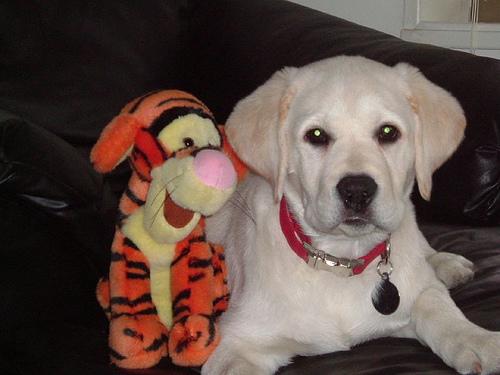
A Labrador Retriever puppy needs roughly 1110–1270 kcal/day at 4 months and 1400–1560 kcal/day at 8 months. On typical large-breed puppy kibble (≈3.7 kcal/g), that's about 300–345 g/day at 4 months and 380–420 g/day at 8 months. Exact amounts depend on adult-weight target, age, and activity level. Body condition score (BCS) trumps the chart.
TL;DR: Labrador Retrievers are a large-breed dog with adult weight 25–36 kg (55–79.5 lb). Labs carry a POMC gene mutation in roughly 1 in 4 pet dogs (Raffan et al., 2016, Cell Metabolism) that drives constant food-seeking — combined with a body type that hides early weight gain, portion control is the single most important Lab puppy decision. The chart below is drawn from the AKC adult-weight standard, AAFCO large-breed growth profile, and the WSAVA / NRC puppy energy formula. Run our feeding calculator for a portion that's tuned to your specific puppy in 30 seconds, or our puppy weight predictor if you're not sure how big yours will get.
Labrador Retriever adult-weight quick reference
These are the AKC breed-standard adult weight ranges. Most Labrador Retrievers settle within them; outliers are normal but worth a vet check if your dog is well outside the band as an adult.
| Range (kg) | Range (lb) | Mid (kg) | |
|---|---|---|---|
| Male | 29–36 kg | 64–79.5 lb | 32.5 kg |
| Female | 25–32 kg | 55–70.5 lb | 28.5 kg |
Size band: Large (25–40 kg adult) — that's what determines puppy-food formula choice (see when to switch puppy to adult food for the cutoff for Labrador Retrievers).
The Labrador Retriever puppy feeding chart (g/day, by adult weight × age)
Calorie needs come from the NRC / WSAVA puppy formula: daily energy requirement (DER) is a multiple of resting energy requirement (RER, where RER = 70 × bodyweight_kg^0.75). The DER multiplier tapers smoothly as the puppy approaches adult weight — about 3.0× RER at weaning (~15% of adult weight) and falling toward 1.6× as the puppy reaches adult size. We use the percent-of-adult-weight transition rather than raw age because a large breed hits those landmarks at a different age than a toy or giant.
We've translated that into grams of typical large-breed puppy kibble (≈3.70 kcal/g). Round to the nearest 5 g and split across the meal count below.
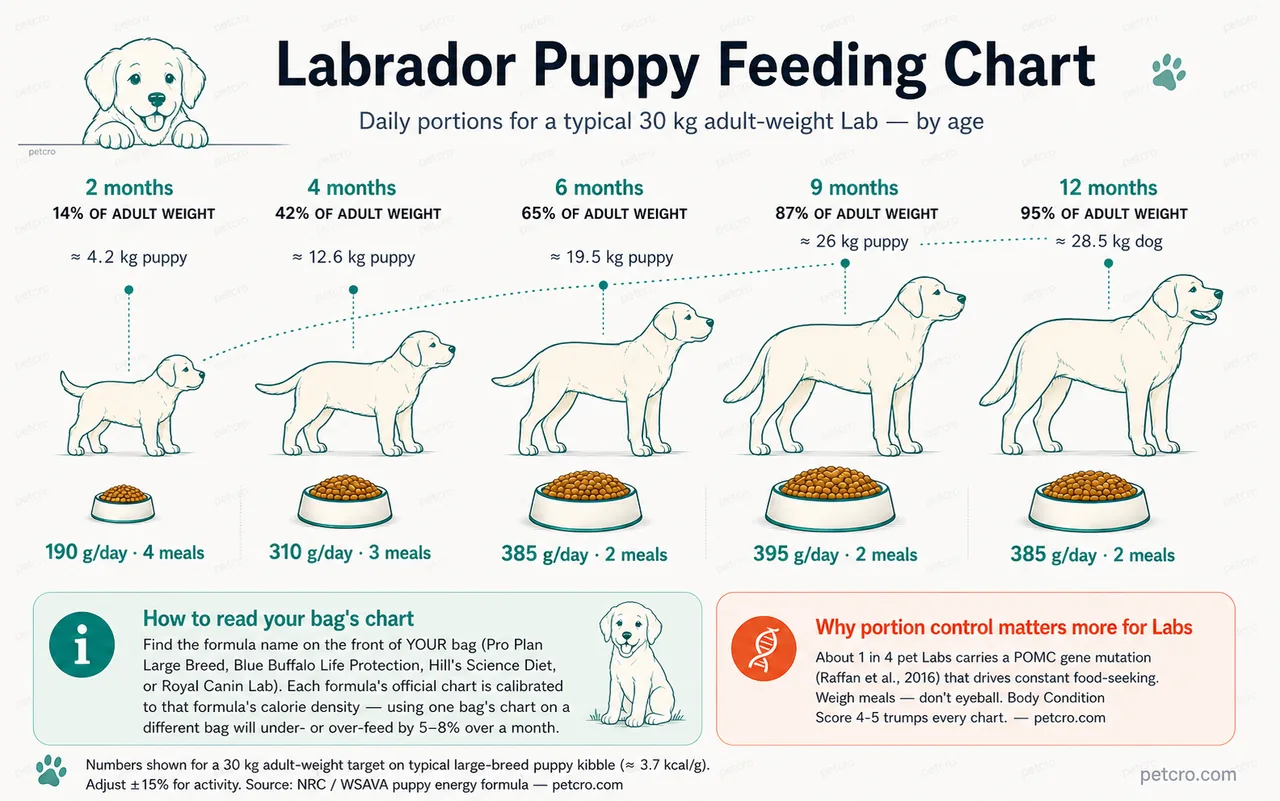
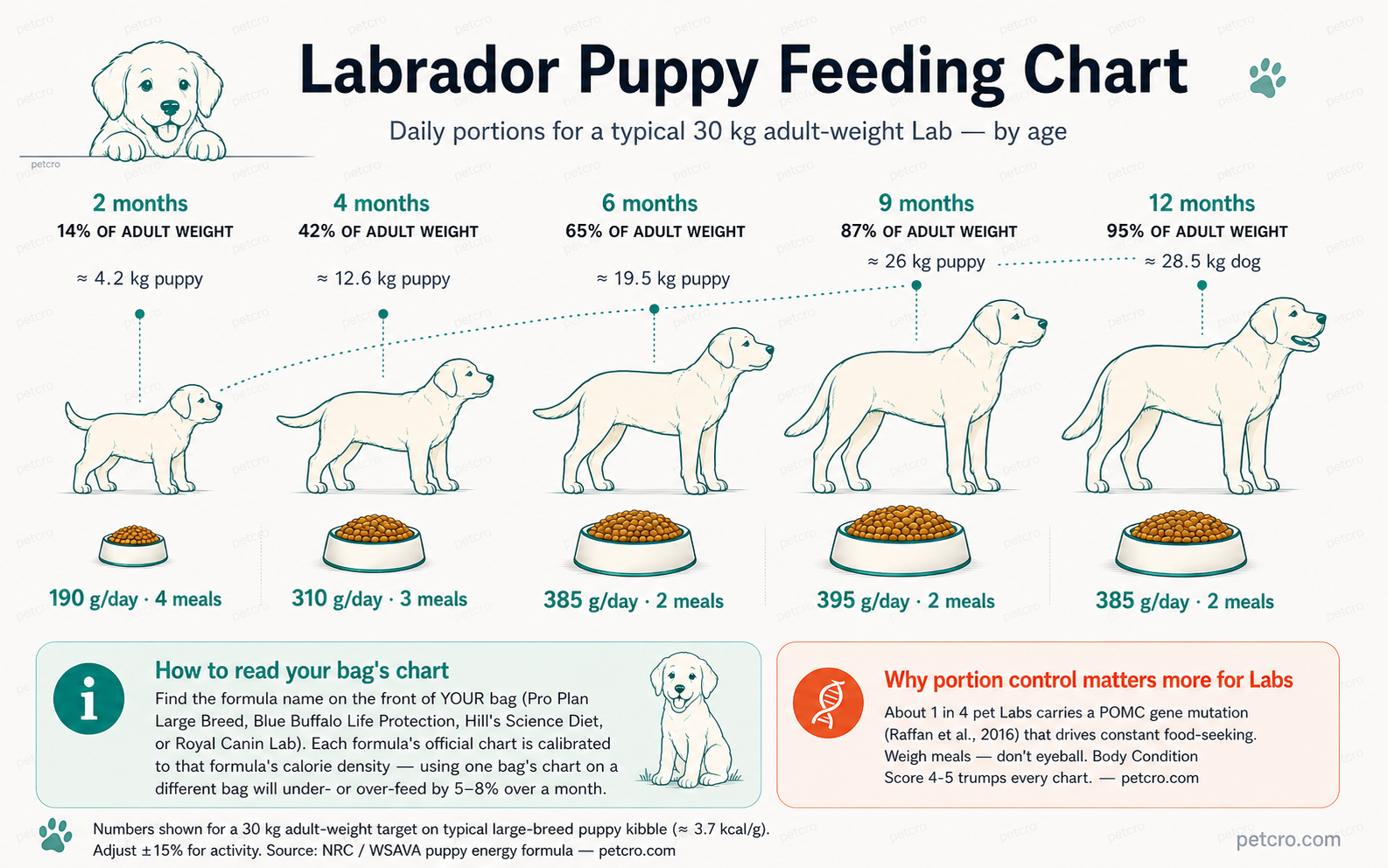
Feeding chart — moderate activity, average puppy
| Adult weight (kg) | 2 mo (g/day) | 4 mo (g/day) | 6 mo (g/day) | 9 mo (g/day) | 12 mo (g/day) |
|---|---|---|---|---|---|
| 25 | 160 | 280 | 335 | 345 | 340 |
| 28.5 | 175 | 310 | 370 | 380 | 380 |
| 32.5 | 195 | 345 | 405 | 420 | 415 |
| 36 | 210 | 370 | 440 | 455 | 450 |
How to read this: find your puppy's adult weight (not current). If you don't know, our puppy weight predictor estimates it from current weight + age + breed. Cross-reference age in months to read off g/day. Split across meals per the table further down.
Why these numbers are lower than the bag chart: commercial puppy-food charts (Pro Plan, Hill's, Royal Canin) typically recommend 20–30% more food than the WSAVA / NRC formula at the same age. They err on the high side to avoid under-feeding complaints — and most puppies eat more than the strict NRC recommendation without issue. Use the chart above as a conservative starting estimate. If your puppy's body condition score (BCS) drops below 4 after 2 weeks, increase 10–15%. The bag chart is also fine — both are starting points, not prescriptions.
Adjust for activity
| Activity level | Description | Multiplier |
|---|---|---|
| Sedentary | Indoor mostly, short potty walks, lots of crate time | × 0.85 |
| Average | 2 walks/day, normal household play (chart default) | × 1.0 |
| Active | Long walks, dog park, hikes most days | × 1.15 |
| Working / sport | Trained working dog, 4+ hours active daily | × 1.25 |
So a 30.5-kg adult-weight Labrador Retriever puppy at 6 months on average activity gets about 385 g/day; bump that to 445 g/day if active or drop to 325 g/day if sedentary.
Meal frequency by age
Same as our general puppy guidance, calibrated for Labrador Retrievers:
| Age | Meals per day | Notes |
|---|---|---|
| 8–12 weeks | 4 | Small stomachs, fast metabolism |
| 3–6 months | 3 | Drop from 4 meals to 3 once stool is consistently firm |
| 6–12 months | 2 | Most Labrador Retrievers do well on 2 meals from 6 months |
| 12+ months | 2 | Most Labrador Retrievers switch to adult food around 16 months (15–18-month range). |
Keep the last meal at least 3 hours before bedtime so house-training stays on track.
Labrador Retriever-specific feeding considerations
The POMC obesity gene
The 2016 study by Raffan et al. in Cell Metabolism identified a 14-base-pair deletion in the canine POMC gene found in roughly 23% of pet Labs and a much higher share of working/assistance Labs (the gene appears to have been selected for in food-motivated working lines). Carriers are measurably more food-motivated, less responsive to satiety signals, and harder to keep at a healthy weight.
What this means at meal time: a Lab puppy who acts hungry after a measured portion is not under-fed if BCS is 4–5. They are POMC-driven hungry, not actually hungry. The single most important habit you can build in year one is to weigh food on a kitchen scale — not eyeball, not use a measuring cup. Volumetric measurement varies with kibble density and how packed the cup is, so cup-measured portions tend to drift higher than weighed ones over months. Over a year, that drift is what turns a healthy Lab puppy into an overweight one.
Why large-breed puppy formula matters
Adult Labs sit firmly in the AAFCO large-breed range (≥32 kg / 70 lb adult). Until 15–18 months, your Lab puppy needs a formula labelled for large-breed growth — primarily for tighter calcium and calcium-to-phosphorus controls. The AAFCO Dog Food Nutrient Profile caps calcium at 1.8% on a dry-matter basis for large-breed growth, with stricter Ca:P ratio limits than regular puppy formulas. Excess calcium during the rapid-growth window contributes to developmental orthopaedic disease — joint problems that often don't show up until adulthood and aren't reversible.
The formula tier (large-breed puppy vs. regular puppy) matters more than the brand. A budget large-breed puppy formula beats a premium regular puppy formula for a Lab past 4 months.
Growth pace and exercise economy
Lab puppies tracking the large-breed size-band curve hit roughly 65% of adult weight by 6 months and ~85% by 9 months. They burn calories on play and adolescent restlessness, but joint impact during the rapid-growth window is the same risk vector as over-feeding: avoid forced repetitive impact (long road runs, agility, stair climbing) until growth plates close around 12–18 months. The widely-cited "5-minute rule" (5 minutes of structured walk per month of age, twice daily) is a heuristic — useful as a ceiling, not a target.
When to switch to adult food
Labrador Retrievers are a large breed, so adult food typically starts around 16 months (range: 15–18 months). Going earlier risks under-providing the higher-protein, controlled-calcium ratios growing puppies need; going later risks weight gain on calorie-dense puppy formulas.
See our full guide: when to switch puppy to adult food.
Best food formulas for Labrador Retriever puppies
We don't pick a single "best" brand — what matters is the formula tier (large-breed puppy vs. all-life-stages, sensitive-stomach vs. standard) and that it's AAFCO growth-tested for the right size class.
For a Lab puppy, choose a formula labelled for large-breed growth — that's the AAFCO designation that controls calcium ratios for puppies whose adult size will exceed 32 kg / 70 lb. Within that constraint, brand is mostly preference and budget:
- Purina Pro Plan Large Breed Puppy — see our Pro Plan Large Breed chart. AAFCO growth-tested, ~3.93 kcal/g (3934 kcal/kg per Purina), calibrated calcium ratio for slower large-breed growth. The most common premium pick at US shelves.
- Blue Buffalo Life Protection Large Breed Puppy — see our Blue Buffalo chart (look for the large-breed Life Protection section). Grain-inclusive recipes, AAFCO growth-tested for large-breed.
- Hill's Science Diet Large Breed Puppy — widely available, vet-recommended, similar profile to Pro Plan Large Breed.
- Royal Canin Labrador Retriever Puppy — breed-specific kibble shape and density tuned to Lab eaters; pricier but a defensible pick if your Lab is fast-eating or BCS-sensitive.
Avoid: regular (non-large-breed) puppy food past 4 months — calcium is too high for Lab skeletal growth pace. Switching brands frequently in year one is also worth avoiding; gut adjustment costs more than the brand savings. Ignore Pro Plan Sport Puppy unless your Lab is genuinely working 4+ hours a day — it's calibrated for working-dog calorie burn, and a typical pet Lab on Sport will gain weight quickly.
Body condition trumps the chart
Re-run a Body Condition Score (BCS) check every 2 weeks during puppyhood. A BCS of 4–5 (out of 9) means you've got the portion right — ribs felt easily through a thin fat layer, visible waist from above, slight tummy tuck from the side.
For Labrador Retrievers specifically: Labs hide weight gain. The breed's broad chest and short coat keep them looking athletic well past BCS 6, so calibrate by feel, not sight — a healthy Lab puppy's ribs should be palpable with light pressure, not requiring a poke to find them.
A BCS of 6+ means cut the portion 10%; BCS 3 or under means add 10%. Check again in 2 weeks.
Common feeding mistakes for Labrador Retriever puppies
- Free-feeding. Labs are POMC-driven; given access to a full bowl, most will eat past satiety. Measure each meal and clear the bowl between feedings.
- Skipping large-breed puppy formula. Calcium-to-phosphorus ratios in large-breed puppy formulas matter for skeletal development. Regular puppy food past 4 months is the most common avoidable mistake for Labs.
- Treats as the silent calorie load. A handful of "small" training treats can push a 5 kg puppy past its daily calorie target. Keep treats under 10% of daily calories — and count them in the daily total.
- Switching to adult food at 12 months. Most Labs need 15–18 months on large-breed puppy. The bag's "12 months" suggestion is the median across all sizes; large breeds are not the median.
- Too much exercise too young. Forced repetitive impact (long runs on hard ground, agility, stair climbing) before growth plates close around 12–18 months damages joints in ways that aren't visible until adulthood.
- Ignoring BCS until the annual vet visit. Re-check body condition every 2 weeks; if you wait for annual checkups you've usually let things drift 6–12 months.
- Trusting the bag chart unmodified. Bag charts assume "average activity" and a single calorie density. Your Lab might be 15% above or below that — triangulate the chart, BCS, and the feeding calculator instead of any single source.
This guide is general guidance, not veterinary advice. For your specific dog's nutrition, health, or behavior needs, consult your veterinarian.
Frequently asked questions
How much should a Labrador Retriever puppy eat per day?
A Labrador puppy at 4 months on average activity needs around 280–370 g/day of large-breed puppy kibble (≈3.7 kcal/g), split across 3 meals. By 9 months that's 345–455 g/day on 2 meals. The exact amount depends on adult-weight target (29–36 kg male, 25–32 kg female), activity level, and body condition score. Run our feeding calculator for a portion tuned to your specific puppy.
When should I switch my Labrador Retriever from puppy to adult food?
Most Labrador Retrievers switch around 16 months (15–18-month range, depending on growth-plate closure and adult weight). Large-breed puppy formulas have specific calcium-to-phosphorus ratios that matter for skeletal development — switching too early risks under-providing those nutrients. See our full when-to-switch guide for a 7–10 day transition protocol.
How many meals a day for a Labrador Retriever puppy?
4 meals/day until 12 weeks, 3 meals/day from 3–6 months, then 2 meals/day from 6 months onwards. Labrador Retrievers do well on 2 meals into adulthood. Labs are highly food-motivated — sticking to scheduled meals (not free-feeding) and measuring portions makes it far easier to spot satiety vs. POMC-driven food-seeking.
What's the best puppy food for a Labrador Retriever?
For a Lab puppy, "best" is whichever AAFCO-growth-tested large-breed puppy formula your dog eats consistently and tolerates well. Brand differences within the large-breed-puppy tier (Pro Plan Large Breed, Blue Buffalo Life Protection Large Breed Puppy, Hill's Science Diet Large Breed Puppy, Royal Canin Labrador Retriever Puppy) are smaller than the difference between any of those and a regular puppy formula. Talk to your vet about prescription or limited-ingredient diets if your puppy has known sensitivities.
How much do Labrador Retrievers weigh by age?
At 26 weeks (≈6 months) a typical Labrador Retriever puppy is about 65% of adult weight. For a 30.5-kg adult, that's around 19.8 kg at 6 months. Use our puppy weight predictor for an exact estimate from your puppy's current weight + age + breed.
My Labrador Retriever puppy isn't finishing meals — am I overfeeding?
Possibly. Labs are at the high end of food drive — finishing every meal is the breed default, and a Lab refusing food is a stronger signal than the same behavior in less-motivated breeds. Drop the portion 10% and watch for a week. If body condition stays at BCS 4–5 and stool is firm, you've found the right amount. Don't push food a healthy puppy is refusing — but if a Lab refuses food for more than 24 hours, call your vet.
Should I free-feed or scheduled-feed my Labrador Retriever puppy?
Scheduled meals, not free-feeding. For Labs especially: free-feeding combined with the POMC gene's appetite drive is a near-guaranteed path to overweight — the food doesn't last long enough in the bowl to be "available" anyway. Scheduled meals also make house-training, BCS tracking, and medication-timing far easier.
TL;DR — the Labrador Retriever feeding cheat sheet
- Adult weight: 25–36 kg (55–79.5 lb), size band large
- Meals: 4 → 3 → 2 at 12 weeks / 6 months
- Switch to adult food at 16 months (15–18-month range)
- Use the chart above as a starting estimate, then adjust −15% (sedentary) to +25% (working/sport) for activity and re-check body condition every 2 weeks
- Lab owners: weigh, don't eyeball — the POMC gene is doing real work, and your puppy's chest will hide weight gain past BCS 6.
- Run our feeding calculator for an exact gram count for your specific puppy
Sources & further reading
- AKC Labrador Retriever official breed standard — adult-weight ranges and breed standard.
- The Royal Kennel Club (UK) Labrador Retriever standard — UK-side cross-reference for the same adult ranges.
- Hill's Pet Nutrition: Dog care guides — vet-nutritionist-led guidance on large-breed puppy growth and feeding.
- WSAVA Global Nutrition Guidelines — the puppy energy-requirement formula behind the chart.
- AAFCO Dog Food Nutrient Profiles — growth-stage minimums for puppy food labelling, including the large-breed calcium ceiling.
- NRC Nutrient Requirements of Dogs and Cats (2006), National Academies Press — the underlying RER / DER math.
- Raffan, E., et al. (2016). "A Deletion in the Canine POMC Gene Is Associated with Weight and Appetite in Obesity-Prone Labrador Retriever Dogs." Cell Metabolism, 23(5), 893–900.
More from Petcro's puppy feeding cluster
- How much to feed a puppy — pillar guide — the master feeding article all chart posts feed back into.
- When to switch puppy to adult food — full transition protocol by size class.
- Labrador Retriever first-year guide — month-by-month timeline, training, health watch-outs.
- Puppy weight predictor — estimate adult weight from current weight + age + breed.
- Feeding calculator — exact gram count for your specific puppy in 30 seconds.
Petcro is reader-supported. We may earn an affiliate commission when you click through links to products in this guide. Our editorial picks are independent of any commercial relationship with any pet-food brand.