Dog Upset Stomach: Causes, Home Care, and When to See a Vet
Dog upset stomach decoded: common causes, safe home-care and bland-diet steps, the red flags that mean vet now, and how long a normal upset should last.

A dog upset stomach usually shows up as vomiting, diarrhea, loud gut noises, drooling, lip-licking, grass-eating, or turning away from food. Most mild cases come from something the dog ate and settle in a day or two on rest and a bland diet. But blood, a swollen belly, repeated vomiting, or a flat, lethargic dog means a vet.
TL;DR: Most upset stomachs are a passing reaction to something your dog ate and settle within 24–48 hours: rest the stomach briefly, offer small sips of water, then a small bland meal of plain chicken and rice. Do not fast a puppy, a small breed, or a diabetic dog, and treat unproductive retching — with or without a swollen belly — as a possible bloat emergency. Blood, repeated vomiting, a suspected toxin, or a lethargic, off-food dog all mean call your vet rather than wait it out.
What a dog upset stomach looks like
"Upset stomach" is an everyday term, not a diagnosis — it covers a cluster of signs that your dog's gut is irritated. Knowing which signs you're seeing helps you decide how worried to be and which of the specific guides below to follow.
Common signs of a mild upset stomach include:
- Vomiting — one or a few episodes; our dog vomiting guide decodes the causes and colors.
- Diarrhea — loose or watery stool; the full picture is in our dog diarrhea guide.
- Loud gut sounds — gurgling and rumbling (borborygmi) as the gut moves gas around.
- Lip-licking, drooling, and repeated swallowing — classic nausea signals; our dog nausea guide covers what they mean and how to settle them.
- Eating grass — some dogs graze when their stomach feels off, though grazing is often normal behavior on its own.
- Reduced appetite — turning away from a meal they'd normally inhale.
- Low energy — a bit quieter or clingier than usual.
A dog who has one or two of these but is still bright, alert, and drinking is usually dealing with a minor, self-limiting upset. It's the company an upset stomach keeps — blood, a swollen belly, relentless vomiting, or real lethargy — that turns it from a watch-at-home situation into a vet visit.
One exception: sudden heavy drooling with unproductive retching, restlessness, or pacing is not mild. That combination is the early picture of bloat — see the red-flag table below.
What causes an upset stomach in dogs?
Most upset stomachs trace back to the gut being irritated or overwhelmed, but some body-wide problems announce themselves through the stomach too. The usual causes:
- Dietary indiscretion — the number-one cause. Garbage, rich table scraps, a stolen fatty treat, or something they shouldn't have eaten.
- A sudden diet change — switching food too fast irritates the gut. Transition new food gradually over 7–10 days (up to 14 for a sensitive stomach).
- Eating too fast or too much — gulped or oversized meals that come straight back up or pass as loose stool.
- Stress and anxiety — a move, travel, boarding, or a change in routine can genuinely upset a dog's gut.
- Intestinal parasites — roundworms, hookworms, giardia, and others, especially in puppies.
- Infections — viral or bacterial. Parvovirus in unvaccinated or partially vaccinated puppies is a life-threatening emergency.
- Toxins — many poisons trigger vomiting or diarrhea. Check anything suspicious against our toxic foods and plants reference, and if you think your dog ate something dangerous, call your vet or ASPCA Animal Poison Control at (888) 426-4435 (a consultation fee may apply) rather than waiting.
- Pancreatitis — inflammation of the pancreas, classically after a fatty meal, causing vomiting, belly pain, and a hunched posture.
- A foreign body or obstruction — a swallowed toy, bone, sock, or string blocking the gut. This is a surgical emergency.
- Bloat (GDV) — the stomach fills with gas and can twist, mostly in large, deep-chested breeds. The early signs are unproductive retching, restlessness, pacing, and sudden heavy drooling, often before the belly looks swollen. A true emergency.
- Systemic disease — kidney, liver, or hormonal disorders can show up first as an upset stomach.
Because the list runs from trivial to critical, the surrounding signs — energy, appetite, blood, belly, and how long it lasts — matter far more than the upset stomach alone. If a cause here looks likely and your dog is anything other than bright and stable, let your vet weigh in.
Is it a simple upset stomach or something serious?
This is the part that decides your next hour. Veterinary sources including petMD and the Merck Veterinary Manual treat the following signs as the line between watching at home and getting help.
| If you see this | Do this |
|---|---|
| 🔴 Unproductive retching — repeated attempts to vomit that bring nothing up, with or without a swollen belly, especially with restlessness or pacing (possible bloat/GDV; the belly is often not obviously distended early); blood in vomit or stool — fresh red, "coffee grounds", or black and tarry; repeated vomiting that won't stop, or a dog that can't keep water down; weakness, collapse, or pale/white gums; a suspected toxin, bone, string, or swallowed object; an unvaccinated or partially vaccinated puppy that's vomiting or has diarrhea | Emergency — vet or ER now |
| 🟠 Vomiting and diarrhea together, especially with low energy; a painful, tense, or bloated belly, or a hunched, "praying" posture; signs still present or worsening after about 48 hours; a puppy, small breed, senior, diabetic, pregnant, or chronically ill dog; or any dog that's off food, drinking less, or just "not right" | Call your vet today — sooner for the small, young, old, or unwell |
| 🟢 One or two episodes in a bright, alert, drinking dog with no other red-flag sign | Rest the stomach and watch at home (below); escalate if anything changes |
Puppies, small breeds, seniors, and dogs with an existing illness get a lower threshold every time — they dehydrate and crash faster, so what's a "watch" in a healthy adult is a "call today" in them. When you're unsure, err toward calling; a quick triage call to your vet or an ER can save you a wasted trip — or tell you to leave now.
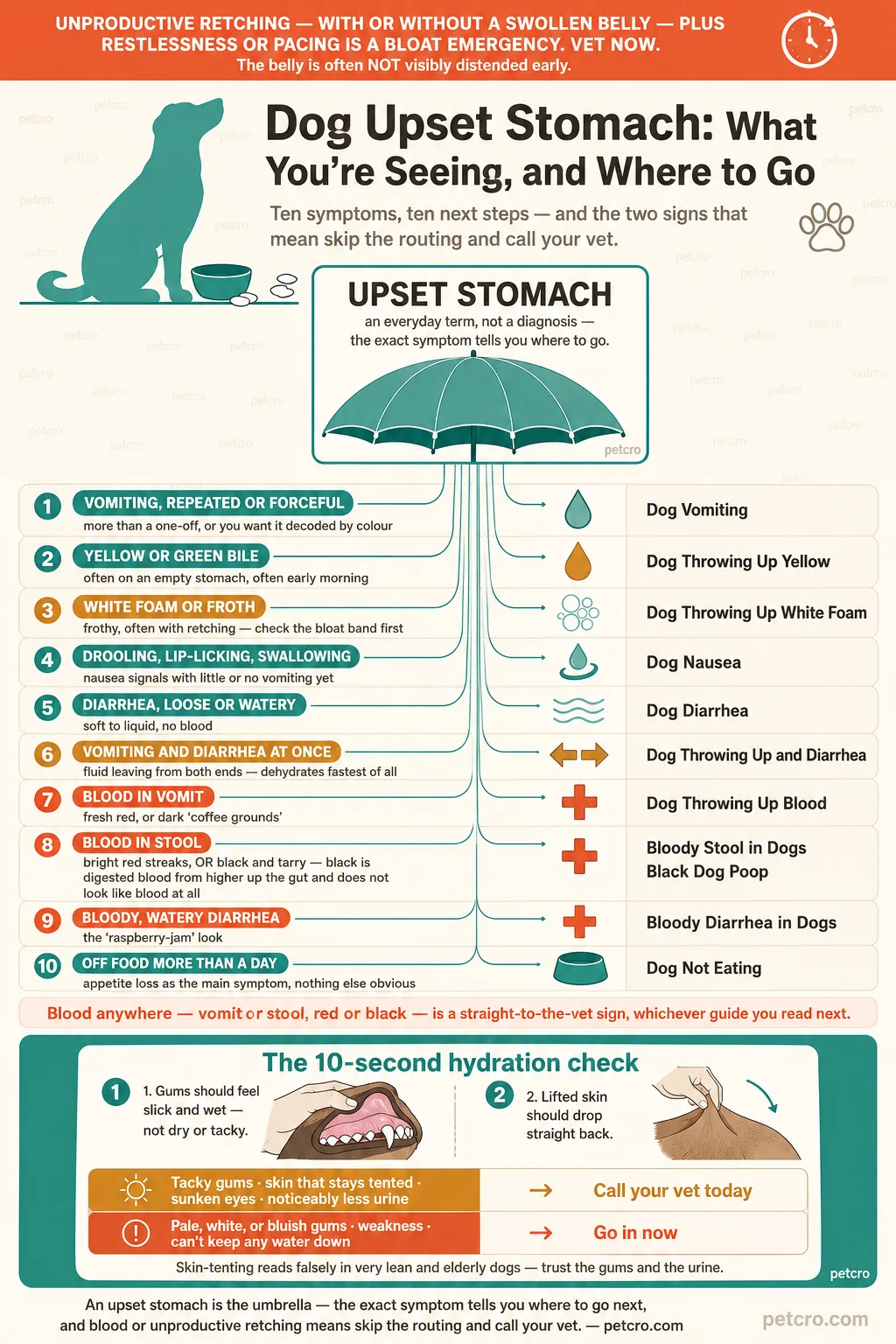
How to check for dehydration. This is what most often turns a mild upset into a genuinely sick dog, so check rather than guess. Lift your dog's lip and touch the gums — they should feel slick and wet, not dry or tacky — then gently lift the skin between the shoulder blades, which should drop straight back. Tacky gums, skin that stays tented, sunken eyes, or less urine alongside ongoing vomiting or diarrhea mean call your vet the same day; pale, white, or bluish gums or weakness mean go in now. Skin-tenting reads falsely in very lean and elderly dogs, whose skin tents even when hydration is fine, so gum feel and urine output matter more in them.
Dog upset stomach home remedies: what to do (and what to skip)
If — and only if — your dog has cleared the red-flag check above (one or two episodes, bright, alert, no blood, no swollen belly, still themselves), a gentle stomach reset is reasonable:
- Rest the stomach for a few hours. Pick up food briefly so the gut can settle — but keep it short. Puppies and small breeds should not go long without food, because they can drop their blood sugar dangerously; ask your vet how long is safe for them rather than fasting them. Don't fast a diabetic dog at all, and don't guess at the insulin dose — a diabetic dog that's vomiting or off food needs your vet's advice the same day, because both a skipped meal and diabetic ketoacidosis are dangerous, and ketoacidosis looks a lot like an ordinary upset stomach.
- Offer small amounts of water. Don't let a nauseous dog gulp a full bowl — that often triggers another round of vomiting. Small, frequent sips are gentler. If the first drink comes straight back up, or your dog repeatedly can't keep water down, stop and call your vet — that's a dehydration risk, not a home case.
- Reintroduce food in small, bland meals. After a few hours with no more vomiting, offer a small bland meal — plain boiled skinless chicken and white rice. The feeding section below covers portions, add-ins, and what to avoid.
- Go back to normal food slowly. Once bland meals are staying down — usually after two to three days — mix their regular food back in over another day or two rather than switching in one meal.
- Skip human medicines unless your vet directs them. NSAID painkillers (ibuprofen, aspirin) and acetaminophen (Tylenol) are outright dangerous to dogs — NSAIDs can cause stomach ulcers and bleeding, and acetaminophen can cause fatal liver and red-blood-cell damage. The stomach remedies people reach for aren't safe self-prescriptions either: Pepto-Bismol and Kaopectate contain a salicylate (the same family as aspirin) and turn stool black, which hides exactly the digested blood your vet is watching for, and loperamide (Imodium) is risky in herding breeds carrying the MDR1 gene mutation and is the wrong drug when a toxin or an infection is driving the diarrhea. Give only what your vet specifically tells you to.
Home care is a short bridge for the mildest cases, not a substitute for a vet. If the vomiting or diarrhea repeats, blood appears, or your dog's energy or appetite drops, stop watching and call.
What to feed a dog with an upset stomach
Food is medicine here — the right meal calms an irritated gut, and the wrong one restarts it. The goal is bland, low-fat, and easy to digest for a few days, not forever.
A bland diet — plain boiled skinless chicken with white rice, low-fat and unseasoned, in small, frequent portions — is the standard reset. Skip butter, oil, salt, garlic, onion, and rich flavorings; fat and seasonings are exactly what a sore gut can't handle. Our bland diet for dogs with diarrhea has the exact ratios, portions, and safe add-ins, and our dog food for diarrhea guide covers gentler everyday options and over-the-counter sensitive-stomach formulas once your dog is on the mend.
The two add-ins owners ask about most are plain 100% canned pumpkin (not pie filling) and a dog-specific probiotic; the bland-diet guide has amounts by dog size. Check with your vet first if your dog is on medication or has a chronic condition, and treat either as support for a mild case, not a reason to delay a call.
Feed bland food for two to three days, then taper back to their normal diet. If your dog needs a bland diet often — or can't seem to hold a normal food down without loose stool — that's a pattern to raise with your vet rather than a permanent home fix, since chronic upset can signal food intolerance or an underlying condition. A weight-and-portion baseline from our feeding calculator helps you get portions right once the gut has settled.
When the symptoms point somewhere specific
An upset stomach is the umbrella; the exact symptom often tells you where to look next. Match what you're seeing, and follow the dedicated guide — each one covers the causes, colors, and red flags in depth:
- Vomiting that's repeated or forceful, or that you want decoded by color → dog vomiting.
- Yellow or green bile, often on an empty stomach → dog throwing up yellow (bile).
- White foam or froth, often with retching → dog throwing up white foam.
- Drooling, lip-licking, and repeated swallowing, with little or no vomiting yet → dog nausea.
- Diarrhea, loose or watery → dog diarrhea.
- **Vomiting and diarrhea at once** — fluid draining from both ends → dog throwing up and diarrhea.
- Blood in vomit — fresh red or "coffee grounds" → dog throwing up blood.
- Blood in stool — bright red streaks, or black and tarry (melena, which is digested blood from higher up the gut and doesn't look like blood at all) → bloody stool in dogs and black dog poop.
- Bloody, watery diarrhea — the "raspberry-jam" look → bloody diarrhea in dogs.
- Not eating for more than a day, or off food with no other clear symptom → dog not eating.
Blood anywhere — in vomit or stool, red or black — is a straight-to-the-vet sign, whichever guide you read next.
If you need to describe loose stool accurately to your vet, our stool-health guide helps you pin down color and consistency — details that genuinely speed up a diagnosis.
How long should a dog's upset stomach last?
A mild, food-related upset stomach usually improves within 24 to 48 hours with rest and a bland diet, and resolves fully within a few days. That's the timeline to expect in an otherwise-healthy adult dog who stays bright and keeps drinking.
Escalate before the clock runs out if things move the wrong way. Vomiting or diarrhea that isn't clearly improving by about 48 hours, keeps recurring, or gets worse rather than better needs a vet — and if your dog can't keep water down, turns lethargic, or you see blood at any point, don't wait on the timeline at all. For puppies, small breeds, seniors, and diabetic, pregnant, or chronically ill dogs, even a few hours of repeated vomiting or diarrhea is a reason to call the same day.
An upset stomach that keeps coming back every few days or weeks is a different problem from a one-off — a recurring pattern deserves a proper workup for food intolerance, chronic GI disease, or an organ issue, even when each episode looks mild.
Preventing the next upset stomach
You can't prevent every off day, but a few habits stack the odds in your dog's favor and cut down repeat episodes:
- Change food gradually. Transition to any new food over 7–10 days (up to 14 for a sensitive stomach), mixing increasing amounts of the new in with the old.
- Keep the garbage and table scraps out of reach. Dietary indiscretion is the top cause; a secured bin and a "no rich scraps" rule prevent most upsets.
- Slow down fast eaters with a slow-feeder bowl or a puzzle feeder. Gulped meals are linked to gas, regurgitation, and — in large, deep-chested breeds — a higher risk of bloat, though no bowl is proven to prevent it.
- Stay current on parasite prevention and vaccines, especially for puppies — routine deworming and the parvo series prevent some of the most dangerous causes.
- Store food properly and check dates, since rancid or spoiled kibble is a quiet culprit.
- Keep known toxins secured — plenty of everyday human foods and houseplants are toxic to dogs, and our toxic foods and plants reference covers the common ones. Human medications belong behind a closed door too, even though they're outside that reference.
This guide is general guidance, not veterinary advice. For your specific dog's nutrition, health, or behavior needs, consult your veterinarian.
Frequently asked questions
What can I give my dog for an upset stomach at home?
For a mild upset in a bright, alert dog, rest the stomach for a few hours, offer small sips of water, then a small bland meal of plain boiled skinless chicken and white rice for a couple of days. Skip fat, salt, and seasonings. Don't give human medicines — not painkillers like ibuprofen or Tylenol, and not stomach remedies like Pepto-Bismol or Imodium — unless your vet tells you to. Call your vet if it doesn't settle in a day or two.
How long does a dog upset stomach last?
A mild, food-related upset stomach usually improves within 24 to 48 hours and clears within a few days with rest and a bland diet. If vomiting or diarrhea lasts beyond about 48 hours, keeps recurring, or comes with blood, lethargy, or an inability to keep water down, see your vet. Puppies, small breeds, and seniors need a call much sooner.
What are the signs of an upset stomach in a dog?
Common signs include vomiting, diarrhea, loud gut gurgling, drooling, lip-licking, repeated swallowing, eating grass, reduced appetite, and lower energy. A dog with one or two of these who's still bright and drinking usually has a minor upset. Blood, a swollen belly, relentless vomiting, or real lethargy are red flags that mean a vet, not home care.
Why is my dog's stomach making loud noises and he won't eat?
Rule out the emergencies first: if the noises come with unproductive retching, restlessness, a swollen or hard belly, repeated vomiting, diarrhea, or a dog who stays flat and off food beyond a day, call your vet or an ER now. Otherwise, loud gut sounds (borborygmi) plus one skipped meal in a bright, alert dog is usually just gas and a mildly irritated gut — offer water and a small bland meal once any nausea eases. Our dog not eating guide covers appetite loss in depth.
Should I make my dog throw up if their stomach is upset?
No — never make a dog vomit unless a vet or poison-control expert tells you to. Many swallowed toxins and objects do more damage coming back up than they did going down, and inducing vomiting is dangerous if your dog is already lethargic. If you suspect a poison or a swallowed item, call your vet or ASPCA Animal Poison Control at (888) 426-4435 (a consultation fee may apply) for direction first.
Can stress cause an upset stomach in dogs?
Yes. A move, travel, boarding, a new pet or person, loud events, or a change in routine can genuinely upset a dog's gut and cause vomiting or diarrhea. Stress-related upsets usually ease as the dog settles and respond to the same bland-diet care. If signs are severe, bloody, or last more than a day or two, treat it as more than stress and see your vet.
TL;DR — the dog upset stomach cheat sheet
- Most upset stomachs come from something the dog ate and settle in 24–48 hours with rest and a bland diet of plain chicken and rice.
- Treat unproductive retching — with or without a swollen belly — as a possible bloat emergency, and never fast a puppy, a small breed, or a diabetic dog.
- Offer small, frequent sips of water — not a full bowl — so a nauseous dog doesn't gulp and vomit again.
- Check hydration at the gums: slick and wet is fine. Dry or tacky gums, skin that stays tented, or sunken eyes mean call the same day; pale or bluish gums or weakness mean go in now.
- Blood in vomit or stool — fresh red, "coffee grounds", or black and tarry — plus repeated vomiting, a suspected toxin, or a flat, off-food dog all mean a vet now, not home care.
- Match the exact symptom to its guide — vomiting, diarrhea, bile, blood, or appetite loss each have a dedicated deep-dive.
- Prevent repeats by changing food over 7–10 days, securing the garbage, and staying current on parasite prevention and vaccines.
Read the whole dog — energy, gums, belly, and how long it lasts tell you more than any single symptom.
Sources & further reading
- AKC — Best Foods to Soothe Your Dog's Upset Stomach — bland-diet foods and home-care basics.
- petMD — Upset Stomach in Dogs: Signs and What To Do — signs, home care, and when to see a vet.
- Merck Veterinary Manual — Disorders of the Stomach and Intestines in Dogs — the GI conditions behind vomiting and diarrhea.
- petMD — Vomiting in Dogs — red flags, dehydration risk, and the limits of home care.
- ASPCA — Animal Poison Control — (888) 426-4435, if a toxin or a swallowed item is a possibility (a consultation fee may apply).
More from Petcro's GI cluster
- Dog Vomiting — causes, color clues, and when to worry.
- Dog Diarrhea — the loose-stool companion to this guide, decoded.
- Dog Nausea — drooling, lip-licking, and how to settle a queasy stomach.
- Bland Diet for Dogs With Diarrhea — exact chicken-and-rice ratios for a recovering stomach.
- Dog Not Eating — when appetite loss is the main symptom.
- Stool-Health Guide — describe your dog's stool accurately for the vet.
Petcro is reader-supported. We may earn an affiliate commission when you click through links to products in this guide. Our editorial picks are independent of any commercial relationship with any pet-food brand.