Dog Throwing Up and Diarrhea: What It Means and When to Worry
Dog throwing up and diarrhea together dehydrates a dog fast. The causes, the dehydration signs to watch, safe home care, and the red flags that mean a vet now.

A dog throwing up and having diarrhea at once loses fluid from both ends, so it dehydrates faster — and that combination matters more than either symptom alone. A single episode in a bright, playful adult dog can be a passing upset, but blood, lethargy, a swollen belly, or an incompletely vaccinated puppy makes it an urgent vet visit.
TL;DR: Vomiting plus diarrhea drains fluid from both ends at once, so it dehydrates a dog fast — treat it more seriously than one symptom alone. In a bright, alert adult dog with one or two mild episodes and no blood, you can rest the stomach, offer small frequent sips of water, and feed a bland diet. Blood in either, low energy, a swollen belly, a dog who can't keep water down, or any puppy that hasn't finished its vaccine series means a vet now — bloody vomiting and diarrhea in a puppy is parvo until proven otherwise.
Why vomiting and diarrhea together is more serious
Either symptom on its own is often a minor, self-limiting upset. Together, they're a different situation — and the reason is fluid. Vomiting empties fluid from the top of the gut while diarrhea drains it from the bottom, so your dog loses water and electrolytes from both directions at once. Dehydration that might take a couple of days to build with diarrhea alone can set in within hours when vomiting is added.
That speed is why the small, the young, and the old are most at risk. Puppies, small breeds, seniors, and dogs with an existing illness have smaller fluid reserves and dehydrate dangerously fast — what looks like a "watch and see" in a healthy adult is a same-day call in them. The combination is also a classic signature of some genuinely serious conditions, from parvovirus to pancreatitis, which is why it earns a lower worry threshold than vomiting or diarrhea by itself. Our dog vomiting and dog diarrhea guides cover each symptom in depth, and our dog upset stomach guide is the wider umbrella; this one is about what it means when they hit together.
What causes a dog to vomit and have diarrhea at the same time?
When both ends go at once, the cause is usually something irritating or infecting the whole gut — but a few body-wide problems produce the same picture. The common culprits:
- Dietary indiscretion — garbage, rich scraps, spoiled food, or a sudden diet change. The most common cause, and usually the mildest.
- Gut infections (gastroenteritis) — viral or bacterial inflammation of the stomach and intestines, which is why both ends go at once.
- Parvovirus — in unvaccinated or partly vaccinated dogs, overwhelmingly puppies but also unvaccinated adults and newly adopted rescues, causing vomiting and often bloody diarrhea. A life-threatening emergency (see below).
- Intestinal parasites — roundworms, hookworms, giardia, and others, especially in puppies and newly adopted dogs.
- Acute hemorrhagic diarrhea syndrome (AHDS) — a sudden onset of vomiting and bloody, "raspberry-jam" diarrhea that can bring on shock; a go-now emergency.
- Pancreatitis — inflammation of the pancreas, classically after a fatty meal, causing vomiting, diarrhea, belly pain, and a hunched posture.
- Toxins — many poisons trigger vomiting and diarrhea together; check anything suspicious against our toxic foods and plants reference.
- A foreign body or obstruction — a swallowed toy, bone, sock, or string. Vomiting with straining or scant, foul stool is a surgical emergency.
- Systemic disease — kidney, liver, or hormonal disorders can present with both symptoms.
Because the list runs from a stolen sandwich to parvo, the surrounding signs — energy, blood, belly, gum color, and your dog's age and vaccine status — decide how fast you act. When both symptoms appear together with anything other than a bright, stable dog, let your vet weigh in rather than waiting it out.
Dog throwing up and diarrhea: when is it an emergency?
This is the part that decides your next hour. Veterinary sources including the AKC and petMD treat the following as reasons to stop watching and get help.
| If you see this | Do this |
|---|---|
| 🔴 Blood in vomit or stool (fresh red, "coffee grounds," black and tarry, or raspberry-jam); an unvaccinated or partially vaccinated puppy with vomiting and diarrhea; can't keep water down or repeated vomiting that won't stop; weakness, collapse, or pale/white gums; unproductive retching that brings nothing up, with or without a swollen belly, especially with restlessness or pacing (possible bloat/GDV — an emergency that needs a vet in minutes, and the belly is often not obviously distended early); a suspected toxin or swallowed object | Emergency — vet or ER now |
| 🟠 Both symptoms lasting more than 24 hours, or worsening; low energy, poor appetite, or signs of dehydration; a puppy, small breed, senior, diabetic, pregnant, or chronically ill dog | Call your vet today — sooner for the small, young, old, or unwell |
| 🟢 One or two mild episodes in a bright, alert, drinking adult dog with no blood and no other red-flag sign | The only case that fits home care — rest the stomach and watch closely (below), and escalate the moment anything changes |
Because two-way fluid loss dehydrates so fast, the green "watch at home" box is narrower here than for vomiting or diarrhea alone. Plenty of vets treat vomiting and diarrhea together as an automatic same-day call, and our own dog diarrhea guide takes that stricter line — so the watch-at-home window here fits a genuinely bright, still-drinking adult after one or two mild episodes, and nothing beyond that. Anything more, anything in a puppy or a small, old, or unwell dog, and you're in the amber row. When you're unsure, err toward calling: a quick triage call to your vet or an ER can save you a wasted trip — or tell you to leave now.
Watch for dehydration
Dehydration is the main danger when both symptoms run together, so knowing the early signs tells you when a home-care case has become a vet case. Check your dog periodically:
- Gums — healthy gums are moist and slick; dry, tacky, or sticky gums suggest dehydration.
- Skin tent — gently lift the skin over the shoulders; it should snap back quickly. If it's slow to fall, that points to fluid loss.
- Energy and eyes — increasing lethargy, weakness, or sunken-looking eyes are warning signs.
- Gum color and refill — pale, white, or bluish gums, or a slow return of color after you press a fingertip on them, mean go now.
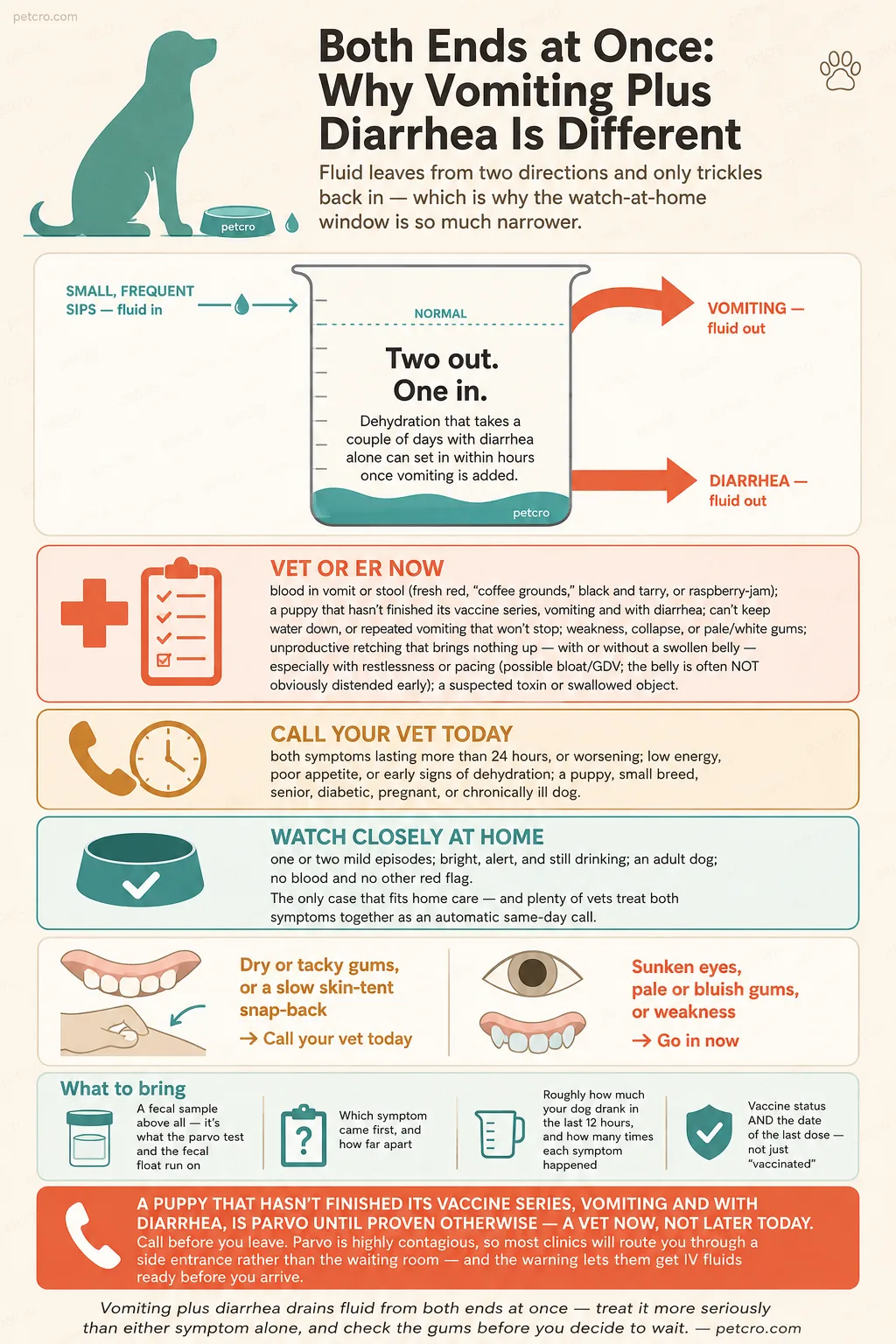
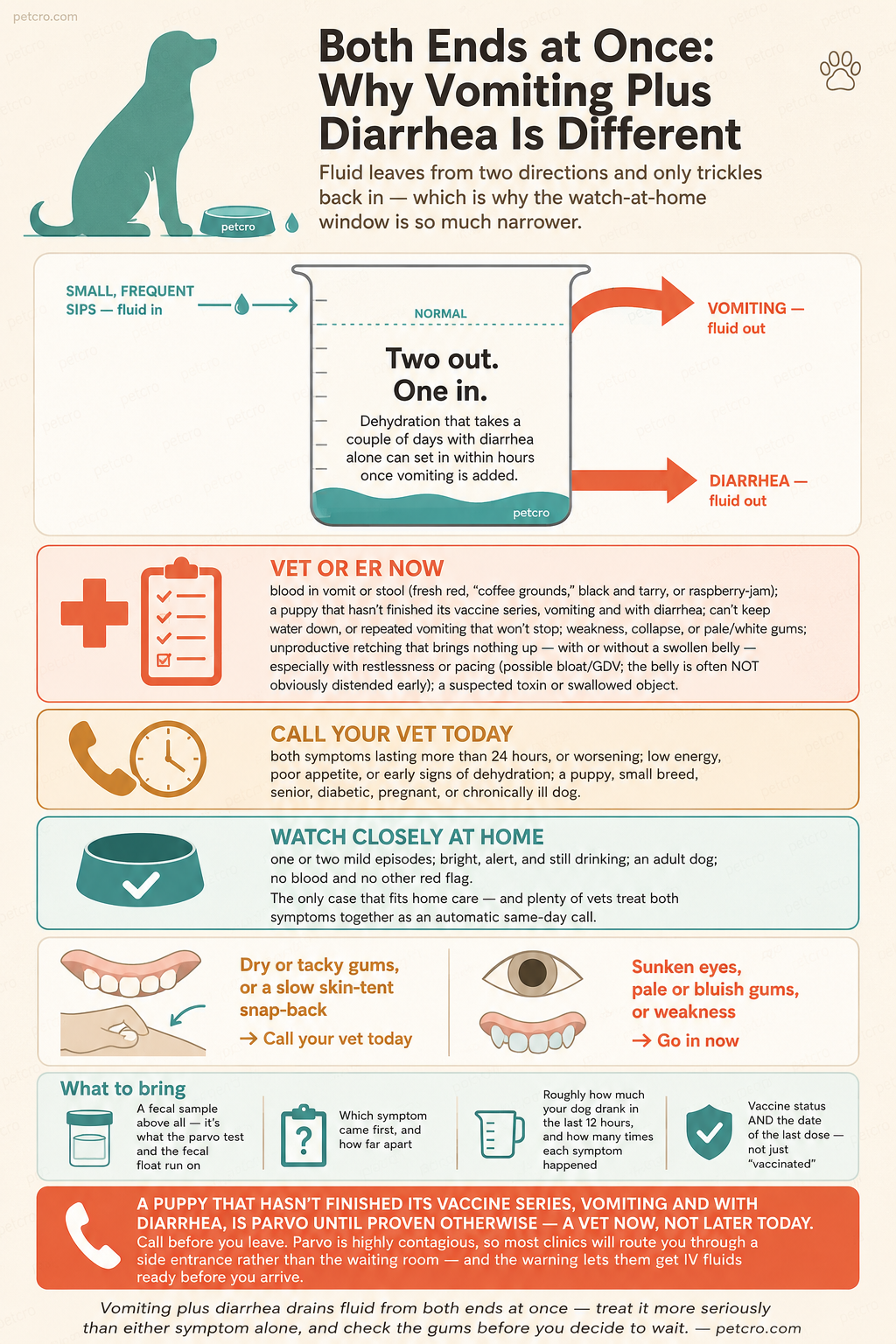
These checks help you decide when to act — they are not a way to treat dehydration at home. Dry, tacky gums or a slow skin-tent snap-back mean call your vet today; pale, white, or bluish gums, sunken eyes, skin that stays tented, weakness, or a dog who can't keep water down mean go in now. A visibly dehydrated or weak dog needs veterinary fluids, not more water from a bowl — offer small, frequent sips only while a mild case still looks bright and stable.
What to do at home for a mild case
Only if your dog has cleared the red-flag check — one or two mild episodes, bright and alert, no blood, no swollen belly, still drinking — is a gentle home reset reasonable. Watch closely, because both symptoms together can turn quickly.
The basic sequence is the one in our dog vomiting guide: rest the stomach for a few hours, offer small and frequent sips instead of a full bowl, then reintroduce plain boiled skinless chicken and white rice in small meals. Our bland diet for dogs with diarrhea has the exact ratios and portions, and dog food for diarrhea covers gentler everyday options once things firm up. Never fast a puppy, a small breed, or a diabetic dog, and don't give human medicines on your own — not painkillers like ibuprofen, aspirin, and acetaminophen (Tylenol), and not anti-diarrheals like Pepto-Bismol or Imodium.
Three things change when both ends are going:
- The fasting window is shorter. Fluid is leaving in two directions, so a long rest costs more than it buys. A few hours is the ceiling — and for puppies, small breeds, and diabetic dogs it isn't an option at all, because they can drop their blood sugar. Ask your vet what's safe for them instead.
- Water is the test, not just the treatment. If the first small drink comes straight back up, home care is over. A dog who can't hold water down while losing it to diarrhea is heading for a dehydration emergency and needs veterinary fluids, not another bowl.
- "The vomiting stopped" is not the all-clear. With one symptom you can usually call it once the vomiting settles. Here the diarrhea can keep draining fluid on its own, so judge recovery on the whole dog — energy, gums, and stool — rather than on the vomiting alone.
Home care is a short bridge for the mildest cases only. If either symptom repeats, blood appears, energy drops, or the belly swells, stop watching and call.
Parvo: the unvaccinated-puppy emergency
One scenario deserves to be pulled out on its own, because it's both common and deadly: an unvaccinated or partly vaccinated puppy with vomiting and diarrhea, especially bloody diarrhea. This is parvovirus until proven otherwise — a highly contagious, rapidly dehydrating infection that kills puppies fast without prompt treatment.
Don't wait to see if it passes. A young puppy that's vomiting and has diarrhea — with or without visible blood — needs a vet now, not later today: call the nearest open clinic immediately, and go straight to an emergency clinic if your own vet can't see you within the hour or it's already after hours. Parvo does respond to treatment, but the response is best when it starts in time. Bloody, foul-smelling diarrhea plus vomiting and lethargy in a puppy is a drive-now situation.
Call before you leave. Parvo is highly contagious, and most clinics will route a possibly-parvo puppy through a side entrance rather than seat you in the waiting room — the warning also lets them get IV fluids ready before you arrive. Puppies are the overwhelming majority of cases, but an unvaccinated adult with the same picture — a newly adopted rescue, say — deserves the same urgency. Our puppy throwing up and puppy diarrhea guides cover both ends of the puppy-specific picture, and any bloody diarrhea belongs in the bloody diarrhea in dogs emergency bracket. If you're seeing blood in the vomit specifically, our dog throwing up blood guide walks through what's urgent.
What the vet will do — and what to bring
Two symptoms give a vet more to work with than one, so a few details from home genuinely change the workup. Worth bringing:
- A fecal sample above all. When both ends are going, stool is the higher-yield sample — it's what the parvo test and the fecal float run on. Photograph the vomit too, but if you can only manage one thing, bring stool. Our stool-health guide helps you describe it accurately.
- Which came first, and how far apart. Vomiting that started well before the diarrhea points somewhere different from both starting together. It's one of the more useful things you can tell a vet, and almost nobody thinks to note it.
- Fluid in versus fluid out. Roughly how much your dog drank in the last twelve hours, and how many times each symptom happened. That arithmetic is what a dehydration estimate is built on.
- Vaccine status and the date of the last dose — not just "vaccinated." In a puppy, that date is what decides how likely parvo is.
Expect a physical exam, then bloodwork (dehydration, organ disease, pancreatitis), a fecal test, a parvo test for at-risk puppies, and imaging — X-ray or ultrasound — if an obstruction is possible. The vet will also estimate how dehydrated your dog is, which is the decision that really only comes up in the combined case: milder losses can often be topped up with fluids under the skin, while ongoing losses from both ends more often call for an IV drip. Once the cause is treated, a weight-and-portion baseline from our feeding calculator helps you rebuild normal meals.
This guide is general guidance, not veterinary advice. For your specific dog's nutrition, health, or behavior needs, consult your veterinarian.
Frequently asked questions
When should I worry about my dog vomiting and having diarrhea?
Worry — and call your vet or an ER — if you see blood in the vomit or stool, low energy, a swollen belly, an inability to keep water down, or a puppy that hasn't finished its vaccine series. Because vomiting plus diarrhea dehydrates a dog fast, also call the same day if it lasts more than 24 hours or your dog is a puppy, small breed, senior, or unwell.
Can I treat my dog's vomiting and diarrhea at home?
Only for the mildest cases — one or two episodes in a bright, alert adult dog with no blood and no other red flags. Rest the stomach briefly, offer small frequent sips of water, then a bland diet of chicken and rice, and watch closely. Don't fast puppies or small dogs, don't give human medicines, and see a vet if anything worsens or doesn't settle within a day.
Why is my dog throwing up and having diarrhea but acting fine?
Often it's a passing upset from dietary indiscretion or a gut irritation, and a dog who's still bright, alert, and drinking may recover with rest and a bland diet. But "acting fine" can change fast when fluid is draining from both ends, so keep watching for lethargy, blood, or dehydration. If either symptom repeats or lasts beyond a day, call your vet even if your dog seems okay.
How long is too long for a dog to have vomiting and diarrhea?
Both symptoms together lasting more than about 24 hours warrant a vet call, sooner than you'd wait for one symptom alone, because of the faster dehydration. If your dog can't keep water down, turns lethargic, or you see blood at any point, don't wait on the clock at all. Puppies, small breeds, and seniors need a same-day call after just a few hours.
What can I feed a dog with vomiting and diarrhea?
Once vomiting has stopped for a few hours, offer a small bland meal of plain boiled skinless chicken and white rice, roughly one part chicken to two parts rice, in small frequent portions. Skip fat, salt, and seasonings. Feed bland for two to three days, then taper back to normal food. If your dog can't hold down even a small bland meal, stop and call your vet.
Is vomiting and diarrhea a sign of parvo in puppies?
It can be. Vomiting and diarrhea — especially bloody, foul-smelling diarrhea with lethargy — in an unvaccinated or partly vaccinated puppy is parvovirus until a vet proves otherwise. Parvo dehydrates puppies dangerously fast and needs immediate treatment. Don't wait it out: a puppy with both symptoms needs a vet now — call the nearest open clinic straight away, or an emergency clinic after hours, and tell them it might be parvo before you arrive.
TL;DR — the dog vomiting and diarrhea cheat sheet
- Vomiting plus diarrhea drains fluid from both ends, so it dehydrates a dog fast — treat it more seriously than either symptom alone.
- Blood in vomit or stool, low energy, a swollen belly, or an inability to keep water down all mean a vet now — and any puppy that hasn't finished its vaccine series is an emergency with both symptoms.
- Watch for dehydration: dry or tacky gums or a slow skin-tent snap-back mean call your vet today; sunken eyes, pale or bluish gums, or weakness mean go in now.
- Home care fits only one or two mild episodes in a bright adult dog: rest the stomach, small sips of water, then a bland diet — and don't fast puppies or small breeds.
- Both symptoms lasting more than 24 hours, or in a puppy, small, senior, or unwell dog, is a same-day vet call.
- Don't give human medicines — painkillers like ibuprofen, aspirin, or acetaminophen (Tylenol), or anti-diarrheals like Pepto-Bismol and Imodium — unless your vet directs it.
Read the whole dog — energy, gums, blood, and age tell you far more than the vomiting and diarrhea alone.
Sources & further reading
- AKC — Dog Diarrhea: Signs, Symptoms, and Treatments — causes, red flags, and when diarrhea with vomiting needs a vet.
- petMD — Gastroenteritis in Dogs — the vomiting-and-diarrhea picture, dehydration risk, and home-care limits.
- Merck Veterinary Manual — Disorders of the Stomach and Intestines in Dogs — the GI conditions behind vomiting and diarrhea together.
- Cornell University College of Veterinary Medicine — Canine Parvovirus — why parvo is an emergency in unvaccinated puppies.
- ASPCA — Animal Poison Control — (888) 426-4435, if a toxin or a swallowed item is a possibility (a consultation fee may apply).
If your dog is retching without bringing anything up — with or without a swollen belly, and especially if they're restless or pacing — don't wait. Bloat (GDV) is an emergency that needs a vet in minutes, not hours.
More from Petcro's GI cluster
- Dog Vomiting — causes, color clues, and when to worry.
- Dog Diarrhea — the loose-stool half of this picture, decoded.
- Bloody Diarrhea in Dogs — the emergency bracket for blood in the stool.
- Puppy Throwing Up — the puppy-specific picture, including parvo.
- Stool-Health Guide — describe your dog's diarrhea accurately for the vet.
Petcro is reader-supported. We may earn an affiliate commission when you click through links to products in this guide. Our editorial picks are independent of any commercial relationship with any pet-food brand.