Rottweiler Weight Chart by Age (kg & lb)
Rottweiler growth chart: males finish at 95 to 135 lb (43 to 61 kg), females at 80 to 100 lb (36 to 45 kg). See weight by age and when they stop growing.
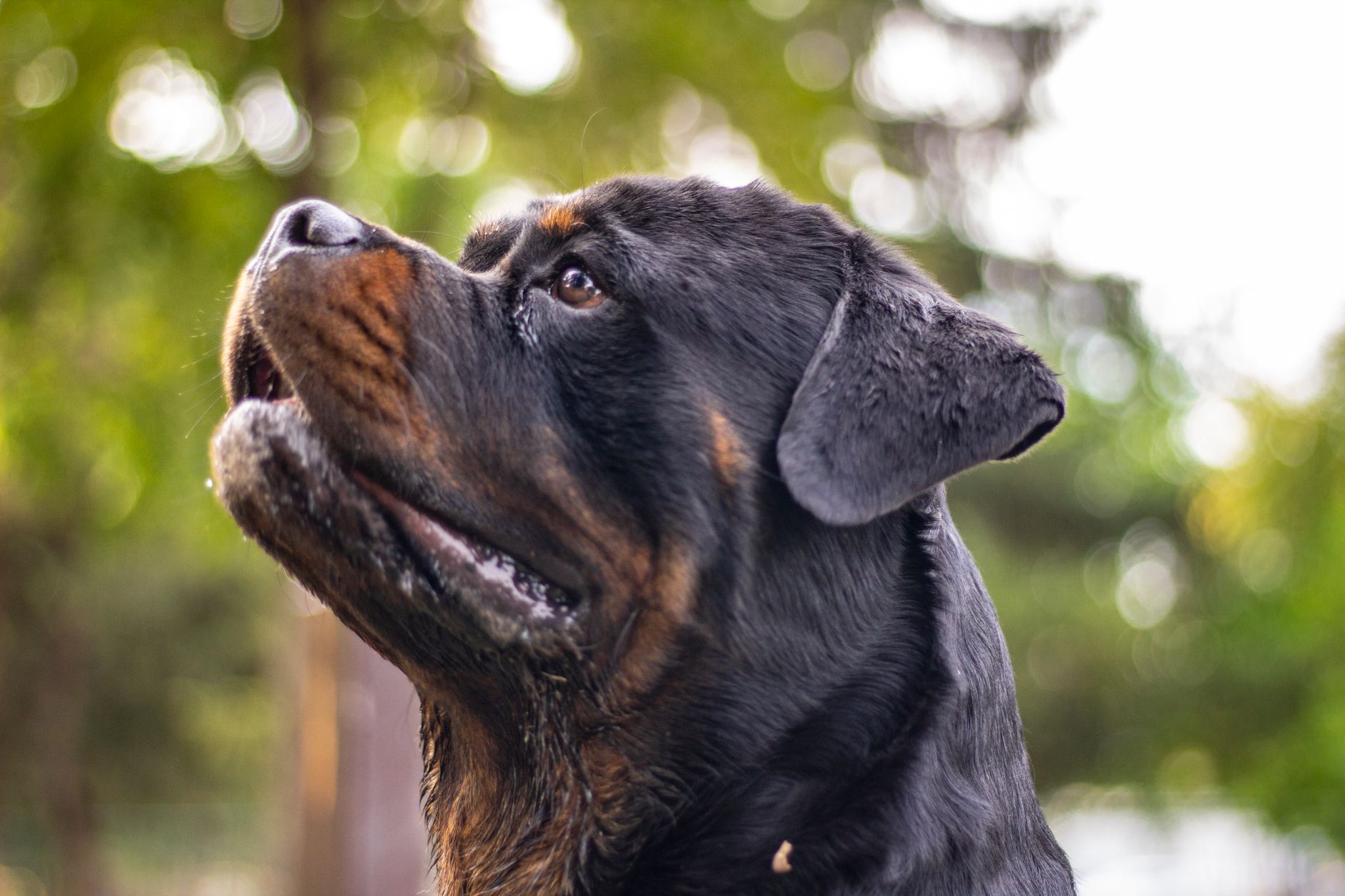
A Rottweiler growth chart tracks weight by age, from roughly 10 to 24 pounds at eight weeks to a finished 95 to 135 pounds for males and 80 to 100 for females. The chart is the easy part. The harder question, and the one that shapes this breed's joints, is when the growing actually stops.
TL;DR: Male Rottweilers finish at 95 to 135 lb, females at 80 to 100 lb, per the AKC. Your puppy is only about 58% of adult weight at six months and 88% at a year, and does not truly finish until around two. What makes this breed different is not the curve, it is what closes it: sex hormones shut the growth plates, and UC Davis found Rottweiler males neutered at 6 to 11 months had 22% joint disorders versus 8% in intact males. On this breed, when you grow matters as much as how fast.

Rottweiler growth chart (weight by age, male and female)
This Rottweiler weight chart splits male and female, and for this breed that matters more than most. Every row carries both pounds and kilograms, so it doubles as a Rottweiler weight chart in kg. Run the AKC adult ranges against each other and females average about 78% of male weight, so a single combined column will make a healthy female look underfed and let a heavy male pass unnoticed. Read your puppy's own column.
| Age | % of adult weight | Male | Female |
|---|---|---|---|
| 8 weeks | ~12–18%* | 11–24 lb (5–11 kg) | 10–18 lb (4–8 kg) |
| 10 weeks | ~17–23%* | 16–31 lb (7–14 kg) | 14–23 lb (6–10 kg) |
| 12 weeks (3 months) | ~22–28%* | 21–38 lb (9–17 kg) | 18–28 lb (8–13 kg) |
| 4 months | ~37% | 35–50 lb (16–23 kg) | 29–37 lb (13–17 kg) |
| 5 months | ~48% | 46–65 lb (21–29 kg) | 38–48 lb (17–22 kg) |
| 6 months | ~58% | 55–78 lb (25–36 kg) | 46–58 lb (21–26 kg) |
| 7 months | ~65% | 62–88 lb (28–40 kg) | 52–65 lb (24–30 kg) |
| 8 months | ~73% | 69–98 lb (31–45 kg) | 58–73 lb (26–33 kg) |
| 9 months | ~78% | 74–105 lb (33–47 kg) | 62–78 lb (28–35 kg) |
| 10 months | ~81% | 77–109 lb (35–50 kg) | 65–81 lb (29–37 kg) |
| 12 months | ~88% | 84–119 lb (38–54 kg) | 70–88 lb (32–40 kg) |
| 18 months | ~96% | 91–130 lb (41–59 kg) | 77–96 lb (35–44 kg) |
| 2 to 3 years | Adult, still filling out | 95–135 lb (43–61 kg) | 80–100 lb (36–45 kg) |
*The three starred rows are the weakest lines on any Rottweiler growth chart, and you should treat them that way. Weight between eight and twelve weeks swings hard on litter size, birth order and line, so it sorts a puppy into a size band rather than predicting an adult. That is why those rows are wide. Plenty of published charts quote confident single figures here, and you should be skeptical of them.
These ranges apply a giant-breed growth curve to the adult weights AKC publishes for the breed, which also sets height at 24 to 27 inches for males and 22 to 25 for females. Real puppies land about 15% either side of a population chart and stay perfectly healthy. To run the numbers against your own dog's current weight, our puppy weight predictor does the interpolation.
How to read the chart: percentages beat pounds
Shop the picks from this guide


Sponsored. As an Amazon Associate I earn from qualifying purchases, at no extra cost to you.
Rottweiler puppy weight by age is only half of what this table tells you. The pounds column is the part everyone looks at, and the part that matters least. Two Rottweiler puppies of the same age can differ by 20 pounds and both be correct, because one is a compact working-line female and the other is a heavy-boned show-line male headed for 130.
The percentage column is the one that tells you something, because it answers a better question: how far along is this dog? A six-month-old at 58% of adult weight is on schedule whether that means 55 pounds or 78.
Three ways to use it:
- Estimate the adult. Divide current weight by the percentage for that age. A 60 lb six-month-old lands around 103 lb adult (60 ÷ 0.58).
- Watch the trend, not the point. Weigh every two weeks and read the direction. One low reading means nothing. Four flat readings in a row means something.
- Let body condition overrule the table. You should feel ribs under a thin layer, see a waist from above, and see a tuck from the side. A puppy who reads light on the chart but scores a healthy 4 or 5 out of 9 on body condition is fine.
When do Rottweilers stop growing?
There are three finish lines, and mixing them up is why the answers online disagree so much.
- Height: about 12 to 18 months. Most of the vertical growth is done by the first birthday, with small gains after.
- Weight: about 18 to 24 months. At 12 months a Rottweiler is roughly 88% of adult weight, so a year-old dog is still carrying roughly 11 to 16 pounds it has not put on yet.
- Body and muscle: two to three years. Chest depth, shoulder spread and the broad head this breed is known for keep developing well past the point the scale settles. Males finish later than females.
So the short answer is around two years for size, and closer to three for the finished dog. Rottweilers are slower to mature than the large breeds they get grouped with. Our German Shepherd growth chart reaches full adult weight at 18 months; a Rottweiler is only about 96% of the way there at the same age. A Standard Goldendoodle is finished at about 17 months, which is the difference between a true large breed and one that only reaches the edge of it.
That timeline also decides your food: stay on a large- or giant-breed puppy formula until growth is genuinely done, then transition. Our guide on when to switch puppy to adult food covers the 7 to 10 day changeover.
Growth plates: the part of the chart nobody prints
Here is what a weight table cannot show you, and it matters more in this breed than in almost any other.
Growth plates are the soft zones at the ends of the long bones where lengthening happens. They close when sex hormones tell them to. Remove those hormones early and the plates stay open longer, so the leg bones keep growing. As the AKC explains, that leaves the dog slightly taller than it was built to be and, more importantly, can leave the joints fractionally out of alignment.
A ten-year study of 35 breeds from UC Davis (Hart et al., 2020) measured what that does breed by breed. The Rottweiler numbers are stark:
| Rottweiler | Joint disorders |
|---|---|
| Intact males | 8% |
| Males neutered before 6 months | 10% |
| Males neutered at 6 to 11 months | 22% |
| Intact females | 16% |
| Females spayed before 6 months | 43% |
Read the male rows carefully, because they do not say what people assume. The risk does not climb steadily the earlier you go. It spikes in the 6-to-11-month window, which is exactly when most owners are booking the appointment, and sits close to intact levels for males done before six months. Females are the opposite: the under-6-month group carries the highest rate in the breed.
The study's own suggested guideline for the breed: "for males, given the risk of joint disorders for those neutered at 6-11 mo. or earlier, is neutering beyond a year of age. For females, given the increased risk of joint disorders with neutering at <6 mo., the suggested guideline is spaying beyond 6 months."
Two pieces of honesty this deserves, because most articles quoting these numbers skip both.
First, the same study found no significant increase in cancers at any neuter age in Rottweilers. An older and much-cited 2002 study did link early gonadectomy to bone sarcoma in this breed, and you will see that figure repeated a lot. The newer, larger dataset did not reproduce a cancer signal here. The joint-disorder finding is the one that held up.
Second, this is an association from observational data, not a prescription, and delaying surgery has real costs of its own: an intact dog needs genuine management, secure containment, and no accidental litters. This is a conversation to have with your vet using your dog's own circumstances. What the evidence does say clearly is that "six months, same as every dog" is not a neutral default for a Rottweiler.
Growing too fast is the part you control
Hip dysplasia is the other joint issue attached to this breed. Cornell's Riney Canine Health Center names Rottweilers among the breeds where it is common, and describes it as "a genetic condition that can be modified by environmental influences, such as nutrition and growth rate."
Genetics set the range. Growth rate decides where inside that range your dog lands, and growth rate is the lever in your hands.
- Feed a large- or giant-breed puppy formula. Controlled calcium and calorie density are the whole point. Never add a calcium supplement to a complete food.
- Feed to lean. Keeping a large-breed puppy slim is the single best-supported thing an owner can do for developing joints. Aim for body condition 4 to 5 out of 9.
- Skip the high-impact work while growing. No forced running, no repeated jumping, no stair marathons before the plates close, which on this breed is later than you think.
- Do not chase size. A 140 lb Rottweiler is not a better Rottweiler. Oversized dogs carry more load on joints that are already the breed's weak point.
For amounts, how much to feed a puppy covers the calorie math behind every breed chart, and puppy weight chart by breed size shows how the giant-breed curve differs from the large one.
Call your vet, rather than adjusting the bowl, if your puppy:
- Stops gaining across two consecutive weigh-ins
- Loses more than 5% of body weight in a week
- Limps for more than a few days, or in more than one leg
- Sits more than 20% off the chart with visible ribs or hip bones
This guide is general guidance, not veterinary advice. For your specific dog's nutrition, health, or behavior needs, consult your veterinarian.
Complete the setup


Sponsored. As an Amazon Associate I earn from qualifying purchases, at no extra cost to you.
Frequently asked questions
How big do Rottweilers get?
Adult males reach 95 to 135 lb and stand 24 to 27 inches at the withers. Females reach 80 to 100 lb and 22 to 25 inches. To estimate your own puppy, divide their current weight by the percentage of adult weight for their age in the chart above. A 60 lb six-month-old is at about 58%, so roughly 103 lb adult.
At what age is a Rottweiler fully grown?
Height finishes around 12 to 18 months and weight around 18 to 24 months, but chest, shoulders and head keep developing until two to three years old. A 12-month-old Rottweiler is typically 88% of final weight, so it is still roughly 11 to 16 pounds short and often looks lanky next to the adult it becomes.
How much should a 6-month-old Rottweiler weigh?
A healthy 6 month old Rottweiler weight is about 58% of adult, which works out to roughly 55 to 78 lb for males and 46 to 58 lb for females. That is a wide range because adult size varies widely in this breed. Steady progress along the curve matters more than matching a number.
Are male and female Rottweiler growth charts different?
Yes, and more than in most breeds. Working from the AKC adult ranges, females average about 78% of male weight. A combined chart will read a healthy female as underweight and let an overweight male go unnoticed, which is why the table above splits them.
Does neutering affect how big my Rottweiler gets?
It can affect proportions more than final weight. Sex hormones close the growth plates, so altering early keeps them open longer and the leg bones grow slightly longer. In Rottweilers specifically, UC Davis recorded 22% joint disorders in males neutered at 6 to 11 months against 8% in intact males, and 43% in females spayed before 6 months against 16% intact. Timing is a decision to make with your vet.
My Rottweiler puppy looks lanky and out of proportion. Is that normal?
Usually yes. Rottweilers build height and length before they fill out, so the stretch between about eight and eighteen months often looks all legs and no chest. The broad, blocky adult shape arrives in year two. Check body condition rather than the silhouette, and resist the urge to feed the frame full early.
TL;DR: the Rottweiler growth chart cheat sheet
- Adults finish at 95 to 135 lb (males) and 80 to 100 lb (females), per the AKC.
- Use the percentage column, not the pounds: about 58% of adult weight at six months, 88% at twelve.
- Rottweilers are not done at a year. Size settles around two, and the body keeps filling out to three.
- Females average about 78% of male weight, so never read a combined chart.
- Growth plates close on hormones: UC Davis found 22% joint disorders in males neutered at 6 to 11 months versus 8% intact, and 43% in females spayed under 6 months versus 16% intact.
- The same study found no significant cancer increase at any neuter age in this breed, contrary to a widely quoted older figure.
- Feed a large- or giant-breed puppy formula, keep the dog lean, and skip high-impact exercise until the plates close.
Grow this breed slowly and keep it lean, and you are protecting the exact joints the Rottweiler is known for losing. There is no version of this where bigger and faster produces a better adult dog.
Sources & further reading
- AKC, Rottweiler breed page and standard. Adult weight and height ranges that anchor every row of this chart.
- Hart et al. 2020, Assisting Decision-Making on Age of Neutering for 35 Breeds of Dogs (PubMed). The UC Davis ten-year study; source of the Rottweiler joint-disorder and cancer figures by neuter age.
- AKC, A Study Updates Spay-Neuter Timeline Guidance for Popular Dog Breeds. Plain-English explanation of how hormones govern growth-plate closure.
- Cornell Riney Canine Health Center, Canine Hip Dysplasia. Rottweilers as a commonly affected breed, and growth rate as a modifiable factor.
- Merck Veterinary Manual, Developmental Osteopathies in Dogs and Cats. Panosteitis and developmental orthopedic disease in rapidly growing large and giant breeds.
If your Rottweiler sits well off the chart, limps, or stops gaining, treat that as a reason to call your vet rather than a reason to change the food on your own.
More from Petcro's puppy-growth cluster
- German Shepherd Growth Chart: the same split-sex approach on a large rather than giant frame.
- Puppy Weight Predictor: run your puppy's current weight against the growth curve.
- Puppy Weight Chart by Breed Size: how the size bands differ, toy through giant.
- How Much to Feed a Puppy: the calorie math behind every breed chart.
- When to Switch Puppy to Adult Food: the 7 to 10 day transition by size class.
- Pitbull Growth Chart: three pit bull breeds, male and female, and why muscle supplements do not change adult size.
Petcro is reader-supported. We may earn an affiliate commission when you click through links to products in this guide. Our editorial picks are independent of any commercial relationship with any brand.