Great Pyrenees Feeding Chart by Age (Puppy to Adult)
Great Pyrenees feeding chart by age and weight: how much to feed at every stage, why the coat hides the answer, and the two-year growth window.
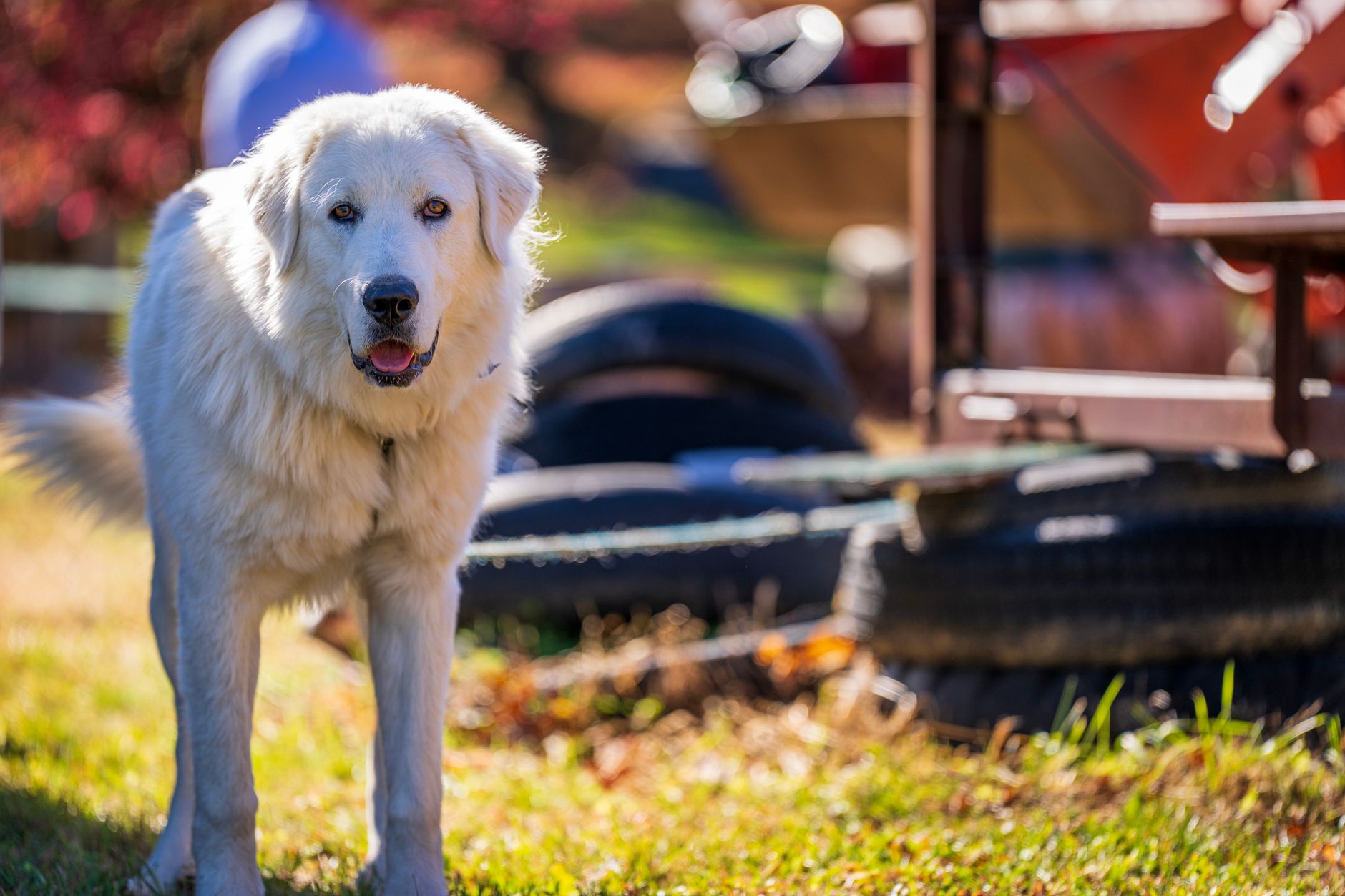
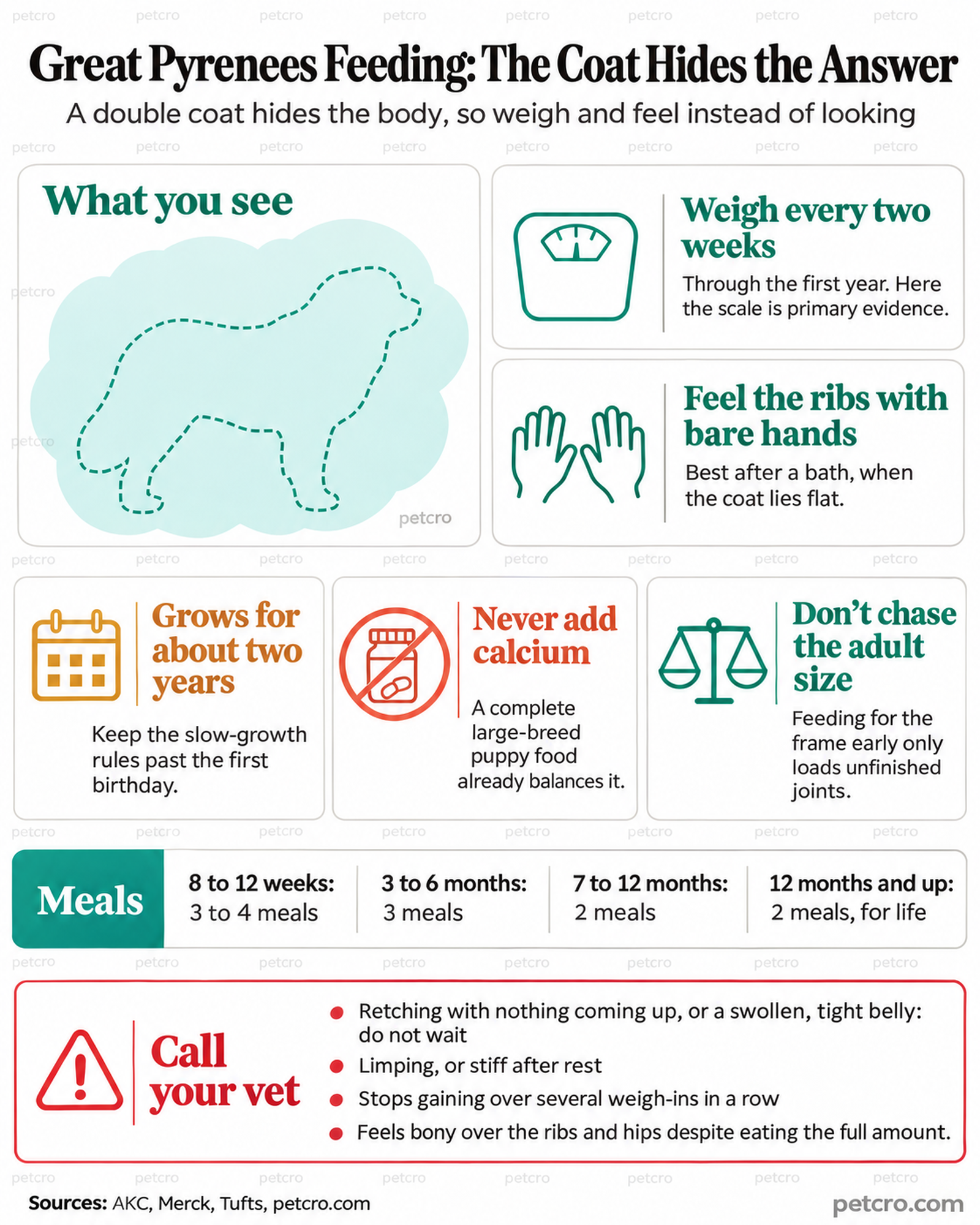
A Great Pyrenees feeding chart by age runs from about 1¾ cups a day at eight weeks to 5¼ to 7 cups while still growing in the second year, on a large- or giant-breed formula. The amounts are the straightforward part. The hard part is that this breed's coat hides whether you got it right.
TL;DR: Feed a large- or giant-breed puppy formula (its AAFCO statement should include growth of large-size dogs), three meals a day through six months, then two for life. This breed grows for two full years and is only 58% of adult weight at six months, so the chart runs far longer than most. The catch nobody warns you about: the AKC publishes no upper weight limit for this breed, only "100 pounds and up" for males, so no chart can tell you your dog's target. Use your hands on the ribs, not the scale, and not your eyes.
Great Pyrenees feeding chart by age and weight
Use this Great Pyrenees puppy feeding chart as a starting range, then adjust to body condition and your own food's giant-breed guide. Match your puppy to the weight column rather than the age column when the two disagree. Used as a Great Pyrenees feeding chart by weight it is the more reliable of the two, because two puppies the same age can be twenty pounds apart and both be healthy. Amounts assume a complete large- or giant-breed puppy formula at roughly 380 kcal per cup.
| Age | Meals/day | Approx. weight | Daily food (starting range)* |
|---|---|---|---|
| 8 to 12 weeks | 3 to 4 | 10–24 lb | 1¾–3¼ cups |
| 3 to 4 months | 3 | 21–41 lb | 3–5 cups |
| 5 to 6 months | 3 | 41–64 lb | 3¼–4½ cups |
| 7 to 9 months | 2 to 3 | 56–85 lb | 4¼–5¾ cups |
| 10 to 12 months | 2 | 69–97 lb | 5–6¼ cups |
| 12 to 24 months | 2 | 75–110 lb | 5¼–7 cups while growing; 4¼–5½ cups once grown → giant-breed adult food |
*Total for the whole day, split across that row's meals. The weight column assumes an adult of 85 to 110 lb, which is the range PetMD gives for the breed. Feed to a lean body, not to the cup. Start at the lower end of your dog's band and follow your food's own giant-breed chart.
These ranges use the puppy energy figures in the Merck Veterinary Manual, the same math as our feeding calculator. Resting energy (RER) is 70 × bodyweight_kg^0.75, and healthy puppies need 3 × RER up to 4 months and 2 × RER after 4 months. Each low figure is the lightest weight in the row and each high figure the heaviest, at 380 kcal per cup, rounded to the nearest ¼ cup. Because the factor drops at 4 months, the 5 to 6 month range tops out lower than the 3 to 4 month range.
The 12 to 24 month row gives two ranges. The first is 2 × RER for a Pyr still growing on puppy food, since Merck notes growth may not be complete until 10 to 16 months in large and giant breeds. The second is Merck's 1.6 × RER for a grown, spayed or neutered adult on adult food (1.8 × if intact), which is also what our calculator uses from 1 year. Ask your vet which one fits your Pyr.
Why no chart can tell you your dog's adult weight
Shop the picks from this guide


Sponsored. As an Amazon Associate I earn from qualifying purchases, at no extra cost to you.
A Great Pyrenees feeding chart by age runs into a problem most breed charts never face. Most charts start from a published adult range. For a Rottweiler the AKC gives 95 to 135 lb, and every row follows from that.
The Great Pyrenees does not have one. The AKC breed page lists "100 pounds and up" for males and "85 pounds and up" for females. There is no upper number. PetMD is similarly open, describing the breed as 85 to 110 pounds "or more."
That is not an oversight. It reflects a working breed that was never selected for a uniform size, and it has a practical consequence: a chart that promises you a target weight for this breed is inventing it. The table above uses 85 to 110 lb because it is the widest range any source will actually commit to, but a male over 120 lb is entirely normal and is not overweight simply for being large.
The honest method is to stop predicting the destination and start reading the dog:
- Divide by the percentage. At six months your puppy is about 58% of adult weight. A 60 lb six-month-old is heading for roughly 103 lb (60 ÷ 0.58). Our puppy weight predictor does this for any age.
- Then ignore the answer if body condition disagrees with it.
How much should I feed my Great Pyrenees puppy?
How much to feed a Great Pyrenees puppy starts with the chart, but it does not end there. Your hands give you the real number, and with this breed hands are not optional.
Check weekly, with fingers not eyes:
- Ribs: you should feel them under a thin layer with light pressure, not press to find them.
- Waist: run both hands back from the ribcage. You are feeling for a narrowing, not looking for one.
- Tuck: the belly should rise from ribcage to hips.
- Target a body condition score of 4 to 5 out of 9 on the standard veterinary scale.
Our how much to feed a puppy pillar covers the calorie math these ranges come from.
The coat problem: why you cannot see the answer
Every giant-breed feeding guide tells you to watch body condition. For most breeds that is a visual check. For a Great Pyrenees it cannot be.
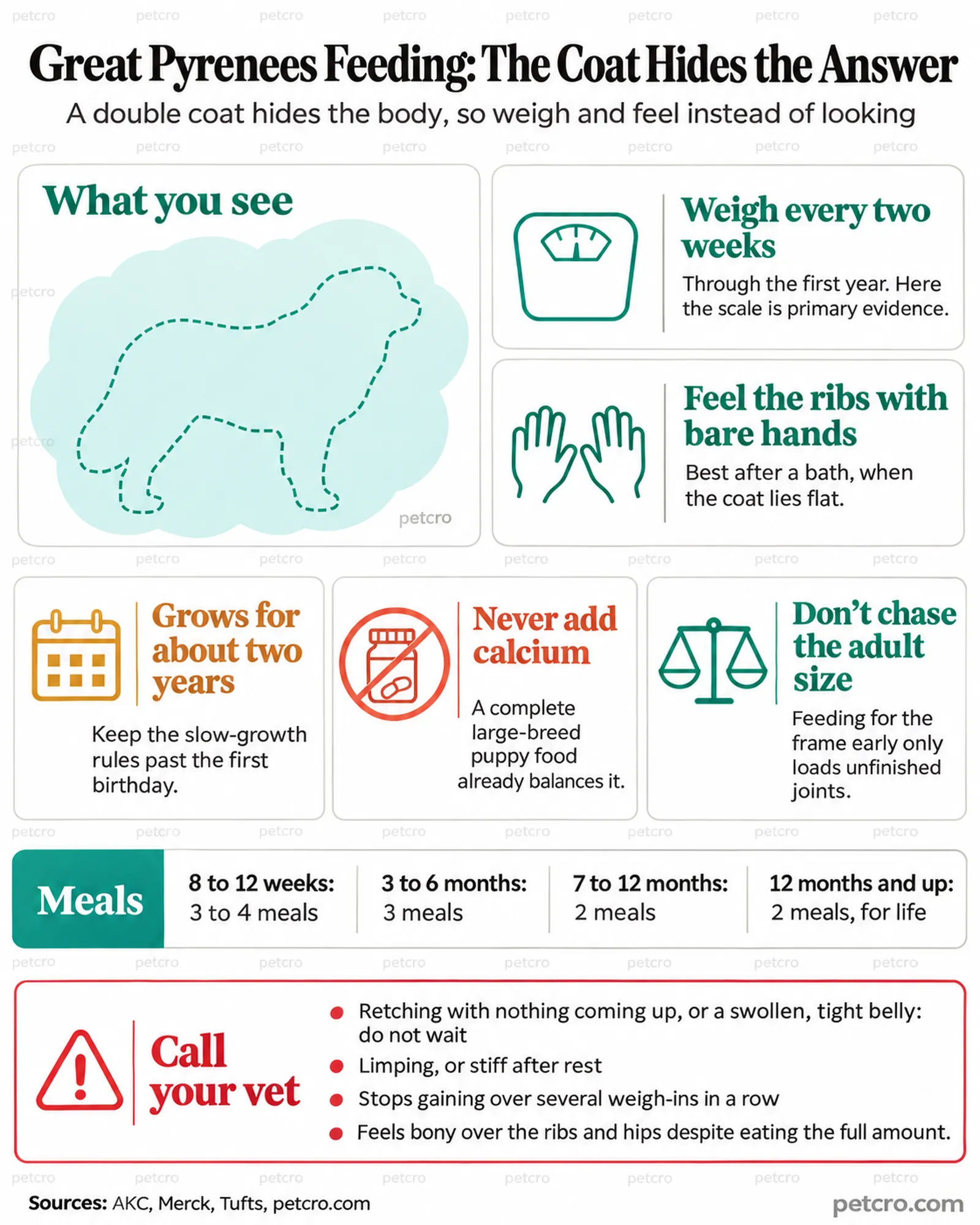
This is a double coat built for a mountain winter: a dense woolly undercoat under a long weather-resistant outer layer. It is doing exactly what it evolved to do, which is hide the outline of the body underneath. A Pyr carrying an extra ten pounds looks like a Pyr. A Pyr that has dropped ten pounds also looks like a Pyr.
Two things follow.
Weigh more often than you think you need to. Every two weeks through the first year. On a breed you can see, the scale is a backup to your eyes. Here it is primary evidence.
Do the rib check with bare hands, on wet fur if you can. After a bath, with the coat flat, is the only time the body shape is genuinely visible. Use it.
The failure mode this creates is specific: owners of visible breeds notice weight gain and correct it early. Pyr owners often do not notice until a vet mentions it, by which point a growing giant has been carrying extra load through open growth plates for months.
A Great Pyrenees grows for two years, not one
A Great Pyrenees is 58% of adult weight at six months, 88% at a year, and 96% at eighteen months. They do not finish until around two.
That matters more than it sounds. A Labrador at twelve months is about 95% of adult weight, so an owner who relaxes the rules then does little harm. Do the same at twelve months with a Pyr and you have relaxed with 12% of their growth still ahead, on the largest frame they will ever carry.
Practically:
- Ask your vet when to switch to adult food. Any Great Pyrenees puppy food you pick should be labeled for large- or giant-breed growth. The AKC puts the switch for larger breeds at 12 to 14 months, and Tufts advises no adult food before 12 months. Tufts adds that growth in giant breeds such as Great Danes and mastiffs may extend through 18 months, and Purina says a giant breed may need puppy food for up to two years.
- Never add calcium. A complete large-breed puppy food already balances it. Merck is direct about this: excessive calorie and dietary supplementation, calcium included, should be avoided in young growing dogs.
- Do not chase the adult size. The frame arrives on its own schedule. Feeding for it earlier only adds weight to joints that are not finished.
Our guide on when to switch puppy to adult food covers the 7 to 10 day transition. The same slow-growth logic runs through our Great Dane and Rottweiler charts.
Great Pyrenees feeding schedule (meals per day)
- 8 to 12 weeks: three to four small meals.
- 3 to 6 months: three meals. The fastest growth stretch.
- 7 to 12 months: drop to two, splitting that row's daily total between them.
- 12 months and beyond: two meals for life.
Two meals rather than one is not just convenience. The AKC notes that dogs fed once a day are twice as likely to bloat as dogs fed twice, and that eating speed is a separate contributing factor. A slow-feeder bowl is worth more here than any amount of bowl-height theory.
Worth being accurate about the risk itself: the shape most associated with bloat is a deep and narrow chest, tall rather than wide, and the breeds the AKC names are Great Danes, St. Bernards, Weimaraners, Setters and Standard Poodles. A Great Pyrenees is broad rather than narrow and is not on that list. The two-meal habit is still the right default for any giant breed, but you have not been handed a high-risk dog.
On raised versus floor-level bowls, the usual advice is to skip the raised bowl, and that stays the safe default here as it is across our Great Dane and Rottweiler charts. Just know the evidence is thinner than it is usually presented. The AKC's own summary is that early studies pointed one way, were later contradicted, and that with conflicting results "a solid recommendation can't be made." Skipping the raised bowl costs nothing, so skip it, but meal frequency is the part with real numbers behind it.
Call your vet, rather than adjusting the bowl, if your puppy:
- Retches without producing anything, or has a swollen, tight abdomen. This is the bloat emergency sign in any large breed, so do not wait
- Limps, or seems stiff after rest
- Stops gaining weight over several weigh-ins in a row
- Feels bony over the ribs and hips despite eating the full amount
This guide is general guidance, not veterinary advice. For your specific dog's nutrition, health, or behavior needs, consult your veterinarian.
Frequently asked questions
How much should I feed my Great Pyrenees puppy?
Start from the chart: roughly 1¾ to 3¼ cups a day at 8 to 12 weeks, rising to 5¼ to 7 cups while still growing in the second year on a large- or giant-breed puppy formula, split across that age's meals. Then adjust to body condition rather than to the number. With this breed, check by feel every week and weigh every two weeks, because the coat hides what your eyes would normally tell you.
How many times a day should I feed a Great Pyrenees?
Three to four small meals until about 12 weeks, three meals through six months, then two from around seven months onward. Keep two meals for life rather than one: the AKC reports that dogs fed once daily are twice as likely to bloat as those fed twice. Slowing the meal down helps too. Skip the raised bowl as the safe default, while knowing the evidence behind that particular rule is thinner than it is usually presented.
How big is a Great Pyrenees at 6 months?
Around 49 to 64 lb, which is only about 58% of adult weight. That is the number owners find surprising: a six-month-old Pyr already looks like a large dog but has more than 40% of its growing still to do. Expect roughly 88% of adult weight at twelve months and 96% at eighteen.
When should a Great Pyrenees switch to adult food?
Ask your vet, because the sources differ. The AKC puts the switch for larger breeds at 12 to 14 months, and Tufts advises no adult food before 12 months. Purina says a giant breed may need puppy food for up to two years. Transition over 7 to 10 days by mixing increasing proportions of the new food.
How can I tell if my Great Pyrenees is overweight?
Not by looking. The double coat hides body outline in both directions, so a Pyr carrying extra weight and a Pyr that has lost weight can look identical. Use your hands: ribs felt under a thin layer with light pressure, a waist you can feel narrowing behind the ribcage, and a belly that rises toward the hips. Check after a bath when the coat is flat.
How much will my Great Pyrenees weigh as an adult?
There is no reliable published ceiling. The AKC lists only "100 pounds and up" for males and "85 pounds and up" for females, with no upper bound. Rather than predicting a target, divide current weight by the percentage for that age: a 60 lb six-month-old at 58% is heading for roughly 103 lb. Then let body condition overrule the estimate.
TL;DR: the Great Pyrenees feeding cheat sheet
- Feed a large- or giant-breed puppy formula whose AAFCO statement includes growth of large-size dogs. Never add a calcium supplement.
- Amounts: about 1¾ to 3¼ cups a day at 8 to 12 weeks, rising to 5¼ to 7 cups while still growing in the second year. Feed to a lean body, not to the cup.
- The coat hides body condition in both directions, so check by hand every week and weigh every two weeks. Your eyes are not evidence on this breed.
- The AKC publishes no upper weight limit for this breed, so treat any chart promising an adult target with suspicion.
- Growth runs to two years: 58% of adult weight at six months, 88% at one year, 96% at eighteen months.
- Three to four meals to 12 weeks, three meals to six months, then two for life. Once-daily feeding doubles bloat risk. Skip the raised bowl, but that rule rests on thinner evidence than the meal-count one.
- Ask your vet when to switch: 12 to 14 months for larger breeds per the AKC, up to two years for giants per Purina. Transition over 7 to 10 days.
Slow, lean, and measured by hand for two full years. On a breed you cannot see the shape of, the weekly rib check is the whole game.
Sources & further reading
- AKC, Great Pyrenees breed page and standard. The open-ended adult weight minimums, "100 pounds and up" for males and "85 pounds and up" for females, that this chart is built around.
- PetMD, Great Pyrenees. The 85 to 110 lb adult reference range and breed health overview.
- Merck Veterinary Manual, Developmental Osteopathies in Dogs and Cats. Developmental orthopedic disease in rapidly growing large and giant breeds, and the role of calcium excess.
- Merck Veterinary Manual: Nutritional Requirements of Small Animals: the RER formula and the puppy and adult multipliers this chart uses.
- Merck Veterinary Manual: Feeding Practices in Small Animals: growth diets for large- and giant-breed puppies, and growth that may run to 10 to 16 months.
- Cornell Riney Canine Health Center, Canine Hip Dysplasia. Genetics modified by nutrition and growth rate.
- AKC, Bloat in Dogs. Chest conformation and the breeds actually at highest risk, the one-meal versus two-meal finding, eating rate, and why no bowl-height recommendation can be made.
If your Great Pyrenees retches without bringing anything up, or the abdomen looks swollen and tight, treat it as an emergency and call your vet immediately rather than waiting.
More from Petcro's puppy-feeding cluster
- How Much to Feed a Puppy: the calorie math behind every breed chart.
- Great Dane Puppy Feeding Chart: the same controlled-growth rules on a taller frame.
- Rottweiler Puppy Feeding Chart: why the elbow, not the hip, decides the bowl.
- When to Switch Puppy to Adult Food: the 7 to 10 day transition by size class.
- Puppy Weight Predictor: estimate adult weight from current weight and age.
Petcro is reader-supported. We may earn an affiliate commission when you click through links to products in this guide. Our editorial picks are independent of any commercial relationship with any brand.